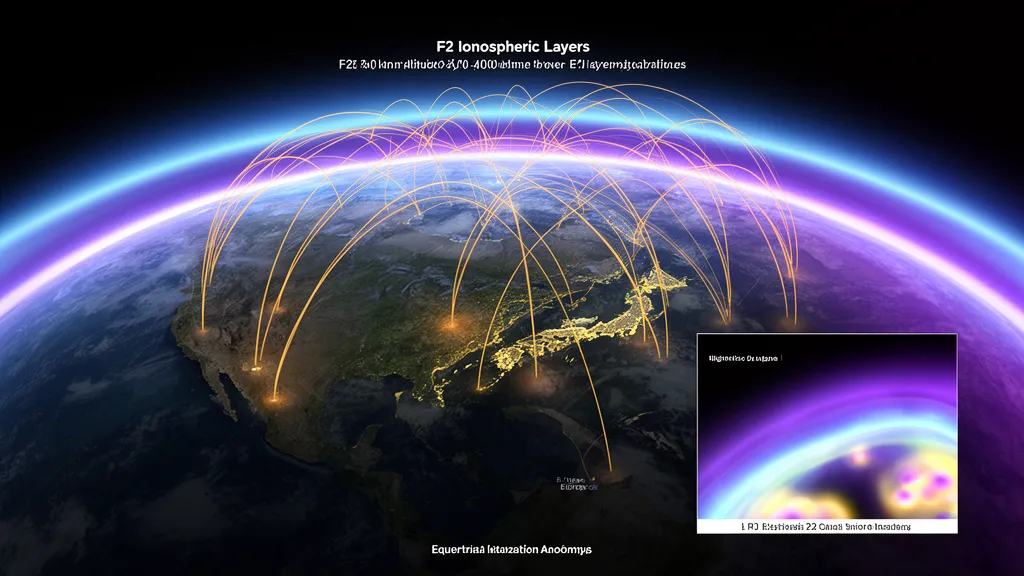
What the F2 Layer Is and Why It Matters
The F2 layer is the highest and most persistent layer of the ionosphere, sitting at 200–500 km altitude with peak electron density typically around 300 km. It is the foundation of nearly all long-distance HF propagation — every 20m transatlantic contact, every 15m transpacific pile-up, and every 10m worldwide opening depends on it. No other ionospheric layer approaches the F2’s combination of altitude, persistence, and electron density for reflecting HF signals across hemispheres.
Understanding how the F2 layer forms, what controls its critical frequency (foF2), and how it behaves through the day, season, and solar cycle is the single most productive investment a serious HF operator can make in propagation knowledge.
Formation: Solar Ionization of the Upper Atmosphere
The F2 layer forms through photoionization — solar extreme ultraviolet (EUV) and X-ray radiation strips electrons from neutral gas molecules at altitudes above 150 km. At F2 altitudes, the dominant neutral species is atomic oxygen (O), and the dominant ions produced are O+ (singly ionized atomic oxygen). This matters because O+ recombines very slowly compared to molecular ions like NO+ and O2+, which dominate the lower ionospheric layers.
The chain is: Solar EUV → ionizes O → produces O+ and free electrons → electron density builds as long as ionization rate exceeds recombination rate.
The free electron concentration (electron density, in electrons per cubic meter) is what reflects radio waves. The maximum electron density in the F2 layer, designated NmF2, directly determines foF2 via the plasma frequency formula:
foF2 (MHz) ≈ 0.009 × √(NmF2)
where NmF2 is in electrons/m³. In hertz, the same relationship is foF2 (Hz) ≈ 9 × √(NmF2). At foF2 = 10 MHz, NmF2 ≈ 1.2 × 10¹² el/m³. This is a large number but the air at 300 km is extremely tenuous — the F2 layer holds most of the ionosphere’s electron content precisely because recombination is slow at that altitude and electrons accumulate over the sunlit day.
F1 vs. F2: Day/Night Splitting
During daylight hours, the F layer splits into two distinct regions:
- F1 layer: 150–200 km altitude. Forms only in daylight from solar ionization of N₂ and O₂. Less important for propagation than F2 but contributes to daytime absorption on some paths.
- F2 layer: 200–500+ km altitude. Dominant for DX propagation day and night.
After sunset, the F1 layer disappears rapidly as molecular ions recombine within minutes. The F2 layer survives, supplied almost entirely by O+ that recombines slowly overnight. By midnight, the F1/F2 distinction has vanished — only the F2 layer remains. The night F2 layer has lower foF2 than its daytime peak (recombination during the dark hours gradually depletes electrons), but it remains substantial — typically 60–70% of daytime peak foF2 at mid-latitudes.
This day/night difference is why 20m (14 MHz) remains open for DX through the night while 10m (28 MHz) typically closes after sunset: at night, foF2 drops to perhaps 6–8 MHz at mid-latitudes, and the MUF for long paths falls below 28 MHz while remaining above 14 MHz.
Chapman Layer Theory and the foF2 Profile
The altitude distribution of electron density in the F2 layer approximately follows a Chapman α-layer profile (Davies 1990), though departures from the ideal Chapman shape are common in the real ionosphere. The Chapman model predicts:
- Peak electron density occurs at the altitude where ionization and recombination rates balance
- Below peak: density rises rapidly with altitude as the atmosphere thickens and absorbs more EUV
- Above peak: density falls slowly as the neutral atmosphere becomes too tenuous to sustain significant ionization
For practical HF purposes, what matters is the peak value (NmF2 → foF2) and the layer half-thickness. A thick F2 layer (which occurs at higher altitudes during quiet geomagnetic conditions) produces more consistent reflections over a wider frequency range than a thin, low layer.
foF2: The Number That Determines Band Openings
foF2 (critical frequency of the F2 layer, in MHz) is the single most important ionospheric parameter for HF operators. It is the maximum frequency that reflects vertically off the F2 layer; for oblique paths, the MUF equals foF2 multiplied by an obliquity factor.
The NOAA/Lowell Global Ionosphere Radio Observatory (GIRO) network operates ionosondes at dozens of stations worldwide, each transmitting vertical-incidence radio pulses across the HF spectrum and recording the reflection delay. The maximum frequency that produces a reflection is foF2. This direct measurement, updated every few minutes at operating stations, is the ground truth for MUF calculations.
What Drives foF2
Four factors control foF2 at any given location and time:
1. Solar flux (SFI). More EUV means higher ionization rates and higher electron density. The correlation between SFI and foF2 is the strongest and most predictable relationship in ionospheric physics. At SFI 70, mid-latitude daytime foF2 is typically 5–7 MHz. At SFI 200, it reaches 12–15 MHz.
2. Time of day. foF2 tracks solar EUV with a 2–4 hour lag. The peak occurs in early-to-mid afternoon local solar time at the ionospheric midpoint. Pre-dawn values are typically 50–65% of afternoon peak.
3. Latitude and the equatorial anomaly. The equatorial ionization anomaly creates two enhanced-foF2 bands at ±10–20° magnetic latitude (discussed below). High-latitude stations (above ~60° magnetic) have lower, more variable foF2.
4. Season. The winter F2 anomaly (discussed below) means winter foF2 at mid-latitudes often exceeds summer foF2 despite shorter solar illumination.
The Solar Cycle Effect on F2 Propagation
The 11-year solar cycle produces dramatic swings in F2 propagation capability. At solar minimum (SFI ~65–80), 10m and 12m are essentially dead for DX at mid-latitudes. The MUF on a 5,000 km path rarely exceeds 20 MHz, and 15m openings are limited to the most favorable hours and latitudes. Operators seeking DX retreat to 20m, 17m, and 40m.
At solar maximum (SFI >150, regularly above 200 near the peak), the picture reverses completely. foF2 can reach 12–15 MHz at mid-latitudes and 18+ MHz at equatorial stations. 10m opens for worldwide DX. 12m carries pile-ups around the clock. 15m and 17m stay open long into the evening. Operators who have only been licensed through solar minimum often describe their first solar maximum as transformative — the same antenna and radio that struggled to work Europe from North America on 15m now works the Pacific, South America, and Africa simultaneously.
Solar Cycle 25 peaked in late 2024 with several months of SFI above 220 and multiple periods of SFI exceeding 250 — the highest since Cycle 22 in the late 1980s. Operators who missed Cycle 19 (the strongest in recorded history, with SFI occasionally exceeding 300) got a preview of what extreme solar maximum conditions produce.
Pro Tip: The first few months of declining SFI after solar maximum are often the best time for 10m and 12m DX because the geomagnetic storm frequency is still elevated (coronal hole activity peaks post-maximum), but the solar flux remains high enough to keep foF2 elevated. Watch for windows of low Kp (below 3) during this period — they combine high SFI and quiet conditions for exceptional propagation.
Single-Hop vs. Multi-Hop F2 Propagation
A single F2-hop covers approximately 3,000–4,000 km — the geometry of a signal leaving at a low angle, reflecting off the F2 layer at ~300 km altitude, and returning to Earth. The skip distance (minimum range for F2 propagation) is typically 800–1,500 km, depending on the MUF relationship — signals aimed at shallower angles skip farther.
For contacts beyond 4,000 km, multiple hops are required:
| Number of Hops | Maximum Coverage |
|---|---|
| 1 hop | ~3,000–4,000 km |
| 2 hops | ~6,000–8,000 km |
| 3 hops | ~9,000–12,000 km |
| 4–5 hops | Up to ~20,000 km |
Each additional hop adds signal loss: ground reflection loss (2–10 dB depending on sea vs. land vs. ice) and re-entry into a potentially different ionospheric region. A 4-hop path from North America to Southeast Asia crosses the Atlantic or Pacific, the European or Pacific F2 region, and potentially the equatorial anomaly zone — any weak link degrades or breaks the path.
In practice, 2-hop F2 at 5,000–8,000 km is the workhorse of amateur DX. The 20m transatlantic path (North America to Europe, ~6,000–7,500 km depending on QTH) is typically 2-hop F2. The transpacific path from US West Coast to Japan (~8,500 km) is 2–3 hop F2.
Operating Example: Transatlantic on 15m
At 15:00 UTC on a day with SFI 140 and Kp 1, an operator in Ohio (EN91) aims for DX in western Europe (~6,500 km via the short path):
- The F2 midpoint is over the mid-Atlantic (~40° N, 30° W)
- Solar time at the midpoint: approximately 12:00–13:00 UTC → midpoint is near local solar noon → foF2 is close to its daily peak
- foF2 at the midpoint: approximately 9–10 MHz at SFI 140, mid-latitude
- sec(θ) for a 6,500 km path: approximately 4.7
- MUF ≈ 9.5 × 4.7 = 44.6 MHz → 10m, 12m, 15m, 17m, 20m are all open
The 15m band at 21 MHz is well below the 44.6 MHz MUF. The operator can realistically expect to work pile-up-size pileups on all five bands simultaneously. This is what solar maximum F2 looks like.
The Equatorial Ionization Anomaly
The equatorial ionization anomaly (EIA) is one of the most powerful geographic advantages in HF operating. During daylight hours, the equatorial electrojet — an eastward current driven by the E-layer dynamo above the magnetic equator — creates an upward plasma drift (the “fountain effect”) that pushes ionized plasma upward and poleward along magnetic field lines. This plasma settles in two symmetric arcs at roughly ±10–20° magnetic latitude, creating dramatically enhanced foF2 at those latitudes.
The practical effect: stations in regions coinciding with the EIA crests — roughly Mexico to Venezuela, equatorial Africa, India, Pakistan, the Philippines, and northeastern Brazil — have foF2 values 2–5 MHz higher than stations at the same solar flux at other latitudes. For those operators, 10m and 12m may remain open for DX while the same bands are closed for mid-latitude stations elsewhere.
The EIA is strongest around 13:00–15:00 local solar time at the equatorial midpoint. It collapses after sunset as the fountain effect ceases, and the enhanced electron density gradually diffuses and recombines overnight.
High-Latitude F2: Reduced and Variable
Above approximately 60° magnetic latitude — Alaska, Iceland, northern Scandinavia, northern Canada — F2 behavior departs sharply from mid-latitude patterns. Three factors combine to reduce and destabilize foF2:
Reduced solar angle. At high latitudes, even in summer, the sun never reaches the zenith. Lower solar elevation means the ionizing EUV passes through more atmosphere before reaching F2 altitudes, reducing the effective ionization rate.
Particle precipitation. Energetic particles from the solar wind enter the atmosphere along magnetic field lines near the magnetic poles, creating irregular D-layer ionization that absorbs HF. During geomagnetic storms, this effect extends equatorward and dramatically disrupts polar F2 behavior.
Sporadic irregularities. High-latitude F2 is prone to irregular plasma structures that create rapid fading, signal spreading, and unpredictable foF2 variations. These effects worsen significantly at Kp 3 and above.
For operators in these regions, HF DX is a weather-sensitive activity. When conditions are quiet and solar flux is adequate, stations in Alaska and Iceland work remarkable DX on favorable paths. But those paths are more fragile and weather-dependent than equivalent paths at lower latitudes.
Seasonal Patterns: The Winter F2 Anomaly
The winter F2 anomaly confounds operators expecting propagation to track seasons simply. At mid-latitudes, F2 ionization — and therefore MUF — is often higher in winter than in summer, despite shorter days and lower solar elevation in winter. This behavior is the opposite of what the E and D layers do.
The cause is thermospheric composition. In summer, upward transport of molecular-rich (N₂, O₂) air from lower altitudes increases recombination rates at F2 heights. O+ ions react with N₂ and O₂ to form NO+ and O2+, which then recombine rapidly with electrons. Net result: lower electron density despite more solar EUV. In winter, the thermosphere is more atomic-oxygen-rich, recombination rates are lower, and electron density builds higher despite less ionization.
The practical implication: December and January 10m and 15m openings are real and exploitable, even with SFI values that would produce poor summer conditions. The equinoxes (March and September) tend to produce the strongest F2 conditions overall — both high foF2 from reasonable solar elevation and favorable thermospheric composition.
| Season | F2 Characteristic | Propagation Implication |
|---|---|---|
| Winter (Dec–Feb) | Higher foF2 than summer at mid-latitudes | Better high-band DX potential than expected for SFI level |
| Spring Equinox (Mar) | Peak foF2 — best of year at many latitudes | Highest MUFs; best time for 10m worldwide contacts |
| Summer (Jun–Aug) | Lower foF2 despite most solar illumination | High bands often underperform SFI prediction; 20m more reliable |
| Autumn Equinox (Sep) | Second peak | Excellent F2 conditions, nearly equal to spring |
Geomagnetic Disturbances and F2
Geomagnetic storms reduce F2 electron density through two mechanisms. First, storm-time particle precipitation creates enhanced D-layer absorption, blocking signals before they can reach the F2 layer. Second, storm-driven thermospheric wind disturbances change composition at F2 altitudes — increasing molecular content and accelerating recombination — which directly depletes foF2.
The combined effect is that a G2 storm (Kp 6) can drop mid-latitude foF2 by 30–50% within hours of storm onset. A foF2 of 9 MHz becomes 5–6 MHz, dropping the MUF on a 5,000 km path from 40+ MHz to below 25 MHz. The 10m and 15m bands go quiet. 17m and 20m hold briefly. 40m becomes the last reliable DX band.
At high latitudes, the foF2 depression can exceed 70% during severe storms. F2 propagation on high-latitude paths (e.g., North America to Scandinavia via the polar route) effectively ceases above Kp 6. For the full picture of how solar activity disrupts HF, see Understanding the K-Index and Kp and A-Index vs. K-Index.
Real Operating Scenarios
Transatlantic Path (North America → Europe, 6,000–7,500 km)
This is the most-contested HF DX path in amateur radio. At SFI 130, Kp 1, 15:00 UTC:
- Two-hop F2 via mid-Atlantic midpoint
- foF2 at midpoint: ~9 MHz → MUF ≈ 42 MHz
- All bands 20m through 10m simultaneously open
- Best bands: 15m and 17m for deepest signal penetration at moderate path loss
At SFI 80, Kp 2, same time:
- foF2 drops to ~6 MHz → MUF ≈ 28 MHz
- 10m and 12m closed; 15m marginal; 17m and 20m open
- Effective DX only on 20m
Transpacific Path (US West Coast → Japan, ~8,500 km)
Three or four F2 hops. The path crosses the Pacific, which provides minimal ground reflection loss (sea water reflects better than land). At SFI 150 and favorable solar geometry:
- 15m opens around 21:00–23:00 UTC from US West Coast (Japanese afternoon)
- 10m may open for 1–2 hours at peak
- 20m workable throughout the night
Trans-equatorial to South America (North America → Argentina/Brazil, ~9,000–12,000 km)
Three to four F2 hops crossing the equatorial anomaly zones. At solar maximum, these paths can carry 10m signals from North America to the southern cone. During the 2024–2025 solar maximum period, 10m was regularly open between North America and Brazil for multiple hours per day, supporting significant DX activity.
Frequently Asked Questions
What is F2 layer propagation in amateur radio?
F2 layer propagation is the dominant HF long-distance propagation mode. Signals reflect off the F2 ionospheric layer at 200–500 km altitude, enabling single-hop contacts at 3,000–4,000 km and multi-hop contacts up to 20,000 km. The F2 layer exists day and night (unlike the D and E layers), making it the primary mode for DX on 10m through 40m. Higher solar flux and quiet geomagnetic conditions maximize F2 propagation.
What altitude is the F2 layer?
The F2 layer’s peak electron density (NmF2) typically sits at 200–400 km altitude, with the layer extending from roughly 150 km to 500 km or higher. Altitude varies with time of day, solar activity, latitude, and season. At night, the F2 peak altitude typically rises as the lower boundary rises and the layer spreads upward.
How does the solar cycle affect F2 propagation?
Solar maximum raises SFI, which increases solar EUV output, elevates foF2, and raises the MUF on all paths. At solar maximum with SFI regularly above 150, 10m and 12m support worldwide DX. At solar minimum with SFI below 80, these bands are largely dead. The current SFI is visible on the DXRadar solar weather page.
What is the equatorial ionization anomaly?
The equatorial ionization anomaly (EIA) creates two belts of enhanced F2 electron density at roughly ±15° magnetic latitude, driven by the equatorial fountain effect during daylight. Stations in these zones — Mexico, Nigeria, Brazil, India, Philippines — enjoy higher foF2 and MUF values than stations at other latitudes. The effect is strongest in early-to-mid afternoon local solar time.
Why does F2 propagation persist at night?
Unlike the D and E layers (which depend on direct photoionization and disappear at sunset), the F2 layer’s dominant ion is O+, which recombines far more slowly than the molecular ions NO+ and O2+ that dominate lower layers. This slow recombination allows the F2 layer to persist through the night — depleted but present. The result is nighttime propagation on 20m and 40m, which the lower layers cannot support.
What is the winter F2 anomaly?
The winter F2 anomaly describes the counterintuitive observation that mid-latitude F2 electron density is often higher in winter than in summer. In summer, molecular-rich air rises into the thermosphere, accelerating recombination and depleting electrons despite more solar illumination. In winter, the thermosphere is more atomic-oxygen-rich, recombination is slower, and electron density builds higher. This produces genuine 10m and 15m DX windows in December–January at SFI values that would not support summer openings.
Content reviewed by DXRadar team. Data sources: ITU-R P.533-14, NOAA SWPC, Lowell GIRO, K. Davies “Ionospheric Radio” (1990).
Related reading: What Is MUF? | What Is SFI? | D-Layer Absorption