Operator's Verdict: The Solar Flux Index is 137 SFU and the planetary K-index is 0.33. Check which bands are open right now for a live band-by-band assessment based on these values.
What the Solar Flux Index Actually Measures
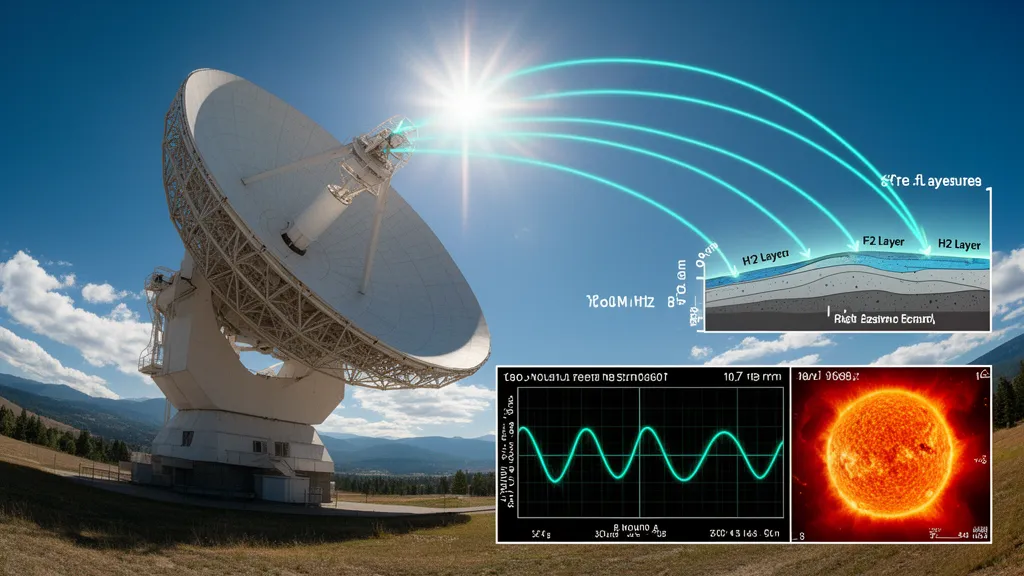
The Solar Flux Index (SFI) is a daily measurement of the Sun's radio emission intensity at 2800 MHz (10.7 cm wavelength), reported in Solar Flux Units (SFU), where 1 SFU = 10⁻²² W/m²/Hz. Measured at the Dominion Radio Astrophysical Observatory (DRAO) in Penticton, British Columbia, it serves as the primary proxy for solar UV and EUV output — the radiation that actually ionizes the ionosphere (NOAA SWPC, Solar Flux Index).
The measurement frequency of 2800 MHz was chosen in the 1940s because it correlates reliably with the solar UV and EUV emissions responsible for ionospheric ionization. Those UV/EUV wavelengths are absorbed by Earth's atmosphere and cannot be measured from the ground, but the 10.7 cm flux is not absorbed and provides an excellent proxy. It is not a coincidence that 2800 MHz happens to sit within the amateur radio 9 cm band — the physics of solar radio emission made it the right choice for ground-based monitoring.
The DRAO takes three measurements daily at 17:00, 20:00, and 23:00 UTC, using a calibrated radio telescope pointed at the Sun. NOAA SWPC then publishes two values: the "observed" flux and the "adjusted" flux corrected for Earth–Sun distance variations. Ham radio propagation tools, including DXRadar, use the adjusted value for consistency.
Across a full solar cycle, SFI ranges from approximately 65 SFU at solar minimum (near the quiet background level of solar emission) to 300 SFU or higher at strong solar maximum peaks. The baseline floor of about 65 SFU represents the minimum solar radio output even when no sunspot activity is present.
Why SFI Drives HF Propagation Conditions
SFI does not directly ionize the ionosphere — the correlation is the key point here. Higher SFI means the Sun is producing more UV and extreme ultraviolet (EUV) radiation. That UV/EUV radiation is what ionizes the F2 layer (the highest and most important layer for HF propagation, at approximately 250–400 km altitude). More ionization means higher electron density, which raises the critical frequency (foF2) and, by extension, the Maximum Usable Frequency (MUF).
The MUF for a single-hop F2 path relates to foF2 as: MUF ≈ foF2 × sec(θ), where θ is the zenith angle at the ionospheric reflection point (ITU-R P.1240-2, Section 3). This simplified formula applies to single-hop paths up to approximately 3,000 km. For multi-hop and long-path circuits, use the full ITU-R P.533 propagation model.
In practical terms: when SFI rises, foF2 rises, MUF rises, and higher-frequency bands become usable for progressively longer paths. A path that is just within the 20m MUF at SFI 100 may be well within the 15m or even 10m MUF at SFI 150. This is why experienced DX chasers check the SFI before deciding which band to call CQ on.
One important nuance: the F2 layer responds to cumulative solar UV exposure, not just today's value. A sudden SFI spike does not immediately produce better propagation — there is a 48-hour lag between an SFI increase and its full ionospheric effect. Conversely, a brief dip in SFI does not immediately collapse conditions. Plan your operating around multi-day SFI trends, not single-day values.
Key fact: A sustained SFI above 150 SFU for three or more consecutive days is one of the most reliable predictors of 10m long-path openings from mid-latitude QTHs.
Band-Opening Thresholds: What Each SFI Level Means
These thresholds are empirical approximations based on observed propagation patterns. Actual band conditions also depend on time of day, season, solar zenith angle, path geometry, and geomagnetic activity. Treat these as planning guides, not rigid cutoffs.
| SFI Range | General Condition | Typical Band Behavior |
|---|---|---|
| Below 80 SFU | Poor | 40m and 80m reliable for regional paths; 20m marginal on short paths; 15m and 10m rarely open via F2 |
| 80–100 SFU | Fair | 40m excellent for NVIS; 20m open regionally; 15m opens on short paths at solar noon; 10m closed via F2 |
| 100–120 SFU | Good | 20m strong globally; 15m open for DX; 10m may open on equatorial paths and at equinox |
| 120–150 SFU | Very Good | 10m opens via F2 to moderate distances; 15m excellent; 12m and 17m highly productive |
| 150+ SFU | Excellent | All bands productive; 10m open for DX simultaneously to multiple continents; 6m may show F2 openings |
During the 2025 solar maximum peak — with the International Sunspot Number (SSN) frequently above 180 — SFI values routinely exceeded 200 SFU. On those peak days, 10m was open simultaneously to Europe, South America, and the Pacific from North American QTHs for six hours or more. Operators running 100W with a simple dipole were working 100+ DXCC entities in a single contest weekend.
At the other extreme, during the Solar Cycle 24 minimum (2019–2020), SFI spent extended periods near 70 SFU. On those days, 10m showed no F2 openings, 15m was marginal on the best paths at solar noon, and serious DX chasers shifted entirely to 40m and 20m for long-haul contacts.
Pro Tip: The DXRadar Solar Weather dashboard shows SFI trends over 27-day (one solar rotation) and 90-day windows. Watch for the 27-day pattern — active regions rotate back into Earth view after ~27 days, often producing a second SFI peak on the same recurring schedule. This is one of the most actionable propagation forecasting tools available to DX operators.
SFI vs Sunspot Number: Why Operators Prefer SFI
The Sunspot Number (SSN, or International Sunspot Number ISN) is a count of visible sunspot groups and individual spots. It has been recorded since the 18th century, providing a continuous record of solar activity across nearly 30 cycles. SFI, by contrast, has been measured instrumentally since 1947 at the DRAO.
The two metrics are strongly correlated — an SSN above 150 almost always corresponds to SFI values above 150 SFU — but SFI has operational advantages:
- Instrumental measurement: SFI is measured by a calibrated radio telescope, not visually counted. It is objective and reproducible.
- Daily cadence: SFI updates three times per day (at 17:00, 20:00, and 23:00 UTC). SSN is a daily count.
- More granular: SSN is an integer count (zero on quiet days masks sub-threshold activity). SFI shows continuous variation even at solar minimum.
- Ionospheric propagation models use SFI: The ITU-R P.533 model accepts SFI directly as an input parameter for foF2 estimation.
For historical comparison, researchers use SSN (the longer record). For operational propagation planning, SFI is the better choice. DXRadar displays both, updated every 10 minutes.
The 48-Hour Lag: Why Yesterday's SFI Matters Today
The ionospheric response to SFI changes is not instantaneous. The F2 layer's electron density builds and decays over a timescale of roughly 24–48 hours in response to changes in solar UV/EUV flux. This lag has a practical implication: today's SFI is less predictive of today's propagation than the 48-hour average.
Here is the mechanism: solar UV ionizes atomic oxygen in the upper atmosphere, creating O⁺ ions and free electrons. These electrons recombine with ions over hours, not seconds. A sudden spike in solar flux (caused by, say, an active region rotating into view) begins ionizing the F2 layer within minutes, but peak electron density takes many hours to accumulate. Similarly, when an active region rotates out of view and SFI drops, the F2 layer remains ionized for a day or two before noticeably degrading.
For the practical operator, this means:
- If you see SFI climbing from 100 to 140 over 48 hours, today's 10m band is likely better than today's SFI alone would suggest — yesterday's high flux is still working on the ionosphere.
- If SFI drops suddenly (a coronal hole, a quiet region rotating into view), conditions may remain good for another day before the degradation hits.
- The 27-day SFI trend chart on the DXRadar Solar Weather page is more useful for planning a DX expedition weekend than a single-day reading.
Planning POTA Activations and DX Chasing With SFI
The operational value of SFI depends on what you are trying to do. Here is how to apply it:
For Parks on the Air (POTA) activations: POTA rules require 10 contacts to qualify a park. At SFI below 80, plan your activation on 40m NVIS — you will reliably reach chasers within 1,500 km regardless of solar conditions. At SFI 100–120, 20m becomes a strong primary band, extending your reach to 4,000–5,000 km and dramatically expanding your chaser pool. At SFI above 120, bring a 10m antenna — you may find unexpected long-path contacts that make the log more interesting without sacrificing the quick qualifier contacts on 20m.
QRP operators (5–10W) need approximately 10–15 SFU more than full-power stations to achieve comparable path reliability. If the SFI is 110 and you are running 5W QRP, think of your effective "propagation budget" as if it were SFI 95–100. Factor this into your band selection.
For DX chasing: Check the current 10m band conditions before committing to a contest or DXpedition pile-up. If SFI is rising above 130 and the K-index is below 3, prioritize 10m and 15m — the pile-ups on 20m will be brutal, but 10m may be relatively uncrowded and the signals may be stronger. If SFI is 90 and the geomagnetic field is disturbed, 40m becomes the DX workhorse band, particularly in the evening hours when D-layer absorption drops.
Timing within the solar cycle: We are currently in Solar Cycle 25, which reached its predicted maximum in 2025 (NOAA Solar Cycle 25 Prediction Panel). SFI values are declining from peak but remain elevated compared to the minimum years. The next solar minimum is projected in the early 2030s. For long-range planning, high-band (10m, 12m, 15m) DXpeditions have the best propagation support over the next 2–3 years before conditions gradually decline.
Check best bands now for a live assessment of which bands are productive based on the current SFI and geomagnetic conditions.
Frequently Asked Questions
What does SFI mean in ham radio?
SFI stands for Solar Flux Index — a daily measurement of the Sun's radio emission intensity at 2800 MHz (10.7 cm wavelength), reported in Solar Flux Units where 1 SFU = 10⁻²² W/m²/Hz. Higher values indicate greater solar UV/EUV output, stronger F2 ionization, and better HF propagation conditions. The current SFI is 137 SFU.
What SFI level is needed for 10 meters to open?
An SFI above 120 SFU typically enables 10-meter F2 propagation on paths up to 5,000 km during daylight hours. At SFI 150 or higher, 10m can support simultaneous openings to multiple continents for six hours or more. Below SFI 100, 10m openings are limited to sporadic-E (sporadic, unpredictable, typically May–August in the Northern Hemisphere) or trans-equatorial propagation (TEP). Check the live 10m status for current conditions.
How often is the SFI updated?
The Dominion Radio Astrophysical Observatory (DRAO) in Penticton, BC measures solar flux at 17:00, 20:00, and 23:00 UTC daily. NOAA SWPC publishes the adjusted value within minutes of each measurement. DXRadar fetches the latest reported value every 10 minutes and displays it on the Solar Weather dashboard.
What's the difference between SFI and sunspot number?
SFI is an instrumental measurement of the Sun's 10.7 cm radio emission. Sunspot Number (SSN) is a visual count of sunspot groups and individual spots. Both correlate with solar activity, but SFI is the operationally superior metric for propagation planning: it is objective, measured three times daily, and used directly by the ITU-R P.533 propagation model to estimate foF2. The historical SSN record dates to 1749; the DRAO SFI record begins in 1947. For planning today's operating session, use SFI.
What is a good SFI for POTA?
For Parks on the Air (POTA) activations, SFI above 100 gives reliable 20m and 15m propagation for contacts at 2,000–5,000 km — enough to quickly accumulate the 10 required contacts while also working interesting DX. At SFI 80–100, focus on 40m NVIS for regional contacts within 1,500 km. At SFI 120 or higher, add a 10m antenna to your kit for potential long-path contacts. QRP operators (5–10W) should target SFI values at least 10–15 SFU higher than the full-power thresholds to compensate for reduced effective radiated power.
For more propagation content, see the DXRadar propagation blog. For a companion guide to geomagnetic activity and its HF impact, read Understanding the K-Index.