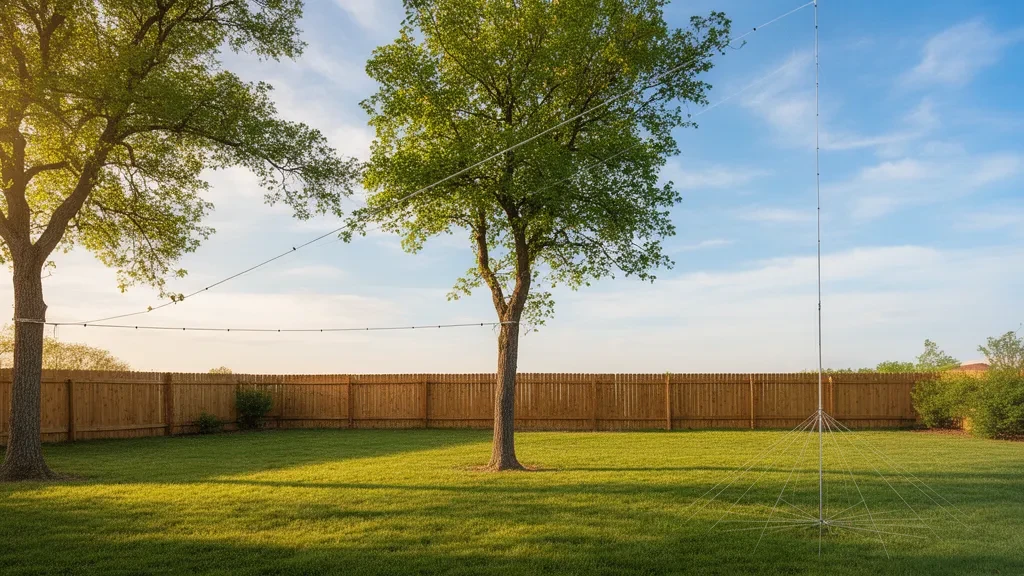
This article contains affiliate links. If you buy through them we may earn a commission at no extra cost to you. We never fake test results — antenna behavior here is standard, well-documented physics.
Almost every HF antenna question comes down to three shapes: a dipole, an end-fed half-wave (EFHW), and a vertical. They’re all good; they just win in different situations. Rather than declare one “best,” this guide gives you the decision framework — then points you to the right gear. The short version: your yard size, your supports, and whether you want DX or regional contacts decide the winner.
The three antennas in one table
| Dipole | End-Fed Half-Wave | Vertical | |
|---|---|---|---|
| Supports needed | Two (both ends) | One (fed at end) | One (self-supporting) |
| Radials needed | No | No | Usually yes |
| Take-off angle | High if low, low if high | Similar to dipole | Low (good for DX) |
| Multiband | One band (or fan) | Easy 40–10m | With traps/tuner |
| Best for | Simplicity, low noise | POTA, easy multiband | Small yards, DX |
| Space | Wide | Wide (or sloped) | Narrow |
How to choose
You want the simplest, quietest antenna → Dipole
A half-wave dipole is the reference antenna: cut it, hang it between two supports, feed it in the center, done. It’s efficient, quiet, and needs no matching transformer. The catch is you need two supports and the full width, and a single dipole covers one band well. Perfect if you have two trees and mostly work one or two bands.
You want easy multiband and have one support → End-Fed Half-Wave
The EFHW is why POTA activators love wire antennas: fed at one end, it needs just a single support and no radials, and a 40m EFHW works 40/20/15/10m with a tuner. It’s the most convenient efficient antenna there is. The only cost is a small matching transformer at the feed point. If you have one tree and want multiple bands fast, this is your antenna.
You have a small yard or chase DX with limited height → Vertical
A vertical takes almost no horizontal space and radiates at a low angle that favors DX — a big advantage when you can’t get a dipole high enough. The tradeoff is radials: a good radial field makes a vertical shine, while a poor one makes it lossy and noisy. No-radial designs trade a little efficiency for convenience. Ideal for HOA lots, small yards, and low-angle DX.
The take-off angle that decides DX vs local
Here’s the physics that matters most: antenna height sets your take-off angle, and take-off angle sets who you work. A low horizontal antenna (under a quarter wavelength high) fires most of its energy straight up — great for NVIS regional contacts out to a few hundred miles, poor for DX. A vertical, or a dipole up high, fires at a low angle that skips far. So “which antenna is best” often really means “do I want regional or DX contacts?” Match the antenna to the distance you want to work — and to what the bands are doing that day.
Our gear picks by type
- Want a portable vertical or a POTA wire? See our best portable HF antenna for POTA picks — verticals like the JPC-12 and the direct-buy EFHW options.
- Building a first home station? Our best HF radio for beginners guide pairs a radio with an antenna that matches your space.
For the classic wire antennas — a resonant dipole or an EFHW kit — the best value often comes from ham-specialist vendors and simple homebrew builds rather than big retailers, so budget a little time to build or source one. It’s the cheapest high-performance antenna you can own.
The bottom line
There’s no universal “best” HF antenna — there’s the best one for your yard and your goals. Two supports and one band? Dipole. One tree and multiband convenience? End-fed. Tight space or low-angle DX? Vertical. Get any of them up as high as you safely can, keep the feedline short and low-loss, and you’ll work the world.
Frequently Asked Questions
Is an end-fed or dipole antenna better?
For most operators with a tree, a resonant end-fed half-wave (EFHW) and a dipole perform similarly — both are efficient half-wave antennas. The EFHW is easier to deploy because it’s fed at one end and needs only one support and no radials, which is why it dominates POTA. A center-fed dipole is slightly quieter and needs no matching transformer, but requires supports at both ends. Choose the EFHW for easy multiband deployment, the dipole for simplicity and low noise on a single band.
Is a vertical or dipole better for DX?
A vertical usually beats a low dipole for DX because it radiates at a lower take-off angle, which favors long-distance paths. A dipole up high — a half-wavelength or more above ground — can equal or beat a vertical, but most backyard dipoles are too low for that on 40m and 80m. For DX with limited height, a vertical with good radials is often the better choice; for regional contacts, a low dipole’s high-angle NVIS radiation wins.
What is the best HF antenna for a small yard?
A vertical or an end-fed half-wave. A vertical takes up almost no horizontal space and works well with radials, and a no-radial vertical suits tight or HOA lots. An end-fed can be run as a sloper from a single support or bent to fit the available space with only a small performance penalty. Both are far easier to fit than a full-size dipole in a small yard.
Do verticals need radials?
Most do. A quarter-wave vertical needs radials or a counterpoise to act as the other half of the antenna — more radials generally mean lower loss and better performance. Some commercial verticals are designed to work without a radial field by using a matching network, trading a little efficiency for convenience. An end-fed half-wave and a dipole, being full half-wave antennas, don’t need a radial field, which is a big practical advantage.
What antenna should a beginner start with?
A simple resonant dipole or an end-fed half-wave is the best first HF antenna: cheap, efficient, and forgiving. If you have two supports and want one band done really well, build a dipole. If you want easy multiband operation and have one tree, an EFHW is superb. Save verticals for when you need to fit a small space or chase DX with limited height.