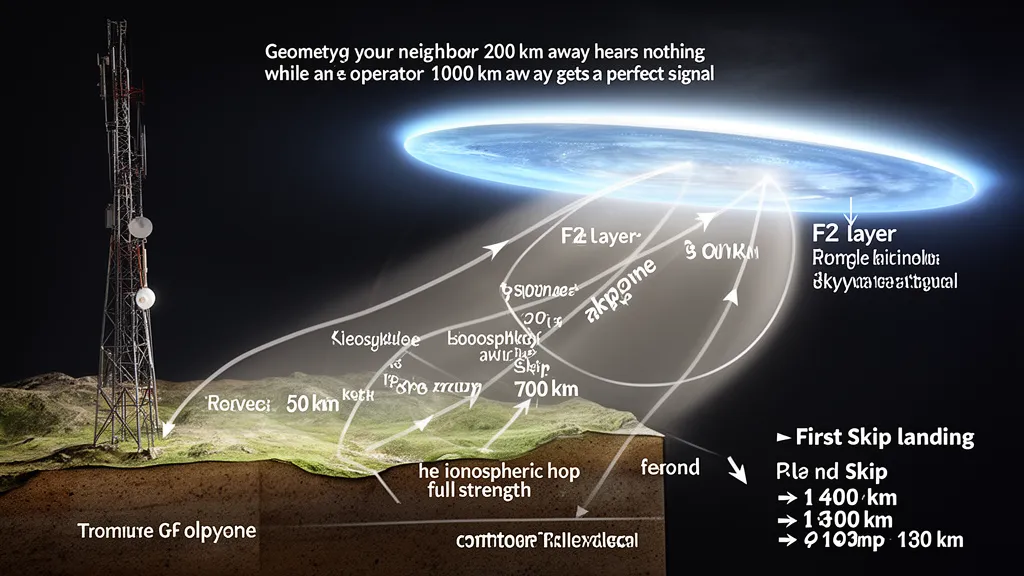
Operator’s Verdict: The skip zone is not a malfunction — it is a predictable consequence of how HF signals propagate. If a station 200–500 km away disappears on 20m while distant DX is pouring in, you are in the skip zone. Switch to 40m, try NVIS on 7 MHz, or accept that regional contacts and DX contacts don’t always coexist on the same band at the same time.
What the Skip Zone Is and Why It Exists
The skip zone is the geographic ring around your QTH where, on a given frequency and set of ionospheric conditions, no signal is received. It sits between the outer edge of ground wave propagation and the inner landing point of the first ionospheric hop — a dead zone where neither propagation mode delivers energy.
Ground wave on HF travels along the Earth’s surface, attenuating rapidly with distance. At 14 MHz (20m), ground wave extends about 50–80 km over typical terrain before falling below any useful signal level. At 7 MHz (40m), ground wave reaches roughly 100–150 km. At 3.5 MHz (80m), it may extend 200–400 km over seawater or flat terrain.
The first sky wave hop lands no closer than a minimum skip distance set by geometry and the MUF. A signal radiated at a low elevation angle (10°–20°) travels upward, refracts from the F2 layer at approximately 250–350 km altitude, and returns to Earth at a distance determined by the geometry of that triangle. Lowering the elevation angle extends the skip distance; raising the elevation angle reduces it — until at near-vertical incidence (80°–90° elevation), the skip distance approaches zero and you achieve NVIS coverage.
The dead zone between those two ranges — ground wave range on one side, minimum skip distance on the other — can be hundreds of kilometers wide on 20m. A station in Ohio on 20m can easily hear W6 in California (~3,200 km) while being completely unable to work W8 stations 200 km away in West Virginia. Both are real. Both are predictable.
Ground Wave vs. Sky Wave: The Two Propagation Modes
Understanding the skip zone requires understanding the interaction between two physically distinct propagation mechanisms.
Ground wave propagates by induction along the Earth’s surface. It follows terrain, can bend over hills to a degree, and is strongly attenuated by the medium it travels through. At higher HF frequencies, ground wave attenuation per kilometer increases dramatically. The loss over the ground increases with frequency squared in the relevant range — meaning 20m ground wave covers roughly one-third the distance of 40m ground wave for the same power. Salt water is dramatically better than dry soil for ground wave because of higher conductivity.
Sky wave propagates at an angle into the ionosphere, refracts at the F2 layer (or E layer for sporadic-E), and returns to Earth at distance. The geometry is essentially that of a triangle: transmit angle above horizontal, F2 layer reflection height, and Earth’s curvature. Minimum skip distance occurs when the elevation angle is at its maximum useful value — approximately 75°–80° for F2 and about 60°–65° for E-layer propagation.
Between the ground wave range (~50–400 km depending on frequency) and the minimum skip distance (~500–3,000 km depending on frequency and conditions), there is no propagation mechanism delivering signal. Receivers in this zone experience zero sky wave and zero ground wave from your transmitter. They are in the skip zone.
Skip Distance by Band and Solar Conditions
The minimum skip distance varies significantly with frequency and ionospheric state. Higher frequencies have longer minimum skip distances because the signal must travel at a shallower angle to refract at the F2 layer rather than passing through it.
| Band | Frequency | Typical Min. Skip Distance | Ground Wave Range | Skip Zone Width (approx.) |
|---|---|---|---|---|
| 80m | 3.5 MHz | 200–500 km | 150–400 km | Minimal to ~300 km |
| 40m | 7 MHz | 500–1,200 km | 100–150 km | ~350–1,100 km |
| 20m | 14 MHz | 1,500–3,000 km | 50–80 km | ~1,400–2,900 km |
| 15m | 21 MHz | 2,000–4,000 km | 30–50 km | ~1,950–3,950 km |
| 10m | 28 MHz | 2,500–4,500 km | 20–30 km | ~2,470–4,470 km |
These are daytime values under moderate solar conditions (SFI ~120). At solar minimum (SFI ~70), the MUF drops and the minimum skip distance on higher bands may actually decrease — or the band may simply not support propagation at all, eliminating the skip zone as a practical concern by making the frequency unusable.
At solar maximum (SFI above 150–180, as observed in 2024–2025), 15m and 10m minimum skip distances extend outward further because the F2 layer is more densely ionized and reflects higher frequencies. During the Cycle 25 peak, some operators found that even 10m had a skip zone extending 3,000–4,000 km from their QTH, making regional contacts on 10m impossible while antipodal DX worked easily.
Pro Tip: The skip zone is band-specific. If you have a net or club contact at 300 km that consistently disappears on 20m in the afternoon, schedule net operations on 40m for regional work and reserve 20m for DX. A two-band setup — 40m for regional, 20m for DX — solves the problem permanently.
NVIS: Eliminating the Skip Zone for Short-Range Work
NVIS — near-vertical incidence skywave — is the deliberate exploitation of near-vertical radiation to eliminate the skip zone. When a signal is radiated at 80°–90° elevation (essentially straight up), it refracts at the F2 layer and returns to Earth within roughly 0–700 km of the transmitter, with maximum coverage around 300–500 km.
This is the exact range that falls in the skip zone on 20m and lower HF bands. NVIS turns the skip zone into a coverage zone.
NVIS works on 3.5–7 MHz (80m and 40m) because the F2 layer reflects these frequencies at near-vertical incidence. At 14 MHz and above, the vertical ray passes through the F2 layer rather than refracting back — the MUF for vertical incidence (foF2) is typically 6–12 MHz during the day, meaning 20m nearly always punches through and cannot be used for NVIS.
A NVIS antenna is typically a horizontal dipole at 0.1–0.2λ height (about 4–14 meters for 80m or 40m), which produces a near-omnidirectional pattern with maximum radiation at high elevation angles. Military HF communications and EMCOMM operators (particularly those working emergency nets covering a state or region) rely heavily on NVIS for reliable regional coverage on 40m and 80m.
From a practical standpoint: if you’re running a regional emergency net covering a 500 km radius, a 40m dipole at 8 meters height is more effective than a 20m antenna at any height. The physics are on your side — the foF2 at your ionospheric midpoint is sufficient to reflect 7 MHz back to Earth, and the near-vertical geometry covers the exact range your skip zone would otherwise exclude.
Multiple Hops and the Skip Zone Effect
Single-hop propagation creates the most pronounced skip zone. Multiple-hop propagation reduces the dead zone somewhat — a two-hop signal can land at distances ranging from roughly twice the minimum single-hop distance down to close to the minimum skip distance, depending on the geometry of each hop.
However, in practice, multiple-hop paths have higher path loss than single-hop paths of the same length. Each additional hop adds ionospheric absorption losses, additional ground reflection losses (each ground bounce loses 3–10 dB depending on terrain and frequency), and more D-layer absorption passes. So while two-hop propagation can theoretically fill parts of the single-hop dead zone, the signal arriving via two short hops from 500 km away will be much weaker than a single-hop signal arriving from 2,000 km away.
The skip zone for multi-hop paths is smaller but does not vanish entirely. At ranges below the minimum skip distance for even two hops (approximately 200–300 km for 40m under typical conditions), no sky wave propagation is possible regardless of the number of hops. Ground wave must cover the gap.
E-Layer Skip: A Shorter Skip Zone
The E layer (90–140 km altitude) occasionally supports propagation on lower HF bands, with a shorter skip distance than F2. Standard daytime E-layer propagation on 7 MHz and below produces a single-hop skip distance of 300–1,000 km — shorter than F2 on the same band. This narrows the E-layer skip zone somewhat compared to F2, but does not eliminate it.
Sporadic-E (Es) is more dramatic. Es clouds form at 90–110 km altitude in discrete, localized patches, and they support very high-frequency E-layer propagation. On 28 MHz (10m), Es skip distances of 1,000–2,500 km are typical — still creating a dead zone at shorter ranges. On 50 MHz (6m, just above the HF bands), Es is the primary long-distance propagation mechanism with skip zones of 1,000–1,500 km.
Es propagation does not respond to SFI the way F2 does. It is driven by wind shear dynamics in the mesosphere that are not well-predicted. The NOAA SWPC space weather forecasts do not include Es predictions for this reason. Experienced operators watch for Es empirically — sudden openings on 10m or 6m with signal levels far above what F2 would provide, coming from specific geographic directions and lasting 15 minutes to a few hours.
The Practical Implications: Band Selection Strategy
The skip zone dictates a simple band selection logic for HF operations:
For regional contacts (50–500 km):
- 80m NVIS on a low dipole (5–10 meters height) — virtually no skip zone, covers exactly this range
- 40m NVIS if 80m is noisy (less effective than 80m for NVIS but workable)
- Avoid 20m, 15m, 10m — you are in the skip zone on all of them during normal daytime F2 conditions
For medium-range contacts (500–2,000 km):
- 40m — skip distance on 40m encompasses this range during most of the day
- 20m — possible single-hop at the outer end of this range
- 80m at night — E layer and F2 with minimal D-layer absorption; covers this range well
For DX contacts (2,000 km and beyond):
- 20m — reliable daytime F2 propagation up to 4,000+ km single-hop
- 15m, 10m at solar maximum — lower path loss, stronger signals, skip zones irrelevant since you’re well beyond them
- 40m at night — low D-layer absorption, long F2 hops possible to 4,000+ km
When a club net or EMCOMM group consistently struggles with stations in a 100–400 km range disappearing on 20m, the solution is not more power. It is band selection: move to 40m or 80m, adjust antenna height for NVIS if needed, and let the ionosphere work for you rather than against you.
A Real Operating Scenario
Consider this situation, which any experienced HF operator will recognize:
It is a Tuesday afternoon in March, SFI 145, Kp 1. You are in Ohio (EN81) running 20m SSB on the W1AW bulletin frequency. You hear a W4 in Florida clearly at S7 (1,600 km, at the inner edge of the F2 skip zone). You hear a VE3 in Toronto (250 km away) — nothing. A VK2 in Sydney, Australia (15,500 km away) answers your CQ at S5. Your neighbor one town over at EN81 calls you on simplex UHF to ask why they can’t hear you on 20m.
This is normal. Sydney is well beyond the skip zone minimum. Toronto is squarely inside it. Florida is at the near edge of a single-hop F2 shot. Physics is working exactly as intended.
If you need to work the VE3 in Toronto:
- QSY to 40m — the 40m skip zone on a mid-latitude path typically extends only 500–800 km during the day; Toronto at 250 km may still be inside it
- Try 80m — ground wave or a short nighttime-style E-layer hop may cover 250 km
- Use 40m NVIS after sunset — 40m opens to short-range night propagation as the D-layer disappears
The skip zone is not a problem to solve with more watts. It is a geometry problem, solved with band selection and antenna choice.
Frequently Asked Questions
What is a skip zone in ham radio?
The skip zone is the geographic dead zone around a transmitting station where, on a given HF frequency and ionospheric condition, no sky wave signal is received and ground wave has already decayed below usable levels. Ground wave on 20m extends about 50–80 km; the minimum single-hop skip distance on 20m is 1,500–3,000 km. Everything between those boundaries is in the skip zone.
How far is the skip zone on 20m?
On 20m (14 MHz), ground wave range is approximately 50–80 km over typical terrain, and the minimum F2 skip distance is typically 1,500–3,000 km under moderate solar conditions (SFI 120). The skip zone — the area receiving neither mode — spans roughly 1,400–2,900 km around the transmitter. At solar maximum, the minimum skip distance may extend slightly further; at solar minimum, the band may not support F2 propagation at all.
How do I communicate within the skip zone?
Use NVIS (near-vertical incidence skywave) on 40m (7 MHz) or 80m (3.5 MHz) with a horizontal antenna at 4–14 meters height to provide coverage from 0 to 500–700 km — the exact range that 20m’s skip zone excludes. 80m NVIS is the most reliable for regional contacts within 300–500 km during daylight. At night, the disappearance of the D-layer on 40m and 80m allows longer hops, reducing the need for dedicated NVIS geometry.
Does the skip zone change with solar conditions?
Yes. Higher SFI increases the MUF and can push the minimum skip distance on higher bands outward, expanding the skip zone for those bands. Lower SFI may reduce the minimum skip distance on 15m and 10m but often renders those bands unusable for propagation entirely. The skip zone on 40m and 80m is less sensitive to solar conditions than on 20m and higher bands. Geomagnetic storms can temporarily alter skip geometry by disturbing F2 layer electron density.