Operator's Verdict: SFI is 104 SFU, planetary Kp is 0, and X-ray background flux is B3.3. Check which bands are open right now for a live band-by-band assessment.
What Propagation Actually Means
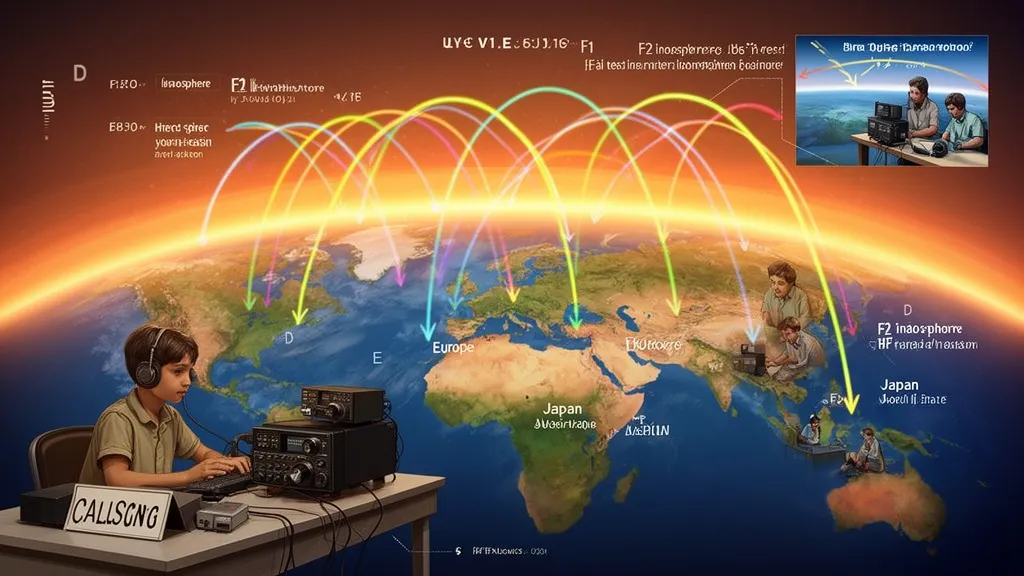
Propagation is what happens to a radio signal between your antenna and the receiving antenna. On HF (3–30 MHz), the signal does not simply travel in a straight line — it refracts off the ionosphere, bounces back to Earth, and can cover thousands of kilometres with no repeaters, no satellites, and no internet infrastructure.
A VHF signal on 2m (144 MHz) mostly passes straight through the ionosphere and continues into space. Line-of-sight governs: the two antennas must be able to "see" each other. That limits typical range to 100–200 km depending on terrain and antenna height. HF is different. The ionosphere acts as a partial mirror for frequencies below the Maximum Usable Frequency (MUF), and that property is what makes working Japan from your backyard possible on a 100W radio with a wire antenna.
Understanding why some bands work and others do not on any given day requires understanding three things: the ionosphere, the sun, and the relationship between them.
The Ionosphere: Your Long-Distance Repeater
The ionosphere is the region of Earth's upper atmosphere, from approximately 60 km to 1,000 km altitude, in which solar ultraviolet (UV) and extreme ultraviolet (EUV) radiation has ionized gas molecules, producing free electrons and ions. These free electrons give the ionosphere the electromagnetic properties needed to refract radio waves.
It is not a sharp, mirror-like surface. It is a region of gradually changing refractive index. A radio wave entering the ionosphere at an angle bends gradually — like light bending as it passes from air into water — until, if conditions are right, its trajectory curves back toward Earth. The critical variable is electron density: the more electrons per cubic metre, the more strongly the medium refracts the wave and the higher the frequency that can be refracted back down.
Electron density is not uniform. It varies by altitude, latitude, time of day, season, and the current level of solar activity. The ionosphere has four identifiable layers, each with distinct properties and roles in propagation.
The D Layer (60–90 km)
The D layer forms during daylight hours when solar X-ray and Lyman-alpha UV radiation ionizes nitric oxide (NO) molecules at low altitude. It is too thin and weakly ionized to reflect HF signals. Instead, it absorbs them — particularly on lower frequencies (160m, 80m, 40m). Signal energy that would otherwise propagate is lost to heating the D-layer gas.
This is why 80m tends to be noisy and short-skip during the day: the D layer absorbs signals on steep angles, and the long-distance refracted signals that do get through are arriving from beyond the skip distance. At night, the D layer disappears almost entirely within about 30 minutes of local sunset (because it requires continuous solar ionization to sustain its electron density). The bands open up dramatically.
The E Layer (90–150 km)
The E layer is ionized primarily by soft X-rays and some UV. It is present during daylight and weakens at night but does not disappear completely. The E layer supports relatively short-skip F2-like propagation at HF and is the layer responsible for sporadic-E (Es) propagation — patches of dense ionization that appear unpredictably, typically at 100–110 km altitude, and enable 10m, 6m, and even 2m contacts at distances of 1,000–2,500 km.
Normal E-layer propagation is predictable; sporadic-E is not. Es patches appear most frequently from May through August in the Northern Hemisphere (with a smaller peak in November–December) and can last minutes to hours. The mechanism that forms them remains partially understood — wind shear in the mesosphere is the leading theory.
The F1 Layer (150–200 km)
The F1 layer exists only during the day and only during higher solar activity. It is produced by UV ionization of molecular oxygen and nitrogen at mid-altitudes. For practical operating purposes, the F1 layer acts as a modest contributor to propagation — it merges with the F2 layer during the day and cannot be separately identified at night. Most propagation resources treat the "F layer" as a single entity, distinguishing F1 and F2 only in technical ionospheric models.
The F2 Layer (200–500 km)
The F2 layer is the layer that matters most for long-distance HF propagation. At 200–500 km altitude, it is high enough that a single refraction off the F2 can return a signal to Earth 2,000–4,000 km from the transmitter. Multiple hops allow coverage of 10,000+ km paths.
Unlike the lower layers, the F2 layer does not disappear at night. Its electron density drops significantly after sunset — because the ion production from solar radiation has stopped — but recombination at those high altitudes is slow enough that a usable F2 layer persists throughout the night. The nighttime F2 layer has lower electron density than the daytime layer, which means the MUF drops. That is why 10m and 15m close after dark while 40m and 80m remain workable.
The F2 layer is also the layer most strongly influenced by the solar cycle. At solar maximum with SFI above 150, the F2 layer can support 10m propagation from sunrise to well after sunset. At solar minimum with SFI near 70, the F2 MUF may never rise above 15–17 MHz on the best mid-latitude paths.
How Radio Waves Actually Bounce
A common simplification says HF signals "bounce off the ionosphere" like a billiard ball off a wall. The physical reality is different and worth understanding.
The ionosphere has a gradient of electron density — it increases with altitude up to a peak and then decreases again. As a radio wave enters this gradient, the increasing electron density changes the refractive index of the medium, causing the wave to bend. For frequencies below the critical frequency (foF2) at vertical incidence, the wave bends enough to return to Earth. For oblique (angled) incidence — which is how all long-distance propagation works — the usable frequency is higher.
The relationship is: MUF ≈ foF2 × sec(θ), where θ is the angle of incidence at the reflection point. A 60-degree oblique path gives a sec(θ) factor of about 2, meaning the MUF for that path is roughly twice the vertical-incidence critical frequency (ITU-R P.1240-2). This is why long oblique paths can support 10m propagation even when the vertical-incidence critical frequency is only 7–8 MHz.
The practical implication: for a given solar condition, longer paths have higher MUF values than shorter paths. A 5,000 km path from the US East Coast to Europe will have a higher MUF than a 1,000 km path within the US. When 10m is "open to Europe" but closed on shorter paths, this geometry is the reason.
Skip distance is the minimum range at which a sky-wave signal can be received. At high frequencies with steep refraction, skip distance is short (500–1,000 km). At lower frequencies or under poorer conditions, skip can extend to 3,000 km. Within the skip zone — the area between your ground-wave coverage and the first sky-wave return — there is a dead zone where nobody hears you.
The Three Numbers That Tell You What to Expect
Before any HF operating session, check three values. All three are available on the DXRadar solar weather dashboard and update continuously.
SFI — Solar Flux Index
SFI measures the Sun's radio output at 2800 MHz, reported in Solar Flux Units (SFU). It is the best single indicator of ionospheric ionization level. Higher SFI means stronger UV/EUV output, higher F2 electron density, higher MUF, and better high-band conditions.
| SFI Range | What to Expect |
|---|---|
| Below 80 SFU | 40m and 80m reliable; 20m short to medium paths; 15m marginal; 10m closed |
| 80–100 SFU | 20m globally reliable; 15m opens on good paths at solar noon; 10m rare |
| 100–120 SFU | 20m excellent; 15m strong for DX; 10m opens on equatorial and equinox paths |
| 120–150 SFU | 10m opens via F2 reliably; 15m and 12m very productive |
| 150+ SFU | All bands excellent; 10m open simultaneously to multiple continents |
The ionospheric response to SFI changes has a 48-hour lag. Today's propagation reflects the average solar output over the past two days, not just today's reading. A rising SFI trend is more bullish than a single high value.
Kp — Planetary K-Index
Kp is a 0–9 scale measuring geomagnetic disturbance, updated every three hours by NOAA (NOAA SWPC, Planetary K-Index). Low Kp (0–2) means a quiet geomagnetic field and undisturbed ionosphere. High Kp means a geomagnetic storm is in progress, which degrades F2 propagation — particularly on high-latitude paths crossing polar regions.
| Kp | Effect on HF |
|---|---|
| 0–2 | Undisturbed; excellent conditions |
| 3 | Slight disturbance; generally workable |
| 4 | Minor storm; polar paths degraded |
| 5–6 | Moderate storm (G1–G2); high-band propagation significantly degraded on paths above 50° latitude |
| 7+ | Severe storm; widespread HF disruption; 40m NVIS still works for regional contacts |
A classic trap for new operators: seeing SFI 140 and wondering why 10m is dead. Check Kp. If it is 6 or higher, a geomagnetic storm is suppressing the F2 layer despite excellent solar flux.
X-Ray Class — Solar Flare Indicator
X-ray class describes ongoing solar flare activity. Flares produce intense X-ray emissions that cause sudden ionospheric disturbances (SID) — a rapid increase in D-layer ionization that absorbs HF signals on the sunlit side of Earth.
The scale is: A (background), B, C, M, and X, with each step representing roughly ten times the X-ray flux. An M2.5 flare means an M-class flare at 2.5 times the M-class base level. X-class flares cause severe D-layer blackouts that can last 30–90 minutes or longer (NOAA SWPC, Solar Flares).
After a major flare, the X-ray flux decays over 30–90 minutes. Until it drops back below C-class levels, D-layer absorption will remain elevated on the sunlit hemisphere. Check the X-ray flux chart before assuming propagation will recover.
Band-by-Band: What Conditions Each Frequency Needs
Different frequencies have different ionospheric requirements. Understanding this lets you pick the right band for current conditions rather than wondering why your favorite frequency is dead.
160 Meters (1.8 MHz) and 80 Meters (3.5 MHz) — Low Bands
These bands work primarily at night. During the day, the D layer absorbs them completely on anything beyond ground-wave range. After sunset — as the D layer disappears — 80m opens for regional paths out to 2,000–3,000 km via F-layer propagation. During the gray line (the sunrise/sunset terminator), skip can extend dramatically on 160m and 80m as D-layer absorption on the path drops to near-zero.
These bands are largely immune to solar flux variations. Even at solar minimum with SFI near 70, nighttime 80m and 40m propagation is reliable. The ionosphere does not need to be highly ionized to support these low frequencies — the D-layer's absence after dark is the enabling factor.
40 Meters (7 MHz) — The Workhorse Band
40m works both day and night, though the character changes dramatically. During the day, the D layer causes moderate absorption on steep angles, limiting effective range to 500–3,000 km depending on solar zenith angle. At night, 40m becomes a true long-haul DX band with reliable propagation to 10,000+ km. NVIS (Near Vertical Incidence Skywave) on 40m — transmitting at near-vertical angles for short-distance reflection — is effective during daylight for contacts within 500 km.
40m is the most resilient HF band for POTA activations. Even at Kp 5 and SFI 80, a POTA activator on 40m can usually complete the required 10 contacts within a reasonable time.
20 Meters (14 MHz) — The DX Workhorse
20m is the primary DX band for most solar cycle conditions. It provides reliable F2 propagation globally during daylight hours at SFI values above approximately 80 SFU. It does not require the high SFI that 15m and 10m need, and it is less susceptible to D-layer absorption than lower bands.
For a first HF contact, aim for 20m between 14:00 and 20:00 UTC with SFI above 100 and Kp below 4. Under those conditions, paths from North America to Europe, Africa, and South America are reliable at 100W with a simple dipole.
At night, 20m remains useful for long-path propagation and often provides good low-noise conditions after local midnight.
17 Meters (18 MHz) and 15 Meters (21 MHz) — Upper Mid-Bands
17m and 15m open progressively as SFI rises above roughly 100 SFU. At SFI 120, 15m is often the most productive DX band: good F2 coverage, less crowded than 20m, and offering enough signal differentiation to make pile-ups manageable. At SFI 80 or below, 15m is marginal except on equatorial paths around solar noon.
These bands close for the night earlier than 20m and open later in the morning. They are primarily daytime bands.
12 Meters (24 MHz) and 10 Meters (28 MHz) — High Bands
10m and 12m are the high-stakes bands. At SFI below 100, they are essentially closed to F2 propagation at most mid-latitude paths. As SFI climbs above 120, 10m begins to open — first on equatorial paths, then progressively higher latitudes as SFI increases further. At SFI 150+, 10m can be the most productive DX band on the planet, with low noise, long skip, and the ability to work 100+ DXCC entities in a single day.
When 10m is open during solar maximum, signals can be startlingly loud — a 5W QRP station with a simple wire antenna can work stations that would normally require 1,000W on 40m. That is the power of high-frequency F2 propagation under strong solar flux.
At solar minimum, however, 10m openings via F2 become rare or nonexistent from mid-latitudes. Sporadic-E (Es) remains the primary path: unpredictable openings of 1–4 hours at distances of 800–2,500 km, most common from May through August in the Northern Hemisphere.
Day vs Night: Why the Same Frequency Behaves Differently
One of the most confusing aspects of HF for new operators is that the same band can be dead at noon and alive at midnight — or vice versa.
The key variable is the D layer. Present only in daylight, the D layer absorbs low-to-mid HF frequencies on steep angles. At night, the D layer is gone, the F1 layer has merged with F2, and the remaining F2 layer — though thinner than its daytime peak — supports long-distance propagation with much less absorption loss.
The result:
- 80m/160m: Dead for DX during the day; come alive at night
- 40m: Regional NVIS during the day; DX workhorse at night
- 20m: DX band during the day; still useful at night, especially for long-path
- 15m/10m: Daytime-only during low solar activity; can extend into evening at solar maximum
The transition happens at the gray line — the sunrise/sunset terminator. As this boundary sweeps across a path, both the transmitting and receiving stations can be near the terminator simultaneously, creating a brief window of exceptional low-band propagation when D-layer absorption is minimal at both ends. Gray line operation on 40m and 80m is one of the most effective techniques for working rare DX from mid-latitude QTHs.
Your First HF Contact: A Step-by-Step Approach
With the propagation theory in place, here is a practical approach for making your first HF contact.
1. Check solar conditions first. Open the DXRadar solar weather dashboard. Note the SFI, Kp, and X-ray class. If Kp is above 5, today will be harder than usual. If SFI is below 80, focus on 40m.
2. Choose the right band for the time. For a first contact, 20m during the afternoon UTC hours (14:00–20:00 UTC) is the safest choice. You will hear European and South American stations if you are in North America, or North American and Asian stations if you are in Europe.
3. Listen before transmitting. Tune slowly across the band. You should hear signals if propagation is open. A completely silent band is a warning sign — either conditions are poor, or you need to check your antenna or receiver.
4. Call CQ or answer a CQ. A standard CQ: "CQ CQ CQ, this is [callsign], calling CQ and standing by." For DX, use "CQ DX." If you hear a station calling CQ, reply with just your callsign — once is enough. The DX station will come back to you if your signal is readable.
5. Log the contact. Record time in UTC, frequency, their callsign, and signal report. The RST system (Readability 1–5, Strength 1–9, Tone 1–9) is standard: RS 59 means your signal is perfectly readable and very strong.
The skip zone means stations within 1,000–2,000 km may be completely inaudible on 20m even when you are working stations 10,000 km away. If you are trying to contact a nearby station, use 40m with a low radiation angle or try 80m NVIS. 20m is for DX, not regional contacts during high solar activity.
Frequently Asked Questions
How does ham radio propagation work for long distances?
HF radio signals travel long distances by refracting off the ionosphere — the electrically charged region of the upper atmosphere 60–1,000 km above Earth. Solar UV and EUV radiation ionizes the gas in this region, creating free electrons. When an HF signal enters the ionosphere, the changing electron density bends the wave's path. If the frequency is below the MUF and the wave is angled correctly, it curves back to Earth. This process — called sky-wave propagation — allows a 100W transmitter to be heard 15,000 km away with no infrastructure in between.
What is the skip zone, and why does it matter?
The skip zone is the area around your transmitter where sky-wave signals do not arrive. Your signal angles up to the ionosphere, reflects (refracts), and comes back to Earth at some minimum distance. Within that distance, no signal arrives. During good 10m conditions, you might hear a station in Japan at signal strength 9 while a station 500 km away cannot hear you at all — they are inside your skip zone. On 40m during the day, the skip zone shrinks because D-layer absorption prevents steep-angle propagation, and NVIS techniques use near-vertical signals to cover the 50–500 km range.
Why does 10m close at night?
The F2 layer's electron density drops at night because solar ionization has stopped and recombination gradually reduces electron count. The MUF drops with electron density. On many nights at mid-latitudes, the F2 MUF falls below 28 MHz (the 10m band), meaning 10m signals pass through the F2 layer and continue into space rather than refracting back. At solar maximum, the daytime ionization is strong enough that some residual electron density persists into the evening and keeps 10m open longer — but reliable 24-hour 10m propagation requires extraordinary solar conditions.
What's the best band for beginners?
20m (14.0–14.350 MHz) is the recommended starting band for new HF operators. It requires relatively modest solar conditions (SFI above 80), works reliably during daylight hours, provides global coverage, and is always active with DX stations. 40m (7.0–7.300 MHz) is the second recommendation, particularly if you want to operate in the evening or early morning. Avoid 10m as a first-band choice — its variable nature will give you a misleading picture of HF propagation.
How do I know if propagation is open right now?
Check the DXRadar best bands now page for a live assessment based on current SFI, Kp, and time of day. You can also look at PSKReporter to see actual digital mode contacts being made — if you see signals crossing your intended path, propagation is open. The ultimate test is listening: tune to the DX portion of the band (14.150–14.350 MHz on 20m for SSB) and listen for signals. If you hear nothing after 2 minutes of careful tuning, conditions may be marginal.
For more depth on the key numbers, read Solar Flux Index Explained and Understanding the K-Index. For ionospheric physics, see The Ionosphere Explained.