Operator's Verdict: Solar Flux Index is 104 SFU and Kp is 0. Higher SFI means higher foF2 and higher MUF across all paths. Check band conditions for current propagation status on your target circuits.
What the MUF Actually Tells You
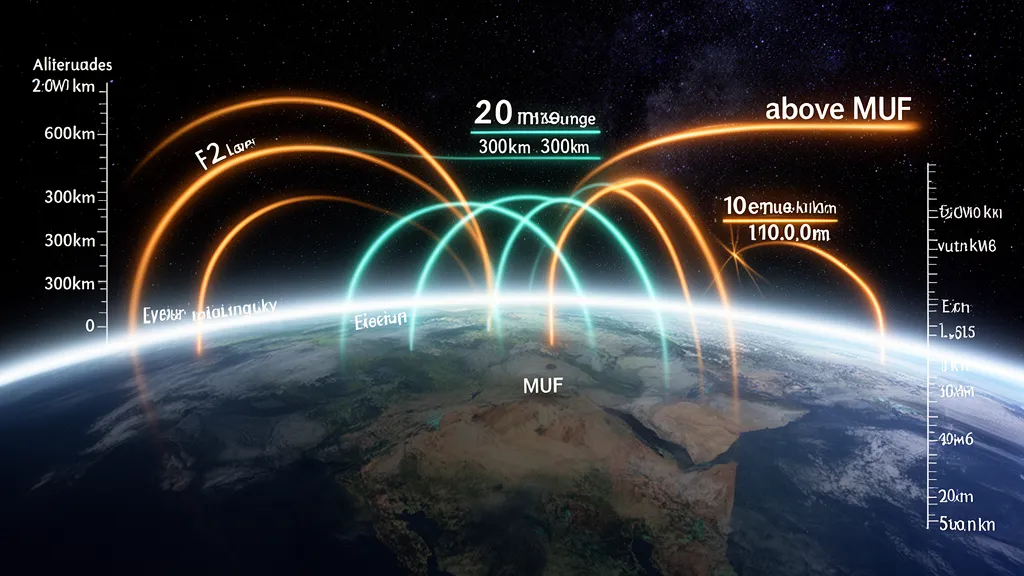
The Maximum Usable Frequency is the highest frequency that will reflect off the ionosphere on a specific transmit-to-receive path at a specific time. A signal transmitted above the MUF passes straight through the ionosphere into space; below the MUF, it reflects and arrives at the intended destination. If the MUF on your transatlantic path is 22 MHz, then 20m (14.0–14.350 MHz) is open, but 15m (21.0–21.450 MHz) is at the MUF boundary, and 10m (28 MHz) is above it and will not support skywave propagation.
This single number — the MUF — determines which bands work for DX on any given path. Everything else in propagation prediction is context for understanding why the MUF is where it is and where it is going.
The Formula: MUF = foF2 × sec(θ)
The MUF for a given path follows directly from the F2 layer critical frequency and the geometry of the path (ITU-R P.1240-2):
MUF = foF2 × sec(θ)
Where:
- foF2 = the critical frequency of the F2 layer at the ionospheric reflection midpoint (MHz)
- θ = the zenith angle of incidence at the reflection point
- sec(θ) = the obliquity factor — how much the oblique path amplifies vertical reflectability
For a vertical (straight-up) transmission, θ = 0° and sec(θ) = 1, so MUF equals foF2. This is the NVIS case. For an oblique path, the signal strikes the ionosphere at a shallower angle, effectively "seeing" a higher reflecting frequency.
Obliquity Factors by Path Length
The sec(θ) value depends on path geometry. Assuming a single F2 reflection at ~300 km altitude:
| Path Length | Approximate sec(θ) | Example |
|---|---|---|
| 0 km (vertical) | 1.0 | NVIS |
| 1,000 km | ~1.5–2.0 | Regional NVIS boundary |
| 2,000 km | ~2.5 | Short skip |
| 3,000 km | ~3.0–3.5 | Single F2 hop, e.g. UK to North Africa |
| 4,000 km | ~4.0 | UK to mid-Atlantic |
| 5,000 km | ~4.5 | North America to Europe (shorter paths) |
| 6,000 km | ~4.5–5.0 | Transatlantic, transpacific |
These figures are ITU-R P.1240-2 typical values for a single F2-layer reflection at 300 km altitude. Multi-hop paths involve multiple reflection points; the effective obliquity factor changes accordingly.
Worked Example
At 14:00 UTC on a moderate-flux day (SFI 130), foF2 over the mid-Atlantic is approximately 8 MHz. For a 5,500 km path from the US East Coast to western Europe, sec(θ) ≈ 4.8.
MUF = 8.0 × 4.8 = 38.4 MHz
All amateur HF bands through 10m (28 MHz) are below the MUF. The path supports propagation on 10m, 12m, 15m, 17m, and 20m simultaneously. On a low-flux day (SFI 80), foF2 might drop to 5.5 MHz, giving an MUF of 26.4 MHz — 10m is above MUF and dead on this path, but 12m and 15m are still open.
foF2: The Variable That Drives Everything
foF2 — the critical frequency of the F2 ionospheric layer — is the foundation of every MUF calculation. It is measured directly by ionosondes: ground-based radar systems that sweep frequencies upward and record the maximum frequency that reflects back (NOAA/Lowell GIRO network). The GIRO network maintains dozens of ionosondes worldwide, with real-time data publicly accessible.
foF2 varies with:
Solar Flux (SFI)
Higher SFI means more solar EUV radiation reaching the upper atmosphere, ionizing more N₂ and O to produce electrons in the F2 layer. The relationship is approximately linear for practical purposes: doubling SFI from 80 to 160 roughly doubles daytime foF2 from ~5 MHz to ~10 MHz at mid-latitudes. This is the primary reason 10m and 12m support DX propagation during solar maximum but are largely dead during solar minimum.
| SFI Range | Typical Daytime foF2 (Mid-latitude) | MUF on 5,000 km Path |
|---|---|---|
| 65–79 | 4–6 MHz | 18–27 MHz (17m–15m open) |
| 80–99 | 5–7 MHz | 22–32 MHz (15m–12m open) |
| 100–119 | 6–9 MHz | 27–40 MHz (15m–10m open) |
| 120–149 | 7–11 MHz | 32–50 MHz (10m fully open) |
| 150–200+ | 9–15 MHz | 40–68 MHz (10m, potential 6m) |
These are midday values at the ionospheric midpoint for a moderately long path. Actual foF2 depends on latitude, season, and time of day.
Time of Day
foF2 peaks 2–4 hours after local solar noon at the ionospheric reflection midpoint. This lag occurs because the F2 layer's electron density continues building after peak solar ionization while the diffusion processes in the thermosphere delay the peak. For a transatlantic path with a midpoint over the mid-Atlantic (~35° W), solar noon at the midpoint occurs around 14:20 UTC — expect peak MUF around 17:00–18:00 UTC.
At night, the F2 layer persists (unlike D and E layers which disappear at sunset), but foF2 drops as free electrons gradually recombine. Nighttime foF2 at mid-latitudes typically falls to 60–70% of daytime peak, reducing the MUF proportionally. This is why 10m DX vanishes after sunset while 20m and 40m remain workable through the night.
Latitude
The equatorial ionization anomaly creates two bands of enhanced F2 ionization roughly ±10–20° magnetic latitude on either side of the magnetic equator. foF2 at these latitudes — roughly Mexico, Nigeria, Brazil, India, Philippines — can exceed mid-latitude values by 2–4 MHz at solar maximum, producing MUFs several MHz higher than adjacent regions. This explains why stations in these "sweet spot" latitude bands often have extraordinary DX capability on 10m and 12m.
Polar and sub-polar regions (above ~60° magnetic latitude) have lower, more variable foF2 due to reduced solar angle, higher recombination rates, and geomagnetic disturbance effects. High-latitude MUFs are typically 30–50% lower than equatorial MUFs under the same solar flux.
Season
F2 propagation shows strong seasonal behavior that differs from what you might expect based on solar elevation alone:
| Season | Mid-Latitude MUF Pattern |
|---|---|
| Winter | foF2 higher than summer at mid-latitudes for N-S paths (winter F2 anomaly) |
| Summer | foF2 lower at mid-latitudes; MUF on long paths often lower despite more sunlight |
| Equinoxes | Strongest F2 conditions — high foF2 at all latitudes |
The winter F2 anomaly (also called the seasonal anomaly) often surprises operators: mid-latitude 10m openings can occur in December and January with SFI values that would not support them in June. This is a well-established ionospheric phenomenon driven by thermospheric composition changes, not solar angle.
LUF: The Lower Bound of the Propagation Window
The MUF sets the upper frequency limit. The Lowest Usable Frequency (LUF) sets the lower limit, determined primarily by D-layer absorption. Between the LUF and MUF is your propagation window.
The D-layer (60–90 km altitude) absorbs HF signals, with absorption increasing steeply at lower frequencies. D-layer absorption follows an f⁻² law: halving the frequency quadruples the absorption. At quiet daytime conditions, the LUF on a typical mid-latitude path might be around 7–10 MHz for longer circuits, which is why 40m can be difficult for long paths during the day — it is near or below the LUF even when the MUF is well above it.
During solar flares, X-ray flux spikes and dramatically enhances D-layer ionization, raising the LUF suddenly across the entire sunlit hemisphere. An M5 flare can raise the LUF on a 10,000 km path from 8 MHz to 20 MHz in minutes — collapsing the propagation window to nothing. (See D-Layer Absorption for the full treatment.)
Pro Tip: When a band "goes quiet" suddenly in the middle of the day, check NOAA's X-ray flux before assuming the MUF dropped. If X-ray flux shows an M-class or higher flare, the LUF likely spiked above the band you were using. The MUF may still be well above your frequency — the band will return once the flare subsides, typically within 10–60 minutes depending on flare class. Watch the DXRadar X-ray page for real-time flare status.
Diurnal MUF Patterns by Path and Band
Understanding the daily MUF cycle lets you predict opening times without checking tools — though DXRadar live data is always better.
Transatlantic Path (North America East Coast ↔ Western Europe, ~6,000 km)
The F2 midpoint is over the mid-Atlantic, ~35° W, 45° N. Solar noon at midpoint: ~14:15 UTC. Expected behavior:
- 06:00–08:00 UTC: MUF rising from overnight values. 20m solid; 17m opening. 15m may be below MUF.
- 10:00–14:00 UTC: MUF climbing through 25–35 MHz. 15m and 12m open. 10m opening begins at SFI >110.
- 14:00–18:00 UTC: Peak MUF window. All bands 10m through 20m potentially open. Best time for 10m DX.
- 18:00–21:00 UTC: MUF declining. 10m closes first, then 12m, then 15m.
- 21:00–06:00 UTC: Nighttime foF2. 20m typically open; 17m intermittent; 15m may have nighttime opening with high SFI.
Transpacific Path (US West Coast ↔ Japan, ~9,000 km)
Multi-hop F2 over the Pacific. Path crosses near-equatorial ionization zones. Expected behavior at SFI 130:
- 14:00–20:00 UTC: Evening opening from Japan perspective; 10m and 15m active.
- 22:00–02:00 UTC: Nighttime propagation on 20m; long-path 40m possible.
- 03:00–07:00 UTC: Morning window as western Pacific F2 wakes up. Excellent 15m.
Short Paths Under 2,000 km
At shorter path lengths, the MUF equals approximately 2 × foF2 or less. A European station trying to work another European station 1,500 km away needs foF2 above 7 MHz for 14 MHz (20m) to work — easily achievable by mid-morning during any solar cycle phase. Short paths are less sensitive to SFI variation than long-haul DX paths, where the high obliquity factor amplifies foF2 differences into large MUF swings.
Practical MUF Estimation Without a Computer
When you are in the field without internet access, you can estimate whether a band is open using foF2 rules of thumb and path geometry:
- Estimate foF2 at the midpoint: use SFI as a rough proxy. At SFI 100 and midday, mid-latitude foF2 is roughly 7–8 MHz.
- Estimate sec(θ) for your path length using the table above.
- Multiply: MUF ≈ foF2 × sec(θ).
- Compare to your target band: if MUF > your frequency, the band supports ionospheric propagation.
For a 4,000 km path (e.g., UK to eastern Mediterranean) with foF2 = 8 MHz and sec(θ) ≈ 4.0: MUF ≈ 32 MHz. The 10m band at 28 MHz is open. The 6m band at 50 MHz is above MUF unless a sporadic-E cloud extends the effective foF2, which is a separate propagation mode.
Multi-Hop Propagation and the 20,000 km Path
Single F2-hop propagation covers approximately 3,000–4,000 km. Longer paths require multiple hops, each adding an Earth reflection and another ionospheric reflection. A transatlantic path at 6,000 km typically uses two hops; transpacific paths at 9,000–12,000 km use two or three hops.
Each hop introduces additional losses: ground reflection loss (2–10 dB depending on terrain), and the risk of one hop landing in a geographically disturbed ionospheric region. Multi-hop paths are more fragile than single-hop paths — a localized storm over one hop point can kill a multi-hop path while single-hop paths on the same band and frequency continue working.
The theoretical maximum for multi-hop F2 propagation is approximately 20,000 km — essentially the antipode. Long-path contacts to stations nearly 180° away are possible, though they require favorable ionospheric conditions at all hop points simultaneously. These paths sometimes open on 20m and 40m after dark when the F2 layer is stable over the entire long-path route.
Frequently Asked Questions
What is the Maximum Usable Frequency (MUF) in ham radio?
The MUF is the highest frequency that reflects off the F2 ionospheric layer on a specific transmitter-to-receiver path at a specific time. Above the MUF, signals escape into space. Below the MUF, signals reflect and arrive at the target. The MUF depends on the F2 layer's critical frequency (foF2) at the path midpoint and the path geometry — longer paths have higher MUFs because of the larger obliquity factor.
How is MUF calculated?
MUF = foF2 × sec(θ), where foF2 is the F2 layer critical frequency at the reflection midpoint and sec(θ) is the obliquity factor — typically 3.0–3.5 for a 3,000 km path and 4.5–5.0 for a 6,000 km path (ITU-R P.1240-2). A foF2 of 8 MHz at the midpoint of a 5,000 km path with sec(θ) = 4.5 gives an MUF of 36 MHz, meaning all bands through 12m are open.
What is the difference between MUF and LUF?
The MUF (Maximum Usable Frequency) is the upper boundary — above it, signals escape the ionosphere. The LUF (Lowest Usable Frequency) is the lower boundary, driven by D-layer absorption — below it, signals are absorbed on the path. Operating between LUF and MUF is the propagation window. During solar flares, the LUF rises sharply, compressing the window. At night, the LUF drops as the D-layer disappears.
What is foF2 and how does it relate to MUF?
foF2 (critical frequency of the F2 layer) is the highest frequency that reflects vertically off the F2 layer. It is measured by ionosondes worldwide through the NOAA/Lowell GIRO network. For vertical incidence (NVIS), MUF equals foF2. For oblique paths, MUF = foF2 × sec(θ). Higher foF2 means higher MUF and more open bands. foF2 rises with higher SFI and peaks 2–4 hours after local solar noon at the reflection midpoint.
When is MUF highest during the day?
The MUF peaks 2–4 hours after local solar noon at the ionospheric reflection midpoint. For a transatlantic path, the midpoint solar noon is around 14:00–15:00 UTC, so peak MUF occurs around 17:00–18:00 UTC. At night, foF2 drops to roughly 60–70% of its daytime peak, reducing MUF proportionally. The F2 layer persists through the night (unlike D and E layers), so nighttime propagation on 20m and 40m remains possible.
How does solar flux (SFI) affect the MUF?
Higher SFI means more solar EUV radiation ionizing the F2 layer, raising foF2 and therefore raising the MUF. At SFI 80, a 5,000 km path MUF might reach 22–28 MHz — 15m open, 10m closed. At SFI 200, the same path MUF exceeds 50 MHz — 10m wide open, possible 6m F2 propagation. The current SFI is shown on the DXRadar solar weather page.
What happens when you transmit above the MUF?
Signals above the MUF pass through the F2 layer into space. No ionospheric reflection occurs, so you receive no skip signals and make no DX contacts via that mode. The band appears "dead" for skywave. However, if you can hear local stations or nearby ground-wave contacts, the band itself is fine — it is the ionospheric propagation mode that has failed at that frequency.
Content reviewed by DXRadar team. Data sources: ITU-R P.1240-2, ITU-R P.533-14, NOAA SWPC, Lowell GIRO.
Related reading: F2 Layer Propagation | What Is SFI? | D-Layer Absorption