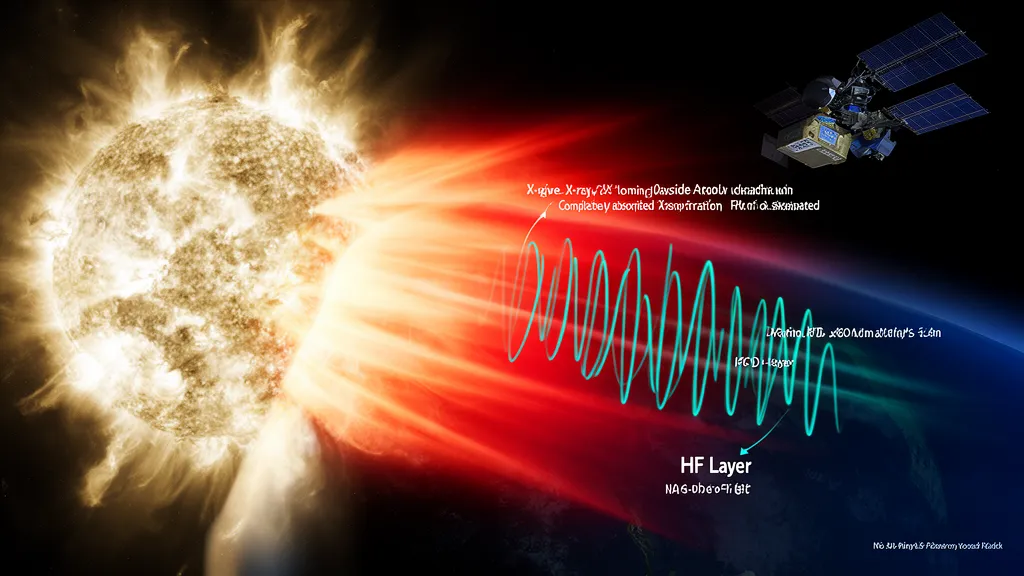
Operator's Verdict: Live X-ray flux is B3.7 (B3.7). An active flare can cause HF blackout across the sunlit hemisphere within minutes. Monitor real-time X-ray data on the DXRadar X-ray page.
Why the D-Layer Goes From Minor Nuisance to Full Blackout
The D-layer is a normally quiet, low-intensity absorber of HF signals. On a typical quiet day, it causes gradual attenuation on lower HF frequencies during daylight hours — a nuisance for 160m and 80m DX operators, but not a crisis. Then a solar flare fires, solar X-ray flux jumps by a factor of 10–1,000, and the same layer transforms into an opaque wall across the entire sunlit hemisphere within minutes. Understanding why this happens — and what you can do about it — requires understanding the D-layer's physics.
The D-Layer: Structure and Normal Behavior
The D-layer occupies roughly 60–90 km altitude, the lowest ionospheric layer. Unlike the F2 layer (which dominates propagation) or the E layer (which enables sporadic-E), the D-layer's primary role is absorption.
At D-layer altitudes, the atmosphere is dense enough that free electrons produced by solar ionization collide frequently with neutral molecules before they can recombine. These collisions transfer energy from the radio wave to the neutral gas — absorption. The collision frequency at 60–90 km altitude is orders of magnitude higher than in the F2 region, making the D-layer an efficient absorber despite having lower electron density than the F2 layer.
Normal Daytime D-Layer
Under quiet conditions, the D-layer is ionized primarily by solar Lyman-alpha radiation (121.6 nm wavelength, extreme UV) and by galactic cosmic rays. Lyman-alpha ionizes nitric oxide (NO), which is present as a minor constituent at D-layer altitudes. This produces enough ionization to cause measurable absorption on lower HF frequencies (1.8–7 MHz) during daylight hours.
The effect is frequency-dependent following an f⁻² law: absorption is inversely proportional to the square of the frequency. At 3.5 MHz (80m), absorption is roughly 16 times greater than at 14 MHz (20m), and 64 times greater than at 28 MHz (10m). This is why long-path 80m DX requires dark-side paths — the dayside D-layer absorption makes them impractical even on quiet days.
At night, Lyman-alpha and cosmic-ray ionization at D-layer altitudes essentially cease. The D-layer disappears after sunset. This is why 40m and 80m become viable DX bands after dark.
The Flare Mechanism: X-Ray Flux and Sudden Ionospheric Disturbances
When a solar flare erupts, the sun emits a burst of X-ray radiation that travels to Earth at the speed of light — an 8-minute transit. There is no warning: the X-rays arrive 8 minutes after the flare begins. (Energetic particles from a flare, which also cause ionospheric effects, arrive minutes to hours later, but X-rays are always first.)
The X-ray burst is detected by NOAA's GOES satellites in real-time, measuring in the 0.1–0.8 nm wavelength band. This is the flux your X-ray charts show. Flare classification (A, B, C, M, X) represents the peak flux in this band:
| Flare Class | Peak X-ray Flux | Example Impact |
|---|---|---|
| B | 10⁻⁷ to 10⁻⁶ W/m² | Negligible |
| C | 10⁻⁶ to 10⁻⁵ W/m² | Negligible to minor |
| M1–M4 | 10⁻⁵ to 4×10⁻⁵ W/m² | Minor HF degradation |
| M5–M9 | 4×10⁻⁵ to 10⁻⁴ W/m² | Moderate HF blackout |
| X1–X9 | 10⁻⁴ to 10⁻³ W/m² | Wide-area HF blackout |
| X10–X19 | 10⁻³ to 2×10⁻³ W/m² | Severe HF blackout |
| X20+ | >2×10⁻³ W/m² | Extreme HF blackout |
X-rays at solar-flare energies (primarily 0.1–8 nm) penetrate deeply into the D-layer, dramatically enhancing ionization of N₂ and O₂. The electron density in the D-layer can spike by a factor of 100–10,000 within minutes of flare onset. The greatly enhanced D-layer absorbs nearly all incident HF energy, producing the shortwave fadeout (SWF) — a sudden, simultaneous collapse of HF signals across all dayside paths.
This collective response to sudden solar X-ray enhancement is called a Sudden Ionospheric Disturbance (SID). The shortwave fadeout is the most significant SID for HF operators, but other SID effects include Sudden Phase Anomalies (SPA) on VLF transmissions and Sudden Cosmic Noise Absorption (SCNA) on galactic radio sources.
Pro Tip: The onset of a shortwave fadeout is almost simultaneous across all dayside paths — signals drop within 1–3 minutes of the X-ray flux exceeding M-class levels. If you notice multiple HF bands going quiet simultaneously during daytime, check the X-ray plot before assuming propagation has failed. A clean, sudden drop in signal on multiple bands is the signature of a flare SID. Watch DXRadar's X-ray monitor for live GOES flux.
NOAA Radio Blackout Scale: R1 Through R5
NOAA classifies HF radio blackouts on its R-scale, mapping GOES X-ray flux to operational impacts (NOAA Space Weather Scales):
| R Scale | X-ray Class | HF Impact | Typical Duration |
|---|---|---|---|
| R1 Minor | M1–M4 | Degradation on some HF bands; minor disruption to radio contact on sunlit side | 10–30 min |
| R2 Moderate | M5–M9 | Limited HF blackout on sunlit side; position loss on some low-frequency navigation systems | 30–60 min |
| R3 Strong | X1–X9 | Wide-area HF blackout; low-frequency navigation disrupted | 1–3 hours |
| R4 Severe | X10–X19 | HF radio communication largely unavailable on daylit side; navigation accuracy degraded | 3–6 hours |
| R5 Extreme | X20+ | Complete HF radio blackout on entire daylit side; navigation position errors for hours | 6+ hours |
The R-scale events are not rare. R1 events occur dozens of times per year near solar maximum. R2 events happen several times per year. R3 and R4 events occur a few times per solar cycle near peak activity. R5 events are very rare — the March 1989 and October 2003 storm periods produced R5 conditions.
D-Layer Absorption by Frequency: Who Gets Hit Hardest
Not all bands experience the same blackout severity. The f⁻² frequency dependence of D-layer absorption means the impact decreases dramatically with frequency:
| Band | Frequency | Relative Absorption (vs. 28 MHz) | R2 Blackout Impact |
|---|---|---|---|
| 160m | 1.8 MHz | ~240× | Complete blackout across entire daylit hemisphere |
| 80m | 3.5 MHz | ~64× | Severe blackout; daylit paths essentially unusable |
| 60m | 5.3 MHz | ~28× | Heavy absorption; significant path loss |
| 40m | 7.0 MHz | ~16× | Strong absorption; long paths fail; short paths degraded |
| 30m | 10.1 MHz | ~8× | Significant absorption; marginal on long paths |
| 20m | 14.0 MHz | ~4× | Moderate absorption; long paths degrade significantly |
| 17m | 18.1 MHz | ~2.4× | Mild-to-moderate; most long paths survive R1–R2 |
| 15m | 21.0 MHz | ~1.8× | Mild absorption; paths often survive R1–R2 |
| 12m | 24.9 MHz | ~1.3× | Minor absorption; R1–R2 mostly unaffected |
| 10m | 28.0 MHz | 1× (reference) | Minimal absorption; limited to R4–R5 significant impact |
This table explains a key operating insight: during an R1 or R2 blackout, lower HF bands die while higher HF bands survive. An operator on 40m in the middle of a daylit contact may lose the path completely, while another operator on 15m on the same geometry experiences only minor degradation.
The Night-Side Exception
D-layer absorption affects only the sunlit hemisphere. Earth's shadow prevents X-rays from reaching the night-side ionosphere. Paths entirely over the dark side of Earth are unaffected by flare-induced D-layer enhancement. During an R3 blackout affecting North America and Europe (daylit), operators in Japan, Australia, and New Zealand (where it is night) can still communicate normally with each other across dark-side paths.
This creates an interesting operational window: paths that route over the day-night terminator may partially survive a blackout if enough of the path lies on the dark side.
Recovery: How Long Does Blackout Last?
Recovery from a shortwave fadeout follows the decline of solar X-ray flux after flare peak. The X-ray flux typically rises steeply (within minutes), peaks, then decays exponentially. For most M-class flares, the X-ray flux returns to pre-flare background within 15–45 minutes of peak.
The D-layer ionization enhancement tracks the X-ray flux closely, dissipating as the flux drops. For an R1 event (M1–M4 flare), HF signals typically return within 20–40 minutes of flare peak. For an R3 event (X1–X9 flare), recovery may take 1–3 hours. Rare R4–R5 events (X10+) produce prolonged enhancement because the X-ray flux remains elevated longer and the D-layer requires more time to fully de-ionize.
A useful monitoring technique: watch the GOES X-ray flux plot in real time. When the 1–8 Å flux drops below roughly 10⁻⁵ W/m² (M-class threshold — the M1.0 lower boundary), D-layer enhancement is fading and HF signals should begin recovering. The DXRadar X-ray page displays this flux in real time.
Proton Events: A Separate Problem
Large X-class flares are sometimes accompanied by solar energetic proton (SEP) events — streams of high-energy protons that arrive at Earth 15 minutes to several hours after the flare. These protons precipitate into polar regions along magnetic field lines, producing Polar Cap Absorption (PCA) — extreme D-layer absorption confined to polar cap regions (above ~60–65° corrected geomagnetic latitude). PCAs can persist for days while proton flux remains elevated. Polar paths through the polar caps (Arctic routes between North America and Europe or Asia) become unusable for the duration.
PCA events are separate from flare-induced SIDs — they can occur even after the flare's direct X-ray phase has ended, and they target polar paths specifically rather than all dayside paths globally.
The NOAA D-RAP Model
NOAA's D-Region Absorption Prediction (D-RAP) model provides real-time maps of estimated D-layer absorption across the globe in MHz, derived from GOES X-ray measurements and a physical model of D-layer ionization. D-RAP outputs a maximum usable frequency threshold below which absorption exceeds approximately 1 dB — signals below the D-RAP threshold face significant absorption loss.
D-RAP maps are available at NOAA SWPC and integrate the current X-ray flux with solar zenith angle at each geographic point to compute absorption. During an R2–R3 event, the D-RAP map shows absorption thresholds of 15–25 MHz across the daylit hemisphere, visually confirming that 40m and 80m are blacked out while 15m may still function.
Operating Strategy During and After Blackouts
During an active blackout (R1–R2):
- Move upward in frequency — 17m and 15m experience far less absorption than 40m and 80m
- Work dark-side paths: if your target station is on the night side, dark-side 40m or 80m paths may survive
- Monitor the X-ray plot; signal return is often rapid (20–30 minutes for M-class flares)
- If you can hear signals but they are weak, try digital modes — FT8 decodes 10–15 dB below what SSB requires
During an active blackout (R3+):
- Expect 1–3 hours of disrupted dayside HF
- 10m and 12m may remain functional for long-path dark-side routing even in severe events
- Use the time for antenna work, equipment maintenance, or wait for recovery
- Check for SEP proton flux — if protons are elevated, polar paths will be affected beyond the X-ray recovery
After blackout recovery:
- Bands typically return with less fanfare than the fadeout — signals gradually rise over 10–20 minutes
- The F2 layer is largely unaffected by X-ray flares (enhancement, not disruption), so MUF is essentially unchanged; the D-layer effect is a transmission problem, not an ionospheric reflection problem
- Post-flare conditions can be excellent if Kp remains low — the X-ray flash alone does not disturb the magnetosphere
Frequently Asked Questions
What is D-layer absorption in ham radio?
D-layer absorption is the attenuation of HF radio signals by the ionospheric D-layer at 60–90 km altitude. Normal daytime D-layer causes moderate absorption on lower HF bands (160m, 80m, 40m). During solar flares, greatly enhanced solar X-ray flux dramatically increases D-layer ionization, causing Sudden Ionospheric Disturbances (SIDs) and HF radio blackouts across the entire sunlit hemisphere.
How long does an HF radio blackout last after a solar flare?
Duration depends on flare class. R1 events (M1–M4 flares) cause blackouts of roughly 10–30 minutes. R2 (M5–M9) lasts 30–60 minutes. R3 (X1–X9) causes 1–3 hour disruption. R4 (X10–X19) may persist 3–6 hours. Recovery tracks the X-ray flux decline — when GOES flux returns to C-class levels, bands begin recovering. Monitor live X-ray flux on DXRadar.
Which HF bands are most affected by D-layer absorption?
D-layer absorption follows an f⁻² law — lower frequencies are absorbed much more than higher frequencies. 160m, 80m, and 40m suffer the most severe blackouts; 10m and 12m are barely affected. During R1–R2 events, 40m and 80m on dayside paths fail while 17m and 15m often survive. This makes higher HF bands the fallback during flare events.
What is a Sudden Ionospheric Disturbance (SID)?
A SID is the collective term for ionospheric effects caused by a sudden solar X-ray flux increase during a flare. For HF operators, the key SID is the shortwave fadeout (SWF) — a rapid, simultaneous collapse of signals across multiple HF bands on all dayside paths. SIDs affect only the sunlit hemisphere; night-side paths are unaffected because Earth blocks the X-rays.
Can you still make HF contacts during a radio blackout?
Yes, depending on the blackout severity and path geometry. Higher frequencies (15m–10m) suffer far less absorption than lower bands. Paths routing over the terminator or entirely on the dark side are unaffected. During R1–R2 blackouts, 17m and 15m contacts on dark-side paths often continue normally while 40m and 80m paths die. Digital modes (FT8) can decode signals 10–15 dB below SSB threshold, extending the workable range during partial blackouts.
What is the NOAA R-scale for radio blackouts?
The NOAA R-scale classifies HF radio blackouts from R1 (Minor, M1–M4 flares) to R5 (Extreme, X20+ flares). R1 causes minor degradation on some HF bands. R3 produces a wide-area HF blackout across the daylit hemisphere. R5 causes complete HF blackout on the dayside. The scale maps directly to GOES X-ray flux measurements and updates in real time.
Content reviewed by DXRadar team. Data sources: NOAA SWPC D-RAP, NOAA Radio Blackout Scales, NASA Solar Dynamics Observatory.
Related reading: Solar Flare Effects on Ham Radio | F2 Layer Propagation | What Is MUF?