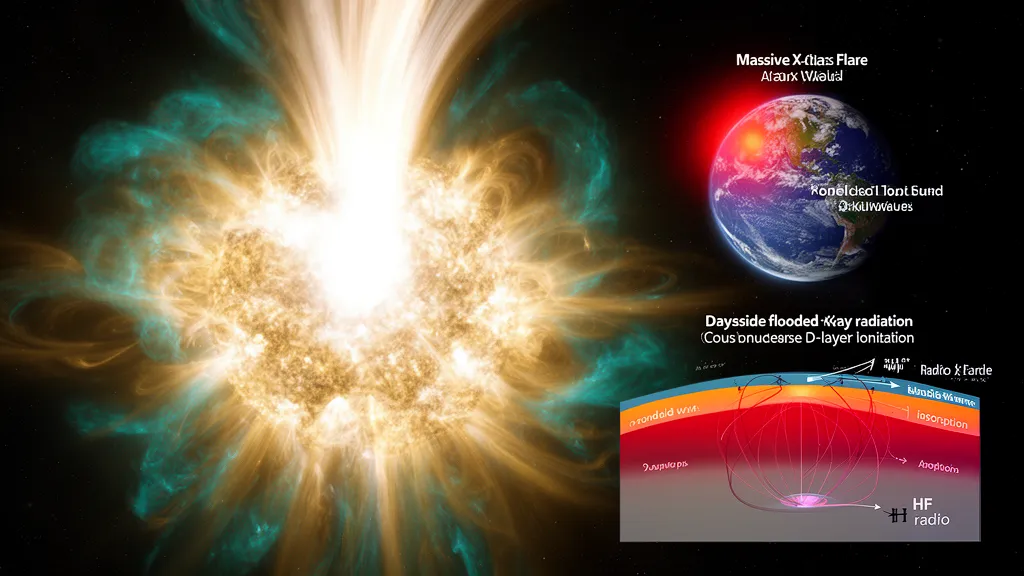
How Solar Flares Cause HF Radio Blackouts
Solar flares cause shortwave blackouts by flooding Earth's upper atmosphere with X-ray radiation, which ionizes the D-layer of the ionosphere within 8 minutes of flare onset — the travel time of light from the Sun. The ionized D-layer absorbs rather than reflects HF radio signals on the sunlit hemisphere, silencing bands from 160m through 10m in proportion to flare intensity.
The mechanism is straightforward: under normal daytime conditions, the D-layer (approximately 60–90 km altitude) absorbs some HF energy but remains thin enough that most signal energy punches through to reflect off the F2 layer. During a flare, X-ray flux can increase by a factor of 10 to 10,000 above background. This floods the D-layer with free electrons via photoionization. The D-layer thickens and its electron density spikes, dramatically increasing absorption — particularly on lower HF frequencies where absorption is proportional to 1/f². Signals on 80m and 160m effectively disappear. The operator hears nothing but noise.
The effect is geometrically locked to the Sun-facing hemisphere. Your night-side QTH is completely unaffected during the same event — signals there propagate normally through a dark, lightly ionized D-layer. This creates a sharp geographic divide: a ham in Tokyo may be experiencing total HF blackout while a ham in Chicago (nightside) has excellent 40m propagation to Europe.
This phenomenon has a precise technical name: Sudden Ionospheric Disturbance (SID). SIDs are detected worldwide by monitoring stations that track absorption on fixed reference frequencies and were first systematically studied by J.H. Dellinger at NIST in 1935.
The Solar Flare Classification Scale
Solar flares are classified on a logarithmic scale using the letters A, B, C, M, and X, based on peak X-ray flux measured in the 1–8 Ångström band by NOAA GOES satellites (NOAA SWPC Space Weather Scales). Each step up the letter scale represents a 10× increase in X-ray flux — the scale is not linear.
| Class | Peak Flux (W/m²) | Approximate Radio Effect | NOAA R-Scale |
|---|---|---|---|
| A | < 10⁻⁷ | None — below background | None |
| B | 10⁻⁷ to 10⁻⁶ | None detectable | None |
| C | 10⁻⁶ to 10⁻⁵ | Minor degradation on lower HF at low latitudes | None to R0 |
| M1–M4 | 10⁻⁵ to ~4×10⁻⁵ | Minor blackout, mainly 10–20 MHz | R1 (Minor) |
| M5–M9 | ~5×10⁻⁵ to 10⁻⁴ | Moderate blackout, 10–30 MHz degraded | R2 (Moderate) |
| X1–X9 | 10⁻⁴ to 10⁻³ | Strong blackout, all HF below 30 MHz affected | R3 (Strong) |
| X10–X19 | 10⁻³ to 2×10⁻³ | Severe blackout, complete HF loss on dayside | R4 (Severe) |
| X20+ | ≥ 2×10⁻³ | Extreme blackout, HF gone for 1–2 hours | R5 (Extreme) |
Within each letter category, a number from 1.0 to 9.9 refines the flux value. An M2.5 flare is 2.5 × 10⁻⁵ W/m². An X2.5 flare is 2.5 × 10⁻⁴ W/m² — ten times stronger than M2.5, not 2.5 times stronger. This logarithmic scaling trips up many operators who see "M5" and "X1" as close together on the NOAA scale. They are not: X1.0 = 10⁻⁴ W/m² while M1.0 = 10⁻⁵ W/m² — a full decade of flux difference.
The NOAA Radio Blackout scale (R1–R5) maps directly onto flare class:
- R1 (Minor): M1–M4 flares. Lower HF degraded. Most operators notice brief absorption on 40m and below.
- R2 (Moderate): M5–M9 flares. Wide HF degradation. 40m NVIS becomes unreliable. Frequencies below 10 MHz may fade.
- R3 (Strong): X1–X9 flares. HF blackout across the dayside. Frequencies below 30 MHz affected. Lower frequencies completely lost.
- R4 (Severe): X10–X19 flares. Near-complete HF blackout for 1–2 hours. Navigation systems and satellite communication also affected.
- R5 (Extreme): X20+ flares. Complete HF blackout on the sunlit hemisphere. Historical examples include the X17.2 Halloween Storm flare of October 28, 2003 and the X28+ event of November 4, 2003 (which saturated the GOES detector at the time).
Which Bands Are Hit Hardest — and Which Survive
D-layer absorption is not uniform across the HF spectrum. The physics dictate that absorption is proportional to the inverse square of frequency: doubling the frequency reduces absorption by approximately 75%. This has direct operational implications.
Worst affected (most absorption):
- 160m (1.8–2.0 MHz) — D-layer is nearly opaque during strong flares. NVIS contacts collapse within minutes of flare onset. Only ground-wave out to ~100 km may survive.
- 80m (3.5–4.0 MHz) — Severely hit. R3+ events cause complete fadeout on 80m NVIS paths. 80m DX on the nightside is unaffected, but any path crossing the dayside terminator into the sunlit region will fade.
- 40m (7.0–7.3 MHz) — Significant absorption in R2+ events. NVIS paths fail. Transcontinental DX paths crossing the dayside hemisphere degrade.
Moderately affected:
- 20m (14.0–14.35 MHz) — Noticeable degradation in R3+ events. Paths entirely on the nightside survive; dayside F2 paths lose 6–15 dB of signal strength.
- 17m and 15m (18 and 21 MHz) — R3 causes noticeable degradation, but these frequencies recover faster because the D-layer is relatively more transparent at higher frequencies.
Least affected (best post-flare survival):
- 12m and 10m (24.9 and 28 MHz) — Absorb the least D-layer energy per unit path. Even during an R3 event, 10m may remain partially open during the rising and recovery phases of the flare because the MUF on dayside F2 paths typically stays above 28 MHz for most of the sunlit hemisphere during Solar Cycle 25 conditions.
Key operating heuristic: During a flare, if any HF band is going to survive, start with the highest frequency your path supports. If 10m is dead and 15m is dead, 20m will be worse — not better. Flip the conventional instinct during blackout conditions.
Pro Tip: The DXRadar X-ray flux monitor displays the real-time GOES X-ray light curve updated every minute. Watch for the sharp spike in the 1–8 Å channel — that is your 8-minute warning. When flux drops back below C5 (5×10⁻⁶ W/m²), HF recovery on higher bands begins within 15–30 minutes.
How Long Does a Flare Blackout Last?
A solar flare radio blackout duration scales with flare class, but the relationship is not strictly linear. Flare duration follows the same rough progression as peak intensity, with typical ranges:
- C-class: 5–15 minutes of minor degradation
- M1–M4 (R1): 10–30 minutes
- M5–M9 (R2): 30–60 minutes
- X1–X9 (R3): 45 minutes to 90 minutes
- X10–X19 (R4): 1–2 hours
- X20+ (R5): 1–2+ hours, with gradual recovery
Recovery is gradual, not instantaneous. As X-ray flux declines after flare peak, D-layer electron density falls. Higher HF frequencies recover first. 10m and 12m may return to near-normal propagation 15–30 minutes after flux drops below C5. 40m typically requires another 30–60 minutes. 80m and 160m are the last to recover.
The operational threshold to watch: When the GOES 1–8 Å X-ray flux falls below C5 level (5×10⁻⁶ W/m²), higher HF bands begin recovering. At B-level flux (below 10⁻⁶ W/m²), full HF propagation on all bands is typically restored. Monitor the DXRadar X-ray feed in real time rather than waiting and guessing.
The Halloween Storms: An Operational Benchmark
The October 28, 2003 X17.2 solar flare (NOAA SWPC historical records) remains the most-studied HF blackout event of the modern era and provides the best operational benchmark for understanding extreme flare effects.
Flare onset was approximately 09:51 UTC. Within 8 minutes, HF operators across Europe, Asia, and the dayside Americas reported complete signal loss. Frequencies below 10 MHz went first. By 10:05 UTC, operators reported nothing audible below 30 MHz on the sunlit hemisphere. The GOES X-ray flux peaked at X17.2 around 11:10 UTC. Recovery began gradually after flux began declining, but many operators reported HF remained unusable until approximately 12:30 UTC — nearly an hour of complete blackout.
An operator at a mid-European QTH described the effect precisely in contemporaneous reports: "40m went first. Then 20m simply faded. By the time I checked 15m, it was gone too. The noise floor was there but not a single signal. It was like the bands had been switched off." Recovery came in reverse order — 10m returned first with weak signals, then 15m, then 20m. 40m remained suppressed for another 90 minutes.
The November 4, 2003 event — estimated at X28+ (the GOES-12 detector saturated) — was even more extreme, but the geometry was less favorable for European dayside impact as the X-ray peak arrived with the flare already late in the operational window.
What makes these events valuable benchmarks: the X-scale serves as a worst-case calibration. An X17 is roughly 170× more intense than an M1. An X28 is approaching 280× M1 flux levels. Modern Solar Cycle 25 activity (which has exceeded 90th-percentile predictions by late 2024) has produced several X-class events — making this calibration operationally relevant again.
Flares vs. CMEs: A Critical Distinction
The most common mistake operators make is conflating solar flares with coronal mass ejections (CMEs) and treating them as a single event with a single effect. They are entirely separate phenomena with entirely different radio impacts.
| Characteristic | Solar Flare | Coronal Mass Ejection (CME) |
|---|---|---|
| Nature | Electromagnetic radiation (X-rays, UV) | Magnetized plasma cloud |
| Travel time to Earth | 8 minutes (speed of light) | 1–3 days (500–2,500 km/s) |
| Effect | D-layer absorption → HF blackout | Geomagnetic storm → aurora, polar path degradation |
| Geographic scope | Dayside hemisphere only | Global (especially high latitudes) |
| Duration | 10 min–2 hours | 12 hours to several days |
| HF impact | Immediate blackout, all bands, dayside | Polar and high-latitude path degradation |
| NOAA scale | R1–R5 (Radio Blackout) | G1–G5 (Geomagnetic Storm) |
The key point: A solar flare does NOT cause the geomagnetic storm. The CME that may accompany or follow the flare does. An isolated flare with no associated CME causes a blackout that ends within 2 hours, and then conditions return to exactly what they were before. A CME-driven geomagnetic storm arrives 1–3 days later and causes completely different effects — enhanced D-layer at high latitudes, polar cap absorption, auroral zone path failures — which can last for 12–72 hours.
Many operators confuse the sequence: a large flare fires, HF goes dead for an hour, HF recovers, and then 36 hours later HF degrades again on polar paths. They attribute both effects to "the solar flare." The first effect was the flare. The second was the CME that was ejected alongside or after it. Check the DXRadar solar weather dashboard for CME alerts separately from X-ray flux — they are tracked on different timescales with different instruments.
Pro Tip: After any X-class flare, open the DXRadar solar weather dashboard and check the CME alert section. If NOAA has issued an S1+ solar radiation storm alert or a CME has been identified as Earth-directed, set a calendar reminder for 24–72 hours to monitor Kp. The flare blackout will have ended — but the geomagnetic storm, if any, is still incoming.
What Survives a Blackout — and What To Do
Operational guidance for HF operators during and immediately after a solar flare:
During an active blackout:
- Frequencies above 30 MHz (10m, 6m) may still support some propagation if the MUF is high enough — worth checking even during R3 events
- Nightside paths are completely unaffected. A path from your QTH to a station on the dark side of Earth may be fully functional while dayside paths are blacked out.
- VHF and UHF are not affected by D-layer absorption — local FM repeaters, digital modes, and satellite paths continue normally
- APRS via VHF continues without interruption
- Any emergency traffic on lower HF bands crossing the dayside should route through nightside relays or alternate frequencies
Monitoring the recovery:
- Watch the DXRadar X-ray flux monitor for the 1–8 Å channel to fall below C5 (5×10⁻⁶ W/m²)
- Higher bands recover first — try 10m, then 15m, then 17m, before dropping to 20m
- 40m NVIS typically needs 45–90 minutes post-peak before recovering enough for reliable regional contacts
- Expect rapid band openings after recovery as pent-up F2 ionization is still present — the ionosphere did not "use up" its F2 layer during the blackout, only D-layer absorption increased
Park on the Air (POTA) operators: If you are mid-activation on 40m NVIS when a flare hits, try dropping to 6m if your rig supports it (VHF is unaffected) or calling CQ on 10m — the F2 MUF on the sunlit hemisphere during Solar Cycle 25 peak conditions often stays above 28 MHz even through moderate flares. If conditions are completely blacked out, use the downtime to check antenna connections and note the UTC time for your log.
Frequently Asked Questions
Do solar flares affect ham radio?
Yes. Solar flares emit intense X-ray radiation that ionizes the D-layer of the ionosphere within 8 minutes of flare onset. The ionized D-layer absorbs HF radio signals on the sunlit side of Earth, causing shortwave blackouts that can last from 10 minutes to 2 hours depending on flare class. The nightside hemisphere is unaffected.
How long does a solar flare affect radio signals?
The radio blackout from a solar flare typically lasts 10 minutes to 2 hours, roughly proportional to the flare's class. An M1 (R1) event may degrade signals for 10–20 minutes. An X10 (R4) event can black out HF for 1–2 hours, with gradual recovery as X-ray flux declines. Monitor the GOES 1–8 Å channel — when flux drops below C5 level, recovery on higher HF bands begins.
What is a shortwave fadeout?
A shortwave fadeout — also called a Sudden Ionospheric Disturbance (SID) — is the rapid loss of HF signal propagation caused by a solar flare. Intense X-ray radiation ionizes the D-layer, which then absorbs rather than reflects HF signals. The effect is limited to the sunlit hemisphere and typically lasts 10 minutes to 2 hours. For a deeper explanation, see the D-layer absorption section above.
What frequency is least affected by solar flares?
Higher HF frequencies (15m, 10m, 12m) suffer the least absorption and recover fastest after a flare. D-layer absorption is inversely proportional to the square of frequency — doubling the frequency reduces absorption by approximately 75%. Lower frequencies (160m, 80m, 40m) suffer the worst blackouts. During an active flare, try the highest frequency your path supports before dropping lower.
What is the difference between a solar flare and a CME?
A solar flare is an intense burst of X-ray radiation that causes HF blackouts within 8 minutes, affects only the dayside hemisphere, and lasts 10 minutes to 2 hours. A coronal mass ejection (CME) is a cloud of magnetized plasma that takes 1–3 days to reach Earth and causes geomagnetic storms — polar path failures, aurora, and Kp-driven HF degradation — affecting the entire globe. These are entirely different events. A flare that accompanies a CME causes an immediate blackout; the geomagnetic storm arrives 1–3 days later as a completely separate effect.
Solar flare X-ray data on DXRadar is sourced from NOAA GOES satellite real-time feeds, updated every minute. For the current X-ray flux level and active alerts, visit the DXRadar X-ray monitor. For more on space weather and HF propagation, see Solar Cycle 25 and band conditions.