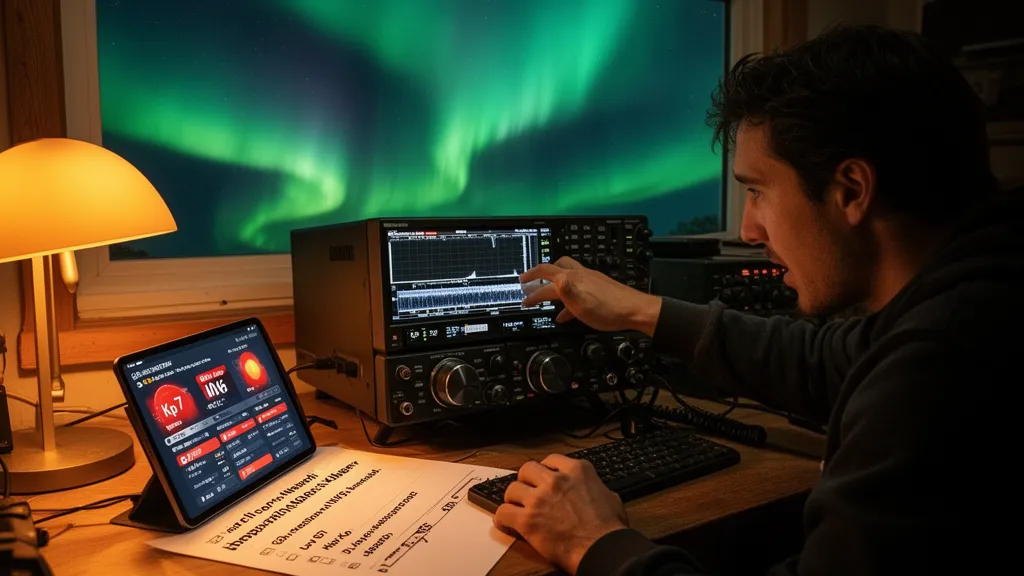
Operator's Verdict: SFI is 105 SFU — Kp is 2 — X-ray flux is B4.6. Check best bands now for which bands are actually workable under these conditions. If you are reading this because your bands are silent, run through the five-cause diagnostic below.
The Bands Are Never Completely Dead
Before diagnosing the cause of a dead band, accept one premise: there is always some HF propagation happening somewhere. The real question is whether your target band supports propagation on your target path right now. A 10m contact from the US East Coast to Japan may be impossible while 10m from Brazil to South Africa is wide open. A band that looks dead to you may be alive to stations in a different location or targeting different paths.
With that said, there are five distinct causes that explain the vast majority of "dead band" situations. Each has a different signature in the solar data, a different duration, and a different mitigation strategy.
Cause 1: Low SFI — Not Enough Ionization
SFI below approximately 90 SFU means the Sun is not producing enough UV and EUV output to ionize the F2 layer to the electron density needed for 10m and 15m propagation at mid-latitudes. This is the most common cause of dead high bands and has nothing to do with disturbances — it is simply a period of quiet, low solar activity.
The current SFI is 105 SFU.
| SFI Level | Bands Affected |
|---|---|
| Below 80 | 15m closed most of the day; 10m closed; 20m works only regionally at best |
| 80–100 | 10m closed via F2 (sporadic-E possible); 15m marginal except at solar noon on good paths |
| 100–120 | 10m opens on equatorial paths and at equinox; 15m solid for DX |
| 120+ | 10m reliable via F2 at mid-latitudes |
If SFI is below 90 and the high bands are dead, that is the expected condition. The solution is not patience — it is switching to lower bands. At SFI 80, 20m is reliable globally during daylight, 40m is the workhorse for evening DX and NVIS, and 80m opens up after local sunset. The bands are not broken; you are asking a band to do something the physics does not currently support.
Low SFI is a multi-day to multi-week condition. If the SFI chart on the DXRadar solar weather page shows a sustained decline over 5–10 days with no recovery, it is a solar-cycle phase issue and the only remedy is time.
An SFI below 90 does not mean 40m is dead — it means 40m is now your primary DX band. During the Solar Cycle 24 minimum (2019–2020), with SFI regularly near 70, active DX operators were making excellent 40m contacts to Europe, Japan, and South America from North American QTHs. The band selection changed; the DX did not stop.
Cause 2: High Kp — Geomagnetic Storm in Progress
Kp above 4 indicates a geomagnetic storm is either in progress or just recovering. Geomagnetic storms suppress F2 electron density by heating the thermosphere, which increases recombination rates and lowers the MUF. The effect is strongly latitude-dependent: operators above 55°N latitude see the most severe degradation; equatorial operators are least affected.
The current Kp is 2.
Kp 5 (G1 minor storm) typically degrades paths crossing above 50° latitude. Kp 7 (G3 strong storm) can essentially shut down polar-route propagation and significantly degrade mid-latitude high-band paths. Kp 9 (G5 extreme) is rare but can create near-total HF failure at high latitudes for several hours.
What to do during a Kp event:
- Abandon polar paths temporarily. If you are in North America chasing Europe or Japan via the short path (which crosses high latitudes), those paths will suffer during elevated Kp. Wait for Kp to drop below 3 before expecting recovery.
- Try low-latitude paths. A mid-latitude station chasing stations in South America, Africa, or the Pacific (via paths that stay below 40° latitude) will see much less degradation.
- Drop to lower bands. 40m NVIS for regional contacts within 1,500 km remains reliable during most geomagnetic storms. 20m equatorial paths often still work.
- Wait for recovery. After the storm peak, the ionosphere typically recovers over 12–24 hours. Check the A-index — when it drops back below 15, conditions are improving.
During the May 2024 G5 geomagnetic storm — the most severe storm in 20 years, with Kp reaching 9 — 20m high-latitude paths from North America to Europe were essentially unusable for 6–8 hours. But 40m NVIS south of 45°N remained functional throughout, and equatorial stations on 20m and 15m reported near-normal conditions.
Cause 3: Solar Flare D-Layer Blackout
An M-class or X-class solar flare causes a sudden burst of X-ray radiation that reaches Earth in 8 minutes, rapidly ionizes the D layer across the entire sunlit hemisphere, and absorbs HF signals. This is called a sudden ionospheric disturbance (SID) or, for severe cases, a radio blackout.
The current X-ray flux is B4.6.
The blackout affects only the sunlit hemisphere — the side of Earth currently facing the Sun. Night-side stations are unaffected. The severity and frequency range of the blackout depends on flare class:
| Flare Class | Frequency Range Affected | Typical Duration |
|---|---|---|
| M1–M5 | Primarily below 10 MHz; 14–21 MHz somewhat degraded | 10–30 minutes |
| M5–M9 | Below 15 MHz severely; 20–28 MHz degraded | 20–60 minutes |
| X1–X5 | All HF bands below 30 MHz; severe disruption | 30–90 minutes |
| X5+ | Complete HF blackout on sunlit hemisphere | 60–180 minutes |
How to confirm a flare blackout is the cause: check the X-ray flux chart. If the flux shows a spike to M or X class in the past two hours, the elevated D-layer ionization may still be in effect. When the flux on the chart returns to below C-class levels, D-layer absorption drops back to background within 15–30 minutes.
During a blackout, bands are not uniformly affected. Because D-layer absorption is inversely related to frequency (approximately 1/f² dependence), 160m and 80m are hit hardest, 40m is significantly affected, 20m and 15m show moderate degradation, and 10m shows the least D-layer absorption. If you must operate during an active blackout, 10m or 15m on paths with short sunlit segments may give the best results.
The night side of Earth is completely unaffected by flare blackouts. If a major flare hits at 14:00 UTC, operators in Japan and Australia (on their night side) are unaffected.
Cause 4: Polar Cap Absorption — High-Latitude Operators Only
Polar cap absorption (PCA) occurs when a solar proton event (SPE) injects energetic protons into the polar ionosphere via Earth's magnetic field lines (NOAA SWPC, Polar Cap Absorption). These protons ionize the D and E layers at polar latitudes to extreme levels, creating an absorption blanket that blocks all HF signals on paths crossing the polar cap.
PCA primarily affects:
- High-latitude stations (Scandinavia, northern Canada, Alaska, Siberia, Greenland, Antarctica)
- Transpolar paths — North America to Europe via the short great-circle path, which crosses the polar cap above 70° latitude
- Polar-route DX — common contest paths for high-latitude operators
Characteristics that distinguish PCA from a geomagnetic storm:
- PCA follows a major solar proton event, which usually accompanies a major X-class flare or CME
- PCA begins shortly after the proton event and can persist for days, unlike storm-driven absorption which typically lasts 24–48 hours
- PCA appears in proton flux data from NOAA GOES satellites — if GOES shows proton flux above 10 particle flux units at >10 MeV, a PCA event is in progress
- Kp may not be elevated during early PCA (the protons arrive before the CME itself)
If you are below 50° latitude and your paths stay below 60° latitude, PCA does not directly affect you. If you are in the Nordic countries or Alaska and your bands are dead while stations in the southern US or equatorial regions are reporting normal conditions, PCA is the likely cause.
Cause 5: Wrong Time of Day
This is the most common cause of confusion for new HF operators: operating on a band at the wrong time of day.
10m and 15m require daytime and solar ionization. The F2 layer's MUF on mid-latitude paths typically exceeds 28 MHz only during the daylight hours when continuous solar UV is maintaining the F2 layer at peak electron density. At night, the MUF usually falls below 28 MHz, and 10m signals pass through the F2 layer into space. If you are trying 10m at midnight local time under moderate SFI conditions and nothing is happening, the answer is simply: try again at 10:00–15:00 UTC.
Conversely, 80m and 160m are primarily night bands. During the day, the D layer absorbs steep-angle 80m signals heavily. Long-distance 80m propagation requires the D layer to be absent — which means nighttime on both ends of the path.
The right-time-of-day rules:
| Band | Best Time (UTC) | Notes |
|---|---|---|
| 160m | Night only (02:00–06:00 UTC for N.Am. paths) | Gray line both ends for DX |
| 80m | Night (21:00–09:00 UTC) | Excellent DX at gray line |
| 40m | Day (NVIS regional); Night (DX) | Most versatile band |
| 20m | Day (12:00–22:00 UTC for most paths) | Still works into early evening |
| 17m/15m | Day (13:00–20:00 UTC) | Closes earlier than 20m |
| 10m/12m | Day (14:00–18:00 UTC peak) | Needs daylight at both ends |
If best bands now shows your target band as "marginal" and it is outside the optimal window for that band, try again in 2–4 hours.
Diagnostic Flowchart
When your bands are dead, run through this sequence:
Step 1 — Check SFI. If below 90, high bands are not expected to open. Switch to 40m or 20m and stop troubleshooting 10m. If SFI is 100+, proceed to Step 2.
Step 2 — Check Kp. If above 4, geomagnetic conditions are degraded. Avoid polar paths and reduce your expected performance on high bands. If your target path is low-latitude, proceed. If Kp is below 3 and SFI is adequate, proceed to Step 3.
Step 3 — Check X-ray class. If M or X class in the past two hours, check the X-ray chart. If flux is still above C-class, wait for recovery before operating on frequencies below 20 MHz on the sunlit hemisphere.
Step 4 — Check the time. Is your target band in its optimal operating window (see table above)? If you are on 10m after 20:00 UTC in winter from mid-latitudes, the problem is the clock, not the solar conditions.
Step 5 — Check polar status (if high-latitude). If you are above 55°N or your path crosses above 70° latitude, check NOAA GOES proton flux. If above 10 pfu at >10 MeV, a PCA event may be in progress and will remain so for 24–72 hours.
Step 6 — If all five look fine and bands are still dead, the most likely remaining causes are: (a) your antenna system has a problem — check SWR and connections; (b) local noise floor is masking signals — use PSKReporter to verify whether actual contacts are being made on that band. If PSKReporter shows active contacts on your target band and path, the propagation is open and your local setup is the issue.
Operator's Verdict: The bands are NEVER completely dead — just misunderstood. A "dead" 10m band simply means you should be on 20m or 40m right now. A "dead" 20m on polar paths means try equatorial ones. Effective HF operating is choosing the right band for the current conditions, not waiting for one specific band to come alive.
Frequently Asked Questions
Why are the HF bands dead today?
Check five things in order: (1) SFI — if below 90, high bands are not expected to open; (2) Kp — if above 4, polar paths are disrupted; (3) X-ray class — if M or X flare in the past two hours, D-layer blackout may be in progress; (4) time of day — 10m and 15m need daylight, 80m needs night; (5) polar cap absorption if you are above 55° latitude. All five are visible on the DXRadar solar weather dashboard.
How do I know if 20m is actually dead or just weak?
Check PSKReporter and look for digital mode contacts (FT8/FT4) on 20m crossing your intended path. If you see active decodes across your target path, propagation exists — your local setup or noise floor may be the issue. PSKReporter shows real contacts being made in near-real-time and is the best ground truth for whether a band is actually open or not.
How long do dead band conditions last?
It depends on the cause. A D-layer blackout from an M-class flare clears in 10–60 minutes. A Kp 5 geomagnetic storm takes 12–24 hours to fully recover. Low SFI periods can last weeks to months during solar cycle decline. Polar cap absorption can persist 2–5 days after a major solar proton event. Knowing the cause tells you the expected duration.
Can I still make contacts when Kp is 7?
Yes, if you choose the right paths and bands. During a Kp 7 storm, 40m NVIS for contacts within 1,500 km typically still works. 20m on paths staying below 40° latitude (for example, a North American station contacting South America or the Caribbean) can still be productive. Abandon high-latitude DX targets during the storm; resume when Kp drops below 3.
Why did I make a great contact on 10m yesterday but the band is dead today?
The most likely explanation is that yesterday's higher SFI, lower Kp, or better time-of-day alignment produced an open band. Alternatively, yesterday may have featured sporadic-E — a short-lived opening unrelated to solar flux. Es can open 10m for 30–90 minutes regardless of SFI and then vanish completely. Use the DXRadar solar weather page to compare yesterday's and today's conditions and identify what changed.
For the complete guide to what these solar numbers mean, read How to Read Solar Data Like a Pro. For background on how the ionosphere creates these effects, see The Ionosphere Explained.