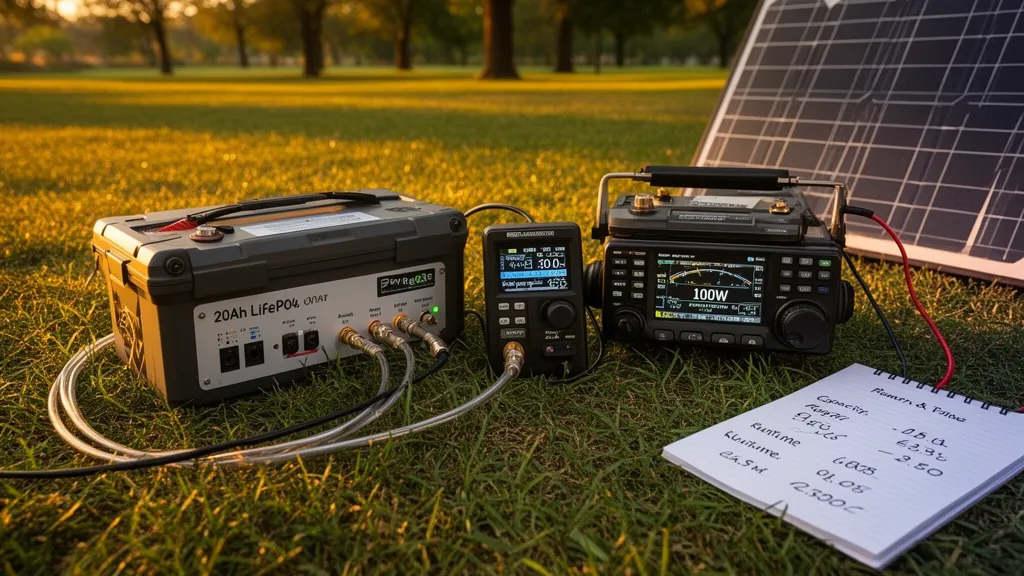
Battery choice: LiFePO4 (lithium iron phosphate) is the best choice for portable HF — 40% lighter than AGM, maintains voltage better, lasts 10× longer. A 10 Ah LiFePO4 runs a 100W radio for ~1.5 hours or a 5W QRP rig for 12+ hours. Calculate your actual current draw (not rated specs) for accurate planning.
Battery Chemistry Comparison
| Chemistry | Weight (10Ah) | Cycle Life | Cold Tolerance | Cost (10Ah) |
|---|---|---|---|---|
| AGM (sealed lead acid) | ~3.5 kg | 300–500 | Poor (-20% at 0°C) | $30–50 |
| LiFePO4 | ~1.3 kg | 2,000+ | Moderate (-20% at 0°C) | $80–180 |
| LiPo (lithium polymer) | ~0.7 kg | 300–500 | Poor (no charging < 0°C) | $40–80 |
| Li-Ion (18650 cells) | ~0.8 kg | 500–1,000 | Poor (no charging < 0°C) | $50–100 |
Recommendation for POTA/SOTA: LiFePO4 for capacity above 10 Ah. USB-C power banks (effectively Li-Ion) for QRP rigs under 15 watts.
Pro Tip: Before heading out for a POTA activation, check the best bands now to know which bands are open — there is no point carrying a 100W radio and a heavy battery if 10m is dead and a 5W QRP rig on 20m will do the job with a fraction of the power budget. To put numbers on that trade-off, the POTA power budget calculator computes required Ah and runtime for your exact radio and mode.
Calculating Your Power Budget
Step 1: Measure actual radio current draw
Radio specifications list maximum current (100W transceiver = “22A maximum”). This is useless for power planning. Measure actual draw:
- Receive (RX): Varies by audio volume and DSP load. Typical: 0.5A (QRP rig) to 2.5A (100W transceiver)
- Transmit at full power: Measure with ammeter or use radio’s built-in power/SWR meter
- Transmit at typical operating power: Many operators run 50–80% of rated power
Step 2: Estimate duty cycle
| Mode | Typical TX Duty Cycle |
|---|---|
| SSB voice | 25–35% |
| FT8 | 45–55% |
| CW | 35–45% |
| FM | 60–70% |
Step 3: Calculate average current
Average current = (TX current × TX duty) + (RX current × (1 − TX duty))
Example — 100W transceiver on SSB:
- TX at full power: 22A, RX: 2.2A, duty cycle: 30%
- Average: (22 × 0.30) + (2.2 × 0.70) = 6.6 + 1.54 = 8.1A average
- 10 Ah LiFePO4 ÷ 8.1A = 1.23 hours runtime
Example — 5W QRP rig on FT8:
- TX: 1.8A, RX: 0.4A, duty cycle: 50%
- Average: (1.8 × 0.50) + (0.4 × 0.50) = 0.9 + 0.2 = 1.1A average
- 10 Ah LiFePO4 ÷ 1.1A = 9 hours runtime
Recommended Battery Systems
Each profile below links to a full buying guide with current picks — this hub owns the how to choose, those posts own the what to buy:
POTA casual (drive-up, 1–3 hours):
- 10–12 Ah LiFePO4 (Bioenno, Dakota Lithium, or LiTime — the three brands compared, including the BMS discharge limits that decide which can run your radio)
- Weight: ~1.3–1.5 kg, sufficient for 100W SSB for 1 hour or QRP all day
POTA serious (multiple bands, long activation):
- 15–20 Ah LiFePO4 — sizes and tiered picks in the LiFePO4 buying guide; radio-specific runtime tables for the IC-705, FT-891, and X6100 in the per-radio battery guide
- Weight: ~2–2.3 kg, runs 100W SSB for 2–5 hours depending on cadence
SOTA (hike-in):
- USB-C power bank 30,000 mAh at 20V (for IC-705, KX2, G90 via USB-C PD) — weight 600g
- Or: Bioenno 5 Ah LiFePO4 (700g) for longer operations or radios without USB-C input
Field Day / camp infrastructure:
- A power station for the laptop, lights, and recharging — with the 12V-port limits every ham should know before buying: power stations for ham radio
- Standardize every connection on Anderson Powerpoles: the field power setup guide
Charging in the Field
A 10W foldable solar panel produces approximately 0.7–0.8A at 12–14V in full sun. This offsets consumption if your average draw is under 0.7A (QRP operation). For 100W operation, solar charging during an activation is impractical — the panel would need to be 100W+ to keep up.
For multi-day portable operations (camping activations), a 30–50W foldable panel with a LiFePO4-compatible solar charge controller handles top-off charging overnight.
The most reliable field approach: charge the battery fully at home the night before. Calculate your activation duration and confirm the battery has adequate capacity with 20% margin.
Frequently Asked Questions
How long will a 10 Ah battery last for POTA operation?
A 10 Ah (amp-hour) 12V battery stores 120 Wh of energy. A 100-watt transceiver drawing 20A on transmit and 2A on receive will consume: (20A × 30% transmit duty cycle) + (2A × 70% receive) = 7.4A average. Runtime: 10 Ah ÷ 7.4A = approximately 1.35 hours. A 5-watt QRP rig drawing 2A TX and 0.3A RX consumes about 0.8A average, giving 10 Ah ÷ 0.8A = approximately 12.5 hours.
Is LiFePO4 worth the extra cost over AGM batteries?
For portable operation, yes. LiFePO4 (lithium iron phosphate) batteries weigh approximately 40% less than equivalent AGM (sealed lead acid) batteries, maintain voltage more consistently through the discharge cycle (AGM voltage sags under load), and tolerate 2,000+ charge cycles versus 300–500 for AGM. The higher upfront cost ($80–$200 for a 10Ah LiFePO4 vs $30–$50 for AGM) is recovered over 5–10 years of field use. For hike-in activations, the weight savings are critical.
Can I use a USB power bank for portable HF?
Yes, for QRP rigs with USB-C power delivery or 12V barrel jack input. Many modern QRP transceivers (KX2, IC-705, X5105) accept 12–13.6V. A high-capacity USB-C power bank (20,000–30,000 mAh at 20V) through a PD trigger cable converts to 12V, providing 3–5 hours of QRP operation at 5–10 watts. Not suitable for 100-watt operation — the current draw exceeds USB-C PD specifications.
How do I calculate power budget for a POTA activation?
Step 1: Find your radio’s actual current draw (not rated maximum). Measure with an ammeter or check manufacturer specifications. Step 2: Estimate duty cycle (SSB voice: ~30% TX; FT8: ~50% TX; CW: ~40% TX). Step 3: Average current = (TX current × TX duty%) + (RX current × RX duty%). Step 4: Runtime = battery Ah ÷ average current. Add 20% margin for battery efficiency losses and temperature effects.
What happens to battery capacity in cold weather?
LiFePO4 capacity decreases in cold: at 0°C (32°F), effective capacity is approximately 80% of rated. At -20°C (-4°F), capacity drops to 50–60%. AGM (sealed lead acid) is worse: 50% capacity at 0°C. Standard lithium-ion (including LiPo) cannot be safely charged below 0°C. For winter SOTA activations, carry the battery inside your jacket until ready to use, and keep it insulated during operation. Operating time in cold weather is significantly shorter than published specs suggest.