This article contains affiliate links. If you buy through them we may earn a commission at no extra cost to you. All specifications below come from the manufacturers’ published data — we have not bench-tested these packs.
Operator’s Verdict: The spec that decides this comparison is not capacity — it’s the BMS discharge limit. Bioenno’s 12Ah pack allows 20A continuous (40A pulse) and is the only one of the three that belongs anywhere near a higher-power radio. Dakota Lithium (10A limit) and LiTime (12A limit) are QRP and 20W-class batteries: excellent for an IC-705 or G90, wrong for an FT-891. Buy by your radio’s transmit current first, warranty and weight second.
The Spec Table That Matters
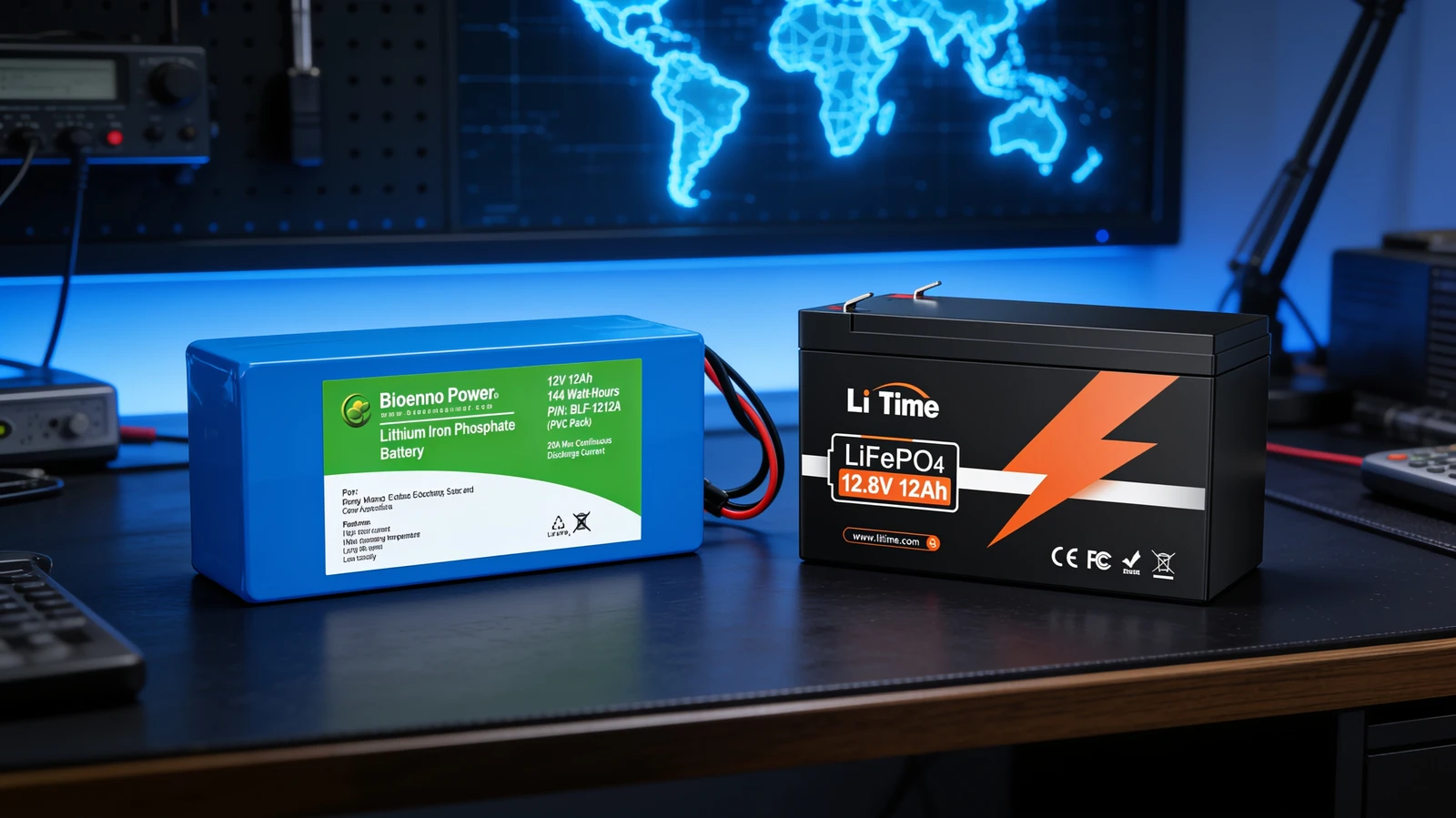
Three popular LiFePO4 packs in the 10–12Ah “activation size,” from each maker’s published specifications:
| Spec | Bioenno BLF-1212A | Dakota Lithium 12V 10Ah | LiTime 12V 12Ah |
|---|---|---|---|
| Capacity | 12 Ah | 10 Ah | 12 Ah |
| Continuous discharge (BMS) | 20 A (40 A pulse) | ≤10 A | 12 A |
| Weight | 3.3 lb (1.5 kg) | 2.77 lb (1.25 kg) | 3.42 lb (1.55 kg) |
| Cycle life (claimed) | ~2,000 | 2,000+ @ 80% DoD | 4,000+ @ 100% DoD |
| Warranty | 2 years | 11 years | 5 years |
| Typical channel | Ham dealers, Amazon | Direct + dealers | Amazon, direct |
Sources: Bioenno, Dakota Lithium, and LiTime product pages, plus Powerwerx’s Bioenno listing for weight and warranty. Cycle-life numbers are manufacturer claims, not independent measurements.
Why the BMS Limit Decides It
Every LiFePO4 pack has a battery management system that cuts output when current exceeds its rating. Match that rating against real transmit draws (manufacturer specs, the same numbers our power budget calculator uses):
| Radio | Max TX draw | Bioenno (20 A) | Dakota (10 A) | LiTime (12 A) |
|---|---|---|---|---|
| Icom IC-705 (10 W) | 3 A | ✅ | ✅ | ✅ |
| Elecraft KX2 (10 W) | 2 A | ✅ | ✅ | ✅ |
| Xiegu G90 (20 W) | 8 A | ✅ | ⚠️ marginal | ✅ |
| Yaesu FT-891 (100 W) | 23 A | ⚠️ over continuous rating | ❌ BMS will trip | ❌ BMS will trip |
The G90 row deserves a note: its 8A maximum sits close enough to Dakota’s 10A ceiling that voice peaks plus any accessory load leave little headroom. It will usually work; it is not comfortable.
The FT-891 row is the one that surprises people. None of these activation-size packs officially supports a 100W radio. Bioenno’s 40A pulse rating rides through SSB voice peaks better than the others, but 23A key-down FT8 at 100W exceeds its 20A continuous spec. If you run 100W in the field, size up to a 15–30Ah pack and check that its BMS continuous rating comfortably exceeds your radio’s maximum transmit current — our LiFePO4 buying guide covers the larger sizes.
Pro Tip: Before assuming you need 100W (and the bigger battery it demands), check current band conditions. When the high bands are open, a 10W radio works the same DX on a pack one-third the size — and the power budget calculator will show you exactly how many amp-hours you save.
Brand by Brand
Bioenno: the ham radio default
Bioenno is the brand you will see at POTA activations and Field Day sites, and the spec table shows why: it is the only maker in this class that builds its BMS for transmitter loads. The 20A continuous / 40A pulse rating on a 12Ah pack means SSB voice peaks from mid-power radios do not trip the protection. The trade-offs are the shortest warranty of the three (2 years) and the highest street price. If your radio draws more than about 10A on transmit, this is the safe choice in this size class.
Dakota Lithium: the warranty play
Dakota’s 11-year warranty is the longest in the industry, and at 2.77 lb its 10Ah pack is the lightest here — attractive for SOTA hikes. The 10A continuous limit is the catch: fine for a 3A IC-705 with margin to spare, tight for a G90, a non-starter for anything bigger. Dakota sells primarily direct and through outdoor retailers (find it on Amazon — stock moves between sellers). Buy it as a QRP battery you intend to keep for a decade.
LiTime: the budget volume seller
LiTime moves enormous volume on Amazon and typically undercuts both rivals on price. The claimed 4,000-cycle life at full depth of discharge is the most aggressive figure of the three — treat it as a marketing ceiling, not a promise, but even half of it outlasts most radios. The 12A BMS handles QRP and 20W radios cleanly. If you are outfitting a first POTA kit around an IC-705, X6100, or G90 and watching the budget, this is the value pick.
Where to Buy
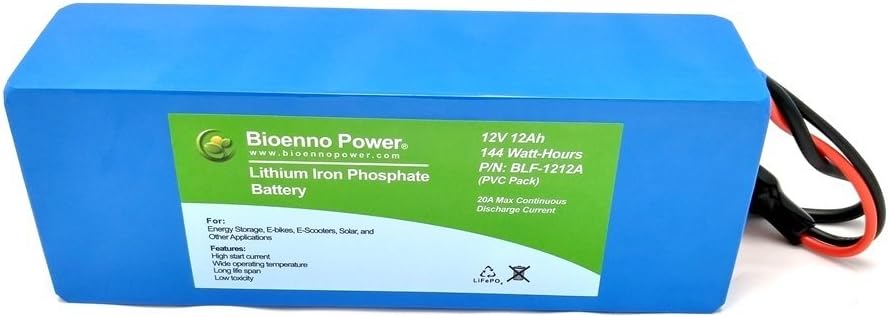
Best for 20W+ radios
Bioenno BLF-1212A 12Ah
The ham-standard pack: 20A continuous / 40A pulse BMS built for transmitter loads.
- 12 Ah
- 20 A BMS
- 3.3 lb
- 2-yr warranty
Amazon: 4.6/5 from 48 reviews. Pair with a LiFePO4-specific charger.
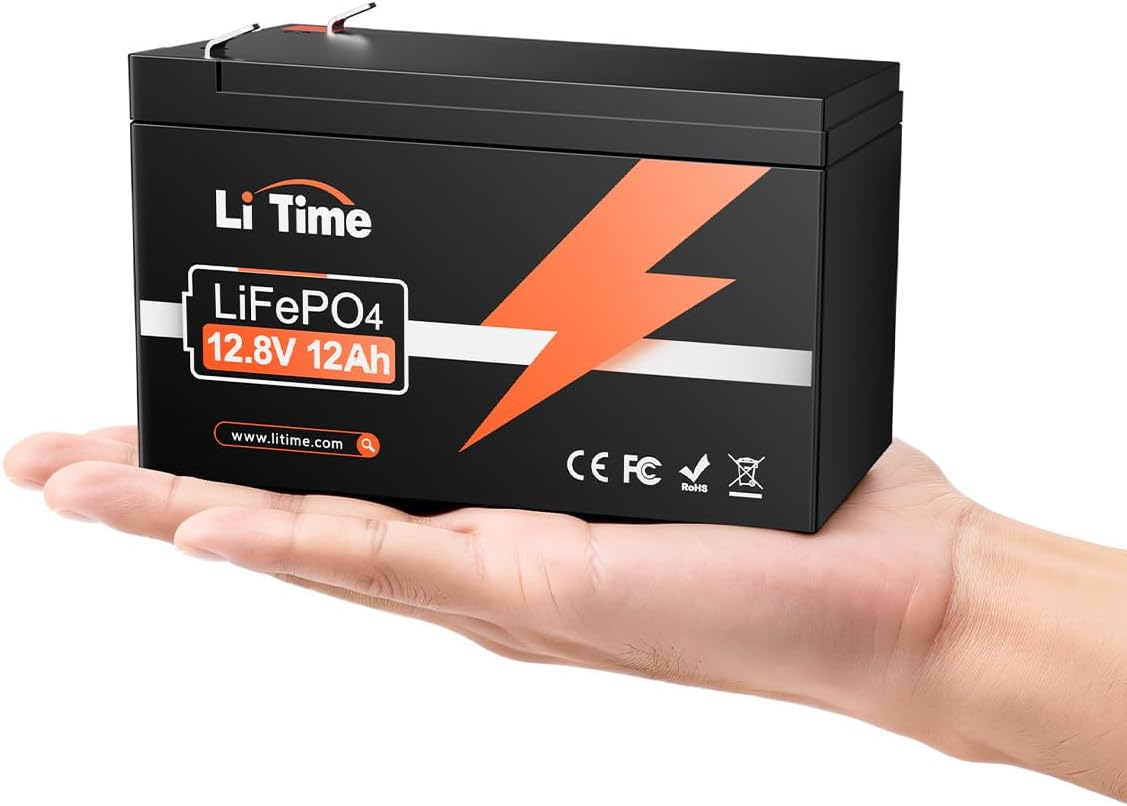
Best QRP value
LiTime 12V 12Ah
Budget 12Ah with a 12A BMS — clean fit for IC-705/X6100/G90 class radios.
- 12 Ah
- 12 A BMS
- 3.42 lb
- 5-yr warranty
Amazon: 4.4/5 from 105 reviews. Not for 100W radios — 12A BMS limit.
Dakota Lithium’s 12V 10Ah sells mostly direct and through outdoor dealers; check current Amazon stock here.
What This Means for Your Radio
Work backwards from your transmit current, not forwards from price:
- Know your draw. Run your radio and mode through the POTA power budget calculator — it uses the same manufacturer specs cited here and adds runtime and required-Ah math.
- BMS continuous rating ≥ your radio’s max TX draw, with headroom. A pack that cuts out mid-CQ is worse than a heavy one.
- Then optimize. QRP operators can pick on weight and warranty (Dakota), price (LiTime), or resale familiarity (Bioenno) — at 3A draw, all three are overkill in the best way.
Frequently Asked Questions
Which is better for ham radio, Bioenno, Dakota Lithium, or LiTime?
It depends on your radio’s transmit current. Bioenno’s 12Ah pack is rated 20A continuous with 40A pulse, so it handles higher-power radios; Dakota Lithium’s 10Ah caps at 10A continuous and LiTime’s 12Ah at 12A, which suits QRP and 20W-class radios but will trip on a 100W rig. For pure QRP use, all three work and the choice comes down to weight, warranty, and price.
Can a LiTime 12Ah battery run a 100W radio like the FT-891?
No — the LiTime 12V 12Ah has a built-in 12A BMS, and a 100W radio like the FT-891 draws up to 23A on transmit per Yaesu’s spec. The BMS will cut output mid-transmission. For 100W operation, choose a larger pack whose BMS continuous rating comfortably exceeds your radio’s maximum transmit current.
Why is Bioenno more expensive than Dakota Lithium or LiTime?
Bioenno sells into the amateur radio market specifically: its packs carry higher-current BMS boards for transmitter loads (20A continuous on the 12Ah model versus 10–12A for the others) and the brand is the de facto standard at POTA and Field Day sites. Whether that premium is worth it depends on your radio — for a 10W QRP rig, the cheaper packs deliver the same operating day.
How many charge cycles do these batteries actually last?
Published figures: Bioenno states about 2,000 cycles for the BLF-1212A, Dakota Lithium states 2,000+ cycles to 80% capacity, and LiTime claims 4,000+ cycles at 100% depth of discharge. All are manufacturer claims, not independent tests — but even the lowest figure means charging twice a week for well over a decade.