This article contains affiliate links. If you buy through them we may earn a commission at no extra cost to you. We only recommend gear we’d carry to a park ourselves, and we never fake test results — verify current prices and specs before you buy.
Solar is the difference between a two-hour activation and an all-day one. But most “solar for ham radio” advice sells you a bigger panel when the number that actually decides whether you stay on the air is your radio’s current draw. This guide sizes a POTA solar setup the right way round — from the load back to the panel — and picks the gear for each way of doing it.
Operator’s Verdict: For QRP POTA (5–10 W), a 50–100 W folding panel, a lithium MPPT controller, and a small LiFePO4 battery will run you all day in good sun. For a 100 W station, solar extends runtime rather than replacing the battery — size the battery to carry the whole activation and let the panel slow the drain. The one rule that matters: the panel must out-produce your radio’s receive current, or you’re just draining slower.
Quick Picks
| Need | Pick | ~Price | Why |
|---|---|---|---|
| 🥇 Easiest, no wiring | EcoFlow River 3 power station | ~$200–260 | Battery, controller, and outputs in one box |
| 🔋 QRP panel + controller route | 100 W folding panel + Victron MPPT | ~$150–260 | Lighter per usable watt-hour, clean 12 V DC |
| 🎒 Ultralight for SOTA | PowerFilm LightSaver Max | ~$250–350 | Rollable, shade-tolerant, packs tiny |
| ⚙️ The controller that won’t cook your battery | Victron SmartSolar MPPT 75/10 | ~$70–90 | True MPPT with a LiFePO4 charge profile |
🥇 Easiest — All-in-One
EcoFlow River 3
A compact LiFePO4 power station with the battery, charge controller, and outputs already integrated. Pair it with any folding panel via the solar input and you have a grab-and-go POTA power plant with no wiring to get wrong. Run the radio from the 12 V car socket, not the AC inverter, to skip conversion losses.
- LiFePO4
- Solar input
- No wiring
Great for casual drive-up activations. Heavier per usable watt-hour than a bare battery.
🔋 Best QRP Panel
100 W Folding Solar Panel
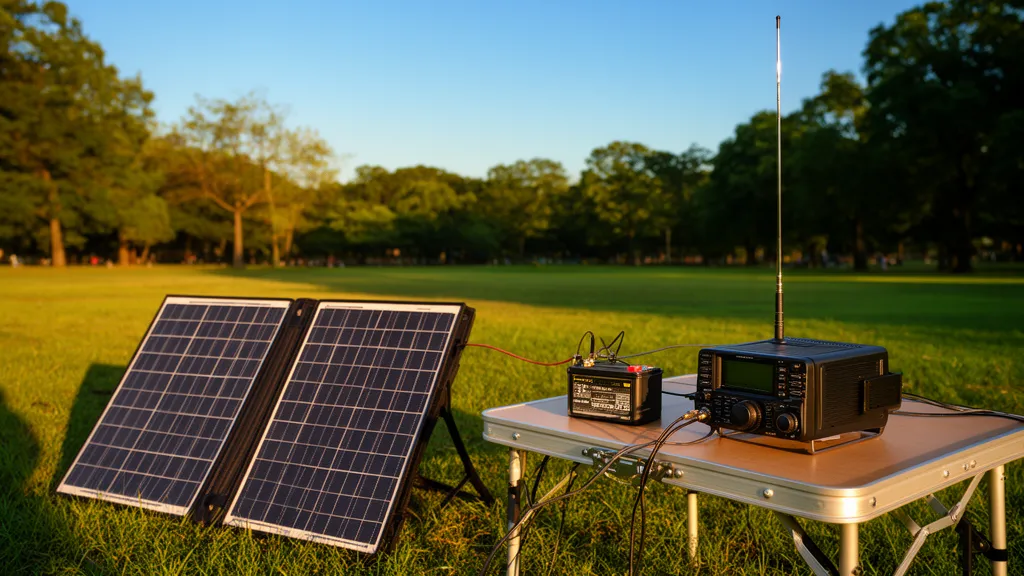
The workhorse of field solar: a foldable 100 W crystalline panel with an integrated stand and common connectors. Enough to keep a 6–20 Ah LiFePO4 topped up for a 5–10 W station through a full day of sun, and light enough to strap to a pack.
- 100 W
- Foldable
- Kickstand
Pair with an MPPT controller and a LiFePO4 battery — not the panel straight to the radio.
🎒 Ultralight / SOTA
PowerFilm LightSaver Max
A rollable thin-film panel with a built-in battery, designed for exactly the shade, cloud, and low-angle sun you get under trees and on ridgelines. Amorphous cells tolerate imperfect placement far better than rigid glass panels — the tradeoff is more area for the same watts.
- Rollable
- Thin-film
- Built-in cell
The pick when grams and pack size beat maximum output-per-dollar.
⚙️ Best MPPT Controller
Victron SmartSolar MPPT 75/10
A true MPPT controller with a proper LiFePO4 charge profile and Bluetooth monitoring, so you can watch charge current from your phone in the field. This is the part that protects the battery and squeezes the extra 10–15% of panel power a PWM controller throws away.
- MPPT
- LiFePO4 profile
- Bluetooth
The Genasun GV-10L for 4S LiFePO4 is the other ham favorite, sold mostly direct.
Does solar actually keep a POTA station on the air?
Yes for QRP, mostly-yes for 100 W — but only if the panel out-produces what your radio draws while listening. A solar-powered field station is a battery station with a trickle of recharge; the goal is to build a system where the panel and controller can make more current in daylight than the radio consumes sitting in receive, so the battery holds or gains charge while you operate (PowerFilm Solar).
That framing matters because a radio spends most of an activation receiving, not transmitting. If your rig draws 1 A on receive and your panel is delivering 3 A in good sun, you are net-charging the whole time you’re calling CQ and listening — you can operate indefinitely. If the same panel only delivers 0.5 A because it’s cloudy or badly angled, you’re draining slower, not charging. Everything downstream — panel size, battery size, how long you last — flows from that one comparison.
One widely reported field configuration makes it concrete: a 100 W panel, a 20 Ah LiFePO4 battery, and a lithium MPPT controller lets a 5 W station “operate indefinitely” in sunshine, because the panel comfortably beats the tiny receive draw of a QRP rig (Off Grid Ham and multiple operator reports). Scale the radio up and that margin shrinks.
The number that matters isn’t panel watts — it’s your radio’s current draw
Before you buy a single panel, find out how much current your radio draws — on receive and transmit — because two radios with the same 100 W output can load your battery completely differently. PowerFilm Solar measured the point bluntly: two stations both putting out 100 W of RF can draw 12–13 A on transmit for one radio versus 20 A or more for another. Same output, nearly double the load.
Receive current is the sleeper. A modern QRP rig like the Icom IC-705 pulls only a few hundred milliamps on receive; many traditional 100 W radios draw 1–3 A before you ever key up (PowerFilm). Over a full day that gap dominates your energy budget:
| Radio class | Typical RX draw | Approx. Ah used just listening over 12 h |
|---|---|---|
| QRP (IC-705 class) | ~0.3–0.5 A | ~4–6 Ah |
| Efficient 100 W (IC-7300 class) | ~1.0–1.5 A | ~12–18 Ah |
| Older / less efficient 100 W | ~2–3 A | ~24–36 Ah |
(RX-only estimates at ~12.8 V, before any transmit current, computer, or display. Real numbers vary — measure yours.)
The practical rule: an efficient radio is worth more than a bigger panel. Dropping receive draw from 1.5 A to 0.5 A saves you more energy over a day than most people gain by upsizing their solar (PowerFilm). Measure your radio’s receive current with an inline meter and build the power system around that figure — not around the transmit spec on the box.
Power station vs panel + battery + controller
There are two honest ways to power a POTA station from the sun, and the right one depends on how much you carry and how much you tinker.
A portable power station (EcoFlow, Jackery, Bluetti and the like) puts the battery, charge controller, and outputs in one sealed box. You plug a folding panel into the solar input and you’re done — no fuses, no Powerpole wiring, nothing to miswire in a parking lot. The cost is weight and repairability: you carry the inverter and case whether you use them or not, and if something fails in the field you can’t fix it. Run your radio from the 12 V DC output, never the AC inverter, or you’ll waste power converting 12 V up to 120 V and back down.
The separate-components route — a bare LiFePO4 battery, a small MPPT controller, and a folding panel — is what most dedicated QRP and SOTA operators run. It’s lighter for the same usable capacity, every part is replaceable, and the radio runs from clean 12 V DC through a Powerpole distribution block. The tradeoff is that you have to size and wire it yourself: battery, controller, fuses, and connectors all rated for the current your station actually draws (PowerFilm). This guide’s picks cover both routes; pick by your tolerance for wiring.
Pro Tip: Solar only pays off if you’re on the right band while the sun is up. Before you set up, check DXRadar’s best bands now to see which bands have live PSKReporter activity from your region — there’s no point running a 100 W SSB battery-burner on a dead band when 40m NVIS or 20m is doing the work. If the bands look flat, the solar weather dashboard will tell you whether SFI or Kp is the reason. And to know whether a panel can sustain your setup at all, run it through the POTA power budget calculator — it computes your average draw and the panel wattage that keeps up.
Choosing the panel: folding vs rollable, and how many watts
Match the panel to your mission, not to a wattage number. For POTA, the two formats that matter are foldable crystalline panels and rollable thin-film (amorphous) panels, and they trade off cleanly (PowerFilm Solar):
- Foldable crystalline (100–200 W): more output from a smaller deployed area, an integrated kickstand, and the best watts-per-dollar. Heavier and less tolerant of shade and low sun. The default for drive-up POTA and Field Day.
- Rollable thin-film / amorphous: flexible, durable, and far more tolerant of partial shade, cloud, and imperfect angles — but needs more surface area for the same watts. The pick for SOTA hikers and anyone operating under tree cover where placement is never ideal.
On wattage: for a QRP station, 50–100 W is plenty to net-charge through the day. For a 100 W station, 100–200 W extends your runtime meaningfully but often won’t fully keep up with transmit draw in real time — the battery still carries the activation, and the panel just slows the drain. Bigger isn’t automatically better, either: a panel you can deploy fast and reposition as the sun moves beats a higher-output panel that’s too bulky to bother re-aiming.
The charge controller: MPPT, and why LiFePO4 needs its own profile
The charge controller sits between the panel and the battery, and for field radio it must be MPPT with a lithium charge profile — this is not the place to save $20. An MPPT (Maximum Power Point Tracking) controller converts the panel’s varying voltage to the battery’s charging voltage efficiently, delivering 95%+ of available power; a cheaper PWM controller tops out around 80–85% and simply wastes the rest (Off Grid Ham).
The bigger risk is chemistry. A LiFePO4 battery needs a controller set for lithium iron phosphate — its constant-current/constant-voltage charging logic is different from lead-acid, and a lead-acid controller should not be treated as interchangeable (PowerFilm). Get this wrong and you either never fully charge the pack or you stress it. The Victron SmartSolar picks above ship with a selectable LiFePO4 profile; the Genasun GV-10L is purpose-built for 4S LiFePO4 and is the other community favorite. Whatever you choose, confirm it’s a lithium-capable MPPT before it touches your battery.
Sizing it: two worked examples
Size from the load back, and add margin for cloud and long operating hours. These are planning heuristics, not measurements — verify against your own gear.
QRP day activation (5–10 W). Radio draws ~0.4 A RX, ~2 A on transmit. A 20 Ah LiFePO4 alone would run it most of a day; add a 100 W folding panel and a lithium MPPT and you net-charge in sun, turning “most of a day” into “as long as you want to sit there.” Total pack weight is a few kilograms. This is the setup that “runs indefinitely” in the field reports.
100 W SSB/digital activation. Radio draws ~1.2 A RX, ~20 A on transmit. Here solar is a runtime extender: a 100–200 W panel can offset the receive draw and part of a light transmit duty cycle, but on SSB peaks or long digital overs the battery supplies the difference. Size the LiFePO4 to carry the entire planned activation on its own — see our best LiFePO4 battery for ham radio guide for capacities — and treat every solar amp as bonus endurance rather than the foundation.
Who should skip solar
If your activations are short and you drive to the park, a single well-sized LiFePO4 battery is simpler, lighter, and cheaper than adding panels you’ll deploy for 90 minutes. Solar earns its weight on long activations, multi-hour Field Day operating, off-grid camping, and emergency communications where recharge matters. And if you operate mostly under heavy tree cover or in poor weather, be honest that output will be a fraction of the panel’s rating — size the battery to stand alone and let solar contribute what it can.
Pair whatever you build with the right radio and antenna — see our best portable HF radio for POTA and SOTA and best portable HF antenna for POTA guides — and read up on the field battery that ties it all together. For more field-operating guides, browse the POTA & field operations hub; then check what’s open before you set up.
Frequently Asked Questions
How many watts of solar do I need for POTA?
For a QRP station (5–10 W) a single 50–100 W folding panel is usually enough to keep a small LiFePO4 battery topped up and operate all day. For a 100 W SSB or digital station, a 100–200 W panel extends your runtime substantially but often will not fully keep up with transmit draw in real time — the battery still does the heavy lifting, and the panel slows how fast it drains.
Do I need an MPPT charge controller or is PWM fine?
Use MPPT for field radio. An MPPT (Maximum Power Point Tracking) controller typically delivers 95%+ of the panel’s available power, while a PWM controller tops out around 80–85% (Off Grid Ham). More importantly, the controller must use a lithium (LiFePO4) charge profile, not a lead-acid one — the charging logic is different and the wrong profile will undercharge or stress the battery.
Can a solar panel run my radio directly without a battery?
No — not reliably. Running a radio straight off a panel works only in perfect sun, and the moment a cloud passes the panel’s output can drop below what the station draws and the radio shuts off (PowerFilm). Always charge a LiFePO4 battery from the panel and run the radio from the battery. The battery is the station’s power source; the panel just recharges it.
Is a portable power station or a panel-plus-battery setup better for POTA?
A power station (all-in-one battery, controller, and outputs) is the easiest, no-wiring option and is great for casual drive-up activations. A separate LiFePO4 battery, MPPT controller, and folding panel is lighter for the same usable capacity, repairable in the field, and runs your radio from clean 12 V DC without an inverter — the choice most dedicated QRP and SOTA operators make.
What size battery should I pair with a solar panel for POTA?
For QRP, a 6–20 Ah LiFePO4 paired with a 50–100 W panel will run all day in decent sun. One widely reported field setup — a 100 W panel, a 20 Ah LiFePO4, and a lithium MPPT controller — lets a 5 W station operate essentially indefinitely in sunlight. For a full battery buying guide, see our dedicated LiFePO4 article rather than sizing it by guesswork.
Does solar work for a POTA activation on a cloudy day?
Partially. Output drops sharply under heavy cloud, so treat solar as runtime extension, not a guarantee, in poor weather. Thin-film (amorphous) panels tolerate cloud, shade, and low sun angles better than rigid crystalline panels, but produce less per unit area (PowerFilm). Size the battery to carry the station on its own, and let the panel add whatever it can.