This article contains affiliate links. If you buy through them we may earn a commission at no extra cost to you.
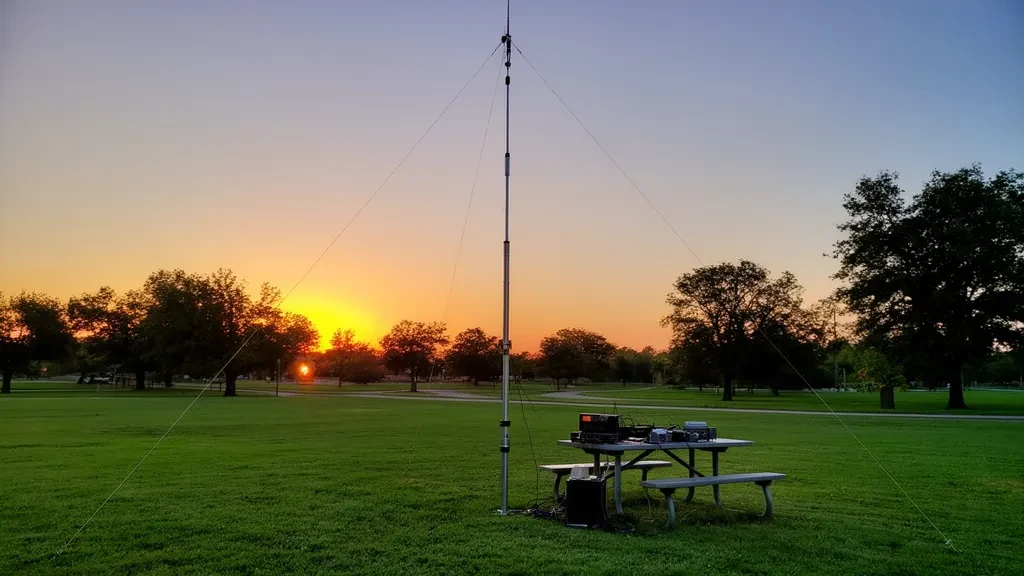
Operator’s Verdict: Before you buy watts, buy height: raising a wire antenna’s feedpoint from 8 ft to 25 ft transforms its takeoff angle and noise pickup for well under $100 — the best dB-per-dollar purchase in field radio. A ~30 ft telescoping fiberglass mast covers nearly every POTA antenna; a $25 crappie pole covers the ultralight QRP case. Guy anything over 20 ft, and tape the joints.
Why Height Is the Upgrade
Antenna height sets the takeoff angle — the elevation your signal leaves at — and for wire antennas at typical portable heights, every added foot lowers that angle toward DX-useful territory (the physics is in the ARRL Antenna Book and our propagation primer). Just as practically: height gets your wire out of the ground-level noise and brush. An EFHW at 10 ft and the same EFHW at 25 ft are different antennas on the air.
The mast is what makes that repeatable at parks with no convenient trees — deserts, prairies, beaches, and every picnic-area activation where the one tree is occupied.
What Each Height Class Does
| Mast class | Typical use | Notes |
|---|---|---|
| 5–7 m fishing pole (~17–23 ft) | QRP wire verticals, end-feds | Featherweight, strap-to-pack; flexible tip supports wire only |
| ~30 ft (9–10 m) telescoping fiberglass | EFHW apex, inverted-V center, 40m ¼-wave wire vertical | The all-rounder; guy it |
| 40 ft+ heavy fiberglass | Low-band wires, Field Day | Premium territory (Spiderbeam class, mostly sold direct); real guying required |
The Failure Modes (Learn Them Cheap)
- Section slippage — the classic. Telescoping sections slowly collapse under wire tension. Fix: a wrap of electrical tape or a hose clamp at each joint after extending.
- Unguyed in wind — fiberglass bends gracefully right up until it doesn’t. Three guys at ~120°, one level minimum above 20 ft, staked wide.
- Feedpoint weight at the tip — the top sections are wire-support thin. Put transformers and coax weight at the bottom of the run (an EFHW’s 49:1 sits near the ground for a sloper) or on a lower, thicker section.
- Power lines. Never anywhere near them — a fiberglass mast is non-conductive but the wire you’re hoisting isn’t. Look up before you extend, every time.
Pro Tip: Mast height matters most exactly when propagation is marginal — a lower takeoff angle squeezes workable DX out of mediocre conditions. Check today’s band conditions before setup: on a wide-open day, even a bush-height wire makes contacts; on a middling day, the mast earns its carry weight.
The Picks
The POTA all-rounder
Mifoci 30 ft Telescoping Fiberglass Mast
~30 ft of RF-transparent support that collapses to pack-friendly length — EFHW apexes, inverted-V centers, and wire verticals covered.
- ~30 ft extended
- Fiberglass
- Telescoping
Add tape wraps at joints + a 3-line guy kit.
Ultralight budget route
5–7 m Telescopic Crappie Pole
The QRP community's favorite trick: a ~23 ft fishing pole that weighs nothing, costs little, and hoists a wire vertical or end-fed anywhere.
- ~17–23 ft
- Ultralight
- Wire only
Support the wire, not the feedpoint hardware.
Complete the kit: guy line and stakes, a drive-on mast mount if you activate from the car (options), and the antenna itself — our POTA antenna guide pairs wire and support choices.
Frequently Asked Questions
How tall a mast do I need for POTA?
For wire antennas, 20–33 ft covers most needs: an EFHW or dipole fed at 20+ ft works regional and DX paths well, and 33 ft (10 m) supports a quarter-wave 40m wire vertical. Taller helps low bands most; on 20m and up, getting the wire clear of ground clutter matters more than the last few feet.
Why fiberglass instead of aluminum for antenna masts?
Fiberglass is RF-transparent and non-conductive — the antenna wire can run right along or over it without detuning, and it doesn’t become part of the antenna. Aluminum masts are stronger per pound but interact with the antenna and add conducted-safety concerns. For wire supports, fiberglass is the ham default.
Do telescoping masts need guying?
Above roughly 20 ft, or in any real wind, yes — three guy lines at one or two levels, staked at about 120°. A collapsed or snapped mast mid-activation is the classic result of skipping it. Many operators also add a tape or clamp wrap at each section joint, because slow section slippage is the most common telescoping-mast failure.
Can I use a crappie fishing pole as an antenna mast?
Yes — 5–7 m telescopic fishing poles are a beloved budget support for QRP wire verticals and end-feds, light enough to strap to a pack. Their limits are tip flexibility (support the wire, not a feedpoint box) and height. For 33 ft and coax-supporting duty, buy a purpose-made mast.