Operator's Verdict: Lower atmospheric noise on 40m and 80m, better nighttime DX on low bands. Trade-off: shorter 10m/15m windows. 20m remains the anchor band. Check SFI and Kp on DXRadar the morning before — a geomagnetic storm during the January event is more likely to kill the high bands than in summer.
January Propagation: What Changes
The last weekend of January presents a distinct propagation environment compared to ARRL Field Day in June. Understanding these differences directly informs band strategy.
Lower bands are better in winter:
| Band | Summer FD | Winter FD |
|---|---|---|
| 160m | Marginal (high noise) | Good (lower QRN) |
| 80m | Moderate (noise) | Excellent (low noise, better DX) |
| 40m | Good but noisy | Very good (low noise) |
| 20m | Excellent | Excellent |
| 15m | Good (long windows) | Moderate (shorter window) |
| 10m | Excellent (Es + F2) | Moderate (SFI-dependent, short window) |
| 6m | Wild card (Es season!) | Mostly closed |
Summer's tropical QRN (atmospheric noise from thunderstorm activity) severely degrades 40m and 80m. In January, this noise source is absent across North America and Europe, revealing these bands in their best state.
Pro Tip: Before heading out for Winter Field Day, check DXRadar's best bands now to see which bands are open in real time — winter band selection is less forgiving than summer, and knowing whether 10m or 15m has any chance saves you from wasting daylight hours on the wrong antenna.
Hour-by-Hour January Band Strategy
Contest start is typically Saturday at 19:00 UTC (or 2:00 PM Eastern US time).
| UTC Time | Priority | Notes |
|---|---|---|
| 19:00–21:00 | 20m + 15m | Check 10m if SFI > 130 |
| 21:00–23:00 | 20m | 15m closing; 40m opening |
| 23:00–01:00 | 40m + 20m | European 40m paths open |
| 01:00–06:00 | 40m primary | 80m for CW operators/multipliers |
| 06:00–09:00 | 20m | European sunrise; best path opens |
| 09:00–13:00 | 20m + 15m | 10m if SFI > 120, check 1100–1400 UTC |
| 13:00–19:00 | All bands | Final push; high bands open in Europe |
Cold-Weather Operating Preparation
Battery management: LiFePO4 capacity is approximately 80% of rated at 0°C and 65% at -10°C. Calculate your power budget assuming 75% of rated capacity if temperatures will be below 5°C. Carry the battery inside your tent or vehicle when not actively operating to maintain temperature.
Display issues: LCD transceiver displays respond slowly at temperatures below -5°C — the liquid crystal molecules take seconds to realign after a key press. TFT and LED-backlit displays (Icom IC-7300, Elecraft K3) handle cold better than older CCFL-backlit displays.
Coaxial cable: Standard RG-8X becomes very stiff at -15°C. LMR-240 UF (ultra-flex) or RG-8X with foam dielectric maintains more flexibility in cold.
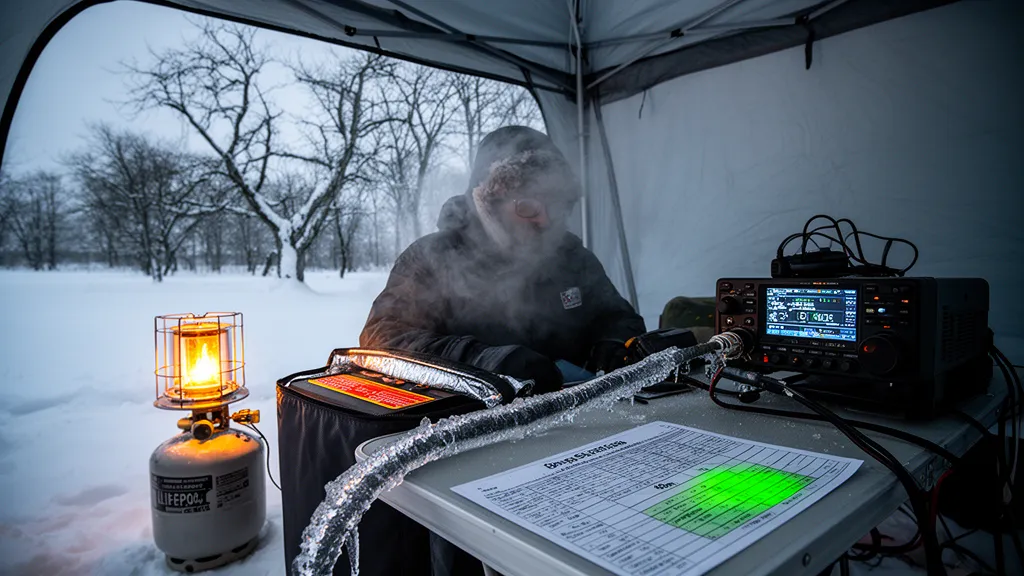
Operating tent: A 10×10 canopy tent with attached sidewalls provides wind protection and allows a small propane heater to maintain above-freezing temperatures at the operating table. Verify local contest rules regarding "shelter" (some categories require "genuine outdoor exposure" without heated tents).
Using DXRadar for Winter Field Day
Check DXRadar's solar weather page at three points:
-
Thursday before the event (T-48h): Look at the SFI and Kp trend. Any geomagnetic storm watches? A G2+ storm during January Field Day will significantly affect high-band performance.
-
Saturday morning (T-1h before contest): Current SFI and live Kp. This determines your opening band priority.
-
Sunday morning (T+12h into contest): Live conditions for the final push. If Kp dropped overnight, try 10m and 15m in the 1000–1400 UTC window.
Frequently Asked Questions
How is Winter Field Day different from ARRL Field Day propagation?
Winter Field Day (January) produces significantly different propagation than summer Field Day (June). The advantages in winter: much lower atmospheric noise on 40m and 80m (summer thunderstorms are absent), longer darkness hours for 80m DX, better 160m DX windows, and reduced sporadic-E interference. Disadvantages: shorter daylight means 10m and 15m windows are compressed; solar elevation is lower, reducing F2 ionisation peak intensity. 40m and 80m perform better in winter; 10m, 15m, and 6m perform better in summer.
What bands should I prioritise for Winter Field Day?
For a January contest: 20m is the primary DX band (still reliable 24 hours). 40m is significantly improved over summer — lower noise floor and better overnight DX. 80m is worth adding overnight, especially for CW operators seeking multipliers. 10m and 15m are worth monitoring but are open for shorter windows — check SFI and operate them during the 1000–1500 UTC window when solar elevation is highest. If solar cycle is at maximum (SFI > 130), 10m and 15m are still productive despite shorter winter openings.
How do I keep my equipment working in the cold?
Key cold-weather equipment considerations: (1) LiFePO4 batteries lose 15–25% capacity at 0°C; keep them warm. (2) LCD displays slow dramatically at -10°C; LED-backlit displays handle cold better. (3) Condensation when bringing cold equipment inside — allow 30 minutes for equipment to warm before powering on. (4) Coaxial connectors and SO-239/PL-259 connectors can crack in extreme cold; handle carefully. (5) Feedline flexibility decreases in cold; extra-flexive coax works better. (6) Carry extra batteries — cold drain is substantial.
Is Winter Field Day less popular than ARRL Field Day?
Winter Field Day attracts approximately 1,500–2,500 groups annually versus ARRL Field Day's 35,000+ participants. The smaller field means less competition but also fewer stations to work. High-band contacts in winter FD are particularly valuable due to lower activity levels. The reduced participant count and quieter bands make Winter Field Day an excellent event for less-experienced operators who find ARRL FD's crowded bands intimidating.
Can I use the same equipment for Summer and Winter Field Day?
Yes, with cold-weather preparation. Main adaptations: insulate your battery (carry inside jacket or use a battery insulation bag); bring battery-heated hand warmers for extended operating; use a tent or canopy with side walls to block wind; consider a small propane heater for the operating position (ensure ventilation); keep spare connectors and tools inside your jacket rather than in the equipment box where they will get cold.
A Winter Field Day team that uses propagation data intelligently will consistently outperform teams who ignore solar conditions and stick to a static band schedule regardless of what the ionosphere is doing.