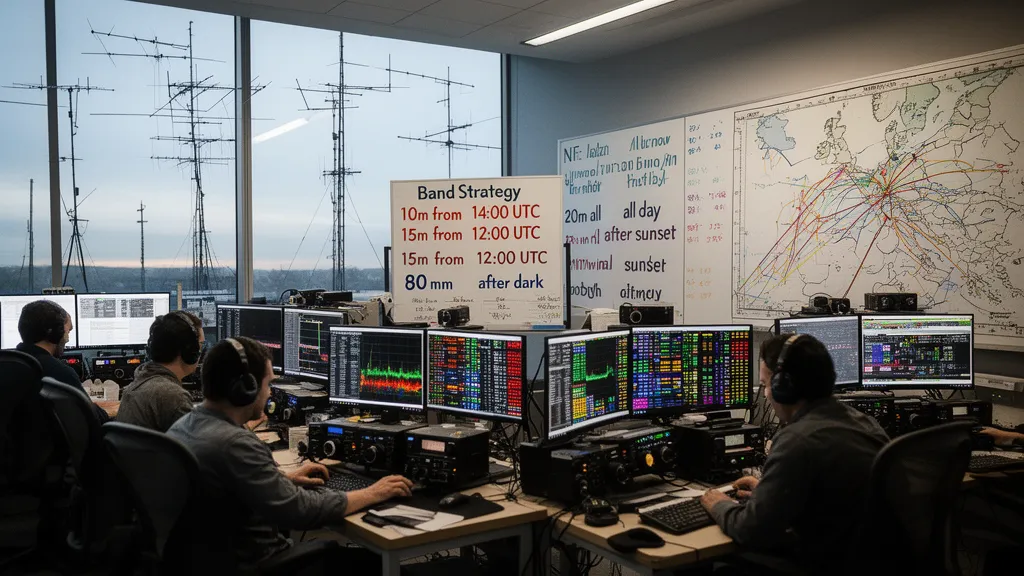
Operator's Verdict: Start on the highest band the solar conditions support. Shift to lower bands as the day progresses and paths close. Use 40m aggressively at night for zones and multipliers. Watch Kp — a storm forces everything to 20m and 40m. Check DXRadar's SFI and Kp before every contest weekend.
Pre-Contest Solar Preparation
The most important contest preparation often has nothing to do with your station or operating skills — it is checking the solar forecast.
Three days before the contest: Check the 3-day SFI forecast on NOAA SWPC. A reliable forecast requires at least 72 hours of solar observations. Solar activity in the 3–5 days preceding the contest typically indicates what to expect during the 48-hour contest period.
Pro Tip: Use DXRadar's best bands now page during the contest to monitor live band scores. If 10m drops from EXCELLENT to FAIR mid-contest, it is time to shift down. Check solar weather for Kp spikes — a sudden G2 storm mid-contest requires an immediate tactical revision to 20m and 40m.
Contest morning: Check current SFI, Kp, and X-ray flux at DXRadar's solar weather page. A Kp spike above 4 or an M/X-class flare in the previous 12 hours requires immediate strategy adjustment.
The Optimal Contest Band Sequence
High Solar Activity (SFI > 140, Kp < 3)
This is the optimum scenario. All bands from 10m through 40m are viable; 80m/160m add nighttime multipliers.
| UTC Time | Primary Band | Secondary Band | Notes |
|---|---|---|---|
| Contest start (14:00 UTC typical) | 10m | 15m | 10m has maximum early multiplier potential |
| 16:00–18:00 | 10m | 15m | Peak 10m propagation window |
| 18:00–20:00 | 15m | 10m (if open) | 10m closing, 15m maturing |
| 20:00–22:00 | 20m | 15m | Transition as European 15m path closes |
| 22:00–00:00 | 20m + 40m | — | 40m opening for zones |
| 00:00–06:00 | 40m | 20m | 40m peak; Asian zones on 40m possible |
| 06:00–08:00 | 20m | 40m | European 20m path opening |
| 08:00–12:00 | 15m + 10m | 20m | High bands opening again |
Moderate Solar Activity (SFI 100–140, Kp < 4)
The most common scenario during the current solar cycle.
- Start on 15m rather than 10m (10m may be marginal at contest start)
- 10m opens 2–3 hours into the contest as the F2 layer develops — be ready to jump up
- 20m is reliable anchor band throughout
- 40m night strategy unchanged
Low Solar Activity / Storm (SFI < 100 or Kp 4+)
- 10m and 15m are unreliable or closed
- 20m becomes the primary DX band for the entire contest
- 40m is the overnight workhorse; may be the best band for the full contest period
- Accept reduced multiplier count; focus on running volume on 20m and 40m
- 80m becomes worthwhile at night for regional multipliers
Rate vs. Multipliers: The Fundamental Tension
Every band-switch decision in a contest is a trade-off between rate (contacts per hour) and multipliers (zones/entities that boost score).
- High bands (10m, 15m) when open: high rate, many unique multipliers available simultaneously
- 20m: medium rate, consistent multipliers throughout the day
- 40m at night: high rate within zone, but fewer new multipliers per hour (same stations from same zones as 20m)
- 80m/160m: low rate, but unique multipliers unavailable on higher bands
The optimal score maximises the product of (contacts × multipliers), not just one dimension. This typically means running high bands aggressively during peak propagation and making strategic short forays to multiplier bands.
How to Use DXRadar During a Contest
- Pre-contest: Check solar weather 24 hours and 1 hour before start. Note SFI, Kp, and any geomagnetic storm watch status.
- Band conditions: The best bands now page shows live band scores. If 10m drops from EXCELLENT to FAIR during the contest, it's time to shift down.
- Storm monitoring: If Kp spikes during the contest, have your lower-band strategy ready. A sudden jump to Kp 5 at contest mid-point requires immediate tactical revision.
- Recovery window: If a storm occurs during the contest and then Kp drops back below 3, watch for post-storm F2 enhancement on 15m and 20m — sometimes the best propagation of the weekend occurs in the 12–24 hours after storm recovery.
Frequently Asked Questions
Which band should I start on at the beginning of a major HF contest?
The optimal starting band depends on current SFI and local time. If SFI > 140 and it's daylight: start on 10m (28 MHz) for maximum rate with the most multipliers available simultaneously. If SFI 100–140: start on 15m (21 MHz) which provides a good combination of activity and path diversity. If SFI < 100 or it's near sunset: start on 20m (14 MHz) which provides the most consistent worldwide coverage regardless of conditions.
When should I move from 20m to 40m during a contest?
Move to 40m for serious operating approximately 1–2 hours after your local sunset, when the 40m DX path opens. For North American operators, European paths open on 40m typically around 2200–0000 UTC; Asian paths open closer to 0600–0900 UTC. Use 40m to collect multipliers and zone contacts that are unavailable on 20m at those hours. Return to 20m around 0700–0800 UTC when European paths open again on the higher band.
How do geomagnetic storms affect contest strategy?
A Kp 4+ storm during a major contest requires a significant strategy shift. 10m and 15m become unreliable on polar-path contacts (Europe-to-Japan via polar cap, USA-to-Europe via high latitudes). Shift resources to 20m and 40m, which are more resilient to geomagnetic disturbances. Accept lower multiplier counts on high bands and focus on running pileups on the more reliable lower bands. Monitor Kp throughout the contest at DXRadar.
Is it better to run or S&P in contests?
Running (calling CQ and working stations that answer you) is more efficient per hour when you can hold a frequency and attract callers. S&P (Search and Pounce — tuning to find and call other stations) is better for multiplier collection and when you cannot hold a frequency due to QRM or weak signal. Most high-scoring operators use running on their primary band to build score while dedicating periodic S&P sweeps on secondary bands for multipliers.
Should I use a second radio in contests?
A second radio (SO2R — Single Operator Two Radio) dramatically increases multiplier collection by allowing you to simultaneously monitor a second band while running on the first. While the first radio runs a pileup on 20m, the second monitors 15m or 10m for band openings. SO2R requires clean station design to avoid RF interference between the two transmitters, and is typically used only by experienced contest operators.