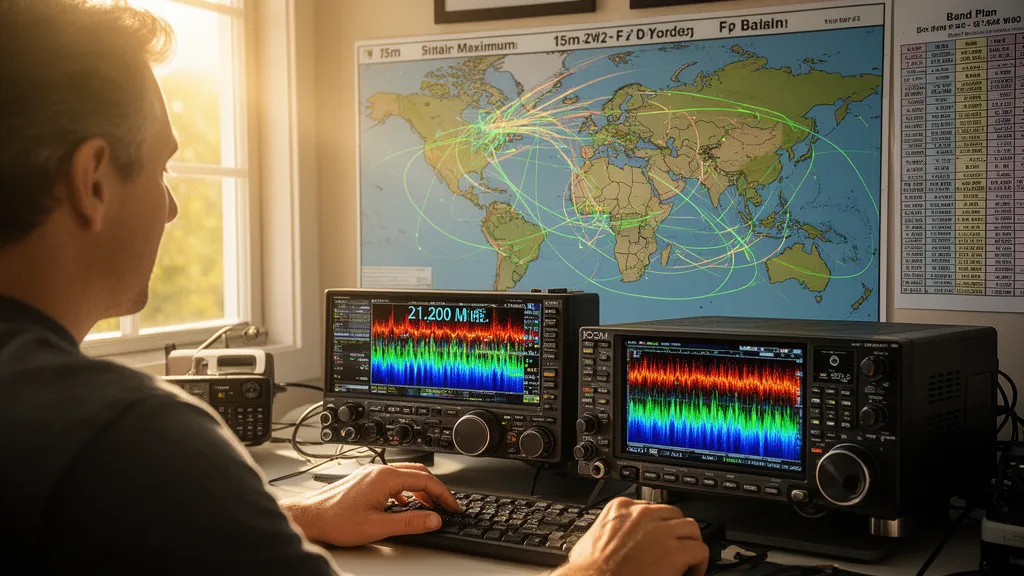
Operator's Verdict: SFI is 105 SFU and Kp is 1.33. Check the live 15m band status for real-time PSKReporter activity. Above SFI 90 with Kp below 4, expect F2 openings on transatlantic and transpacific paths during local daylight hours at the path midpoint.
What Makes 15m the Workhorse DX Band
15m is the band that performs when 10m is too unreliable and 20m is too crowded. At SFI 90–100, when 10m supports only marginal F2 on the best paths, 15m carries solid DX across multiple continents. At SFI 130+, 15m and 10m compete as the premier DX bands, with 15m sometimes outperforming 10m on paths where D-layer absorption is a limiting factor.
The 15m band occupies 21.000 to 21.450 MHz, a 450 kHz allocation. The lower frequency threshold (compared to 10m's 28 MHz) means that for the same F2 electron density, 15m can propagate on paths where 10m cannot. This translates to a practical advantage: 15m opens and closes approximately 45–90 minutes before and after 10m at a given SFI level.
For operators who track the solar cycle, 15m is the band that remains productive across most of the active portion of the solar cycle — from early ascending phase through well into declining phase — whereas 10m is productive only near and at maximum.
15m Band Plan
The ARRL band plan for 15m (ITU Region 2) allocates the band as follows. Operators in Region 1 (Europe/Africa) and Region 3 (Asia/Pacific) should verify local variations:
| Frequency Range | Mode / Use |
|---|---|
| 21.000–21.070 MHz | CW |
| 21.070–21.149 MHz | Narrow-band digital (FT8: 21.074 MHz) |
| 21.150–21.200 MHz | Weak signal / digital / beacons (21.150 MHz IARU beacon) |
| 21.200–21.449 MHz | SSB (phone) |
| 21.285 MHz | SSB calling frequency (primary) |
| 21.340 MHz | SSB secondary calling |
21.074 MHz is the primary FT8 frequency on 15m and is the fastest way to verify whether the band is open. If the FT8 waterfall shows DX paths on multiple continents, F2 is running. The IARU beacon network on 15m (around 21.150 MHz) provides path-specific confirmation of open circuits.
Pro Tip: On 15m, CW occupies only 70 kHz (21.000–21.070 MHz) but contains some of the most productive DX contacts on the band. During a 15m opening at SFI 120+, 21.010–21.040 MHz is often full of DX CW activity. If 21.074 MHz FT8 is saturated, the CW end is a less crowded alternative with immediate QSO completion feedback.
SFI Thresholds and Expected 15m Behaviour
The following thresholds assume a mid-latitude QTH (35°–55°N or S), daylight hours at the path midpoint, and quiet geomagnetic conditions (Kp below 3):
| SFI Level | 15m F2 Condition | What to Expect |
|---|---|---|
| Below 70 | Closed (F2) | No F2 propagation. Band effectively dead except possible Es. |
| 70–90 | Marginal | Short equatorial paths only; limited productivity |
| 90–110 | Good | Transatlantic, trans-Pacific F2 openings; productive for DX |
| 110–130 | Very good | Multi-continent openings; 15m competitive with 10m |
| 130–160 | Excellent | Simultaneous worldwide F2; band open 8+ hours from mid-latitudes |
| 160+ | Outstanding | 15m becomes secondary to 10m for pure DX, but still excellent |
At SFI 90, a mid-latitude operator can expect reliable 15m F2 from Europe to North America and across the Pacific during daylight hours on the path. At the same SFI, 10m would show only occasional marginal openings. This SFI gap — roughly 30 SFU lower threshold than 10m — is the key advantage of 15m in the solar cycle's declining and ascending phases.
During Solar Cycle 25's peak (2024–2025), SFI regularly exceeded 200, making both 10m and 15m exceptional. In 2026's declining phase, SFI values in the 120–160 range are more common, placing 15m firmly in the productive range while 10m opens only intermittently by comparison.
Time of Day and Daily Propagation Pattern
15m F2 follows the same daily cycle as 10m but with a slightly earlier opening and later closing. Because 21 MHz requires a lower foF2 than 28 MHz, the F2 layer becomes reflective for 15m earlier in the day and holds longer after sunset.
Typical daily pattern for a mid-latitude station:
| UTC Approximate | 15m Condition (Mid-latitude, SFI 110+) |
|---|---|
| Pre-sunrise + 1 hr | Opening begins on east-facing paths |
| Sunrise + 2 hrs | Full F2 opening in progress, multiple continents |
| Solar noon ± 2 hrs | Peak propagation, widest path coverage |
| Sunset − 1 hr | Most F2 paths still open; high-latitude paths closing |
| Sunset + 1 hr | Only low-latitude paths remaining; higher latitudes closed |
| Night | F2 closed except near-equatorial circuits |
This pattern shifts seasonally. At the equinoxes, the daily open window is longest. At the solstices, shorter — though the F2 winter anomaly (discussed below) modifies this in a counterintuitive way at certain latitudes.
The F2 Winter Anomaly on 15m
The F2 winter anomaly is real and counterintuitive: 15m (and 10m) can propagate better in winter than in summer at high mid-latitudes. This seems wrong — the sun is lower in winter, so shouldn't ionisation be lower? For the D layer, yes. But the F2 layer behaves differently due to atmospheric chemistry effects.
At latitudes above approximately 45°N, the F2 layer's electron density — foF2 — is actually higher on winter days than summer days. The reason involves photodissociation of molecular nitrogen and atomic oxygen at different altitudes, which affects the recombination rate that determines electron density at F2 heights.
The practical consequence: in December and January, a mid-latitude European or North American station may find 15m producing better transatlantic F2 than in June or July at the same SFI level. This anomaly is most pronounced in the 45°–60°N zone. Equatorial stations do not exhibit it.
For contest planning: the CQ WW CW contest (late November) often has excellent 15m conditions partly due to the winter anomaly at mid-latitudes, and this is separate from the SFI level — it is a structural atmospheric effect.
Pro Tip: During periods of moderate SFI (90–110) in December–January, check 15m before assuming the band is closed. The winter anomaly can keep 15m productive on transatlantic paths even when the same SFI in June would produce borderline conditions. This effect is less pronounced on 20m and irrelevant to 40m.
Geomagnetic Activity: How Storms Affect 15m
15m degrades before 20m and after 10m in a geomagnetic storm sequence. The storm degrades the F2 layer by reducing electron density at high latitudes and distorting the layer's geometry. Higher frequency bands need a higher MUF, which requires higher electron density, so they fail at lower storm intensity.
The rough degradation sequence during a developing G2–G3 storm:
- 10m fails first on polar paths, then on all paths
- 15m fails on polar paths (transpolar Europe–Japan, NA–Japan via Arctic)
- 15m fails on high mid-latitude paths (Europe–North America at high latitudes)
- 20m degrades on polar paths
- 15m fails on remaining mid-latitude paths
- 20m fails on high-latitude paths; 40m begins to degrade
At G1 (Kp 5): expect 15m transpolar paths to weaken; mid-latitude paths usually survive. At G2 (Kp 6): polar and high-latitude 15m paths failing; equatorial 15m more resilient. At G3 (Kp 7): 15m largely unusable on most long-haul paths; switch to 20m. At G4–G5 (Kp 8–9): 20m also failing; 40m NVIS is the reliable fallback.
The silver lining: 15m is the first band to recover after storm passage. As Kp drops from 5 back toward 2–3, watch for 15m paths to reopen before 20m paths even show improvement. The post-storm positive phase on 15m can be excellent — elevated foF2 post-storm boosts the MUF above pre-storm levels.
Comparing 15m, 20m, and 10m for DX
| Parameter | 10m (28 MHz) | 15m (21 MHz) | 20m (14 MHz) |
|---|---|---|---|
| Minimum SFI for F2 | ~120 | ~90 | ~70 |
| Opens at solar minimum? | Rarely | Occasionally | Usually |
| Best season | Equinox | Equinox + Winter anomaly | Year-round |
| Storm sensitivity | High | Medium | Lower |
| D-layer absorption | Low | Low | Moderate |
| Night propagation | None (F2) | Minimal | Good |
| Antenna size (dipole) | 5.2m | 6.75m | 10.3m |
| Crowding at SFI 140+ | Moderate | Heavy | Very heavy |
When 10m is borderline — SFI 100–115 — 15m is the pragmatic choice. It offers most of the same long-haul path capability with significantly higher confidence of a productive session. When SFI drops below 80, migrate to 20m and accept the more crowded conditions.
Transpolar Paths on 15m
The Japan-to-North America path via the polar region is one of the most impressive F2 circuits on 15m. At SFI above 120, JA stations beam north and east-coast NA stations beam northwest, and the signal travels via two F2 hops over the polar cap at latitudes above 70°N. This path is highly productive during high solar flux and quiet geomagnetic conditions.
However, this path is also the first to fail during geomagnetic disturbance. At Kp 4–5, the transpolar segment begins degrading. At Kp 6, the JA–NA path on 15m typically fails completely. The geographic alternative — long-path from JA to North America via the South Atlantic and South America — is much less efficient and adds nearly 40,000 km of path.
For operators trying to work JA from the northeast USA or eastern Canada on 15m: the window is roughly 12:00–15:00 UTC in winter, when the polar F2 segment is best illuminated. Check Kp before the opening — if Kp is already above 4, the probability of a successful path drops sharply.
Antenna Considerations for 15m
A half-wave dipole for 15m is 6.75 metres (22 feet) — short enough to fit almost any property and practical for temporary POTA or field installation. The impedance is approximately 73 ohms at resonance, feeding directly with 50-ohm coax via a 1:1 choke balun.
For serious DX, a 3-element Yagi on a 6-metre boom provides approximately 7.2 dBd forward gain with a front-to-back ratio exceeding 20 dB. This outperforms a dipole by 5× in effective radiated power — meaningful on a marginal F2 opening. A 5-element Yagi on a longer boom reaches 10 dBd or more. At the shorter 15m wavelength, a 5-element antenna remains physically practical in a typical suburban setting.
For portable and POTA use:
- End-fed half-wave (EFHW) for 15m: 6.75m wire with a 49:1 or 64:1 transformer. Easy to deploy in a tree or on a pole.
- Vertical quarter-wave ground plane: 3.5m radiator with three or four 3.5m radials. Good for low-angle F2 radiation.
- Inverted-V dipole at 5+ metres: Slightly elevated radiation angle compared to a flat dipole at the same height, but workable on moderate F2 openings.
F2 propagation on long paths uses low radiation angles (5°–15°), so horizontal antenna height matters. A dipole at 10m height radiates more effectively on long-haul F2 paths than the same antenna at 5m height.
Operating 15m: Practical Strategies
Finding the Opening
The fastest confirmation of a 15m F2 opening is the DXRadar 15m page, which pulls real-time PSKReporter spots filtered to 15m. Spot patterns to look for:
- F2: Spots showing paths 3,000–12,000 km from multiple continents; signal strength typically −10 to +10 dB; time-distributed over several hours
- Sporadic-E (Es): Spots showing specific path distances of 800–2,000 km; very strong signals (+10 dB or higher); appearing and disappearing rapidly; any time of year
If 21.074 MHz FT8 shows nothing but you expect an opening based on SFI, check the IARU 15m beacon (21.150 MHz). The beacon network includes 4U1ITU (Geneva), and other IARU-registered stations. A beacon decode confirms the path is open before you invest time calling CQ.
FT8 Strategy on 15m
During strong F2 openings, 21.074 MHz concentrates enormous activity in a narrow bandwidth. The WSJT-X waterfall will show hundreds of signals. Strategies that improve your rate:
- Run split: if you are the DX station, enable Fox/Hound mode and work Hound callers with 5 simultaneous decodes
- If you are calling a DX station, use a non-default frequency 200–400 Hz offset from where everyone else is calling to improve the probability of a unique decode
- At peak SFI, the band is productive for many hours — patience is less necessary than during marginal openings, so wait for a lull in pile-up intensity
CW and SSB on 15m
The CW portion (21.000–21.070 MHz) is significantly less crowded than FT8 even during peak openings. Signal reports on CW are easier to exchange with weaker stations, and CW contacts complete in under 30 seconds versus 90+ seconds for an FT8 QSO. During a strong 15m F2 opening, CW operators can run very high rates.
SSB on 15m requires more signal margin than CW or FT8. During a solid F2 opening (SFI 130+), SSB works well — signals are strong enough. During borderline conditions (SFI 90–100), SSB QSOs are harder to complete as signal-to-noise ratios may be insufficient for intelligible voice.
15m and Solar Cycle 25
Solar Cycle 25 has been more active than its predicted moderate peak. Through 2025 and into 2026, SFI values have regularly exceeded 140, placing 15m in the "very good" to "outstanding" regime for significant fractions of the year. The declining phase through 2026–2028 will see SFI gradually returning toward minimum values.
The practical implication: in 2026, 15m remains an excellent DX band for the majority of the year. By 2028–2029, SFI values will more often fall below 90, reducing 15m to marginal or closed F2 conditions for extended periods. If 15m DX is a priority goal — rare DX entities, contest performance, specific path records — the current declining phase still offers significantly better average conditions than the approaching minimum. The DXRadar solar weather page tracks the SFI trend.
Frequently Asked Questions
What SFI does 15m need to open?
F2 propagation on 15m becomes viable at SFI 90–100 for mid-latitude paths. Above SFI 120, 15m supports multi-continent openings comparable to what 10m sees at SFI 140. Below SFI 80, 15m F2 is marginal except on equatorial paths.
Is 15m open right now?
Check the DXRadar live 15m status for real-time PSKReporter spots and the current SFI. Above SFI 90 with Kp below 4, expect F2 openings on transatlantic and transpacific paths during daylight hours at the path midpoint.
What is the FT8 frequency on 15 meters?
FT8 on 15m operates on 21.074 MHz, the primary digital mode frequency in the 21.070–21.149 MHz narrow-band digital segment of the ARRL band plan.
How does 15m compare to 10m?
15m opens at SFI 90 vs. 10m's SFI 120 threshold, making it productive across a wider range of solar cycle phases. 10m offers more antenna gain for a given antenna size and becomes the primary DX band at SFI 150+. When SFI is 90–115, 15m is the better choice.
What are the best seasons for 15m propagation?
The equinoxes (March and September) produce the strongest 15m F2 at all latitudes. The F2 winter anomaly additionally boosts 15m at latitudes above 45°N during December–January, making it better in winter than summer months despite lower solar elevation.
What antenna is needed for 15 meters?
A half-wave dipole for 15m is 6.75m (22 feet) — easily portable. A 3-element Yagi on a 6-metre boom delivers approximately 7 dBd gain and is practical in most suburban installations. For POTA, an EFHW or resonant vertical performs well during solid F2 openings.
How does geomagnetic activity affect 15m?
15m degrades before 20m during storms because its higher frequency requires a higher MUF. At G2 (Kp 6), polar and high-latitude 15m paths fail. At G3 (Kp 7), most long-haul 15m is unusable. Post-storm enhancement after Kp recovery can produce excellent 15m conditions for 12–36 hours.
For companion reading, see The Complete 10 Meter Band Guide, What is the Solar Flux Index?, and F2 Layer Propagation. Check live conditions at the DXRadar 15m band page.