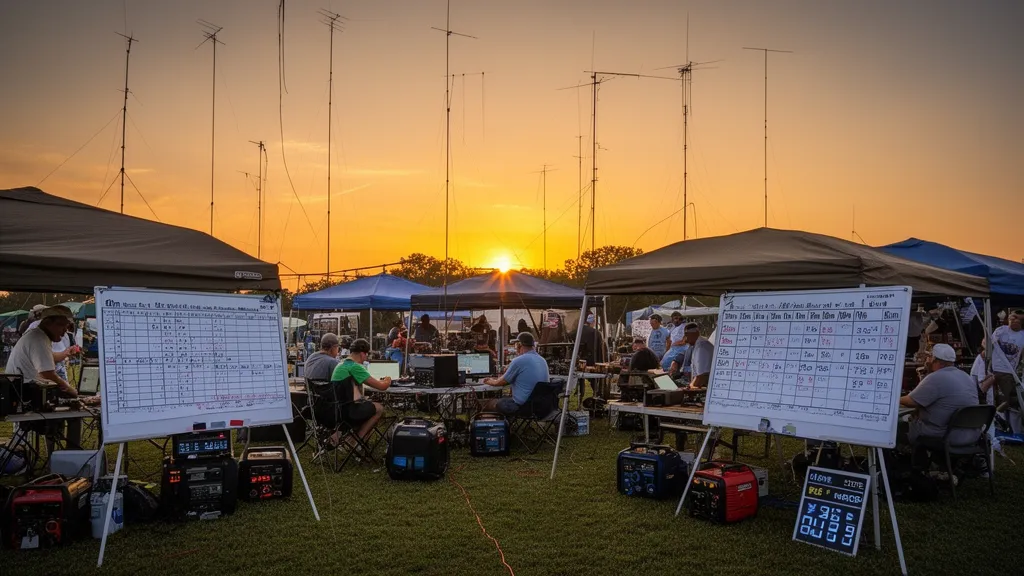
Operator's Verdict: Start on 20m at contest open; jump to 10m and 15m by midday if SFI > 120; watch 6m all day for sporadic-E; work 40m throughout the night; return to high bands Sunday morning. Check SFI and Kp on DXRadar 24 hours before and at contest start.
Field Day's Unique Propagation Context
ARRL Field Day (last full weekend of June, starting at 18:00 UTC Saturday) has a distinctive propagation profile driven by late June characteristics:
Favorable:
- Peak sporadic-E season (May–August) — 10m and 6m may open unpredictably
- Long daylight hours at mid-northern latitudes — extended window for 15m and 10m
- Solar Cycle 25 peak (2025–2026) — SFI typically 130–180 during the contest
Challenging:
- Summer atmospheric noise on 40m and 80m is at its highest
- 40m DX window is compressed (later sunset, earlier sunrise)
- Tropical weather QRN can be severe at night
Pro Tip: Check DXRadar's best bands now and your band-specific pages before heading out — live propagation data beats any static forecast.
Hour-by-Hour Band Strategy
| UTC Time | Priority 1 | Priority 2 | Watch For |
|---|---|---|---|
| 18:00–20:00 | 20m | 15m | 6m Es opening |
| 20:00–22:00 | 15m + 10m | 20m | 6m Es (afternoon peak in North America) |
| 22:00–00:00 | 20m | 40m (night opens) | Kp spike? → shift to 40m |
| 00:00–06:00 | 40m | 20m | 80m for regional/bonus QSOs |
| 06:00–08:00 | 20m | 40m (still open) | European 20m path opening |
| 08:00–12:00 | 15m | 10m (check Es) | 6m morning Es possible |
| 12:00–18:00 | 10m + 15m | 20m | 6m Es peak afternoon |
The 6m Sporadic-E Wild Card
6 meters during Field Day is never guaranteed but often spectacular. Sporadic-E clouds at 90–120 km altitude reflect 50 MHz signals to points 800–2,500 km away. During peak Es season in late June:
- 6m can open to all of North America simultaneously from a mid-continent location
- A 6m opening can produce 100 contacts in 60 minutes — among the highest contact rates in ham radio
- Es openings typically last 30 minutes to 3 hours before fading
Monitoring 6m:
- Keep a receiver continuously monitoring 50.313 MHz (FT8) or 50.110 MHz (SSB calling)
- Alert your team immediately when you decode FT8 signals from unexpected distances
- A dedicated 6m station/operator is worth considering for well-resourced club groups
Solar Conditions and Contingency Plans
Check DXRadar at T-24 hours and T-1 hour:
If SFI > 140 and Kp < 3: Aggressively pursue 10m and 15m. These bands will be crowded with productive domestic and international contacts. Consider dedicating a station to 10m for the first 6 hours.
If SFI 100–130: 15m is reliable but 10m is marginal. Plan 15m as the secondary band to 20m rather than 10m.
If Kp 4+ storm: All polar paths degrade. Focus on 20m and 40m. Accept reduced international contacts and maximise domestic/zone contacts on lower bands.
If M or X-class flare within 12 hours: D-layer absorption likely. 10m and 15m may be black for hours. Bonus: recovery on these bands can be spectacular when the flare clears.
Practical Tips for Field Day Propagation Management
- Assign one team member as the "propagation monitor" — checks DXRadar every 30 minutes and communicates band status to all operators
- Have pre-configured macros for each band to enable quick QSY without setup delays
- Log band changes with timestamp — useful for post-event analysis of optimal strategies
- Listen before transmitting on each band — a crowded 20m CQ zone means the band is productive; silence on 15m means move on
- FT8 on 20m at night is highly productive even for traditional voice-oriented Field Day groups — consider enabling it even if your main operation is SSB
Frequently Asked Questions
What propagation conditions can I expect for ARRL Field Day?
Field Day (last full weekend of June) falls during summer, which has specific propagation characteristics: sporadic-E is at peak activity on 10m and 6m; 20m is the workhorse DX band; 15m is variable; 40m provides good nighttime DX but increased daytime noise. The solar flux in late June depends on the solar cycle — in Solar Cycle 25 peak years (2025–2026), expect SFI 140–180 providing excellent 10m and 15m during daylight hours.
Is 6 meters worth operating during Field Day?
Absolutely. The last weekend of June is peak sporadic-E season. 6m openings during Field Day are common, sometimes spectacular — a single 6m sporadic-E opening can produce 50–100 contacts in under an hour. Field Day QSOs on 6m count the same as HF QSOs (1 or 2 points each depending on category). Adding a simple 6m dipole and monitoring 50.110 MHz SSB and 50.313 MHz FT8 can significantly boost your score. Never abandon a 6m Es opening for marginal 15m activity.
How do I check propagation during Field Day weekend?
Check DXRadar's solar weather page and best-bands-now the morning before Field Day starts. Key metrics: SFI above 120 → plan aggressive 10m and 15m strategy; Kp below 3 → good conditions expected; Kp 4+ → shift focus to 20m and 40m. During the contest, refresh DXRadar hourly. The 6m sporadic-E prediction requires monitoring DXMaps or DXRadar's cluster for real-time Es spots — it cannot be predicted days in advance.
What is the best band sequence for a typical Field Day?
A typical high-activity Field Day sequence from a North American club station: Start on 20m and 15m simultaneously (14:00 UTC, contest start). Move aggressively to 10m if SFI > 130 and the band opens by 15:00–16:00 UTC. Watch 6m throughout daylight for sporadic-E. Transition to 20m as the primary night band from 22:00–06:00 UTC. Add 40m as a second night station from 23:00 UTC for zones and multipliers. Return to 15m and 10m at 08:00 UTC Saturday for the second day.
Do non-commercial power bonuses affect band strategy?
Field Day's scoring bonuses (100% bonus for battery/generator power, 5 bonus points per Natural Power QSO) reward QRP or reduced power operation. The QRP category (5W maximum) receives the highest power bonus multiplier. This creates a strategic incentive: a QRP station on 20m during good propagation earns twice the points per contact as a 100W station. During Solar Cycle 25 peak, 5W on 20m FT8 or CW can easily sustain 30+ contacts per hour.