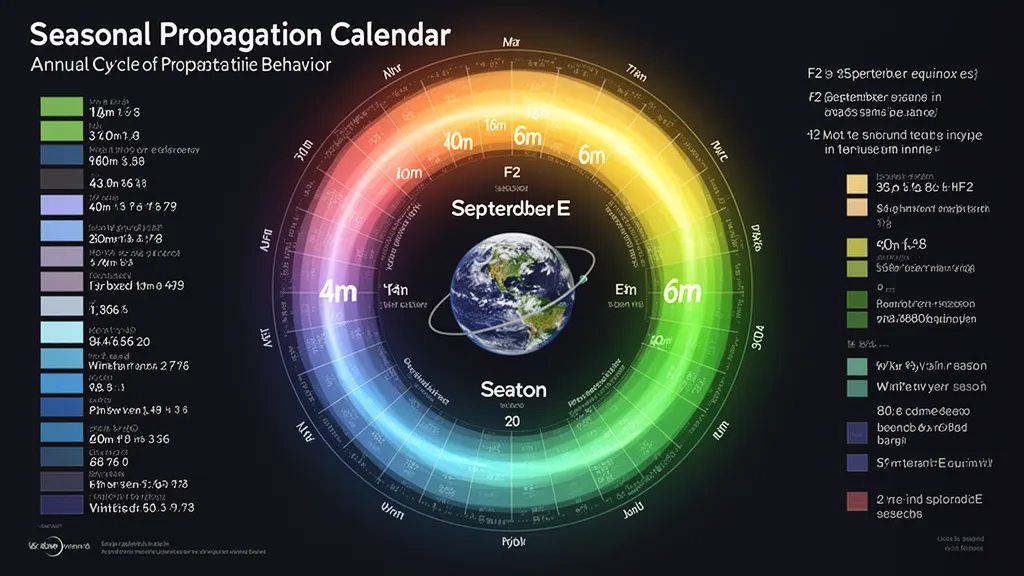
Operator's Verdict: Seasonal patterns are among the most reliable propagation predictors available. Knowing that F2 favors 10m and 15m in northern winter, that 6m peaks in June–July via Es, and that all bands benefit from equinox geometry in March and September gives you a predictable framework — independent of daily solar conditions — for planning when to operate which bands.
Why Propagation Changes with the Seasons
HF propagation varies seasonally for three independent reasons, each operating on different timescales and affecting different bands. Understanding all three prevents common mistakes like expecting summer to be peak 10m DX season (it isn't, due to the F2 winter anomaly) or being surprised when geomagnetic activity spikes in late March.
The three drivers are:
- F2 ionospheric chemistry (seasonal anomaly): Thermospheric composition changes alter F2 electron density in ways that counteract the simple expectation that more solar illumination equals more ionization.
- Sporadic-E meteorology: E-layer patchy ionization tracks weather and wind-shear patterns in the mesosphere, producing a strong summer peak.
- Solar wind coupling geometry (Russell-McPherron effect): Earth's orientation relative to the solar wind changes how efficiently geomagnetic energy is transferred, causing statistical equinox enhancements in storm activity.
Each mechanism operates at a different altitude and through different physics. None of them wait for each other.
Pro Tip: Use DXRadar's best bands now page alongside seasonal knowledge for the most accurate band selection. Seasonal patterns tell you what should work; live PSKReporter spot density on DXRadar tells you what is working right now. Check the solar weather dashboard for SFI to confirm whether 10m and 15m have the solar support they need for the current season.
The F2 Winter Anomaly: Why 10m Is Better in December Than June
The F2 seasonal anomaly (also called the winter anomaly) is one of the most counterintuitive facts in HF propagation. F2 electron density at mid-latitudes is typically higher in winter than in summer, even though the Sun is lower in the sky and hours of daylight are shorter (Hargreaves 1992; ITU-R P.533-14).
The cause is thermospheric composition. In summer, upwelling carries molecular-rich air (N₂ and O₂) from lower altitudes into the F2 region. Molecular ions (N₂⁺, O₂⁺, NO⁺) recombine with electrons much faster than atomic oxygen ions (O⁺). The result: higher recombination rates reduce the steady-state electron density despite adequate ionization. In winter, the thermosphere is more atomic-oxygen-dominated, recombination is slower, and electron density builds higher for the same solar input.
Practically, this means:
- 10m (28 MHz) and 15m (21 MHz): Best F2 DX months in the Northern Hemisphere are December, January, February, and early March — not June and July. An SFI of 120 SFU might open 10m DX reliably in January but fail to produce consistent openings in July from the same QTH.
- 20m (14 MHz): Less affected by the winter anomaly because 20m can propagate at lower foF2 values. Still slightly better in winter at mid-latitudes.
- The effect is latitude-dependent: It is strongest at mid-latitudes (30–55°). Near the equator, the anomaly is weaker; at very high latitudes, the effect is overwhelmed by polar ionospheric dynamics.
If you want to work 10m DX from northern Europe, the UK, or northeastern North America, aim for December–February mornings (08:00–13:00 UTC) and September equinox — not the June peak of sporadic-E season, when the F2 layer is actually less effective despite the Es boost.
During the Northern Hemisphere winter with SFI above 130, monitor 15m and 10m in the morning hours for F2 paths to the Southern Hemisphere — Japan, VK, ZL, South America. The F2 winter anomaly applies to your hemisphere, not the path's far end. Southern mid-latitudes are in their summer, where F2 is lower. You have the advantage.
Sporadic-E Season: May Through August (NH)
Sporadic-E (Es) doesn't follow the F2 playbook. It is driven by dynamic processes in the mesosphere and lower thermosphere — wind shears, tidal oscillations, and meteor-deposited metallic ions — that have a strong seasonal cycle independent of solar activity (ARRL Handbook).
Northern Hemisphere: Es season runs May through August, with peak intensity in June–July. The secondary peak in November–December is real but substantially weaker.
Southern Hemisphere: Peak is November–January, corresponding to the austral summer.
Band-by-band Es behavior:
| Band | Es Frequency | Notes |
|---|---|---|
| 6m (50 MHz) | Peak: June–July | Multi-hop 6m transatlantic possible |
| 10m (28 MHz) | Peak: May–August | Strong, frequent; often multiple openings per day |
| 12m (24 MHz) | May–August | Similar to 10m, slightly less frequent |
| 15m (21 MHz) | Less frequent | Requires denser Es cloud |
| 20m (14 MHz) | Rare | Strong multi-hop Es only |
On the air in June, 10m comes alive with Es signals that sound unmistakably different from F2: very strong, fast-changing QSB (fading cycles measured in seconds), signals appearing and disappearing over 15–30 minutes with little warning. You may work eight or ten countries in 20 minutes on 10m SSB during a strong Es opening, then have the band go completely silent.
Watch for 6m openings when 10m is active with Es. If 10m signals from 1,200–1,800 km are arriving via Es, the cloud density is often sufficient to support 50 MHz as well. Check 6m immediately — the window may be 30 minutes wide.
Equinox Effects: March and September
Both the March and September equinoxes produce reliably enhanced propagation on the upper HF bands. Two mechanisms contribute.
Solar Terminator Geometry
At the equinoxes, the solar terminator runs almost exactly north-south. East-west paths across mid-latitudes can be simultaneously illuminated at both ends — transmitter and receiver both see a reasonable solar elevation, maintaining the F2 layer in both locations. This geometry is particularly favorable for:
- North America to Europe on 15m and 20m (east-west, mid-latitude)
- Japan to North America on 10m and 15m
- Long-path openings where both endpoints are near the gray line simultaneously
At the solstices, the tilted terminator creates large asymmetries — one end of a path may be in polar night while the other end is in continuous daylight, degrading path balance on some circuits.
Russell-McPherron Geomagnetic Enhancement
The Russell-McPherron effect causes a statistical increase in geomagnetic storm frequency at the equinoxes (Russell & McPherron 1973). At the equinoxes, the geometry between Earth's dipole axis and the ecliptic plane maximizes the efficiency with which a southward-directed interplanetary magnetic field (IMF Bz negative) couples into Earth's magnetosphere. The same solar wind conditions that produce Kp 4 in December may produce Kp 6 in March.
For HF operators, this is a double-edged effect:
- Negative: More storms means more frequent F2 degradation at high latitudes. High-latitude and polar paths are most affected.
- Positive: Enhanced geomagnetic activity means more aurora events, boosting VHF aurora scatter on 50 MHz and 144 MHz. It also sometimes creates conditions for enhanced E-layer ionization in the auroral zone.
Month-by-Month Propagation Guide
The following table summarizes typical conditions from the Northern Hemisphere perspective. Southern Hemisphere operators should apply a 6-month offset for seasonal effects (but not for the Russell-McPherron equinox effect, which is symmetric).
| Month | 10m / 15m F2 | 20m / 40m | 6m Es | Notes |
|---|---|---|---|---|
| January | Good (winter anomaly) | Excellent | None | Best NH mid-lat 10m/15m DX; F2 winter anomaly peaks |
| February | Good | Excellent | Rare | Winter anomaly still active; building toward spring equinox |
| March | Excellent (equinox) | Excellent | Occasional | Equinox enhancement; Russell-McPherron storms possible |
| April | Good–excellent | Very good | Occasional | F2 still good; early Es starting in southern latitudes |
| May | Moderate–good | Good | Building | Es season begins; 10m Es openings start; F2 declining |
| June | Moderate (F2) + Es | Good | Peak | Es at peak intensity; 6m transatlantic Es possible; F2 summer minimum |
| July | Moderate (F2) + Es | Good | Peak | Similar to June; Es openings multiple times per week |
| August | Moderate (F2) + Es | Good | Declining | Es tailing off; F2 still in summer minimum |
| September | Excellent (equinox) | Excellent | Rare | Equinox enhancement rivals March; best autumn DX month |
| October | Good | Very good | Rare | Post-equinox; F2 building for winter; storms possible |
| November | Good (F2 improving) | Excellent | SH Es beginning | F2 winter anomaly building; Southern Hemisphere Es starts |
| December | Excellent (winter anomaly) | Excellent | None (NH) | Peak F2 winter anomaly; best NH mid-lat 10m DX of year |
What This Means for Different Band Strategies
10m Strategy
From northern mid-latitudes (35–55° N), the primary 10m strategy is:
- December–February: Exploit F2 winter anomaly. Aim for transatlantic and transpacific F2 paths in morning hours (09:00–14:00 UTC for Europe, 12:00–17:00 UTC for Pacific). Need SFI above ~120 for consistent openings.
- May–August: Opportunistic sporadic-E. No solar flux requirement. Monitor frequently; openings come and go within an hour. Distances 800–2,500 km dominate; multi-hop Es extends range.
- March and September: Equinox F2 enhancement. Long DX paths open reliably, especially in afternoon hours.
20m Strategy
20m is the most seasonally forgiving band. F2 propagation is available year-round under virtually all solar conditions. However:
- Winter: More reliable transpacific paths; D-layer absorption lower due to shorter days
- Summer: More noise (atmospheric static, QRN), slightly higher daytime absorption, but paths remain viable
- Equinox: Best long-path performance (around the 180° great-circle bearing)
6m Strategy
6m is essentially an Es mode from mid-latitudes in the Northern Hemisphere. F2 openings on 6m require very high SFI (above ~180) and typically occur near the equinoxes — not guaranteed even at solar maximum. The reliable 6m season is May–August for Es. Plan all 6m DX activity around the Es peak.
40m and 80m Strategy
Lower HF bands (40m and 80m) are relatively immune to the F2 seasonal anomaly, but they have strong seasonal effects driven by atmospheric noise:
- Summer: QRN (lightning static) is worst, especially afternoon and evening local time. Noise floor on 40m can rise 10–20 dB above winter baseline.
- Winter: Quieter noise floor; better SNR for the same signal level. Regional and DX contacts benefit from lower QRN.
- Daytime D-layer absorption: Stronger in summer due to higher solar elevation (more D-layer ionization), reducing skip distance. This affects 40m most noticeably — summer daytime 40m has a larger skip zone than winter.
Frequently Asked Questions
Is 10m better in summer or winter for DX?
At mid-latitudes in the Northern Hemisphere, 10m F2 DX is typically better in winter (December–February) due to the F2 seasonal anomaly — higher F2 electron density despite lower solar elevation. Summer 10m activity is dominated by sporadic-E, which covers shorter distances (500–2,500 km) than F2 but doesn't require high solar flux. For long-haul DX (transatlantic, transpacific), winter is better; for European and regional contacts, summer Es compensates.
Why does geomagnetic activity increase at the equinoxes?
The Russell-McPherron effect causes this statistical increase. At the equinoxes, Earth's dipole axis is oriented to maximize the efficiency of energy transfer from the southward component of the interplanetary magnetic field into the magnetosphere. The same solar wind conditions that would cause minor disturbances at solstice can trigger moderate geomagnetic storms at equinox. It is a geometric effect of Earth's orbit and axial tilt (Russell & McPherron 1973).
What SFI level is needed for 10m to open in winter versus summer?
This is latitude-dependent, but a useful mid-latitude guideline: in winter (December–February), 10m F2 DX contacts are typically possible at SFI above 110–120 SFU. In summer (June–August), the F2 layer is weaker and the same paths may require SFI above 140–150 to be reliable via F2. In both cases, sporadic-E can open 10m regardless of SFI. Check DXRadar's live spot data alongside the current SFI to see what's actually working right now.
How do I know whether a 10m contact was F2 or sporadic-E?
Distance is the most reliable indicator. Sporadic-E single-hop distances are typically 800–2,500 km. If you're working stations beyond 3,000 km on 10m, it's almost certainly F2. Signal behavior also differs: F2 has slow, gradual QSB over minutes; Es produces rapid, deep QSB over seconds, and openings often end abruptly. The UTC time and season provide further context — a 10m DX opening in December at mid-latitudes is almost certainly F2; the same distance in June could be either.