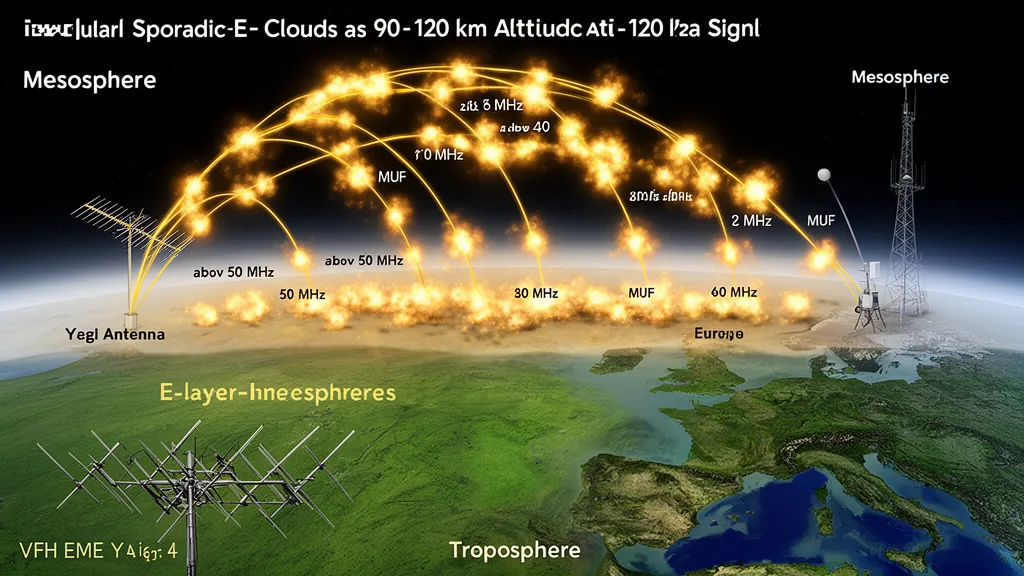
What Sporadic-E Propagation Is
Sporadic-E (abbreviated Es) is ionospheric propagation caused by intense, irregular patches of ionization forming in the E layer at approximately 90–120 km altitude. These patches reach electron densities far exceeding the normal E layer, reflecting radio signals at frequencies well above the ordinary E-layer critical frequency. Unlike the F2 layer, which provides predictable long-distance HF propagation, Es patches are localized, short-lived, and appear without reliable warning.
The physics distinguishes Es from every other propagation mode. The ionized clouds responsible are typically 50–150 km wide and only a few kilometers thick. They drift with high-altitude winds at speeds of roughly 100 km/h, which means the reflective geometry between two stations changes continuously. A strong, readable signal can appear, peak at S9, and vanish within five minutes as the patch drifts out of the optimal reflection angle.
On a practical radio, Es has an unmistakable character. A station at 1,200 km will appear at full quieting on 6m SSB where the frequency was empty moments before. The signal builds rapidly, often peaks in a matter of minutes, then fades as abruptly as it arrived. The fast flutter characteristic of tropospheric ducting is absent — Es signals are typically remarkably stable when the patch geometry is right, often cleaner and stronger than many ionospheric modes.
The 6-meter band (50–54 MHz) is the classic Es showcase because it sits right at the boundary where normal ionospheric propagation ends and sporadic-E begins. On 10m, 12m, and 15m, Es contributes to openings alongside F2 and other modes; it can be difficult to distinguish. On 6m, Es is nearly the only mechanism capable of ionospheric propagation — which makes every Es opening on that band immediately obvious.
Pro Tip: During Es season, monitor the DXRadar 6m Sporadic-E map, DXRadar’s 6m band page, and best bands now for real-time spot clusters. When PSKReporter shows FT8 decodes from 1,000+ km on 50.313 MHz, an Es lane is active — tune in immediately, because the opening may last only 15–30 minutes.
Why Sporadic-E Happens: The Incomplete Science
Sporadic-E forms when wind shear in the upper atmosphere concentrates metallic ions into thin, dense layers through a process called windshear accumulation. The exact triggering mechanism remains an active research area — no single theory fully explains all observations (HamSCI, AGU Journal of Geophysical Research, multiple papers 2018–2025).
The leading candidates, none definitively proven:
- Wind shear / tidal oscillations — The most widely accepted mechanism. Collisions between opposing upper-atmosphere wind streams concentrate free metallic ions (primarily magnesium, iron, and calcium from meteorite ablation) into thin layers. When the concentration reaches a critical density, the patch becomes reflective to radio waves.
- Meteor ablation seeding — Meteors entering the atmosphere deposit metallic vapor at E-layer altitudes. This material may provide nuclei around which further ionization concentrates. The correlation between major meteor showers and Es activity is statistically observable but not strong enough to explain the bulk of openings.
- Lightning-driven gravity waves — Thunderstorm activity can launch gravity waves into the upper atmosphere, potentially triggering Es formation. Some data suggests higher Es activity over regions with active convective weather systems, but the mechanism is not established.
What is established: sporadic-E correlates poorly with solar activity. SFI and Kp have almost no predictive value for Es. An operator with an SFI of 70 during solar minimum can work as much Es DX on 6m as one with SFI 200 at solar maximum. This independence from the solar cycle is one of Es’s defining characteristics and a significant reason why 6m remains productive even in the depths of solar minimum.
The MUF Concept for Sporadic-E: When 6m and 2m Open
Every Es opening has a Maximum Usable Frequency (MUF) — the highest frequency the patch will reflect for a given path. When the Es MUF crosses 50 MHz, the 6-meter band opens. When it crosses 144 MHz, 2-meter openings become possible. Understanding this threshold explains why some openings affect only 10m while others simultaneously blast 6m and touch 2m.
The Es MUF is not fixed — it varies continuously as the patch evolves. A typical sequence on a summer afternoon might look like this: the 10m band shows enhanced activity around 14:00 UTC as the MUF climbs through 28 MHz. By 15:30 UTC the cluster of 10m spots has moved to 15m frequencies as the patch strengthens. Then 6m FT8 at 50.313 MHz erupts — spots appear on PSKReporter showing dozens of contacts forming along a diagonal lane across the map. Over the next 90 minutes the lane migrates, the 6m opening fades, and 10m remains enhanced for another hour as the MUF drops back through the VHF threshold.
True 2m Es openings require the MUF to reach or exceed 144 MHz. This demands exceptionally dense Es clouds — the sort that form only a handful of times per season, usually during the peak of the Northern Hemisphere summer (late June to mid-July). When they do occur, 2m SSB pile-ups of 800–1,500 km are possible. MSK144 digital mode contacts on 2m are feasible at somewhat lower MUF values than SSB.
A reliable rule of thumb: if 6m is showing sustained openings across multiple paths simultaneously, check 2m. The Es cloud responsible may be dense enough to push the MUF above 144 MHz — at least briefly.
Pro Tip: When you see 6m FT8 erupting on PSKReporter, open 6m band conditions on DXRadar in a second tab. The spot cluster visualization shows which direction the Es lane is oriented from your QTH — letting you know whether to point a beam north, east, or south before you even hear the first signal.
Sporadic-E Season: When and Where to Expect It
The Northern Hemisphere Es season runs from approximately May 1 through August 15, with peak activity in June and July. Within that window, the highest-intensity openings — those that push the MUF above 100 MHz regularly — cluster around the June solstice period.
| Month | N. Hemisphere Activity | S. Hemisphere Activity |
|---|---|---|
| January | Low (secondary peak possible) | Peak season |
| February | Low | Declining |
| March | Low | Late season |
| April | Increasing | Low |
| May | Active — opening season | Low |
| June | Peak — highest MUF events | Low |
| July | Peak — highest spot counts | Low |
| August | Declining but still strong | Increasing |
| September | Low | Increasing |
| October | Low | Active |
| November | Low | Peak season |
| December | Secondary peak (some years) | Peak season |
A secondary Northern Hemisphere Es peak occurs in December, though it is weaker and less consistent than the summer maximum. The mechanism for this winter enhancement is not fully understood — it may relate to differences in upper-atmosphere wind patterns during the solstice periods.
Daily Es activity follows a weak diurnal (daily) pattern in summer: opening probability increases from mid-morning through early afternoon local time, with a secondary chance in the early evening. Unlike F2 propagation, Es does not shut down at sunset — nighttime Es openings on 6m do occur, though they are less common than daytime events.
Geographic distribution is not uniform. The continental United States, Europe, and Japan are well-documented Es-rich regions due to their latitude bands and underlying upper-atmosphere dynamics. Operators between roughly 35° N and 60° N latitude experience the highest Es frequency. Tropical and polar stations see less Es activity.
Path Geometry: How Far Es Propagation Reaches
A single-hop Es path spans 800–2,000 km, with most activity in the 1,000–1,800 km range. This is geometrically constrained by the E-layer patch height (~100 km) and the angle at which a signal can enter and exit the cloud while still reflecting back to Earth.
At the minimum end, sporadic-E becomes geometrically difficult for paths shorter than about 500 km — the signal angle becomes too steep to reflect from the layer. This means Es propagation has a characteristic skip zone inside roughly 500 km. Stations at 200 km separation will not benefit from the same Es patch that opens contacts at 1,200 km.
Multi-hop Es extends range dramatically. Two-hop paths reach 3,000–4,000 km; three-hop paths can approach 6,000 km. Each hop requires a suitable Es patch at the intermediate reflection point, which reduces reliability — but during strong season openings, two-hop Es across the Atlantic Ocean from eastern North America to western Europe (approximately 5,500–6,000 km) is a documented and repeatable phenomenon.
The spatial structure of an Es opening has a characteristic lane shape. A single patch illuminates a corridor roughly 100–200 km wide and 1,200–1,800 km long. Stations at both ends of the lane gain access to each other; stations just outside the lane edges — even a few hundred kilometers away — hear nothing. This explains why during a 6m Es opening, your neighbor three states away may be working Europeans while you hear nothing on the same frequency.
Key operational fact: During a confirmed Es opening, if you’re not hearing anything, try slightly different frequencies along the band. The MUF boundary is not perfectly sharp — signals near the MUF crossover may be accessible at some frequencies but not others within the 6m band allocation.
How to Identify and Catch Sporadic-E in Real Time
PSKReporter is the primary real-time Es detection tool available to operators. Because FT8 on 50.313 MHz is active globally, 24/7, even during poor conditions, it acts as a continuous tripwire: the moment an Es patch forms and reaches sufficient MUF, PSKReporter spots begin appearing from distant stations. An experienced 6m operator watching PSKReporter can see an opening develop — first one or two spots from a distant region, then rapidly a cluster of dozens — before hearing anything on the audio.
A practical detection sequence:
- Watch PSKReporter (or DXRadar’s 6m Sporadic-E map) for sudden clusters of spots from stations 1,000–2,000 km distant
- Go to 50.313 MHz in WSJT-X FT8 mode — look for decodes from distant call areas
- Check DX cluster on 50.000–50.200 MHz for SSB and CW DX announcements
- Call CQ on FT8 or monitor SSB frequencies — Es openings often have more capacity than operators realize
The most important habit during Es season is keeping a receiver active. Background monitoring of 50.313 MHz FT8 during May through August costs nothing in terms of transmitter time, and it catches the short, intense openings that can arrive and depart within 10–20 minutes. Many of the rarest Es contacts — W1 to UA9, or G3 to VK — occur during brief double-hop openings that lasted less than 30 minutes total.
Because Es is solar-independent, checking the solar weather dashboard before an Es session tells you nothing useful about Es probability. SFI, Kp, and X-ray flux are irrelevant to Es formation. What matters is the season and the time of day — and, frankly, luck.
Contrasting Sporadic-E with F2 Propagation
Es and F2 are the two primary ionospheric propagation modes for HF and lower VHF, but they differ in almost every operationally relevant way:
| Property | Sporadic-E (Es) | F2 Propagation |
|---|---|---|
| Layer altitude | ~90–120 km | ~250–400 km |
| Typical path distance | 800–2,000 km (single-hop) | 2,000–5,000 km (single-hop) |
| Solar activity dependence | None (effectively) | Strong (SFI-driven) |
| Seasonal pattern | May–August peak (N. Hemisphere) | Year-round, equinox-enhanced |
| Predictability | Very low | Moderate (SFI-driven model) |
| Duration | Minutes to a few hours | Hours to days |
| MUF threshold for 6m | ~50 MHz Es MUF | Rarely reached (SFI 250+ needed) |
| Primary bands affected | 6m, 10m, 12m, 15m | 10m–40m (solar-dependent) |
F2 propagation on 6 meters requires the F2 MUF to reach 50 MHz — which demands an SFI above approximately 200–220 SFU and favorable path geometry. Even at solar maximum, sustained F2 propagation on 6m is rare and short-lived. This is why 6m DX operators care almost exclusively about Es — not F2 — for their openings.
F2 is also vastly more predictable. Tools like VOACAP and the DXRadar band model can estimate F2 MUF on a given path within about 10–15% accuracy. Es prediction remains essentially impossible beyond “it’s Es season.” There is active research (HamSCI, multiple universities) attempting to use weather model data and machine learning to forecast Es, but as of 2026 no reliable short-term Es forecast exists.
The practical implication: treat Es as an opportunistic mode. Maximize your chance of catching openings by monitoring passively, act quickly when an opening appears, and do not wait for a forecast to tell you to turn on the radio.
Frequently Asked Questions
What is sporadic-E propagation?
Sporadic-E (Es) is ionospheric propagation caused by intense, irregular patches of ionization forming in the E layer at approximately 90–120 km altitude. These patches reflect radio signals at frequencies far above the normal E-layer critical frequency, enabling single-hop contacts of 800–2,000 km on bands including 10m, 12m, 15m, and most noticeably 6m (50 MHz).
When does sporadic-E occur?
In the Northern Hemisphere, Es peaks from May through August, with the strongest activity in June and July. A secondary peak occurs in December in some years. In the Southern Hemisphere the season is shifted by six months. Es can occur year-round at reduced intensity, but sustained daily openings are concentrated in the warm-season window.
What frequency does sporadic-E affect?
Es affects all bands, but its impact is most dramatic on 6 meters and occasionally 2 meters. On HF, Es contributes to openings on 10m, 12m, and 15m. When the Es MUF exceeds 50 MHz, the 6m band opens. When MUF crosses 144 MHz — a rarer summertime event — 2m Es contacts become possible.
How far can sporadic-E propagation reach?
Single-hop Es typically spans 800–2,000 km. Multi-hop Es, where the signal bounces off two or more patches, extends range to 4,000–6,000 km. Double-hop Es across the Atlantic — approximately 5,500–6,000 km — is a documented and repeatable event during strong Northern Hemisphere summer openings.