Operator's Verdict: The current planetary K-index is 0.33. Aurora-driven HF disruption begins at Kp 5 on polar paths and intensifies with every point above that. If HF is deteriorating at your QTH, check the live aurora dashboard — conditions that kill 20m often open 6m aurora scatter simultaneously.
What Aurora Actually Does to the Ionosphere
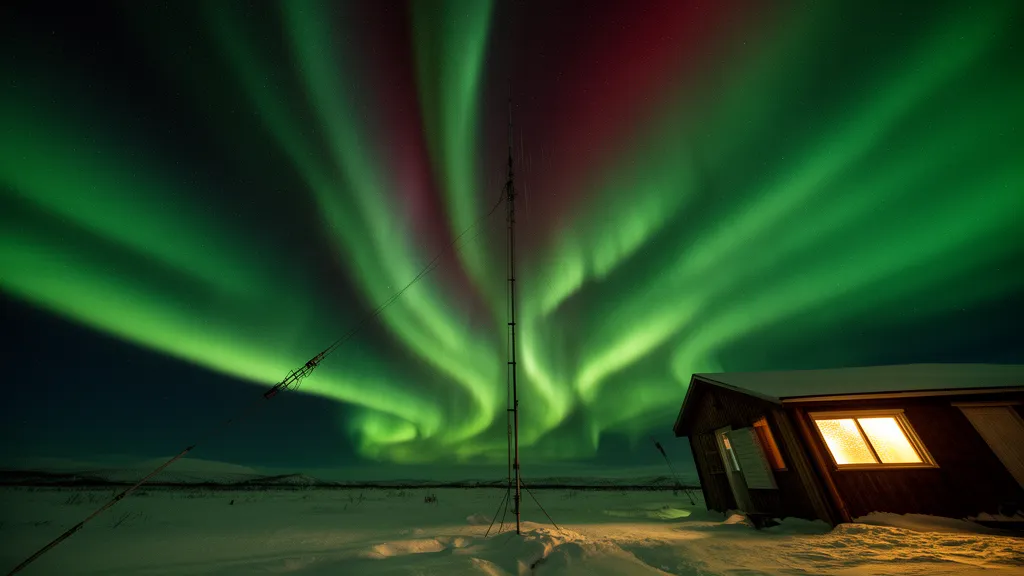
Aurora is not simply a visual light show. It is the radio-frequency consequence of energetic charged particles — electrons and protons — from the solar wind funneling into Earth's atmosphere along magnetic field lines. These particles collide with atmospheric gases at altitudes of 100–300 km, exciting oxygen and nitrogen molecules into emitting visible light. The same collision cascade also dramatically alters the electron density distribution across the ionosphere, and that is what matters to radio operators.
Two physically distinct effects unfold simultaneously. The D-layer — the lowest ionospheric region, at roughly 60–90 km altitude — becomes intensely over-ionized across polar latitudes. Over-ionized D-layer absorbs HF signals instead of refracting them; an HF wave trying to cross the polar cap during a storm loses energy to the D-layer like sound absorbed by thick foam. At the same time, the E-layer at 100–120 km altitude becomes heavily structured by aurora, forming ionized columns aligned with the magnetic field. These columns are excellent scatterers at VHF frequencies.
The net result: the same geomagnetic disturbance that makes HF go silent on transpolar paths can simultaneously open 6m (50 MHz) and 2m (144 MHz) for scatter contacts that are impossible under quiet conditions. Understanding which effect dominates at your latitude and frequency is the difference between watching the bands go dead and working a memorable contact.
How Geomagnetic Storms Damage HF Propagation
Geomagnetic storms disrupt HF propagation through three mechanisms: D-layer absorption over the polar cap, auroral zone absorption along the auroral oval, and ionospheric irregularities that scatter and defocus HF signals. All three are proportional to storm intensity (the NOAA G-scale, driven by Kp).
Kp 5 corresponds to a G1 (Minor) geomagnetic storm, the first rung on NOAA's scale (NOAA Space Weather Scales). At this threshold, transpolar HF paths begin to degrade — routes from North America to northern Europe via the polar cap, from Europe to East Asia over Russia, or any path spending significant time above 65° N geomagnetic latitude. Operators trying to work Scandinavia from the US Pacific Northwest on 20m may notice signals going raspy, S-meter dropping, or paths simply going dead.
Kp 7 (G3 storm) extends significant disruption to all HF paths above 10 MHz crossing latitudes north of 45° N. The classic W–EU 20m path fails first; 17m and 15m degrade shortly after. Operators who shifted to 40m find it still partially usable via NVIS for regional work but increasingly noisy and unreliable for transoceanic paths.
Kp 9 (G5 extreme storm) can produce near-total HF blackout on the sunlit hemisphere. During the May 10–11, 2024 G5 storm — which reached Kp 9.33, the most intense since the October 2003 Halloween Storms (NOAA SWPC Storm Report) — 20m fell completely silent on all high-latitude paths. Operators across North America, Europe, and Russia reported S0 to S1 noise floors with no usable signals above 14 MHz on polar and mid-latitude paths throughout the storm peak.
Latitude vs. Kp: How Your QTH Determines the Impact
Latitude is the single largest variable in how a geomagnetic storm affects you. The auroral oval expands equatorward as Kp rises, so operators at high latitudes feel mild storms acutely, while operators closer to the equator may not notice until a major storm hits.
| Geomagnetic Latitude | Noticeable HF impact starts | Major HF disruption |
|---|---|---|
| 65° N (Alaska, northern Scandinavia) | Kp 2–3 | Kp 5 |
| 60° N (central Scandinavia, southern Alaska) | Kp 3 | Kp 5–6 |
| 55° N (Scotland, northern Germany, central Canada) | Kp 4 | Kp 6 |
| 50° N (southern England, northern US border) | Kp 5 | Kp 7 |
| 45° N (northern France, central US, Japan) | Kp 6 | Kp 7–8 |
| 40° N (northern Spain, Colorado, central Japan) | Kp 7 | Kp 8–9 |
| 30° N (Texas, North Africa, southern Japan) | Kp 8 | Kp 9 |
Note: geomagnetic latitude differs from geographic latitude by up to 10–15 degrees depending on longitude. Operators in Alaska and northern Canada sit at higher geomagnetic latitudes than their geographic coordinates suggest.
An operator in Oslo (geomagnetic latitude approximately 58° N) running a polar path to Japan will experience noticeable path degradation at Kp 3 — a threshold that an operator in Texas (geomagnetic latitude approximately 40° N) would not feel at all. These operators are living in effectively different space weather environments during the same storm.
Pro Tip: The DXRadar aurora dashboard shows the live NOAA OVATION aurora oval with the equatorward boundary plotted on a world map. Before committing to a polar path, check whether your great-circle route crosses the oval — if it does and Kp is climbing, plan an alternative route or band.
The Low-Band Lifeline: How 40m NVIS Survives Storms
40m NVIS (Near Vertical Incidence Skywave) is the propagation mode most resistant to geomagnetic storm disruption for operators at mid-latitudes. NVIS on 40m uses near-vertical radiation angles (60–90 degrees from horizontal) to bounce signals off the F2 layer at low altitude, covering a radius of roughly 200–800 km with no skip zone.
The key reason 40m NVIS survives G2–G3 storms for stations below 55° N is geometry: the signal path stays local. It never crosses the polar cap where D-layer absorption is most severe. The relatively low frequency (7 MHz) also means the D-layer absorption index is proportionally lower than at 14 MHz or 21 MHz — absorption scales roughly with 1/f², so 40m suffers less than 20m even when both are crossing the same disturbed region.
During G2 storms (Kp 6), a station in central Europe at 50° N can typically maintain 40m NVIS contacts out to 600 km throughout the storm — while 20m goes completely dead. Emergency nets in Germany, France, and the UK have documented this pattern repeatedly. If your DX path is gone and the high bands are silent, shift to 40m NVIS and work your regional net. 80m NVIS (160–3,000 km depending on ionospheric height) is similarly resilient but requires more antenna length and suffers more from atmospheric noise.
One practical limitation: 40m daytime NVIS has a skip zone issue after approximately 14:00 local solar time as the D-layer thins. If you are trying to contact stations beyond 500 km in late afternoon during a storm on 40m, you may find yourself in the "dead zone" between NVIS range and the storm-impaired long-distance F2 skip range.
Aurora Scatter on 6 Meters: The VHF Silver Lining
Aurora scatter on 6m (50 MHz) is one of amateur radio's more dramatic propagation modes — and it only becomes available during geomagnetic storms. When the auroral oval passes over or near a station's horizon, the ionized columns of the aurora act as a diffuse scatterer, redirecting 6m energy across distances of 800–2,500 km in directions that would otherwise be impossible.
Kp 5 or higher is required for reliable 6m aurora scatter at mid-latitudes (approximately 45–55° N). Below Kp 5, the oval is typically too far north and too dim to produce a useful scattering volume. As Kp rises above 6, the oval expands equatorward and intensifies, and 6m aurora scatter becomes workable from progressively lower latitudes — at Kp 8–9 during extreme storms, stations as far south as 40° N can work aurora scatter.
The operating technique is specific:
- Beam north — toward the aurora, for both the transmitting and receiving station. Pointing at each other does not work; both must illuminate the same scattering volume.
- Use CW or FT8 — SSB signals passing through the auroral column acquire a characteristic raspy, buzzed quality that makes voice communication very difficult. CW tones become slightly warbled but are still decodable. FT8 on 50.313 MHz handles the Doppler spread and flutter well.
- Log "Aurora" as the propagation mode in your log and spot — this is how the DX cluster community tracks aurora-scatter contacts. ADIF mode code:
AU. - Expect range 800–2,500 km — shorter paths lack the geometry to put both stations pointing at the same part of the oval; longer paths exceed the usable scatter geometry.
2m (144 MHz) aurora scatter also works, but requires Kp 6–7 for mid-latitudes and typically produces contacts at shorter ranges (400–1,200 km). The signal quality at 2m is generally more distorted than at 6m.
Pro Tip: During active aurora events, open the DXRadar 3D Space Weather Globe to see the live auroral oval extent and the estimated equatorward boundary. If the oval reaches within 10–15 degrees of your latitude, point your 6m beam north and call CQ on 50.313 MHz FT8 — or listen for CW around 50.100 MHz.
The NOAA OVATION Model: Predicting Aurora Reach
NOAA's OVATION model is the primary tool for predicting where the auroral oval will sit in the near term. It generates a 30-minute forecast of auroral energy flux at each latitude and longitude, from which the equatorward boundary of the visible (and radio-active) aurora can be derived.
The key parameter for radio operators is the equatorward boundary of the oval, which correlates with Kp as follows (NOAA SWPC, OVATION model documentation):
| Kp Level | NOAA Storm Level | Aurora oval equatorward boundary (approx. geomagnetic latitude) | Visible from |
|---|---|---|---|
| 3 | Unsettled | 66° N | Northern Norway, Alaska interior |
| 4 | Active | 64° N | Tromsø, Fairbanks AK |
| 5 | G1 Minor | 60° N | Helsinki, Reykjavik, Anchorage |
| 6 | G2 Moderate | 56° N | Edinburgh, southern Iceland, Juneau AK |
| 7 | G3 Strong | 52° N | Dublin, Copenhagen, southern Canada |
| 8 | G4 Severe | 48° N | Munich, Paris, northern US border states |
| 9 | G5 Extreme | 45° N or lower | Rome, Denver, central US |
For 6m aurora scatter, the radio-active oval extends somewhat further equatorward than visual aurora — the ionized E-layer column producing scatter may be brighter and more structured than what the eye detects. A station at 50° N that cannot see aurora visually may still work it on 6m if the oval boundary is at 55° N and geometry allows both stations to illuminate the scatter volume.
The May 2024 G5 Storm: What Really Happened on the Bands
The May 10–11, 2024 G5 geomagnetic storm — driven by a series of X-class flares and associated CMEs from Active Region 13664 — reached a peak Kp of 9.33, making it the strongest storm since the October 2003 Halloween events (NOAA SWPC Storm Report, May 2024).
HF behavior was exactly what the physics predicts. By 18:00 UTC on May 10, 20m was silent on all transpolar and North America–Europe paths. Stations in the US Midwest reported complete absence of European signals on 14 MHz — bands that normally carry wall-to-wall DX during a late-afternoon EU opening. 15m and 17m were similarly dead. 10m had already closed before the storm peak; 40m NVIS was holding for stations below 50° N.
The 6m story was different. With Kp at 8–9 and the auroral oval extending to 45° N geomagnetic latitude, aurora scatter on 50.313 MHz FT8 produced what many operators described as their most memorable 6m contacts in years. EU–NA contacts via aurora scatter were being logged throughout the storm peak — paths that are geometrically impossible under normal F2 or Es conditions. The characteristic buzz of the aurora-scattered FT8 signals was audible in shared audio clips posted to social media. Operators on CW around 50.100 MHz reported similar activity, with stations in Germany, England, and Scandinavia working east coast US stations via aurora scatter. WSJT-X logged the mode as AU and the QSB was fast, typical of aurora.
This event is a textbook example of the dual-nature effect: the same storm that killed HF opened VHF in a way that quiet conditions never permit.
Storm Timing: When to Watch and When to Act
Geomagnetic storm timing is driven by CME transit time. A CME ejected from the Sun travels at 400–2,000 km/s and takes 1–4 days to reach Earth, with a median transit time of roughly 48–72 hours for typical solar events. The storm does not begin the moment the CME launches; it begins when the CME's interplanetary shock arrives and the embedded magnetic field southward component (negative Bz) connects with Earth's magnetosphere.
The practical implication: the NOAA 3-day geomagnetic forecast gives you lead time. When NOAA SWPC posts a G2 or higher watch, mark your calendar 48–72 hours out and plan accordingly. Storms typically peak 12–36 hours after initial shock arrival, then decay over 24–48 hours.
Watch these signals in order:
- CME detected at the Sun (from SDO, SOHO imagery) — starts the countdown
- NOAA issues G-scale watch — usually 1–3 days in advance
- ACE/DSCOVR spacecraft detects CME arrival at L1 — 15–60 minutes before Earth impact; Bz going negative is the key indicator
- Kp begins rising — aurora scatter window opens, HF starts degrading
- Kp peaks — maximum aurora scatter opportunity, worst HF conditions
- Kp declining — HF recovers slowly over 12–24 hours, aurora scatter fades
You can track the live ACE solar wind Bz data and the real-time Kp value on the DXRadar solar weather dashboard — when Bz goes strongly negative (below −10 nT) and Kp is climbing, point your 6m beam north.
What This Means for Your Operating Strategy
The correct response to a geomagnetic storm is not to turn off the radio. It is to change mode and frequency.
When Kp reaches 5 and is rising:
- If you are north of 50° N: prepare for HF path degradation. Transpolar paths (NA–EU via northern routes) will be the first to fail. Shift 20m contacts to southern great-circle routes if possible; try 40m for intra-regional work.
- Tune 50.313 MHz FT8 and check is-6m-open — aurora scatter may be starting. Point your beam north.
- CW operators: monitor 50.100–50.130 MHz for aurora CW activity.
When Kp reaches 7 and HF above 14 MHz is clearly dead:
- 40m NVIS is your primary HF tool for regional work (200–800 km radius).
- 6m aurora scatter is at peak activity — this is the prime operating window.
- If you have 2m capability, try 144.100–144.200 MHz for aurora CW or 144.174 MHz FT8.
When Kp begins to drop below 4 on recovery:
- HF recovery follows Kp down, but with a lag. 40m recovers first, then 20m. Allow 12–24 hours after Kp drops for paths to fully stabilize.
- The aurora scatter window closes as the oval retreats north. Aurora contacts typically stop before HF fully recovers.
The DXRadar band board shows live 40m conditions derived from PSKReporter spot density, which is a useful proxy for the current state of the D-layer during a storm — when spot counts drop dramatically, the storm is degrading paths.
Frequently Asked Questions
How does aurora affect HF propagation?
Aurora causes geomagnetic storms that dramatically increase D-layer absorption at high latitudes, killing HF paths that cross polar regions. The D-layer, normally thin enough to pass HF signals with modest loss, becomes heavily ionized during storms and absorbs energy from HF waves attempting to traverse it. At Kp 5 (G1 storm threshold), transpolar and high-latitude paths begin to fail. At Kp 7 or higher, HF above 10 MHz becomes unreliable across all paths north of 45° N latitude. The effect is latitude-dependent — operators in northern Scandinavia or Alaska feel even moderate storms (Kp 3) acutely, while operators in the southern US may not notice until a major storm (Kp 7–8) arrives.
What Kp level disrupts ham radio?
Kp 5 is the G1 storm threshold (NOAA Space Weather Scales) and marks the start of noticeable HF disruption on high-latitude and transpolar paths. For operators at 60° N geomagnetic latitude, disruption is perceptible at Kp 3. For operators at 45° N, meaningful disruption begins around Kp 6. At Kp 9 (G5 extreme), HF above 14 MHz can go completely silent across the entire northern hemisphere on the sunlit side.
Can aurora improve radio propagation?
Yes — but only on VHF. While aurora devastates HF by increasing D-layer absorption, it simultaneously creates a scattering medium in the E-layer at 100–120 km altitude. Signals on 6m (50 MHz) and 2m (144 MHz) scatter off the ionized auroral columns, enabling contacts from 800–2,500 km that are otherwise impossible. This aurora scatter requires Kp 5 or higher for mid-latitude stations and peaks during the storm's most intense phase — the exact time when HF is at its worst.
What is aurora scatter on 6 meters?
Aurora scatter on 6m (50 MHz) is a VHF propagation mode where radio signals reflect off the ionized plasma columns of the auroral display at 100–120 km altitude. Both stations must beam their antennas north toward the aurora. Contacts range from 800–2,500 km. Signals have a distinctive raspy or buzzing quality from rapid amplitude and phase fluctuations as the aurora moves. CW and FT8 (50.313 MHz) work well; SSB is usually too distorted for intelligible voice. The mode is logged and spotted with the identifier "Aurora" or ADIF mode AU.
What frequency works best during a geomagnetic storm?
The answer depends on storm intensity and your latitude. At Kp 5–6, 40m (7 MHz) NVIS remains workable for regional paths up to 800 km for stations below 55° N — the signal path stays low enough to avoid the worst polar absorption. 6m aurora scatter becomes viable simultaneously. At Kp 7+, 40m NVIS for regional work and 6m/2m aurora scatter for VHF are the best options. The DXRadar 40m band page shows live regional spot activity to help assess current 40m conditions in real time.