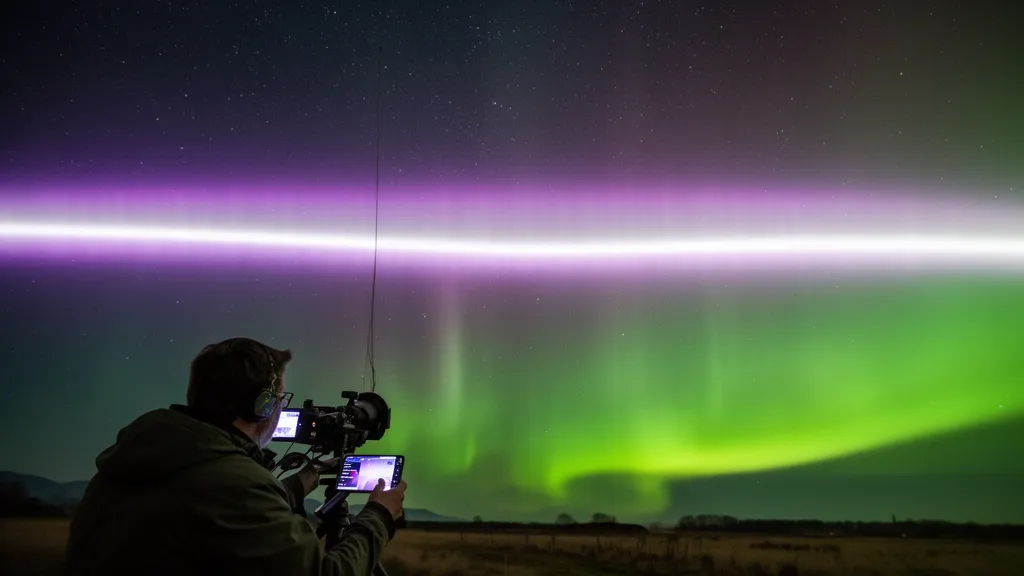
Operator’s Verdict: STEVE is a narrow mauve/purple arc visible during geomagnetic storms at subauroral latitudes — roughly equatorward of the main aurora oval. It is NOT aurora; it is caused by a hot plasma jet at 300–400 km altitude. It has no direct HF effect, but its presence signals a Kp 4–6 storm that will degrade polar HF paths.
Discovery: Citizen Scientists Beat the Professionals
In 2016, members of the Alberta Aurora Chasers group — a community of aurora photographers in Canada — began sharing images of an unusual feature: a narrow, ribbon-like arc of mauve or purple light stretching east-west across the sky, clearly distinct from the green and red curtains of the surrounding aurora.
Professional aurora scientists reviewing the images were puzzled. The feature did not match any known emission. It appeared at latitudes slightly south of the main auroral oval, and its colour — a pale purple-white — did not correspond to standard oxygen or nitrogen emission lines at 100–120 km altitude.
Pro Tip: If you observe STEVE visually, the same geomagnetic storm conditions are degrading HF polar paths. Check DXRadar’s aurora page for real-time Kp and Bz — if Kp is 4–6, shift HF operations to low-latitude paths or drop to 40m NVIS. Meanwhile, point a VHF Yagi northward and check 50.110 MHz for aurora scatter opportunities.
In 2016, space physicist Elizabeth MacDonald at NASA Goddard Space Flight Center reached out to the Alberta aurora community. The citizen scientists had data professionals lacked: thousands of photographs taken over years, geographically distributed, timestamped, with camera metadata intact.
The collaboration produced a landmark 2018 paper in Science Advances: “New science in plain sight: Citizen scientists lead to the discovery of optical structure in the upper atmosphere.” The authors named the phenomenon STEVE — initially a joke reference to the 2006 film Over the Hedge, in which animals name an unknown creature “Steve” to avoid admitting they have no idea what it is. The name was later backronymed to Strong Thermal Emission Velocity Enhancement.
What STEVE Actually Is
STEVE is an optical emission from the subauroral ionosphere, at altitudes between approximately 300 and 400 km. This is considerably higher than conventional aurora, which occurs at 100–150 km during electron precipitation.
The cause is a phenomenon called the subauroral ion drift (SAID): a narrow, fast-flowing (several km/s) westward plasma current that forms in the sub-auroral zone during the recovery phase of geomagnetic storms. This plasma jet heats the ambient neutral atoms through ion-neutral frictional heating, causing oxygen atoms to emit a characteristic mauve-to-white optical glow.
| Feature | Conventional Aurora | STEVE |
|---|---|---|
| Altitude | 100–150 km | 300–400 km |
| Mechanism | Particle precipitation | Plasma jet heating |
| Emission | Green (557.7 nm O), Red (630 nm O) | Mauve/purple-white (multiple) |
| Location | Auroral oval | ~5–10° equatorward |
| Duration | Minutes to hours | 20 minutes to ~1 hour |
The “picket fence” structure sometimes seen below STEVE — short vertical streaks of green — is a separate but related phenomenon caused by particle precipitation in the same region. It is classified separately from STEVE proper.
The Ham Radio Connection
STEVE appears during geomagnetic storms at Kp 4–6. For radio operators, this means:
What STEVE means for HF: Nothing directly. STEVE is an optical/thermal event, not an ionization event. It does not absorb or reflect radio waves. However, the same storm conditions that produce STEVE — elevated Kp, substorm activity, enhanced ring current — will significantly affect HF propagation on paths transiting the auroral zone.
If you are photographing STEVE from a mid-latitude location, your trans-Arctic HF paths (North America to Europe over the polar cap, Asia to North America via the Arctic) are likely experiencing significant degradation. 40m NVIS may still function for regional paths below approximately 40° N, but anything routing through the auroral zone above 60° N is at risk.
What STEVE means for VHF: During the storm conditions that produce STEVE, aurora scatter on 6m and 2m is often active equatorward of the main oval — which is exactly where STEVE appears. If you observe STEVE visually, it’s worth pointing your Yagi northward and checking 50.110 or 144.100 MHz SSB for aurora scatter signals.
How to Observe and Report STEVE
STEVE is visible to the naked eye and easily captured with standard DSLR cameras using wide-angle lenses. Key parameters:
- ISO: 800–3200 depending on sensor
- Aperture: f/2.8 or faster
- Exposure: 5–15 seconds (longer may show motion blur)
- Focus: Manual, set to infinity, confirmed on a bright star
STEVE typically appears as a narrow, roughly east-west oriented arc, often persisting for 20–60 minutes before fading. It often occurs after the main aurora display begins to quiet, during the recovery phase of a substorm.
The Aurorasaurus citizen science project (supported by NASA) collects STEVE reports alongside conventional aurora observations. Submitting timestamped photos with GPS coordinates and camera settings contributes to the ongoing scientific study of this phenomenon.
HamSCI and STEVE Research
The Ham Radio Science Citizen Investigation (HamSCI) project, which formally involves amateur radio operators in ionospheric research, has noted STEVE events as potential markers for studying subauroral ionospheric conditions. HamSCI’s Grape software-defined receiver network monitors ionospheric variations at HF frequencies, and STEVE events — well-documented by citizen photographers — provide opportunities to correlate visual observations with radio propagation measurements.
If you are operating a Grape receiver or participating in HamSCI’s Personal Space Weather Station program, logging your observations during a STEVE event adds scientific value.
Summary
STEVE is one of the more remarkable examples of citizen science producing a genuinely new atmospheric discovery. For radio operators, it is:
- Not a propagation hazard itself — it does not absorb or reflect radio
- A reliable marker of geomagnetic activity at Kp 4–6 — which does affect HF
- A cue for VHF aurora scatter — STEVE appears in the subauroral zone where aurora scatter is possible
- A photographic and scientific opportunity — well-documented observations have research value
Monitor geomagnetic conditions at DXRadar’s aurora dashboard whenever STEVE or aurora is forecast.
Frequently Asked Questions
What is STEVE?
STEVE (Strong Thermal Emission Velocity Enhancement) is a narrow, mauve or purple arc of optical emission that appears in the subauroral zone — roughly 5–10 degrees equatorward of the regular auroral oval — during and after geomagnetic storms. Despite its similarity to the aurora in photos, STEVE is caused by a different physical mechanism: a fast-flowing ribbon of hot plasma at 300–400 km altitude in the subauroral ionosphere, not by precipitating electrons like conventional aurora.
Is STEVE an aurora?
No. STEVE is not classified as aurora by the scientific community. Aurora is produced by charged particles (electrons and protons) precipitating from the magnetosphere into the upper atmosphere at 100–150 km altitude. STEVE is an optical emission from the subauroral ionosphere at 300–400 km altitude, caused by a westward-flowing plasma jet (the subauroral ion drift, or SAID) heating neutral oxygen atoms. The distinction matters scientifically but both phenomena are spectacular visually.
What Kp level is needed to see STEVE?
STEVE appears during geomagnetic storms, typically requiring Kp 4–6 at mid-latitudes (approximately 50–60° geographic latitude). Unlike the main auroral oval, STEVE appears slightly equatorward, which means it can sometimes be visible at latitudes where the aurora itself is not prominent. Reports from the Alberta Aurora Chasers citizen scientist community show STEVE most frequently at Kp 4–5 events.
Does STEVE affect HF radio propagation?
STEVE itself has no confirmed direct effect on HF propagation — it is an optical/thermal phenomenon at altitude, not an ionization event. However, STEVE appears during geomagnetic storms that do affect HF propagation. The correlation is: if you’re seeing STEVE, a Kp 4–6 storm is underway, and your high-latitude HF paths (especially transpolar routes) will be degraded. The storm causes the HF effects, not STEVE.
Who discovered STEVE?
STEVE was formally identified through a collaboration between citizen scientists in the Alberta Aurora Chasers Facebook group and professional scientists. In 2016, aurora photographers noticed a distinct mauve arc that didn’t match any known phenomenon. They shared images with researchers at NASA and the University of Calgary. The formal scientific description was published in Science Advances in 2018 by MacDonald et al., who coined the acronym ‘STEVE’ as a playful reference before it became an official backronym.