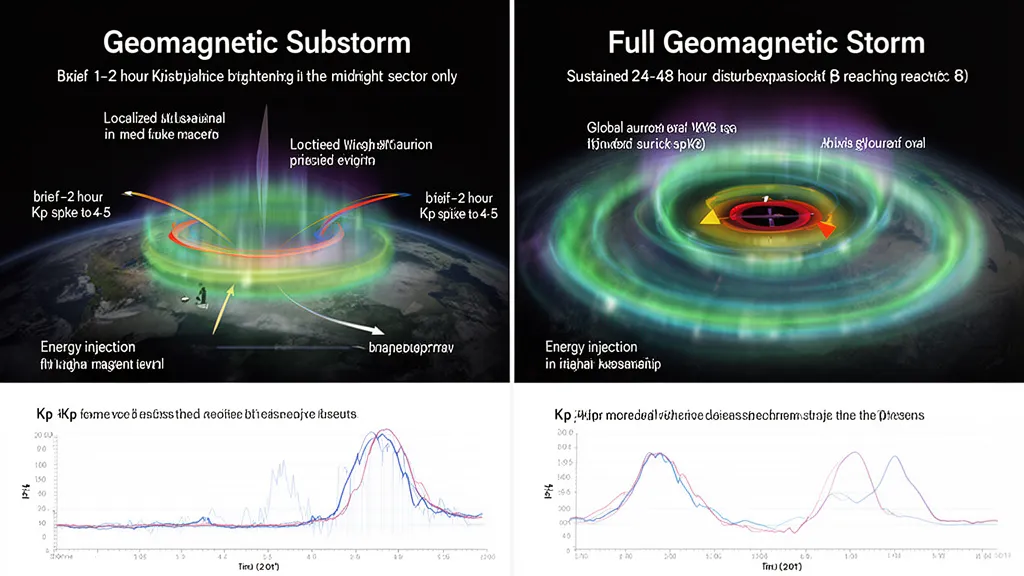
What Distinguishes a Substorm from a Geomagnetic Storm
A geomagnetic storm and a magnetospheric substorm are distinct physical events, not synonyms. Conflating them leads to incorrect expectations about HF degradation and missed VHF aurora scatter opportunities. Understanding the difference lets you predict radio conditions more accurately than Kp alone permits.
A geomagnetic storm is a planet-scale disturbance of Earth’s magnetosphere driven by a sustained southward interplanetary magnetic field (Bz) component following a CME or high-speed stream arrival. The defining measurement is the Dst index, which tracks the ring current intensity. Dst falling below −50 nT defines a moderate storm (G2); below −100 nT defines a severe storm (G3–G4). Storms last hours to days and affect the entire global magnetosphere.
A magnetospheric substorm is a separate, shorter energy loading and release cycle in Earth’s magnetotail. It lasts 1–3 hours per cycle, can occur at any overall Kp level (including during complete magnetic calm), and is fundamentally about magnetic reconnection in the tail rather than ring current intensification in the inner magnetosphere.
The key operational difference: a storm is what kills HF; a substorm is what produces the brief, intense aurora scatter opening on 6m at Kp 4.
The Physics of a Substorm: Load, Release, Recover
The magnetospheric substorm cycle has three phases, described by the Akasofu substorm framework:
Growth Phase (15–60 minutes)
Solar wind energy flows into the magnetotail, stretching and loading the plasma sheet. The auroral oval brightens slightly but remains relatively quiet. The magnetotail stretches from its typical 20 Earth-radii extent to 30 or even 40 Earth radii. During this phase, no dramatic HF or VHF effects are visible — the energy is being stored.
Expansion Phase (15–30 minutes)
Magnetic reconnection occurs abruptly in the magnetotail, typically at 10–20 Earth radii (approximately 64,000–128,000 km behind Earth). The reconnection releases the stored magnetic energy explosively. This is the aurora breakup. The aurora brightens rapidly in the midnight sector (local midnight auroral zone), then expands poleward and westward in a characteristic pattern called the westward travelling surge.
For radio operators, this is the signal: rapid brightening of aurora in the midnight sector, followed by poleward expansion and the classic “dancing curtains” visual signature. If you are on 6m during this phase, open the FT8 or CW window — aurora scatter signals may appear immediately.
Recovery Phase (30–120 minutes)
The magnetotail returns to a near-normal configuration. Aurora fades from the breakup pattern, drifts equatorward, and displays quieter forms (arcs, bands). HF conditions at high latitudes briefly deteriorate further (D-layer absorption from particle precipitation), then recover.
The entire cycle from growth onset to recovery end typically spans 1–3 hours. Multiple substorms can occur on the same evening — three to five substorm cycles per day is common during active solar wind conditions.
Pro Tip: The AE (Auroral Electrojet) index is a more sensitive substorm detector than Kp, because Kp is a 3-hour average that can mask a sharp substorm spike. Real-time AE data is available from the Kyoto World Data Center (wdc.kugi.kyoto-u.ac.jp). An AE spike above 500 nT typically indicates an active substorm. An AE spike above 1,000 nT is a strong substorm and often produces good 6m aurora scatter.
Substorms During Quiet Conditions: The Surprise Aurora Scatter Opening
The most important operational consequence of substorms for ham radio is that they can produce intense aurora scatter on 6m and 2m even when Kp is only 3–4. Geomagnetic storm watch? Not required. G-scale alert? Not required. If the solar wind delivers a brief southward Bz pulse sufficient to trigger magnetotail reconnection, a substorm follows.
The aurora breakup expands the auroral oval equatorward — temporarily. During the expansion phase, the equatorward edge of the oval may move 5–10° equatorward within minutes. For an operator at 50°N geomagnetic, the oval may suddenly come within aurora scatter geometry for 20–30 minutes and then retreat.
This explains a pattern experienced VHF operators recognise: on a quiet day with Kp forecast at 2–3, a 30-minute 6m aurora scatter opening appears around magnetic midnight, then disappears. No storm declared, Kp still averaging 3 for the period — but the substorm expansion phase was intense enough to produce scatter.
The practical approach for VHF operators:
- Monitor the real-time IMF Bz from NOAA SWPC or DXRadar solar weather tools. A southward rotation to Bz −5 nT or below is a substorm precursor.
- Watch local magnetometer data if available — a rapid swing of the horizontal component is a substorm signature.
- When you see these signatures, put on 6m CW or FT8 immediately. The window is short.
Substorms vs. Storms: Radio Impact Comparison
| Characteristic | Geomagnetic Storm (G2+) | Magnetospheric Substorm |
|---|---|---|
| Duration | Hours to days | 1–3 hours per cycle |
| Global extent | Planet-wide | Localised (midnight sector, auroral zone) |
| Kp threshold | Kp 5+ defines onset | Can occur at Kp 1–3 |
| HF degradation | Sustained; polar paths fail for hours | Brief; mostly high latitudes; 30–90 minutes |
| Aurora scatter (VHF) | Sustained during main phase | Brief, intense during expansion phase |
| Visual aurora | Widespread, equatorward of oval | Intense breakup in midnight sector |
| Dst signal | Drops below −50 nT | Usually small Dst perturbation |
| Predictability | CME/stream arrival provides hours of warning | Difficult to predict exact timing |
Substorms Superimposed on Storms
During an active geomagnetic storm, substorms continue to occur on top of the storm-level activity. A G3 storm does not simply maintain steady Kp 7 — it exhibits substorm cycles with rapid Kp fluctuations within the overall disturbed period. This is visible in the 3-hour Kp time series: instead of a smooth curve through the storm, you see jagged peaks corresponding to individual substorm injections.
For HF operators, this means a storm does not degrade HF uniformly. There can be brief periods of slightly improved propagation (inter-substorm lulls) within a major storm, though these are generally not long enough for consistent HF operation. For VHF operators, storm-time substorms produce the most intense aurora scatter — the expansion phases are more energetic because the magnetotail has loaded more energy during the overall disturbed period.
During the May 2024 G5 storm, operators reported multiple distinct episodes of VHF aurora scatter on 6m and 2m, each lasting 20–60 minutes, with quiet periods of 30–90 minutes in between. These episodes corresponded to individual substorm cycles superimposed on the G5 main phase.
How Kp Can Mislead: The Substorm Problem
Kp is a 3-hour averaged index. A single intense substorm occurring within one 3-hour period contributes to that period’s Kp value, but is averaged with the quieter conditions before and after. A Kp report of 4 for a 3-hour period could mean:
- Steady Kp 4 throughout (minor activity uniformly distributed)
- A brief substorm spike to Kp 7 for 45 minutes within a quiet background of Kp 2–3
These two situations produce very different radio effects. The brief substorm spike at Kp 7 may produce better aurora scatter during its peak than the steady Kp 4 condition — but the 3-hour averaged Kp does not reveal this.
For radio operators who rely on Kp alone, this averaging creates false confidence during quiet periods and may cause them to miss brief high-activity windows. The more granular the data, the more actionable it is:
- 1-minute Kp equivalent (ak index): Provides near-real-time activity level with less averaging
- AE index: Most direct measure of substorm activity (available in quasi-real-time from Kyoto WDC)
- Real-time magnetometer data: Ground stations near your latitude provide immediate local activity signatures
- IMF Bz (DSCOVR): 15–60 minute lead time on substorm triggers
Pro Tip: For aurora scatter hunting, the most actionable real-time data source is the IMF Bz from NOAA’s DSCOVR feed, combined with your local magnetometer deflection. Set up a browser tab with the NOAA real-time solar wind product (swpc.noaa.gov/products/real-time-solar-wind). When Bz drops below −5 nT, listen on 50.150 MHz (CW) or 50.230 MHz (FT8) for aurora scatter signals. You will catch openings that Kp-watchers miss.
Identifying a Substorm in Progress
If you are at a high-latitude location and you see the following on the aurora camera or outside:
- Quiet arc low on the northern horizon
- Sudden rapid brightening in one sector (often in the NE–N direction)
- Brightening expands poleward and westward — the aurora “breaks up”
- Active curtains and rays, sometimes rapid motion (seconds per full movement)
- Green (and sometimes red at higher altitudes) with rapid flickering
You are observing an auroral substorm expansion phase. Get on 6m or 2m immediately. The scatter geometry is best when pointing roughly toward the brightest part of the aurora — often north to north-northeast from mid-latitude locations.
For radio-only detection (no visual), a rapid increase in noise from the auroral direction on a fixed-antenna 6m receiver, or sudden appearance of drift-spread signals in the 50.1–50.2 MHz range on a wide SDR waterfall, indicates the aurora scatter onset.
Frequently Asked Questions
What is a magnetospheric substorm?
A magnetospheric substorm is a 1–3 hour energy release event in Earth’s magnetotail caused by magnetic reconnection at approximately 10–20 Earth radii. It produces rapid auroral brightening and expansion (aurora breakup), increases particle precipitation at auroral latitudes, and can generate brief intense aurora scatter on VHF even without a full geomagnetic storm.
What is the difference between a substorm and a geomagnetic storm?
A geomagnetic storm is a sustained, planet-scale magnetospheric disturbance lasting hours to days, defined by Kp 5+ and Dst below −50 nT, caused by CME or high-speed stream arrival. A substorm is a shorter (1–3 hour), more localised magnetotail energy release that can occur independently at any Kp level. Storms degrade HF for hours; substorms cause brief disruption on high-latitude paths.
Can a substorm produce aurora scatter without a full storm?
Yes. A substorm at Kp 3–4 can produce a 15–45 minute aurora scatter opening on 6m and 2m during its expansion phase. This is the explanation for unexpected short VHF aurora openings on otherwise quiet evenings.
How can I detect a substorm in real time?
Monitor the IMF Bz component from NOAA’s DSCOVR real-time solar wind feed — a rapid southward rotation to −5 nT or below is a substorm precursor. The AE (Auroral Electrojet) index, available from Kyoto World Data Center, provides the most direct substorm signature; spikes above 500 nT indicate active substorm conditions.
Does a substorm affect HF radio?
Substorm HF effects are brief (30–90 minutes) and mostly confined to high latitudes. At mid-latitudes, isolated substorms produce little detectable HF degradation. In contrast, full geomagnetic storms cause sustained HF degradation on polar and high-latitude paths for hours to days.
For companion reading, see Kp Index and Aurora: Visibility and Radio Effects and Aurora Scatter on VHF. Monitor real-time IMF Bz and geomagnetic activity on the DXRadar aurora page.