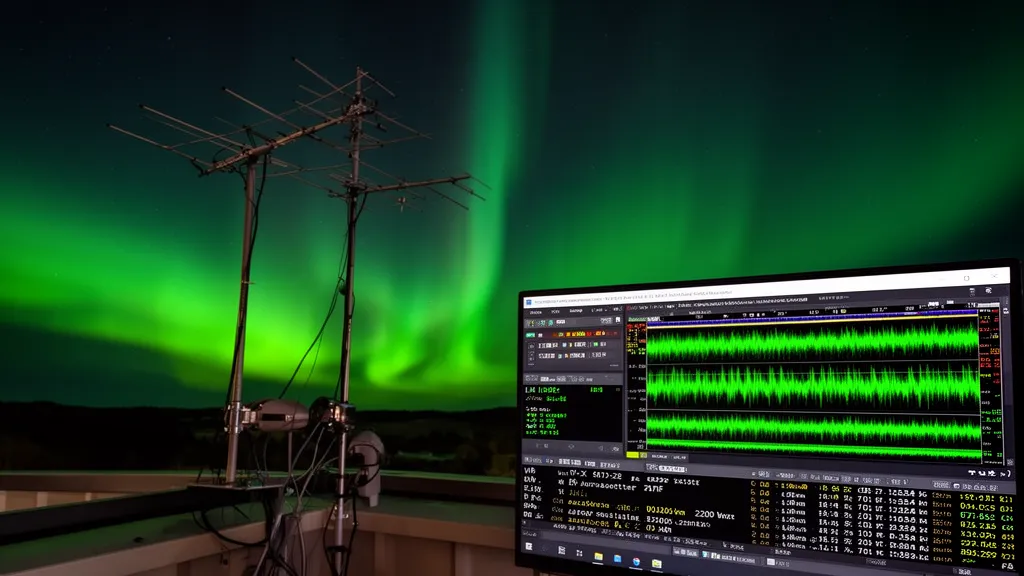
The Physics of Aurora Scatter
Aurora scatter on VHF operates through a mechanism fundamentally different from every other ionospheric propagation mode. Where F2 propagation reflects signals off the smooth F-layer, and sporadic-E reflects off coherent E-layer patches, aurora scatter scatters signals off a turbulent field of plasma irregularities aligned along the Earth's magnetic field lines in the auroral ionosphere.
During geomagnetic storms, energetic charged particles precipitate along magnetic field lines into the auroral zone, depositing energy into the E-region ionosphere at altitudes of 90–130 km. This creates intense ionization in a complex, dynamic structure — not a smooth layer but a turbulent, striated region of density variations. These density variations, aligned approximately parallel to Earth's magnetic field, are called field-aligned irregularities (FAIs).
VHF signals in the 50–300 MHz range scatter off FAIs with significant efficiency when the radar geometry is appropriate — specifically, when the signal propagation path is perpendicular (or near-perpendicular) to the magnetic field lines at the aurora region. This geometric constraint explains the key operating technique: both stations must point antennas toward the common region of auroral ionosphere that satisfies the perpendicularity condition. For stations in the northern hemisphere, this means beaming toward the magnetic north — toward the auroral oval — rather than directly at each other.
The scattering region altitude (90–130 km) is well below the F2 layer (200–400 km) and slightly above or within the normal sporadic-E layer (90–120 km). The location moves with the auroral oval — during quiet conditions, the oval sits near 67°–70° geomagnetic latitude; during a G3 storm it expands to ~55°; during a G5 it can reach 40°–45°. As the oval moves equatorward, more stations can illuminate the same aurora region simultaneously, extending aurora scatter into lower latitudes.
Signal Characteristics: The Aurora Signature Sound
Any operator who has heard an aurora scatter signal can identify it immediately. The characteristic sound is harsh, raspy, and buzzy — unlike any other propagation mode.
The cause is Doppler spectrum spreading. A normal reflected signal returns a clean, narrow Doppler shift. Aurora scatter returns signal energy spread across a range of Doppler shifts because each irregularity in the turbulent FAI region is moving at a slightly different velocity. The composite signal at the receiver is a superposition of hundreds of slightly different frequency components, all within a few hundred hertz of the nominal frequency, producing the characteristic rough sound.
On CW, this manifests as: instead of a clean tone, the signal sounds like a buzz or a harsh "Bzzzz" rather than "Beeeep." Experienced aurora operators say it sounds like someone running a stick along a fence — rapid amplitude variations superimposed on the signal, with no two moments of silence looking the same.
On SSB, the signal is largely unintelligible. Voice audio becomes a rough, unintelligible modulated noise. For this reason, SSB is essentially useless for aurora scatter contacts except at very high signal levels with mild aurora disturbance.
On FT8, the tone spreading partially defeats the decoder. A spreading of 50–200 Hz on the FT8 tones — which have 50 Hz nominal spacing — can make the decoder fail even on signals that copy well to the ear on CW. CW remains the mode of choice for aurora scatter; JT65A performs better than FT8 for aurora due to its wider tone spacing.
Operator's Verdict: CW is king on aurora scatter. An operator with a 100W transceiver, a 4-element 6m Yagi, CW proficiency, and 15 minutes of aurora scatter experience will out-contact operators running FT8 with the same hardware. The mode advantage reverses from normal propagation: aurora scatter rewards the CW skill.
Geometry: Why You Beam North, Not at Your Target
The most common beginner mistake in aurora scatter is beaming toward the other station. That is incorrect. Both stations must beam toward the common auroral scatter volume — the patch of FAI-dense ionosphere that both antennas can illuminate simultaneously.
For two stations at, say, 500–1,000 km apart in the mid-latitudes of the northern hemisphere, the geometry works as follows:
- The auroral oval is approximately 1,000–2,000 km to the north of both stations during a moderate storm
- Both stations beam toward a common point in the auroral oval that is roughly north of each
- Station A transmits, signal travels north, scatters off FAIs, returns southward toward Station B
- Station B receives the scattered signal from that northern scatter point
For this to work, both stations need to illuminate the same patch of aurora. If the two stations are east and west of each other at similar latitude, they both beam north and both illuminating the same auroral zone — the geometry works. If one station is 1,000 km to the south of the other, the geometry is more complex and specific heading calculations are needed.
The practical guidance: for most mid-latitude aurora contacts, point within ±30° of magnetic north. The exact optimal heading changes as the aurora oval moves during the storm. Some operators sweep their antenna heading across the 300°–030° range to find the strongest scatter response — the maximum usually indicates the bearing to the densest FAI concentration.
For distances greater than 1,500 km on aurora scatter, the geometry requires the stations to have their antennas pointing in somewhat different directions to both illuminate the same auroral zone — a more advanced calculation based on knowing both grid squares and the approximate oval position.
Conditions Required: Kp Thresholds and Oval Position
Not all geomagnetic activity produces workable aurora scatter. The conditions need to satisfy several criteria simultaneously.
On 6m (50 MHz):
- Kp5 or above is typically the minimum for workable scatter
- The auroral oval must have expanded to within approximately 500–800 km of one of the operating stations
- Elevation angle requirements are modest — the aurora region at 90–130 km altitude is visible at low elevation angles (5–20°) from distances of hundreds of kilometers
On 2m (144 MHz):
- Kp6 or above is generally needed
- Higher frequency reduces backscatter efficiency, requiring either more intense aurora (stronger FAIs) or the oval to be closer to the stations
- Path attenuation is higher at 144 MHz for the same geometry
Season and time of day matter less than for other modes. Aurora scatter is driven by particle precipitation, not by solar UV — it works equally well at 03:00 UTC or 15:00 UTC, in midwinter or midsummer. Some operators note that post-midnight activity can be more intense due to substorm occurrence statistics, but this is a statistical tendency, not a rigid rule.
Geographic sweet spots for aurora scatter in the northern hemisphere:
- Scandinavia: Norway, Sweden, Finland, Iceland — directly under or adjacent to the auroral oval even at moderate Kp levels; best 2m aurora activity in the world
- Scotland, northern England: frequent Kp5–Kp6 events put the oval within range; strong DX on 6m to central Europe and 2m to Scandinavia
- Northern Canada (Manitoba, Ontario, Quebec): access to aurora at Kp5–Kp6; 6m contacts throughout eastern North America
- Alaska: deep within the auroral zone; extreme aurora scatter activity during storms
Southern hemisphere aurora scatter mirrors this in the opposite hemisphere — southern Australia, New Zealand, southern South America, and the Falkland Islands have equivalent access to the southern auroral oval.
Monitor DXRadar's Kp trend in addition to the current value. A Kp that has been 4 for two hours and is rising toward 5 is a better setup than a Kp that just dropped from 7 to 5 — the rising phase often produces more intense and structured FAIs than the recovery phase. Set up your antenna before the peak, not after.
Operating Technique: Making the Contact
Aurora scatter contacts have a characteristic operating procedure shaped by the signal properties.
Before the contact:
- Point antenna toward magnetic north (approximately 000°–020° magnetic in most mid-latitude locations)
- Tune to the aurora CW calling frequency: 50.110 MHz (6m) or 144.100 MHz (2m)
- Listen for the characteristic harsh tone indicating aurora scatter is active
- Use headphones — the raspy aurora tone is easier to copy when you're not fighting room noise
Making the call:
- Send CW at 12–18 WPM — faster than normal. Slow CW is harder to copy through aurora buzz.
- Use short, standard calls: "CQ AU K2ABC" (AU = aurora)
- Exchange: signal report + grid square. Reports use a special aurora notation: 57A, 55A, etc. — the "A" denotes aurora scatter.
- Keep transmissions short — aurora intensity varies rapidly. Copy what you can and confirm quickly.
Power and antenna:
- 100W is the standard minimum for aurora scatter on 2m. 400W is more comfortable.
- On 6m, 100W with a 4-element Yagi or larger is workable; 50W to a dipole is marginal.
- High-gain antennas provide significant benefit because you can concentrate EIRP on the scatter volume.
- Antenna orientation matters more than power. Correct bearing to the auroral zone outweighs extra watts pointed the wrong direction.
When conditions change:
Aurora scatter conditions fluctuate on timescales of minutes as FAI intensity varies with the geomagnetic storm's substorm activity. Operators report signals going from S9 to nothing and back to S9 within 5 minutes. Patience during lulls and rapid operating during peaks is the key skill.
Notable Aurora Scatter Records and Events
The most productive aurora scatter conditions occur during G4–G5 geomagnetic storms when the oval expands dramatically equatorward, enabling new contact geometry and opening aurora scatter to operators who rarely experience it.
The May 2024 G5 storm produced remarkable activity on 6m aurora scatter. Operators in central Europe — latitudes that rarely see aurora scatter — worked stations across 1,200–1,800 km via aurora scatter for several hours during the storm's main phase. Reports from ON, DL, F, and OZ operators documented contacts that would be impossible in typical conditions.
Documented distance records:
- 6m aurora scatter: > 3,000 km has been reported on exceptional G5 events, though most contacts fall in the 600–1,500 km range
- 2m aurora scatter: reliable contacts to approximately 1,500 km; records of 2,500+ km on rare G5 events
- 70 cm (432 MHz): aurora scatter contacts have been made on rare extreme events, typically under 800 km
The October 2003 Halloween storms remain the gold standard for aurora scatter activity in modern ham radio history. European operators on 2m documented hundreds of contacts over several days, with aurora visible from France and Spain. The DX logs from that event are studied by aurora enthusiasts for insight into optimal operating technique during extreme conditions.
DXRadar and Aurora Scatter Operations
DXRadar's aurora dashboard provides the real-time data needed to prepare for aurora scatter operations:
- Kp index: threshold monitoring for 6m (Kp5) and 2m (Kp6) opportunities
- Hemispheric Power: leading indicator of substorm activity that can precede Kp increases
- Aurora oval map: NOAA OVATION model showing estimated equatorward boundary — your most direct visual tool for judging whether the oval is close enough
- Bz component: negative Bz in the solar wind is the primary driver of geomagnetic storms; watching Bz go negative is your early warning to set up antennas and monitor the aurora calling frequencies
Set a Kp alert at threshold 4 on DXRadar, not 5. At Kp4, aurora is probably not workable yet, but it gives you 30–60 minutes to set up your antenna, tune the transceiver, and monitor the calling frequency before conditions become active. Being ready before Kp5 means you catch the opening from the start, not after other stations have already filled the pileup.
Frequently Asked Questions
What is aurora scatter on VHF?
Aurora scatter is a propagation mode at 50 MHz and 144 MHz where VHF signals scatter off field-aligned irregularities (FAIs) in the auroral ionosphere at 90–130 km altitude during geomagnetic storms. It enables contacts over 500–2,000 km between stations that can simultaneously illuminate the aurora region. Signals have a distinctive harsh, raspy quality caused by Doppler spectrum spreading.
What Kp is needed for aurora scatter?
Kp5 or above for 6m (50 MHz) aurora scatter; Kp6 or above typically for reliable 2m (144 MHz) work. The oval must also have expanded to within a few hundred kilometers of at least one of the operating stations. During G4–G5 storms (Kp8–9), aurora scatter reaches stations far south of their usual range.
Why do aurora scatter signals sound so distorted?
The signal scatters from many individual FAI elements, each moving at a slightly different velocity. Each contributes a slightly different Doppler shift to the received signal. The composite at the receiver is a spread of closely packed frequencies, producing the characteristic raspy, harsh buzzing tone. There is no discrete reflection off a smooth surface — the scattering is distributed and turbulent.
Which direction should I beam for aurora scatter?
Toward magnetic north — toward the auroral oval — not directly at the other station. Both stations aim at the common auroral scatter volume that lies to the north of both. Optimal heading is typically 330°–030° magnetic for most mid-latitude northern hemisphere stations, with the exact bearing depending on oval position and your latitude.
Does FT8 work for aurora scatter?
FT8 works but has limitations. Signal spreading from aurora scatter can widen the FT8 tone structure enough to defeat the decoder even on signals audible on CW. CW remains the most effective mode for aurora scatter because it tolerates Doppler spread better. JT65A performs better than FT8 for aurora due to wider tone spacing. Many experienced aurora operators use CW exclusively.
What are the best frequencies for aurora scatter?
6m CW calling: 50.110 MHz; 6m FT8: 50.313 MHz. 2m CW calling: 144.100 MHz. Both bands show aurora activity clustering on and near the CW calling frequencies during storms. Directional antennas — 4-element or larger Yagi on 6m, 9-element or larger on 2m — provide meaningful advantage over omnidirectional antennas.
What is the maximum distance for aurora scatter contacts?
Most contacts fall in the 500–1,500 km range. Under extreme G4–G5 storm conditions, the oval expands far enough equatorward to enable contact geometry out to 2,500+ km on 2m and 3,000+ km on 6m in documented cases. These distances require the oval to be simultaneously within range of both stations and the geometry to place both within the scatter volume's illumination cone.