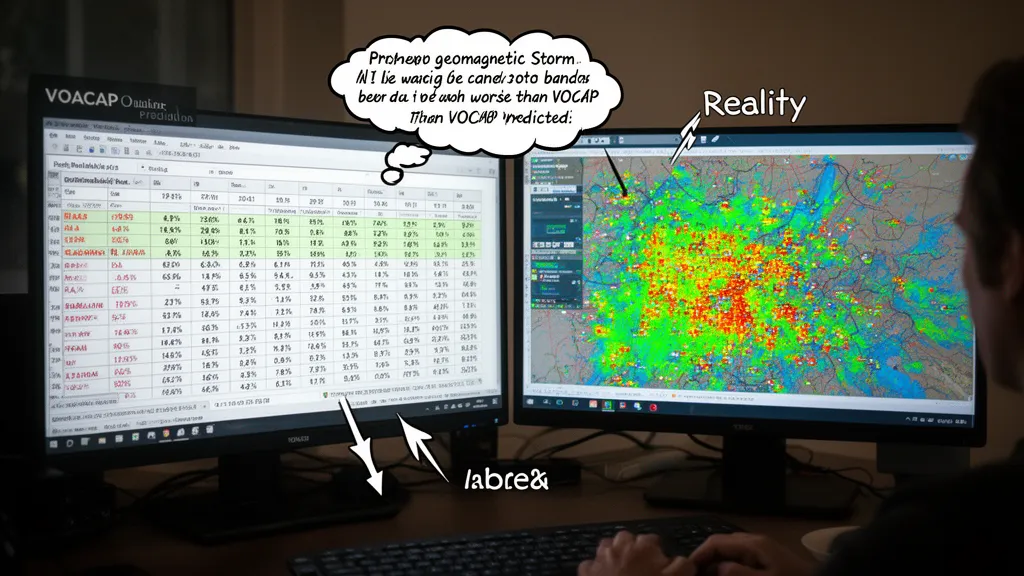
Operator's Verdict: VOACAP answers "what bands are probably good between these locations this month?" Live spots answer "what is open right now?" Use VOACAP for planning expeditions and antenna choices weeks in advance. Use DXRadar's live propagation data for deciding what band to operate in the next 30 minutes.
The Fundamental Difference
VOACAP and live DX spots answer different questions. Conflating them leads to frustration when VOACAP says "20m is 90% reliable" and you can't hear anything on 20m — or when VOACAP says "10m is 20% reliable" and 10m is completely open due to sporadic-E.
The distinction is statistical vs. observational:
- VOACAP = statistical prediction based on ionospheric models and historical data
- Live spots = direct observation of what operators are actually hearing right now
Neither is "better" — they answer different questions.
Pro Tip: Use VOACAP for planning and DXRadar for execution. Feed the current SFI from DXRadar's solar weather page into VOACAP for the most accurate predictions, then verify with best bands now before you transmit. If live spots contradict the prediction, trust the spots — reality always beats the model.
What VOACAP Is Good At
Long-range path planning
Before a DXpedition to a rare location, VOACAP answers questions like:
"If I operate from Bouvet Island (3Y0) in February with 100W and a dipole, what hours will 20m be workable to European stations?"
VOACAP generates an hour-by-hour table showing predicted signal reliability percentages. An 80% reliability prediction means that, under median conditions for that month, 80% of attempts will produce a workable signal. This guides operating schedule planning.
Antenna selection
VOACAP can calculate performance difference between two antenna designs for a specific path. "Will a 3-element Yagi aimed northeast produce better reliability to Japan than a dipole?" — VOACAP answers this quantitatively.
Understanding long-term band behaviour
The long-term statistical pattern of HF propagation is well-captured by VOACAP:
- Winter = better low-band performance at high latitudes
- Solar maximum = 10m reliable year-round; solar minimum = 10m unreliable
- 40m works both day and night at mid-latitudes; 15m is mainly a daytime band
These patterns are stable enough that VOACAP statistical output is reliable for strategic planning.
What VOACAP Can't Do
Sporadic-E prediction
VOACAP's ionospheric model does not include sporadic-E clouds. The sporadic-E plasma is localised, random, and cannot be predicted from climatological statistics. A VOACAP prediction for 10m in June may show 30% reliability — but during a major Es opening, 10m is 100% open for thousands of kilometres. Equally, during a day without Es, 10m may be completely closed despite VOACAP's statistical expectation.
This is the most important VOACAP limitation for 10m, 6m, and 15m operators.
Real-time storm effects
During a G3+ geomagnetic storm, VOACAP's predictions are essentially invalidated for high-latitude and polar paths. The storm depresses the F layer, increases absorption, and disrupts the MUF in ways that VOACAP's median statistical model doesn't capture. If you rely on VOACAP predictions during a storm, you'll be operating on bands that the model says are "good" but that are actually severely degraded.
Current DX activity
VOACAP tells you propagation probabilities, not whether anyone is on the air. A path can be statistically excellent while no operators are active on that band.
How DXRadar Complements VOACAP
DXRadar provides what VOACAP cannot: current, observational data.
| Need | Use |
|---|---|
| Plan a DXpedition in 3 months | VOACAP |
| Know which band is open right now | DXRadar propagation map |
| Understand why 15m is good today | DXRadar solar weather (current SFI) |
| Understand why 15m failed last Tuesday | VOACAP baseline + DXRadar storm history |
| Choose antenna for 10m DX work | VOACAP |
| Find active DX stations right now | DXRadar DX cluster map |
Using VOACAP with DXRadar's Solar Data
When using VOACAP for predictions, input the current SFI from DXRadar's solar weather page. VOACAP requires you to specify the solar activity level (SFI or SSN). Using the actual current SFI rather than a climatological average improves prediction accuracy for current conditions.
For example:
- In January 2025 with SFI = 220 (Solar Cycle 25 maximum): enter 220 into VOACAP → predictions show strong 10m, 15m performance
- Same month in 2019 with SFI = 70 (solar minimum): enter 70 → VOACAP shows 10m essentially unusable
The solar weather context from DXRadar feeds directly into VOACAP's key input parameter, making the combination more powerful than either tool alone.
Practical Workflow
For a weekend operating session:
Day before:
- Open VOACAP Online (voacap.com) and enter your grid square + target region
- Set SFI to current value from DXRadar
- Review the hour-by-hour band table — which bands are predicted good at your planned operating times?
Day of, 30 minutes before operating:
- Open DXRadar's propagation map — confirm the bands VOACAP predicted are actually showing spots
- Check solar weather — any storm or flare that might change the prediction?
- Look at best-bands-now for the current colour-coded summary
During the session:
- Trust live spots over VOACAP for real-time decisions
- If a band VOACAP said would be poor is showing active spots, try it — reality beats prediction
- If VOACAP said a band would be good but it's silent, check DXRadar for storm/flare events that may have changed conditions
The most effective operators combine the strategic planning of VOACAP with the real-time awareness of DXRadar live data.
Frequently Asked Questions
What is VOACAP and how does it work?
VOACAP (Voice of America Coverage Analysis Program) is a long-range HF propagation prediction software developed by the US Institute for Telecommunication Sciences, based on the ITU-R P.533 recommendation. It uses a statistical ionospheric model to predict, for any given month and year, the probability of successful communication between two specific locations on each HF band at each hour of the day. VOACAP requires inputs of: transmit location, receive location, antenna types, transmit power, required reliability, and the solar flux (SFI) or sunspot number. It outputs a table showing which bands are predicted to support communication during each hour, with reliability percentages.
What are the limitations of VOACAP predictions?
VOACAP produces statistical averages, not real-time predictions. It tells you what propagation is like in median conditions for a given month — it cannot tell you what is happening right now. VOACAP does not model: sporadic-E (which is inherently unpredictable), geomagnetic storms (which can dramatically change conditions from the statistical average), sudden ionospheric disturbances (radio blackouts), or the actual solar activity on the specific day you're operating. Predictions assume quiet geomagnetic conditions. During a G3+ storm, VOACAP's prediction of 'good 15m propagation' may be completely wrong because the model assumes conditions the storm has invalidated.
What do live DX spots show that VOACAP can't?
Live DX spots (from PSKReporter and the DX cluster) show what is actually happening on the radio at this moment. They reveal: whether a sporadic-E opening is occurring (impossible to predict with VOACAP), whether a geomagnetic storm has closed the high bands (VOACAP assumes quiet conditions), which specific geographic paths are working right now (VOACAP gives statistical probability, not real-time status), and whether a rare DX station is active. The spots are direct observational evidence — they tell you that W3XYZ was heard in Japan right now, which is more useful for making a contact than any model prediction.
When should I use VOACAP instead of live spots?
VOACAP is most valuable for: planning a DXpedition (what bands will work between my planned location and the regions I want to reach, during which hours?), building an antenna system (which antenna pattern maximises coverage to my target regions?), scheduling a contact with a specific station (what hour is 15m most likely to be open between my location and theirs?), and understanding long-term band behaviour (is 10m worth operating in January at this solar cycle phase?). These are advance-planning questions where statistical probability is more useful than snapshot real-time data.
Does DXRadar use VOACAP internally?
DXRadar uses live observational data (PSKReporter, DX cluster, NOAA solar indices) rather than VOACAP predictions as its primary data source. The live data approach provides current conditions rather than statistical averages. DXRadar's band condition assessments (best-bands-now, band status pages) are based on observed spot density and solar indices, not VOACAP models. This makes DXRadar better for 'what's happening right now' questions. For long-range planning using statistical models, VOACAP Online (free at voacap.com) remains the standard tool.