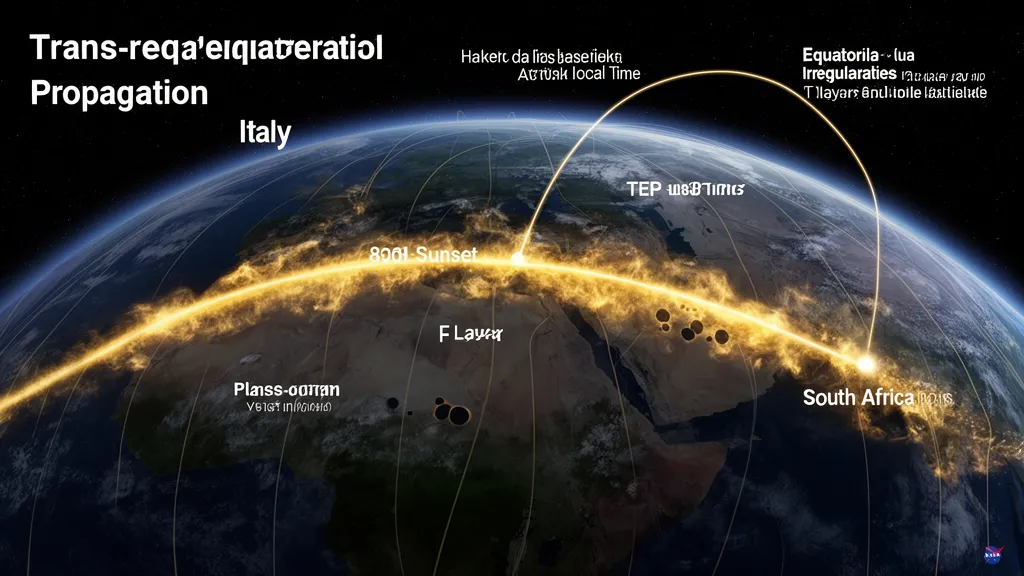
Operator’s Verdict: Trans-equatorial propagation carries 144 MHz signals 4,000–9,000 km using equatorial plasma bubbles as a natural relay. Seasonal windows are March–April and September–October. Only stations within ~35° magnetic latitude of the equator can participate. Solar Cycle 25 maximum (2025–2026) is the best time in a decade to attempt TEP contacts.
The Unique Physics of Trans-Equatorial Propagation
Trans-equatorial propagation stands apart from all other VHF propagation modes. Sporadic-E, tropo ducting, and meteor scatter all involve relatively straightforward scattering or refraction. TEP involves guided propagation along Earth’s magnetic field lines through a region of the ionosphere that develops plasma instabilities — essentially natural plasma turbulence in the equatorial F layer.
The mechanism requires two conditions:
-
Equatorial plasma bubbles: After local sunset, the bottom of the equatorial F layer rises rapidly. This creates conditions for the Rayleigh-Taylor plasma instability — analogous to a dense fluid sitting atop a lighter one. The instability produces rising columns of depleted plasma (plasma bubbles) that create intense electron density irregularities in the F layer.
-
Magnetic field geometry: Earth’s magnetic dipole field lines from the northern hemisphere connect to conjugate points in the southern hemisphere. The plasma bubbles that form along these field lines create a scattering medium that guides VHF signals along the field geometry, effectively acting as an ionospheric relay 300–1,000 km overhead.
The combination produces propagation paths that are physically impossible for ground-wave or simple single-hop ionospheric modes. Signals effectively travel upward from the transmitter, are scattered and guided by plasma bubbles in the equatorial ionosphere, and descend to the distant receiver — paths spanning 4,000–9,000 km.
Pro Tip: TEP is suppressed by geomagnetic storms. Before planning a TEP watch, check Kp on DXRadar’s solar weather page — aim for Kp below 3. Combine that with best bands now to confirm 6m activity, then monitor 144.174 MHz FT8 during equinox evenings for the first signs of a TEP opening.
TEP Geographic Requirements
Not all stations can access TEP. The geometry imposes strict geographic constraints:
Magnetic latitude requirement: Stations must be within approximately 20–40° magnetic latitude from the magnetic equator. This is close to (but not exactly) geographic latitude, because the magnetic equator is tilted relative to the geographic equator.
Northern hemisphere TEP zones (144 MHz):
- Southern Europe (southern Spain, Italy, Greece, Turkey) — 30–45°N geographic
- Middle East (Israel, Lebanon, Egypt)
- Japan (Kyushu, Shikoku) — northern stations in Japan are marginal
- Southern USA (Texas, Florida) — occasionally
Southern hemisphere TEP zones (144 MHz):
- Southern Africa (South Africa, Zimbabwe) — most productive zone
- Australia south of approximately 28°S geographic (Perth, Adelaide, Sydney, Melbourne)
- New Zealand (marginal — some stations in North Island)
- Southern Brazil, Argentina, Uruguay
The classic TEP paths:
| Path | Distance | Typical Activity |
|---|---|---|
| Italy / Greece → South Africa | 8,000–9,000 km | Reliable during equinox |
| Southern Spain → Kenya / East Africa | 7,000 km | Less common, requires specific conditions |
| Japan (Kyushu) → Australia | 7,000 km | Productive path during Sep–Oct |
| Florida / Texas → Brazil | 6,000–8,000 km | Less documented; NAm activity lower |
Seasonal and Diurnal Patterns
Seasonal windows: TEP is most reliable during the equinoctial months — March–April in northern spring and September–October in southern spring. The equinox timing corresponds to when the solar zenith angle at the equator is perpendicular to Earth’s surface, producing the strongest daytime ionospheric heating and the most intense post-sunset plasma bubble formation.
Minor TEP activity occurs in other months, particularly in years of high solar activity, but the equinox windows are the primary operating seasons.
Time of day: TEP events begin after local sunset at the magnetic equator — typically 1500–1600 UTC for Atlantic/African paths, 0700–0900 UTC for Pacific paths. Events typically peak between 1800–2100 local equatorial time and can continue until midnight. Pre-sunrise events are rare but documented.
Solar cycle dependence: TEP on 144 MHz requires sufficient ionospheric electron density to support the plasma instability. Higher solar activity (SFI > 100) dramatically increases TEP frequency and intensity. Solar Cycle 25 is tracking above average in solar maximum intensity, and 2025–2026 represents a multi-year opportunity window for 144 MHz TEP.
Geomagnetic sensitivity: Unlike sporadic-E (which is relatively unaffected by geomagnetic conditions), TEP is suppressed by geomagnetic storms. Elevated Kp (above 4–5) disrupts the equatorial ionosphere and inhibits plasma bubble formation. Monitor Kp on DXRadar’s solar weather page — schedule your TEP watch for periods with Kp below 3.
What TEP Sounds Like
TEP signals have a distinctive character quite different from tropo ducting or sporadic-E:
Pinging and fluttering: Signals often arrive as rapid, irregular bursts — this is the plasma bubble turbulence causing fast-fading and amplitude variations. Some signals sound almost like rapid meteor scatter pings in sequence.
Deep fades: Between burst periods, signals may fade completely for seconds or tens of seconds before returning. This is characteristic of the patchy, irregular nature of the plasma bubble scatter.
Doppler shift: Moving plasma structures can cause rapid Doppler frequency shifts, producing the characteristic “gurgling” or “swooshing” sound of weak TEP signals.
Strong events: During active TEP openings with strong plasma bubble activity, signals can be remarkably strong — armchair copy on SSB. European stations have reported 59+ signals from South African stations on 144 MHz during exceptional events.
Operating Strategy for TEP
When to be on the air
Monitor 144 MHz during:
- March 15 – April 30 (spring equinox window)
- September 1 – October 31 (autumn equinox window)
- 1400–2200 UTC for Europe–Africa paths
- 0600–1100 UTC for Japan–Australia paths
Check DXRadar’s solar weather for current Kp. If Kp is below 3 and SFI is above 100, conditions are potentially favourable.
Frequencies to monitor
| Band | Frequency | Notes |
|---|---|---|
| 144 MHz | 144.100–144.200 MHz | SSB calling during TEP events |
| 144 MHz | 144.174 MHz | FT8 — most sensitive for marginal events |
| 144 MHz | 144.300 MHz | European SSB calling |
| 50 MHz | 50.110 MHz (NA) / 50.100 MHz (EU) | TEP also appears on 6m |
Real-time alerts
DX cluster spots on 144 MHz from unusual DX distances are the most reliable real-time indicator. When Italian operators spot South African stations on the DX cluster, a TEP event is in progress.
The ON4KST VHF/UHF chat is particularly valuable during equinox seasons — experienced TEP operators post alerts in real time.
Working a TEP contact
During a TEP event, the propagation is patchy and time-limited. Key operating habits:
- Respond immediately to CQ calls — the opening may last only minutes
- Exchange grid squares — this verifies path length and establishes the contact for contest and award purposes
- Try FT8 if SSB fails — MSK144 or FT8 on 144.174 MHz extends the reach of marginal events
- Log the time — TEP events are scientifically interesting; sharing observations with the VHF DX community contributes to understanding
TEP vs. Sporadic-E on 6m
On 50 MHz, the boundary between sporadic-E and TEP is sometimes ambiguous. Es on 6m can produce long-distance contacts that superficially resemble TEP. Distinguishing characteristics:
| Feature | Sporadic-E | TEP |
|---|---|---|
| Time of day | Afternoon and morning peaks | Post-sunset primarily |
| Signal character | Smooth, rising MUF | Fluttery, pinging |
| Geographic constraint | Variable, any direction | Toward magnetic equator |
| Distance | 500–3,000 km typically | 4,000–9,000 km |
| Season | May–August primary | March–April, Sep–Oct |
On 144 MHz, sporadic-E reaching above 144 MHz is extraordinarily rare (requires MUF > 144 MHz, which happens perhaps a few days per decade globally). Any 144 MHz DX contact of more than 3,000 km is almost certainly TEP, not Es.
Solar Cycle 25’s maximum period offers the best opportunity in a decade for stations in TEP-capable geographic locations to document and work these remarkable paths. If you are in southern Europe, Japan, southern Africa, or Australia, the 2025–2026 equinox seasons warrant serious attention on 144 MHz.
Frequently Asked Questions
What is trans-equatorial propagation?
Trans-equatorial propagation (TEP) is a VHF propagation mode where signals travel through the ionosphere along magnetic field lines that connect conjugate points on opposite sides of the magnetic equator. Unlike ionospheric F2 propagation (which requires high solar flux at HF), TEP is driven by plasma bubbles and instabilities in the equatorial ionosphere. These bubbles form in the F layer after local sunset, creating electron density irregularities that scatter and guide VHF signals across the magnetic equator. TEP enables remarkable 144 MHz contacts of 4,000–9,000 km between stations located approximately symmetrically on either side of the magnetic equator.
Which stations can work TEP on 144 MHz?
TEP on 144 MHz requires stations to be located within approximately 25–40° magnetic latitude on each side of the magnetic equator. For northern hemisphere stations, the prime TEP zone runs roughly across southern Europe (Mediterranean coast), the Middle East, and central Japan. Southern hemisphere TEP zones include southern Africa, Australia (south of 30°S), New Zealand, and southern South America. Classic TEP paths include Italy–South Africa (~8,500 km), Japan–Australia (~7,000 km), and Spain–Brazil. Stations in central northern Europe (UK, Germany) are generally too far north for 144 MHz TEP, though 50 MHz TEP extends to higher latitudes.
When does trans-equatorial propagation occur?
TEP occurs primarily in two seasonal windows: March–April (spring equinox) and September–October (autumn equinox). These equinoctial periods are when equatorial ionospheric irregularities (plasma bubbles) are most intense. Local time is also critical — TEP events occur in the afternoon/evening hours after local sunset in the equatorial region, typically 1500–2200 local time for the equatorial region. Events are more frequent and intense during high solar activity (Solar Cycle 25 maximum in 2025–2026 is excellent for TEP). Individual TEP events can last 30 minutes to several hours.
What is the difference between F2 and TEP propagation?
F2 propagation on VHF (50 MHz, occasional 144 MHz) occurs when the F layer’s maximum usable frequency (MUF) rises above 50–144 MHz. This requires very high solar flux (SFI > 200 for 2m F2) and is extremely rare at 144 MHz. TEP is fundamentally different: it is driven by equatorial plasma bubble irregularities after sunset, independent of the overall MUF. TEP on 144 MHz occurs regularly during equinox seasons at moderate solar activity (SFI > 100). F2 is a large-scale, gradual phenomenon; TEP is patchy, rapid-onset, and highly directional. TEP signals often sound like ‘meteor scatter’ pings rather than smooth F2 openings.
What equipment is needed to work TEP?
TEP on 144 MHz does not require extraordinary equipment, but sensitivity helps significantly. Recommended: 100–500 watts output, 9+ element Yagi beam, mast-mounted LNA (0.3 dB NF), directional rotator. Operating modes: SSB is workable during strong events; FT8 (50.313 or 144.174 MHz) enables contacts during marginal conditions. The highly directional nature of TEP means accurate antenna pointing is important — the path geometry is predictable (toward the magnetic equator), but fine-tuning antenna bearing can improve signals noticeably. Monitor 144.100–144.200 MHz for SSB activity and 144.174 MHz for FT8 during equinox seasons if you are in a TEP-capable geographic zone.
Can I predict TEP openings in advance?
TEP cannot be predicted hours or days in advance with precision. The physical driver — equatorial plasma bubbles — forms after local sunset in the equatorial ionosphere, influenced by factors including solar flux, season, geomagnetic activity, and atmospheric tides. Seasonal prediction is reliable: March–April and September–October are the primary TEP windows. Geomagnetic quiet conditions (Kp < 3) generally favour TEP; magnetic storms can suppress equatorial irregularities or shift them unpredictably. The best approach is monitoring known TEP frequencies during equinox seasons and using real-time DX cluster spots as immediate confirmation of an active event.