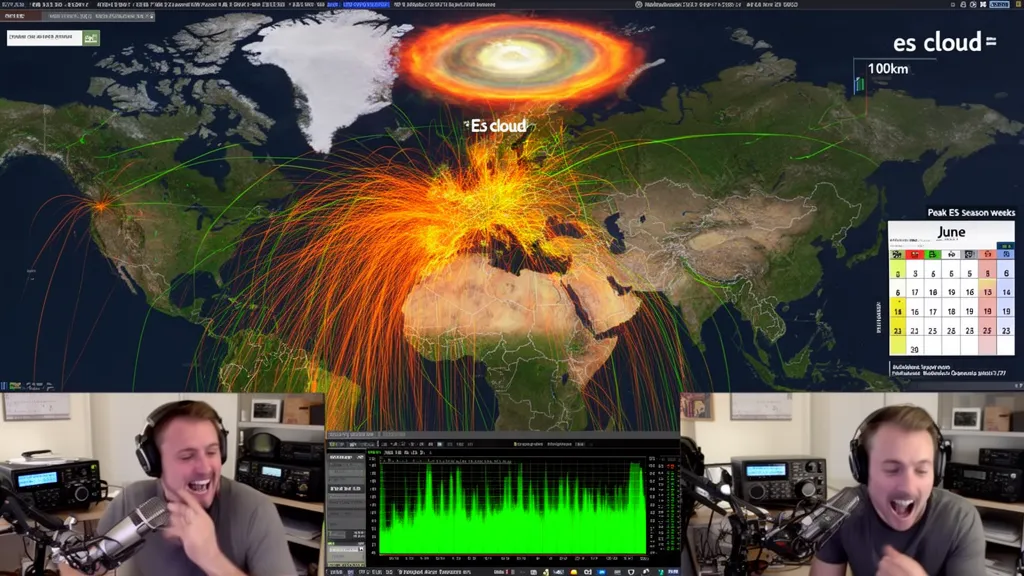
Operator's Verdict: June and July are peak sporadic-E months in the northern hemisphere — expect multiple 6m openings per week and frequent 10m Es. Monitor DXMaps and 50.110 MHz daily during May–August. Winter secondary season (December–January) is real but less intense — focus on 10m and 12m rather than 6m.
The Annual Sporadic-E Calendar
Sporadic-E (Es) is not random — it follows a repeatable annual pattern driven by seasonal variations in the upper atmosphere. Understanding this calendar lets you plan when to monitor, what bands to use, and what to realistically expect.
Pro Tip: During Es season, keep DXRadar's 6m band page open alongside best bands now to catch openings in real time. When 6m FT8 spots start appearing on PSKReporter from 1,000+ km, an Es lane is forming — tune to 50.313 MHz immediately and point your beam along the spot cluster direction.
Northern Hemisphere Sporadic-E by Month
| Month | 6m Es Frequency | 10m Es Frequency | Notes |
|---|---|---|---|
| January | Rare | Occasional | Secondary winter season edges |
| February | Very rare | Rare | Winter season ending |
| March | Rare | Occasional | Early season |
| April | Uncommon | Frequent | Season beginning |
| May | Frequent | Very frequent | Season opening; 6m Es first contacts |
| June | Very frequent | Very frequent | Peak season; daily openings possible |
| July | Very frequent | Very frequent | Peak season; highest MUF openings |
| August | Frequent | Frequent | Season declining |
| September | Uncommon | Occasional | Season ending |
| October | Rare | Rare | Post-season |
| November | Occasional | Frequent | Winter season beginning |
| December | Occasional | Frequent | Winter Es peak; 10m/12m primary |
The Peak Days
The statistical peak of sporadic-E in the northern hemisphere occurs around the summer solstice (June 20–22). The two weeks centered on the solstice consistently produce the most active Es of the year. Rare 2m Es contacts, which require multi-hop or very high MUF, are most likely in this period.
The Physical Basis: Why Summer?
The summer Es pattern correlates with the jet stream position and gravity wave activity in the mesosphere (80–110 km altitude). Wind shear in this altitude range creates differential ion velocity gradients that concentrate plasma into thin layers. The seasonal wind pattern in summer produces more favorable shear conditions for Es formation.
This explanation, while supported by observations, remains an active research area. The correlation between the jet stream and Es is statistical — there is no deterministic model that predicts individual Es cloud formation from atmospheric data alone.
Daily Timing of Es Openings
In addition to seasonal patterns, sporadic-E shows a diurnal (daily time-of-day) pattern:
- Morning peak: 0800–1200 local time — Es openings are more common in late morning
- Afternoon secondary: 1600–1900 local time — second peak, often the strongest openings
- Evening/night: Es is less common but not impossible; some spectacular 6m transatlantic openings occur at night
The physical basis for the morning and afternoon peaks is thought to relate to tidal oscillations in the upper atmosphere affecting the wind shear responsible for Es formation.
What to Monitor During Es Season
Primary monitoring frequency: 50.110 MHz SSB calling (North America) or 50.100 MHz (Europe) — the 6m CW/SSB calling frequency. Weak signals suddenly appearing from unusual directions signal an Es opening.
Digital monitoring: 50.313 MHz FT8 provides 24/7 Es detection. If you see FT8 signals from stations 800–2,500 km away on 6m during morning or afternoon, an Es opening is underway.
DXMaps: The dxmaps.com real-time map shows PSKReporter-sourced spots on 6m and 10m, making Es openings immediately visible as new geographic regions light up on the map.
DXRadar: Check the 6m band status and 10m band status for current Es indicators sourced from the DX cluster.
Strategic Operating in Es Season
Never leave 6m unmonitored in June and July. A spectacular opening can begin and end within 30 minutes. Operators who leave a receiver tuned to 50.110 MHz during working hours (or run WSJT-X monitoring 50.313 MHz FT8 continuously) catch openings that others miss entirely.
When an opening begins on 10m, it often extends to 6m within 30–60 minutes as the MUF rises. Operators who notice an unusual 10m opening should immediately switch to 6m and monitor.
Frequently Asked Questions
When is sporadic-E season?
The primary sporadic-E season in the northern hemisphere runs from approximately May 1 through August 31, with peak activity in June and July. A secondary season occurs in November–January, with December and early January being the most active months. The southern hemisphere experiences the same pattern shifted 6 months: November–February (primary) and May–June (secondary). Es can occur at any time of year, but these seasons represent when openings are most frequent and intense.
What frequencies does sporadic-E affect?
Sporadic-E most consistently affects frequencies from about 20 MHz to 150 MHz. This range includes 15m (21 MHz), 12m (24 MHz), 10m (28 MHz), 6m (50 MHz), and 4m (70 MHz). The MUF of sporadic-E plasma clouds typically reaches 50–90 MHz during peak summer openings. Very intense Es (called 'multi-hop' when two clouds form a relay chain) can push MUF to 144 MHz (2m), enabling rare 2m Es contacts.
How long does a sporadic-E opening typically last?
Sporadic-E openings vary greatly in duration. Brief openings on 6m may last only 10–30 minutes before the plasma cloud dissipates or drifts. Medium openings of 1–4 hours are common during active Es season. Extended openings of 6–12 hours occur a few times per season when multiple Es clouds form a chain or when a large stable cloud persists. Monitoring tools like DXMaps show opening duration in near real-time through accumulated spots.
Is there any way to predict sporadic-E?
Reliable sporadic-E prediction more than a few hours in advance is not currently possible. The physical mechanism (wind shear at 90–120 km altitude creating ionised plasma concentrations) cannot be accurately forecast with existing numerical models. Short-range indicators include: real-time spots on DXMaps showing Es forming in adjacent geographic areas; sudden appearance of signals at unusual distances on nearby frequencies; historical climatology showing higher probability on certain dates (mid-June peak). The best approach is consistent monitoring during Es season rather than prediction.
What is the difference between summer and winter sporadic-E?
Summer Es (May–August) is more frequent, produces higher MUF (regularly reaching 50 MHz), and lasts longer than winter Es. Winter Es (December–January) produces shorter-duration, often lower-MUF openings — frequently reaching 10m and 12m but less often reaching 6m. Winter Es is also less geographically predictable. The physical cause of this seasonal difference is not fully understood; jet stream patterns and gravity wave activity at mesospheric altitudes are implicated.