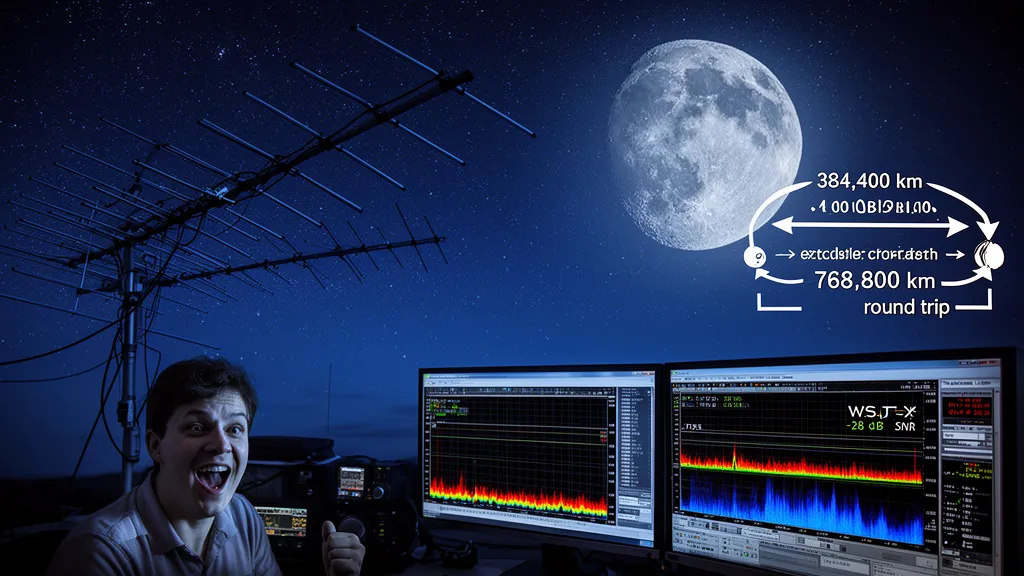
Operator’s Verdict: Moonbounce is the ultimate VHF challenge — 252 dB of path loss, 2.56-second round-trip delay, and contacts up to 12,756 km. JT65 digital mode makes small-station EME achievable with 4×Yagi arrays and 200–500W. The Moon must be simultaneously visible from both stations. ARRL EME Contest in October/November is the best time for first contacts.
The Physics of Bouncing Signals Off the Moon
EME represents the most demanding propagation mode in amateur radio. Every photon of your transmitted signal must travel 384,400 km to the Moon, reflect off a cold, rocky, largely non-conducting surface, and travel 384,400 km back — arriving at Earth with less energy than a single quantum of visible light from a dim star.
The fundamental challenge is captured in the link budget:
EME Link Budget (144 MHz)
| Factor | Value |
|---|---|
| Transmitter power | +60 dBm (1 kW) |
| Transmit antenna gain | +20 dBd (4×Yagi array) |
| One-way free-space path loss (384,400 km, 144 MHz) | −187 dB |
| Moon scattering loss + return path (EME radar equation) | −65 dB |
| Receive antenna gain | +20 dBd |
| Receive LNA noise figure loss | — |
| Net received signal | ~−152 dBm |
Note: The total EME system loss (~252 dB) comes from the radar equation: L = (4π)³ × d⁴ / (σ_Moon × λ²), where σ_Moon ≈ 6.6 × 10¹¹ m² at 144 MHz. This is split here as one-way FSPL (187 dB) plus the Moon’s effective scattering and return contribution (~65 dB).
The received signal from a 1 kW station with a 20 dBd array is approximately ~10⁻¹⁸ W (−152 dBm). This is close to the thermal noise floor of a 2.5 kHz receiver (~−169 dBm), meaning SNR is marginal — which is why JT65 was developed.
Why JT65 Makes EME Possible
JT65 exploits several information-theoretic techniques:
- Long integration time: Each JT65 message takes 46.8 seconds to transmit, allowing signal averaging over many seconds
- Powerful error correction: Reed-Solomon coding can reconstruct complete messages from highly corrupted received data
- Coherent detection: WSJT-X uses sophisticated synchronisation to extract signal phase from noise
- Threshold: JT65B can decode at SNR of −28 dB in a 2.5 kHz bandwidth — equivalent to detecting a signal 600 times below the noise power
Before JT65 (circa 2003), EME required massive antenna arrays producing 25+ dBd gain and kilowatts of power. Post-JT65, a station with 4 × 9-element Yagis and 200 watts can complete EME contacts.
Pro Tip: Monitor DXRadar’s solar weather dashboard for real-time space weather data — check it before every operating session.
Equipment for EME
Antenna Systems
EME antennas must satisfy three requirements: high gain (toward the Moon), full sky coverage (azimuth + elevation tracking), and low noise temperature (the ground and warm sky behind the antenna add system noise).
| System | Gain (144 MHz) | Notes |
|---|---|---|
| 4 × 9-el Yagi | ~17 dBd | Minimum viable; JT65B only |
| 4 × 17-el Yagi | ~21 dBd | Standard small station; good QSO rate |
| 8 × 17-el Yagi | ~24 dBd | Competitive station |
| 16 × 17-el Yagi | ~27 dBd | Large station; CW EME possible |
| 5-metre dish | ~28 dBd | Excellent but requires tracking mount |
| 10-metre dish | ~34 dBd | Professional-class; hears own echoes |
Tracking mount: The antenna must follow the Moon across the sky continuously. Computer-controlled rotators (azimuth + elevation) controlled by tracking software are standard. Popular software: WSJT-X includes built-in Moon position calculation; LinPot, PstRotator interface with antenna controllers.
The Moon moves approximately 0.5°/minute in the sky. A Yagi with 15° beamwidth needs correction roughly every 15 minutes. Narrower-beamwidth dishes need continuous tracking.
Receive Chain
The LNA (Low-Noise Amplifier) is arguably the most critical component after the antenna. Every 1 dB of system noise figure is 1 dB of lost sensitivity.
| Component | Typical NF | Notes |
|---|---|---|
| SSB Yaesu FT-991A | 5 dB | Poor for EME without external LNA |
| Mast-mounted MGF1302 LNA | 0.4 dB | Standard; transforms system NF |
| Cryogenically cooled LNA | 0.1 dB | Used by contest stations and research |
A 0.4 dB NF LNA mounted at the antenna feedpoint, combined with a 5 dB NF transceiver and low-loss feedline, produces an overall system noise figure of approximately 0.5 dB. This is the threshold for competitive small-station EME.
Polarisation: The Moon rotates Faraday polarisation of reflected signals unpredictably. Most serious EME stations use circular polarisation (RHCP and LHCP switchable) to avoid polarisation-dependent losses. Linear-polarised antennas suffer up to 30 dB polarisation losses during unfavourable Faraday rotation — contacts may be impossible during these periods.
Transmitter
200 watts is the practical minimum for 144 MHz EME. 500–1,500 watts is more common. RF power amplifiers for 144 MHz: commercial (TE Systems, Tokyo HyPower) or homebrew LDMOS designs producing 500–1,000W.
The transmitter must be extremely frequency-stable — frequency errors above a few hundred hertz cause JT65 to fail.
The EME Operating Procedure
Software Setup
- Download and install WSJT-X from wsjt.sourceforge.io
- Configure transceiver interface (CAT control via USB/serial)
- Configure audio: PC soundcard input from radio AF output
- Enable Moon tracking in WSJT-X settings (enter your grid square)
- Sync computer clock to within ±1 second of UTC (critical)
JT65 Message Exchange
JT65 uses a fixed 1-minute transmit/receive cycle (T/R period). Each message takes 46.8 seconds to transmit, leaving approximately 13 seconds for receive decode.
Standard EME QSO sequence:
- CQ:
CQ K1JT FN20— calling CQ with callsign and grid - Response:
K1JT G4ABC IO91— reciprocal exchange - Report:
G4ABC K1JT OOO— signal report (OOO = audible; RO = received; RRR = confirmed) - Confirm:
G4ABC K1JT 73— 73 to close
The “OOO” system for signal reports pre-dates JT65 and has been carried forward for EME tradition.
Lunar Windows
Use WSJT-X’s built-in Moon position display to identify your lunar window. Key factors:
- Elevation > 0°: Minimum to hear/work EME; higher is better
- Common window: Both your location and target station must have Moon above horizon simultaneously
- Perigee Moon: When the Moon is at perigee (closest approach, ~356,000 km), path loss is reduced by ~1.5 dB — every dB counts for marginal stations
Online resources like dk3xt.com/lunwin and N0UK’s EME calendar show mutual lunar windows between specific stations.
Finding EME Contacts
ON4KST Chat (ON4KST.com): Real-time chat system for VHF/EME coordination. During active EME sessions, experienced operators post CQ calls, availability, and sked requests here. This is the primary coordination channel.
DX Cluster: Some EME spots appear on the standard DX cluster. Filter for 144000+ frequencies.
Random CQ: During ARRL EME Contest weekends, calling CQ on 144.100 MHz (JT65 EME calling frequency) with antenna on Moon will produce responses without pre-arrangement.
Practical First Steps
If you’re interested in EME but don’t yet have dedicated equipment:
Step 1 — Hear the Moon: Before transmitting, confirm you can receive EME signals. During ARRL EME Contest weekends, large stations (VK3UM, W5LUA, RK3WWF) transmit continuously. If you can decode them in WSJT-X with your existing antenna elevated toward the Moon, your station has receive capability.
Step 2 — Echo test: With your antenna pointed at the Moon, transmit a JT65 signal and watch the waterfall 2.56 seconds later for your own echo. This tests the round-trip path and verifies your transmit signal is reaching the Moon.
Step 3 — First QSO: Arrange a sked on ON4KST chat with an experienced EME station during a mutual lunar window. Large stations (EME “big guns”) with 8+ Yagi arrays can often complete contacts with small stations on first attempts.
EME is the pinnacle of VHF operating achievement — every contact is a genuine technical accomplishment that required your signal to travel 800,000 km through space and return. The digital mode revolution has made EME accessible to a far wider range of stations than was possible before 2003. If you operate on 144 MHz and want a challenge unlike anything else in amateur radio, EME is the answer.
Frequently Asked Questions
What is EME or moonbounce?
EME (Earth-Moon-Earth), commonly called moonbounce, is a radio propagation technique where signals are transmitted toward the Moon, reflected off its surface, and received back on Earth. The Moon is approximately 384,400 km from Earth. A radio signal transmitted from Earth takes about 1.28 seconds to reach the Moon and another 1.28 seconds to return, giving a one-way path length of 384,400 km and a round-trip path of 768,800 km — a total round-trip delay of 2.56 seconds. Despite the enormous distance, VHF signals on 144 MHz, 432 MHz, and microwave bands can make the round trip with modern digital modes and appropriate antennas. EME is the ultimate long-distance radio communication — any two stations on Earth that can simultaneously see the Moon can communicate, achieving effective distances of up to 12,756 km (Earth’s diameter).
What digital mode is used for EME?
JT65 is the standard digital mode for EME, developed by Nobel Prize winner Joe Taylor (K1JT) specifically for the propagation challenges of moonbounce. JT65 uses 65-tone frequency shift keying with powerful error correction, and can decode signals at -28 dB SNR — far below the noise floor of conventional modes. A complete JT65 QSO consists of 4 message exchanges, each lasting 1 minute, for a total contact time of 4 minutes. Q65 (a newer mode from WSJT-X) is increasingly used on microwave EME paths and in some 144 MHz applications. Both modes are included in the free WSJT-X software package.
What antenna do I need for 144 MHz EME?
The minimum practical antenna for 144 MHz EME in the current era (using JT65B) is approximately 4 × 9-element Yagi (sometimes called a ‘small station’ — about 17 dBd total gain). Many successful EME operators use 4 × 17-element Yagi arrays (about 21 dBd). Larger stations use 8–16 Yagi arrays or dish antennas. The antenna must be steerable in both azimuth and elevation (Moon tracking) — a fixed antenna pointing at the horizon cannot do EME. Minimum power is typically 200 watts, though 500–1,500 watts is more common. The LNA (low-noise preamplifier) noise figure is critical — best available is 0.2–0.3 dB NF for 144 MHz.
How much path loss is there in EME?
The total EME system loss at 144 MHz is approximately 252 dB — this is the full radar-equation path loss accounting for both one-way FSPL legs (~187 dB each) and the Moon’s effective scattering cross-section. To put this in perspective: a 1 kW transmitter (60 dBm) with a 20 dBd antenna at 144 MHz, reflected off the Moon and received with an equivalent 20 dBd antenna, arrives at Earth with a received signal of approximately -152 dBm. A 1 dBi antenna receives about 10^-18 watts — essentially nothing. The key is to reduce this deficit through high-gain antennas (which focus power toward and from the Moon), high transmit power, and extremely sensitive receivers. JT65’s ability to work at -28 dB SNR is the critical enabler of small-station EME.
What is ‘lunar window’ and why does it matter for EME?
The lunar window is the period during which both stations in an EME contact can simultaneously see the Moon above their local horizon. Because the Moon is a point reflector, both transmitting and receiving stations must have the Moon above their horizon (elevation > 0°) simultaneously. A typical lunar window for two stations at mid-latitudes lasts 4–8 hours. The best EME operating windows are during ‘mutual lunar window’ periods — when the Moon is above the horizon for both stations at a favorable elevation. High elevation improves signal levels because antenna gain is maximised and atmospheric path length is minimised. Moon elevation above 10° is recommended for minimum-capability stations.
Are there organized EME contests?
Yes. The primary EME contest is the ARRL EME Contest (formerly the International EME Contest), held over two weekends in October and November. The contest activates a large portion of the EME community simultaneously, making it the best time for first EME contacts. The CQ WW VHF Contest in July also has significant EME activity on 144 MHz. The EME2024/EME2026 gatherings (AMSAT/IARU-coordinated) attract hundreds of EME stations. For non-contest operations, the ON4KST chat system coordinates EME skeds in real time, allowing operators to arrange contact attempts during mutual lunar windows.