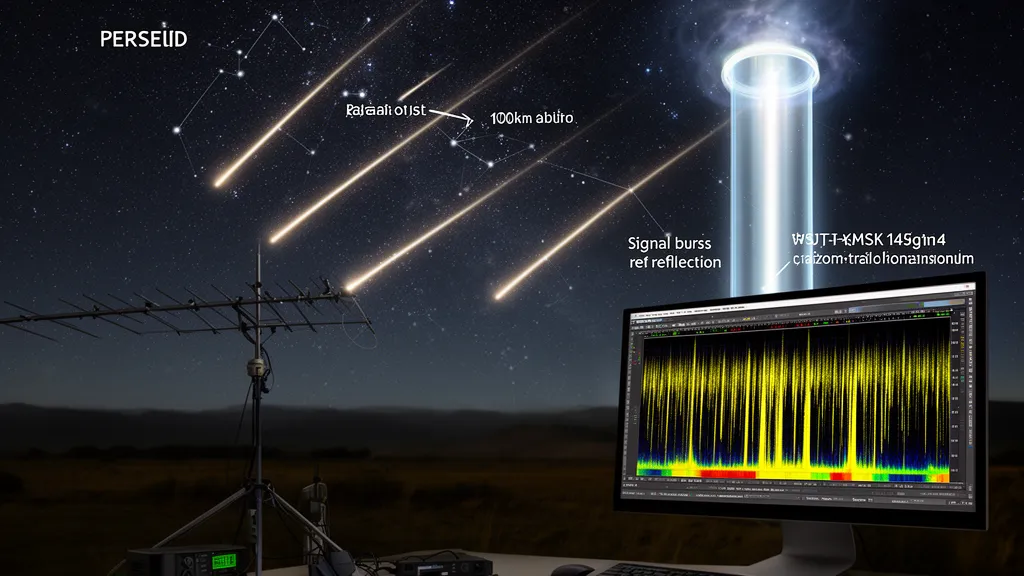
Operator’s Verdict: Meteor scatter in brief: MSK144 digital mode makes 2m meteor scatter accessible to any station with a 100W transceiver, Yagi, and WSJT-X. Best results during Perseid (August) and Leonid (November) showers. Geometry limits contacts to 150–2,200 km. Timing accuracy is critical — sync your clock before every session.
How Meteor Scatter Works
Every day, approximately 40,000 tonnes of extraterrestrial material enters Earth’s atmosphere. Most of it is microscopic dust, but a fraction consists of larger particles — meteoroids — that produce the visible streaks we call meteors (or “shooting stars”) as they ablate in the upper atmosphere.
When a meteoroid enters the atmosphere at typical velocities of 15–70 km/s, it heats the surrounding air molecules to thousands of degrees Kelvin. The extreme temperature ionises gas molecules along the meteor’s path, creating a column of free electrons — the meteor trail — at altitudes of 80–120 km.
This ionised column is conductive at VHF frequencies. Radio signals directed at the trail are reflected (more precisely, scattered) back toward Earth, enabling path lengths of 500–2,200 km depending on the trail geometry and signal angles.
The key challenge: meteor trails are brief. A typical sporadic meteor trail lasts 10–500 milliseconds. Bright shower meteors may produce trails lasting 1–10 seconds. These short reflection windows require digital modes that can complete a QSO in a single burst — which is exactly what MSK144 provides.
Pro Tip: Meteor scatter on 2m is most productive during major showers. Check DXRadar’s best bands now for current HF conditions — if HF is poor due to geomagnetic activity, VHF meteor scatter operates independently and may be your best option. The solar weather dashboard shows current Kp for planning.
The Physics of the Reflection
Meteor trails fall into two categories based on electron line density:
Underdense trails (electron line density < 2.4 × 10¹⁴ electrons/metre): Individual electrons scatter signals independently. The reflection is coherent and produces the classic sharp bursts seen in MSK144 decoding. Most sporadic meteors produce underdense trails on 144 MHz.
Overdense trails (electron line density > 2.4 × 10¹⁴ electrons/metre): The trail acts as a conducting plasma cylinder. These produce longer-duration, stronger reflections but can be overloaded at the plasma frequency. Bright Perseid or Leonid fireballs produce overdense trails visible in MSK144 as extended multi-second pings.
The optimal frequency for meteor scatter is approximately 50–144 MHz — high enough to penetrate the ionosphere and not be affected by HF ionospheric propagation, but low enough that the electron density of typical meteor trails exceeds the critical density required for reflection.
MSK144: The Standard Meteor Scatter Mode
WSJT-X’s MSK144 mode (Minimum Shift Keying, 144 baud) was specifically designed for meteor scatter. Key parameters:
| Feature | Value | Significance |
|---|---|---|
| Frame length | 72 ms or 144 ms | Captures brief meteor pings |
| Message bits | 72 | Encodes callsigns + grid + signal report |
| Bandwidth | 2.5 kHz | Concentrated power in narrowband burst |
| Sync requirement | ±1 second UTC | Critical — miscued clocks fail to decode |
| Minimum SNR | −10 dB | Well below SSB threshold |
MSK144 sequences: Station A transmits first 15 seconds of each minute, station B in the second 15 seconds. This ensures both stations know precisely when to transmit and listen, maximising the probability of capturing a mutual trail reflection.
The QSO Sequence
A complete MSK144 QSO consists of 4 message exchanges:
- CQ / first call:
CQ G4ABC IO91(callsign + Maidenhead grid) - Reply:
G4ABC DL9XYZ JO31(reciprocal callsign + grid) - Report:
DL9XYZ G4ABC R-12(RST report confirmation) - Confirmation:
DL9XYZ G4ABC RR73(confirm and sign off)
WSJT-X handles all encoding and decoding automatically. The operator’s job is to point the antenna in the right direction and monitor the waterfall.
Meteor Shower Calendar
The major showers productive for 144 MHz meteor scatter:
| Shower | Peak Date | ZHR* | Radiant | Notes |
|---|---|---|---|---|
| Quadrantids | Jan 3–4 | 120 | NE | Short peak (6h); often productive at 2m |
| Perseids | Aug 11–13 | 100 | NE | Most reliable for MS contacts; 3-day activity window |
| Orionids | Oct 21 | 15 | E | Minor shower; useful for sporadic enhancement |
| Leonids | Nov 17–18 | 15–1000 | E | Variable; storm years produce exceptional MS |
| Geminids | Dec 13–14 | 120 | SE | Excellent rates; cold but productive |
| Ursids | Dec 22 | 10 | N | Minor; less commonly worked |
*ZHR = Zenithal Hourly Rate (maximum rate under ideal conditions; actual observed rates are typically 30–60% of ZHR)
The Perseid shower in mid-August is the most productive for northern European and North American operators. High ZHR, multi-day activity window, overnight maximum (radiant high in the sky), and warm weather make it the premier MS event.
The Leonid shower is variable. Most years it produces a modest ZHR of 15–20, but in storm years (1999, 2001, and periodically thereafter) it produces ZHR of 500–1,000+. Leonid storms are rare but produce extraordinary MS conditions.
Operating on Meteor Scatter
Frequency Planning
| Band | Calling Frequency (EU) | Calling Frequency (NA) | Usage |
|---|---|---|---|
| 50 MHz | 50.230 MHz (MSK144) | 50.260 MHz | High sensitivity; common |
| 144 MHz | 144.360 MHz (MSK144) | 144.140 MHz | Primary 2m MS band |
| 432 MHz | — | — | Rarely worked via MS (trail density too low) |
On shower days, pre-arrange skeds (scheduled contacts) via the ON4KST chat or DX cluster. The scatter geometry means not every direction works at the same time — the reflection must occur in the region where both stations’ antenna beams intersect the meteor trail zone at the shower radiant altitude.
Antenna Pointing for Meteor Scatter
Unlike tropo ducting (where you point along the Earth’s surface) or EME (where you point at the Moon), meteor scatter geometry requires pointing antennas toward the common scatter volume — the overhead region above the midpoint between your station and the target, approximately 80–120 km altitude.
In practice, this means:
- For contacts of 500–1,500 km: point your beam approximately toward the other station’s bearing
- The optimal elevation angle is slightly elevated (5–15°) rather than flat horizon
- During shower peaks, experiment with pointing slightly toward the radiant, as the highest-density trail zone moves with the radiant
Pre-Dawn Sporadic MS
Even without a major shower, the pre-dawn hours (03:00–08:00 local time) see significantly elevated sporadic meteor rates. The leading hemisphere of the Earth (the morning side) sweeps up more interplanetary debris than the trailing evening side. This effect is reliable and repeatable.
Experienced MS operators regularly work 2–5 sporadic MSK144 contacts on a weekday morning before sunrise during autumn and winter, when background sporadic rates are highest.
Equipment for Competitive MS Operation
Antenna: A 9-element Yagi provides ~12 dBd gain and is the minimum useful antenna. 15–17 element designs producing 15 dBd are preferred for sporadic MS work. Long Yagis with 17+ elements (16+ dBd) are competitive for DX contacts over 1,500 km. Antenna pointing accuracy matters — modern Yagi rotators with degree-accurate readout are an advantage.
Preamplifier: A mast-mounted LNA reduces system noise figure. On 144 MHz, a quality LNA (0.3–0.5 dB NF) improves receive sensitivity by 3–5 dB, directly translating to more burst captures from weaker trails.
Transceiver: Any modern all-mode 144 MHz transceiver (Yaesu FT-991A, Kenwood TS-790, Icom IC-9700) works with WSJT-X via computer audio interface. The IC-9700 has direct USB audio integration.
Clock: GPS-disciplined clock or internet-synced system clock (using NTP). Clock accuracy within ±0.5 seconds is recommended for MSK144. A clock error of more than 2 seconds causes complete decoding failure. Windows users: use w32tm, Meinberg NTP, or Dimension 4. macOS syncs automatically via NTP.
Diagnosing Your Meteor Scatter Installation
If you’re calling CQ during a shower and getting no responses:
- Check clock sync — this is the single most common cause of failed MSK144 sessions. Verify UTC accuracy before every operating session.
- Verify antenna polarity — 144 MHz MS typically uses horizontal polarisation in Europe. Vertical polarisation is common in North America. Polarisation mismatch costs 20 dB.
- Confirm frequency — 144.360 MHz is the European MSK144 centre frequency. North America uses 144.140 MHz.
- Transmit sequence — are you calling CQ in the first or second 15-second slot? Either works, but a consistent sequence helps partners find you.
- Monitor for pings — if you can hear pings (brief bursts) in WSJT-X but can’t complete a QSO, your station is receiving correctly. Increase power or antenna gain to improve the complete-QSO rate.
- Use ON4KST chat — arranging skeds on the real-time chat dramatically improves QSO completion rate versus blind calling.
Meteor scatter rewards patience and clock discipline. During the Perseid shower peak, a well-configured station calling on 144.360 MHz will typically complete 10–30 QSOs in a 3–4 hour morning session.
Frequently Asked Questions
What is meteor scatter propagation?
Meteor scatter (MS) is a VHF propagation mode where radio signals are reflected off the ionised trails left by meteors burning up in the upper atmosphere at 80–120 km altitude. A meteor entering the atmosphere heats surrounding air molecules to plasma temperatures, creating a column of ionised gas. VHF signals (principally 50 MHz and 144 MHz) reflect off this plasma trail, enabling brief contacts over 500–2,200 km. Individual meteor trails last from milliseconds (for sporadic meteors) to several seconds (for bright Perseid or Leonid events). Using MSK144 digital mode, complete QSOs can be made in single-burst contacts even from very brief trails.
What software is used for meteor scatter?
MSK144 (part of the WSJT-X package) is the standard digital mode for meteor scatter on 144 MHz. It uses 144-symbol, 72-bit messages transmitted in 72 ms or 144 ms frames, synchronised to the UTC second. The short frame length allows capture of individual meteor trail reflections. JT6M was the previous mode and is now obsolete. FSK441 is sometimes still encountered on 6m meteor scatter but MSK144 is superior. WSJT-X software handles all encoding, timing, and decoding — it is free and available for Windows, macOS, and Linux.
When is meteor scatter most productive?
Meteor scatter activity peaks during major meteor showers. The Perseid shower (August 11–13) and the Leonid shower (November 17–18) are the most productive for 144 MHz MS. During shower peaks, meteor rates can be 50–100+ per hour (Zenithal Hourly Rate), dramatically increasing the frequency of reflective trails. Outside showers, sporadic meteor activity (steady background rate of 5–20/hour) enables contacts but at lower rates. The pre-dawn hours (03:00–08:00 local time) see the highest sporadic rate because the Earth’s leading hemisphere is sweeping up meteoroids as it orbits the Sun.
How far can meteor scatter reach on 144 MHz?
Meteor scatter on 144 MHz has a characteristic working range of 800–2,200 km. The geometry is constrained by the reflection altitude (80–120 km) and the need for both stations to illuminate the same trail simultaneously — this limits the minimum range to about 150 km (skip zone) and the maximum to about 2,200 km. Contacts between the UK and central Europe (1,000–1,500 km) are typical during Perseid and Leonid showers. Trans-continental contacts are possible during exceptional shower peaks when multiple trails and scatter from different azimuths accumulate. 50 MHz (6m) has been worked up to 3,000 km via MS.
What equipment is needed for 144 MHz meteor scatter?
Minimum recommended equipment for 144 MHz MSK144 meteor scatter: transceiver covering 144.360 MHz (the MSK144 calling frequency in Europe; 144.140 in North America), 100 watts output, a directional Yagi antenna (9+ elements, 12–15 dBd gain improves results significantly), and a computer running WSJT-X with GPS-disciplined or internet-synced clock (±1 second timing accuracy is critical for MSK144 decoding). A low-noise preamplifier on the mast is beneficial. Timing accuracy is the single most critical requirement — a clock off by more than 1–2 seconds will prevent MSK144 decoding entirely.
What is the difference between shower and sporadic meteor scatter?
Shower meteor scatter occurs when Earth passes through a stream of cometary debris orbiting the Sun. All shower meteors travel in parallel from the same radiant point (e.g., the Perseus constellation for Perseids). This predictability allows operators to pre-schedule contacts knowing both stations can point antennas toward the shower radiant scatter zone. Sporadic meteor scatter results from random interplanetary debris entering the atmosphere from all directions. Sporadic MS is continuous year-round but lower rate. Modern MSK144 has made sporadic MS practically useful — a short period (15–30 minutes) of calling at 144.360 MHz on an autumn morning will often produce 1–3 QSOs via sporadic MS.