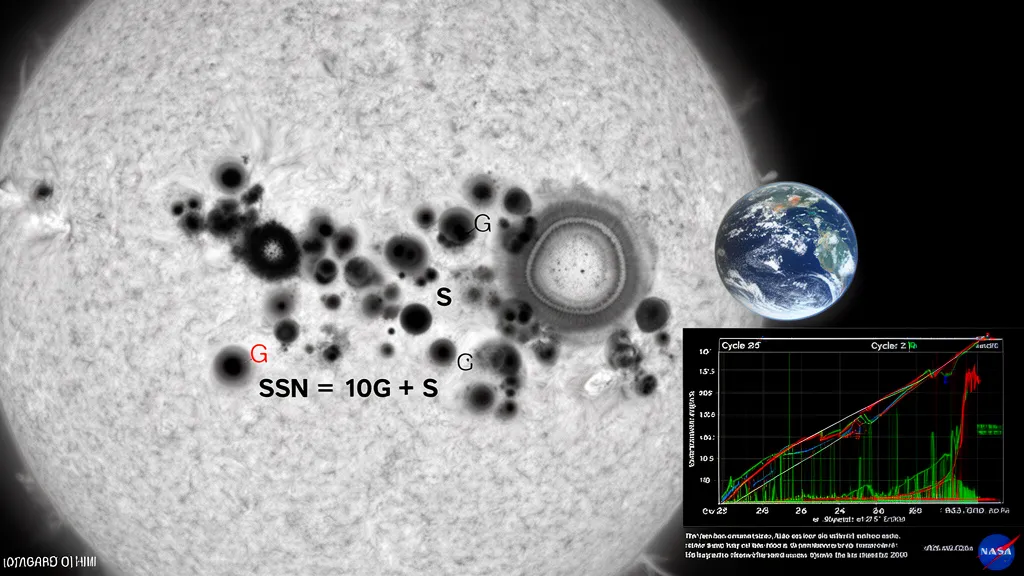
Operator's Verdict: SSN counts solar activity directly. Higher SSN = more ionospheric F layer ionisation = 10m and 15m open for worldwide DX. SSN 50 = 10m beginning to open; SSN 150 = 10m excellent. Solar Cycle 25 peak (2024–2026) produced SSN 150–220 — the best 10m conditions in 30 years. Check current SSN on DXRadar's solar weather page.
Counting Sunspots: The 400-Year Record
Sunspots have been counted since Galileo first turned a telescope toward the Sun in 1610. The continuous record of solar activity maintained by the World Data Center for Sunspot Index and Long-term Solar Observations (WDC-SILSO) in Brussels extends back to 1749 with modern-calibrated data, making it one of the longest continuous scientific datasets in existence.
The counting method, refined over centuries, follows the Wolf formula:
SSN = 10G + S
Where:
- G = number of sunspot groups (clusters of spots sharing magnetic structure)
- S = total individual spots visible across all groups
A day with 3 groups and 12 individual spots: SSN = 10(3) + 12 = 42.
Individual daily SSN values fluctuate rapidly. The more stable indicators used for propagation planning are:
- Smoothed SSN: 13-month running average — this is what defines solar minimum and maximum
- SFI (Solar Flux Index): More precisely measurable, used as SSN proxy in modern tools
Pro Tip: Track live SSN and SFI on DXRadar's solar weather page — the smoothed SSN trend tells you where you are in the 11-year cycle and whether high bands like 10m will open today.
The 11-Year Solar Cycle
Sunspot activity follows approximately an 11-year cycle (ranging from 9 to 14 years). Cycles are numbered from Cycle 1, which began in 1755 when systematic counting started.
The current cycle is Solar Cycle 25, which began in December 2019 (the formal minimum between Cycle 24 and 25). The cycle peaked in 2024–2025 at smoothed SSN values well above the pre-cycle predictions (the panel predicted a below-average cycle; the actual strength exceeded Cycle 24 significantly).
Solar minimum (lowest point): SSN drops to 0–20 for extended periods. The F layer ionisation is minimal. 10m is largely closed. 15m is unreliable. Only 20m and below provide consistent DX.
Solar maximum (peak): SSN values 100–300+. F layer ionisation is intense. 10m is wide open. 15m provides excellent DX. Even 12m and 6m F2 openings become possible.
SSN and Frequency Band Behaviour
This table shows approximate SSN thresholds for reliable F2 propagation on each HF band at mid-latitudes (the figures are rough guides; path specifics matter):
| Band | Frequency | SSN Needed for Good F2 | Notes |
|---|---|---|---|
| 10m | 28 MHz | SSN 50–80+ | Closed at solar minimum |
| 12m | 24 MHz | SSN 30–50+ | Nearly closed at minimum |
| 15m | 21 MHz | SSN 20–30+ | Marginal at minimum |
| 17m | 18 MHz | SSN 10+ | Works through most of cycle |
| 20m | 14 MHz | Works at any SSN | The reliable DX band year-round |
| 30m | 10 MHz | Works at any SSN | Digital mode backbone |
| 40m | 7 MHz | Works at any SSN | Better at lower SSN (less D-layer absorption) |
| 80m | 3.5 MHz | Works at any SSN | Night DX; better at solar minimum |
This is why 20m is the primary DX band — it works at any point in the solar cycle. 10m is spectacular during solar maximum but essentially useless during solar minimum.
Solar Cycle 25: Exceptional Activity
Solar Cycle 25's growth surprised solar scientists who predicted a below-average cycle. Instead, it tracked significantly above average from 2022 onward, with smoothed SSN values exceeding 180 by late 2024 — the highest since Cycle 22 in 1989–1991.
For radio operators, the implications:
- 2024–2026: Excellent 10m conditions, with transcontinental and transoceanic contacts achievable daily during daylight hours
- 6m F2: Solar flux regularly exceeding 200 produced 6m F2 contacts impossible for 15+ years
- 15m contest season: ARRL November Sweepstakes, CQ WW contests running on 15m with contact rates not seen since the 1990s
Operators who were licensed during the previous solar minimum (2017–2019) may have never experienced a strong solar maximum. The opportunity to witness what 10m sounds like during a genuine maximum is one of the gifts of the current cycle.
Frequently Asked Questions
What is a sunspot number?
The sunspot number (SSN, also called Wolf number) is a daily count of sunspot groups and individual spots on the solar disk. Sunspots are areas of intense magnetic activity on the Sun's surface that appear darker than surrounding areas because they are cooler (about 3,500 K vs. 5,800 K for the surrounding photosphere). The classic Wolf formula is: SSN = 10G + S, where G = number of sunspot groups and S = total number of individual spots. An SSN of 100 might mean 5 groups with 50 individual spots. Higher SSN means more solar magnetic activity, which means more solar UV and X-ray radiation, which ionises the F layer more intensely, raising its critical frequency and the Maximum Usable Frequency (MUF) for HF propagation.
How does the sunspot number affect radio propagation?
Higher sunspot numbers produce stronger ionospheric F layer ionisation, which raises the MUF (Maximum Usable Frequency) — the highest frequency that will be reflected back to Earth for a given path. As SSN increases: 10m (28 MHz) becomes usable, then 12m, then 15m become more reliable. On lower bands, higher SSN doesn't help much — 40m and 20m work at almost any SSN. As SSN decreases (solar minimum), the MUF drops: 10m closes, 12m becomes unreliable, and even 15m becomes marginal. The solar flux index (SFI) is a more directly measurable proxy for SSN used in modern propagation prediction.
What is a typical sunspot number at solar maximum vs. minimum?
The 11-year solar cycle produces roughly regular peaks and troughs in sunspot activity. At solar minimum: SSN commonly drops to 0–20 for extended periods — even 0 (no visible sunspots) for days or weeks. At solar maximum: SSN values of 100–300 are typical, with isolated peaks exceeding 300. Solar Cycle 25, which peaked in 2024–2025, produced smoothed SSN values around 180–220 — above average for modern cycles. Historical solar maximum values: Cycle 19 (1957–1958) produced SSN above 300 — the strongest recorded cycle. The current cycle is roughly comparable to Cycle 21–22 (1979–1991) in strength.
What is the difference between SSN and SFI?
Both SSN (sunspot number) and SFI (solar flux index at 10.7 cm wavelength) measure solar activity, but they differ in derivation. SSN is a visual count of sunspot groups and individual spots — a direct observation of solar surface features. SFI is a radio emission measurement at 10.7 cm wavelength made with a radio telescope — it measures the radio output of the active solar corona. SFI correlates well with SSN but is more precisely measurable (as a physical quantity in solar flux units, sfu) and updates daily from radio observatories in Canada and elsewhere. SFI is the standard input to modern propagation prediction software because it's more objectively quantified than a visual sunspot count. DXRadar shows current SFI on the solar weather page.
What SSN value indicates good propagation on 10m?
For reliable 10m (28 MHz) F2 propagation at mid-latitudes, a smoothed SSN of approximately 50–70 or higher is generally needed. At SSN 100, 10m is open reliably during daylight hours on most paths. At SSN 150+, 10m provides outstanding DX conditions with contacts achievable worldwide. At SSN below 30, 10m F2 is unreliable — the MUF at typical paths rarely reaches 28 MHz. During Solar Cycle 25's maximum (2024–2025), SSN regularly exceeded 150, producing exceptional 10m conditions not seen since Cycle 22 in the early 1990s. Note: sporadic-E can open 10m even at solar minimum — SSN only affects F2 propagation.
Check the current SSN and SFI on DXRadar's solar weather page and compare it to the solar cycle progression chart to understand where we are in the 11-year cycle.