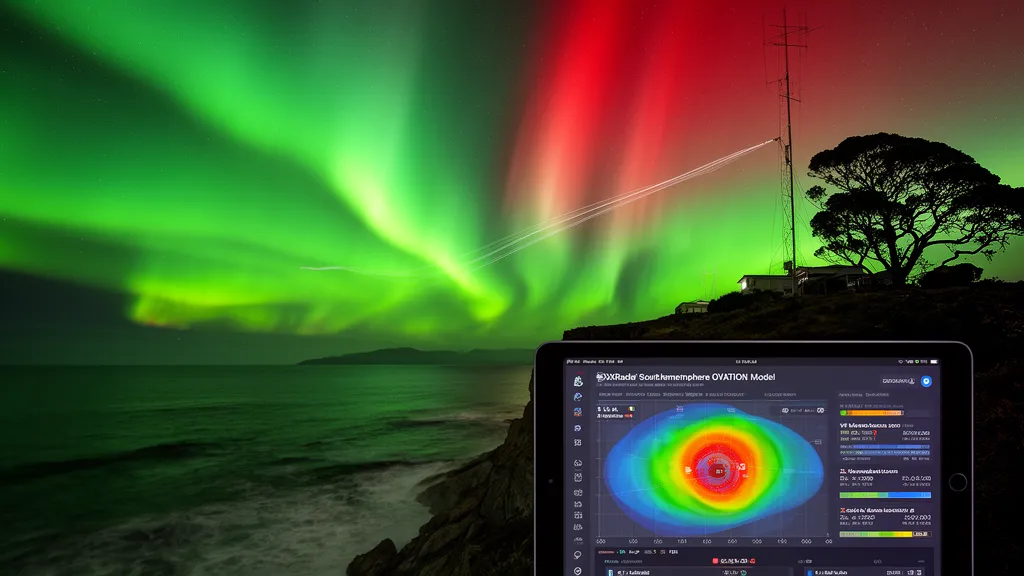
Operator's Verdict: Kp is 0.33 right now. Above Kp 5, transpolar HF paths from VK/ZL to South Africa and South America degrade. At Kp 7+, aurora australis becomes visible from southern Tasmania and Invercargill. Check the DXRadar aurora page for the live auroral oval.
Aurora Australis: The Same Physics, Different Hemisphere
Aurora australis is the southern hemisphere's aurora, produced by identical physical processes as aurora borealis. Energetic electrons and protons from the solar wind are guided by Earth's magnetic field lines into the upper atmosphere at both magnetic poles simultaneously. The same geomagnetic storm that lights the sky over Norway lights the sky over Antarctica — and, during major storms, over New Zealand and southern Australia.
For ham radio operators, the operational consequences mirror those in the north exactly: HF polar-path degradation, enhanced D-layer absorption at high southern latitudes, and VHF aurora scatter opportunities on 6m and 2m. The only practical differences are geographical — where the auroral zone falls relative to land and populated amateur radio stations.
The Southern Magnetic Pole and What It Means for Radio
The south magnetic pole is located at approximately 64°S, 136°E — well offshore in the Southern Ocean between Antarctica and the southern Australian coast. This is important for two reasons.
First, the southern auroral oval is centred on the magnetic pole, not the geographic south pole. The oval extends roughly 10–15° equatorward of the magnetic pole at quiet conditions, and expands further at high Kp. This places the southern auroral zone largely over the Southern Ocean, with limited land exposure compared to the north, where the auroral oval runs directly over populated Scandinavia, Iceland, Canada, and Alaska.
Second, the south magnetic pole's longitude position (near 136°E) creates a geomagnetic latitude asymmetry similar to the north American offset in the northern hemisphere. New Zealand and southeastern Australia sit at relatively high geomagnetic latitudes for their geographic latitudes, making them more likely to observe aurora than stations at similar geographic latitudes in South America.
| Location | Geographic Latitude | Approx. Geomagnetic South Latitude | Kp for Visible Aurora |
|---|---|---|---|
| Invercargill / Bluff, NZ | 46°S | ~55°S geomagnetic | Kp 4–5 |
| Hobart, Tasmania (VK7) | 43°S | ~53°S geomagnetic | Kp 5–6 |
| Dunedin, NZ (ZL4) | 46°S | ~54°S geomagnetic | Kp 4–5 |
| Christchurch, NZ (ZL3) | 44°S | ~53°S geomagnetic | Kp 5–6 |
| Melbourne, VK3 | 38°S | ~48°S geomagnetic | Kp 7–8 |
| Punta Arenas, Chile (CE) | 53°S | ~59°S geomagnetic | Kp 3–4 |
| Ushuaia, Argentina (LU) | 55°S | ~61°S geomagnetic | Kp 3–4 |
Operators in Punta Arenas and Ushuaia, at the southern tip of South America, are geomagnetically the closest southern-hemisphere equivalents to northern Scandinavia. They sit deep under the auroral oval even at moderate storm levels.
HF Radio Effects: Which Paths Fail First
Southern hemisphere operators on HF face exactly the same storm-time degradation sequence as northern hemisphere operators, but on their own set of polar and near-polar paths.
Transpolar Paths
The long-path from VK (eastern Australia) to Europe runs over Antarctica. At G2 (Kp 6), this path begins to degrade. At G3 (Kp 7), it often fails entirely. Operators who work ZS (South Africa) from VK on paths that arc over the Southern Ocean are similarly vulnerable at G2–G3.
During the May 2024 G5 storm, VK and ZL operators reported complete HF failure on polar-routed paths for over 24 hours during the storm's main phase. 40m NVIS remained functional for regional circuits below 45°S.
Transpolar vs. Short Path
For VK–Europe contacts, the short path routes northwest via Asia. This path is less affected by southern polar disturbances, though it may still cross the northern auroral zone depending on the great-circle arc. During a global G4–G5 storm, both poles are disturbed simultaneously — path selection matters less when the whole ionosphere is degraded.
Pro Tip: When a geomagnetic storm hits, VK and ZL operators should switch from long-path to short-path for Europe contacts before the storm peak, not after. The long-path polar degradation onset is faster than short-path degradation. By the time you notice the long path failing, the 12-hour short-path window may already be the better option.
Short-Distance HF: Most Resilient
Regional paths within VK, between VK and ZL, and within New Zealand are far less affected by southern auroral storms than polar-routed long-path circuits. At G1–G2, only paths that cross through high southern geomagnetic latitudes degrade significantly. 40m NVIS from a VK3 (Melbourne) station to another VK3 can continue through all but the most extreme events.
Aurora Season for Southern Hemisphere Operators
The equinoxes — March–April and September–October — are the peak periods for aurora australis, exactly as in the north. This is not coincidental. The Russell–McPherron effect describes enhanced solar wind coupling to Earth's magnetosphere near the equinoxes due to the geometry of the interplanetary magnetic field. Both auroral ovals are affected simultaneously, so the seasonal statistics are hemisphere-symmetric.
Southern hemisphere peak aurora season therefore corresponds to:
- Austral autumn: March–April
- Austral spring: September–October
Northern summer (June–August) and northern winter (December–February) are typically quieter but not immune — the October/November 2003 Halloween Storms and the May 2024 G5 storm demonstrate that severe events can occur outside the statistical peak.
Aurora Scatter on VHF: VK and ZL Paths
Aurora scatter on 6m (50 MHz) and 2m (144 MHz) is the same in the south as in the north — the auroral curtain reflects VHF signals with the characteristic "buzz" or "rough" signal quality caused by Doppler spreading across the moving plasma. Southern hemisphere operators have documented aurora scatter openings on 6m between VK7 (Tasmania) and ZL4 (Otago/Southland) during G2–G3 storms.
The key geometry: for aurora scatter, both stations must be able to "see" the auroral oval at roughly equal angles. From Tasmania and southern New Zealand, the oval is to the south during storms, and both ends of the path scatter off the same auroral curtain. East–west paths oriented roughly parallel to the auroral oval work best.
During quiet conditions (Kp below 4), the oval sits too far south for VK3 or ZL2/ZL1 stations to access via aurora scatter. At Kp 5–6, the oval expands northward and southern New Zealand and Tasmania come under or near it. At Kp 7+, even Melbourne-latitude stations (VK3) may achieve brief aurora scatter contacts.
Pro Tip: Unlike HF, where aurora degradation is mostly bad news, VHF aurora scatter is an opportunity. When Kp exceeds 5, check 50.150 MHz (6m aurora scatter calling frequency in Australia/New Zealand) and 144.150 MHz for 2m. The window of activity is typically 15–60 minutes during the most active phase. CW and FT8 decode through aurora scatter better than SSB due to the signal distortion.
Conjugate Aurora: Both Hemispheres Light Up Together
Conjugate aurora is one of the most striking demonstrations of Earth's magnetic field geometry. Because magnetic field lines connect opposite hemispheres, an auroral event energising the northern oval also energises the southern oval on the same field lines — simultaneously.
NASA satellite data and ground-based magnetometer measurements confirm that aurora events are largely simultaneous in both hemispheres, with a lag of seconds to at most minutes. A G3 storm that produces aurora over Scandinavia at 21:00 UTC produces aurora over the Southern Ocean and New Zealand at the same time.
This means southern hemisphere ham radio operators experience HF degradation at the same UTC time as their northern counterparts. There is no "safe period" for one hemisphere while the other is storming — geomagnetic storms are global events. A VK or ZL operator seeing Kp 7 should apply exactly the same operating adjustments as a VE or G station seeing Kp 7.
Best Locations to Observe Aurora Australis
For operators also interested in visual aurora (and aurora photography, which has direct citizen science value for geomagnetic research):
- Invercargill / Bluff, New Zealand (ZL4): The southernmost city in New Zealand at 46°S geographic. Aurora australis visible from here at Kp 4–5, often brighter than from anywhere else in the ZL callsign area.
- Dunedin, New Zealand (ZL4): Excellent dark sky access south and southwest. Aurora Australis Facebook group has over 600,000 members, many based in Otago and Southland.
- Hobart, Tasmania, Australia (VK7): Best mainland Australian location. Southern horizon has no significant light pollution to the south over the Southern Ocean.
- Mount Wellington / kunanyi, Tasmania: Elevated dark site above Hobart. At Kp 6+, fully developed auroral curtains are visible.
- Punta Arenas, Chile (CE9): Consistently the best South American location. Under the auroral oval at G2.
- Ushuaia, Argentina (LU): Southernmost city in the world at 55°S. Nearly sub-auroral at quiet conditions.
AuroraWatch New Zealand (aurorawatch.nz) operates real-time magnetometer stations across New Zealand and issues alerts when local geomagnetic disturbances indicate aurora probability. This is the southern hemisphere equivalent of the NOAA SWPC K-index alerts and is worth bookmarking for ZL operators.
D-Layer Absorption at High Southern Latitudes
Solar proton events (SPE) and X-class flares cause polar cap absorption (PCA) events that affect both polar caps simultaneously. During an SPE, energetic protons penetrate the polar ionosphere and dramatically enhance D-layer absorption at latitudes above approximately 60° geomagnetic. For southern hemisphere operators, this means stations in Antarctica and the extreme southern tip of South America (CE9, LU9) experience complete HF blackout during major SPEs.
SPE effects differ from standard geomagnetic storm aurora. SPE-induced polar cap absorption can last days (not hours), persisting even after the geomagnetic storm has ended. If you are operating portable from a high-latitude location and HF goes completely dead with no recovery after 24 hours, check NOAA SWPC for an active SPE rather than assuming a local equipment problem.
Monitoring Resources for Southern Hemisphere Operators
NOAA SWPC (services.swpc.noaa.gov) is the primary real-time space weather resource for all operators globally. The OVATION aurora forecast model (30-minute nowcast) shows the global auroral oval including the southern hemisphere view — rotate the globe on the DXRadar aurora page to see the southern oval.
AuroraWatch New Zealand (aurorawatch.nz) provides New Zealand-specific magnetometer readings and alert levels calibrated to local conditions. The alert threshold is set for ZL stations, not global averages.
The Aurora Australis Facebook Group (private, approximately 600,000 members as of 2026) is the largest community network for crowdsourced aurora reports in Australia and New Zealand. Reports from this group provide useful nowcasting when the sky is clear at high southern latitudes.
Frequently Asked Questions
Does aurora australis affect HF radio the same way as aurora borealis?
The physics and operational effects are identical. Both hemispheres are energised by the same geomagnetic storm. VK and ZL operators experience polar path degradation, D-layer absorption at high southern latitudes, and VHF aurora scatter opportunities on exactly the same timescale as northern hemisphere operators.
What Kp level is needed to see aurora australis from New Zealand?
From Invercargill or Bluff (ZL4, 46°S geographic), Kp 4–5 routinely produces visible aurora australis. From Hobart (VK7, 43°S), Kp 5–6 is typically required. Melbourne (VK3, 38°S) needs Kp 7 or higher for naked-eye visibility under dark, clear skies.
When is aurora australis most active?
The peak seasons are March–April and September–October — the equinoxes. This matches northern hemisphere aurora borealis seasonality exactly, driven by the Russell–McPherron effect.
Can you work aurora scatter from Australia or New Zealand?
Yes. During G2–G3 storms, 6m and 2m aurora scatter openings between VK7 and ZL4 have been documented. The characteristic buzz-tone is identical to northern aurora scatter. CW and FT8 are more effective than SSB through the Doppler spreading.
Which HF paths are most affected by aurora australis?
Transpolar paths from VK/ZL to South Africa (via the Southern Ocean) and the long-path from VK to Europe (over Antarctica) are most affected at G2+. Short-path VK–Europe via Asia is significantly more resilient during southern polar events.
What is conjugate aurora?
Conjugate aurora is simultaneous aurora in both hemispheres on the same magnetic field lines. Because a geomagnetic storm energises both auroral ovals together, VK/ZL operators experience HF degradation at the same UTC time as their northern hemisphere counterparts. There is no "safe hemisphere" during a geomagnetic storm.
How does the southern magnetic pole position affect aurora visibility from land?
The south magnetic pole sits near 64°S, 136°E, deep in the Southern Ocean. This positions the southern auroral oval primarily over water rather than land, limiting accessible aurora observation sites compared to the northern hemisphere, where the oval crosses Scandinavia, Iceland, and Canada. New Zealand and Tasmania are the best-positioned land areas for regular aurora australis observation.
For companion reading, see Kp Index and Aurora: Visibility Thresholds and Aurora and Ham Radio Effects. Monitor the live southern auroral oval on the DXRadar aurora page.