Why Geographic Latitude Alone Does Not Predict Aurora Visibility
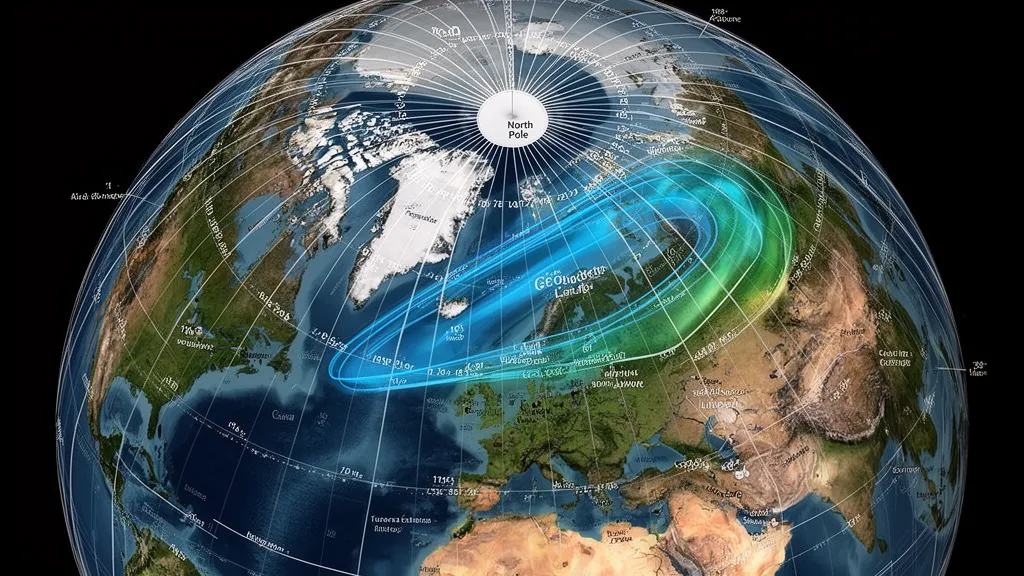
The auroral oval does not center on Earth’s geographic North Pole. It centers on the geomagnetic pole — the pole of Earth’s main dipole magnetic field — which is currently located near Ellesmere Island, Canada, at approximately 80° N, 72° W. This offset of roughly 10–15 degrees from the geographic pole has large practical consequences for predicting where aurora will be visible.
An operator in New York City (40.7° N geographic) looking at a latitude map might conclude they need an extreme geomagnetic storm to see aurora. But New York’s corrected geomagnetic latitude is approximately 51° N — comparable to Scotland or the southern tip of Scandinavia. The aurora arrives overhead at New York at Kp levels that operators in central Europe at the same geographic latitude (Lisbon, Madrid) would not see at all.
The reason is geometry. The auroral oval is a roughly circular ring around the geomagnetic pole, not the geographic pole. Locations directly below the geomagnetic pole are the first to see aurora as Kp rises. Because the pole tilts toward northern Canada, the entire eastern North American continent is dragged closer to the pole in geomagnetic coordinates. Western Europe is further from the pole than its geographic latitude suggests.
Where Earth’s Magnetic Pole Actually Is — and That It Moves
Earth’s magnetic field is generated by convective motion in the liquid iron outer core. The dominant component, the dipole field, can be approximated as a bar magnet tilted about 11 degrees from Earth’s rotation axis, with the geomagnetic north pole currently located near Ellesmere Island, Canada.
The pole is not fixed. It has been drifting steadily for decades and has been moving toward Siberia at accelerating speed since the late 20th century. The British Geological Survey tracks this movement; as of the early 2020s, the pole has been moving at roughly 50 km/year northwest toward Russia.
This drift has measurable effects on aurora visibility over decades. As the pole drifts from Canada toward Russia:
- Eastern North American stations will gradually lose their geomagnetic latitude advantage
- Siberian and northern European stations will gradually see the pole approach their geomagnetic meridian
On human timescales (decades), the shift is small but measurable. The World Magnetic Model (WMM), maintained by NOAA and the British Geological Survey, is updated every five years to account for this drift. It is the authoritative source for geomagnetic coordinates and is used in everything from smartphone compass apps to aviation navigation.
For amateur radio purposes, the practical implication is that geomagnetic latitude tables should be checked against the current WMM epoch rather than using outdated values from a 1980s handbook.
Pro Tip: To find your corrected geomagnetic latitude, enter your grid square coordinates at the NOAA World Magnetic Model calculator (ngdc.noaa.gov/geomag). This gives you the CGM (Corrected Geomagnetic) latitude, which is the value that maps directly onto the auroral oval model used by NOAA OVATION.
The Practical Latitude Offset by Region
The table below shows the geographic vs. corrected geomagnetic latitude for representative amateur radio locations. The offset column shows how much higher or lower the geomagnetic latitude is compared to the geographic.
| Location | Geographic Latitude | Approx. Corrected Geomagnetic Latitude | Offset |
|---|---|---|---|
| Fairbanks, Alaska | 64.8° N | 65.1° N | +0.3° |
| Anchorage, Alaska | 61.2° N | 61.3° N | +0.1° |
| Vancouver, BC | 49.3° N | 54.1° N | +4.8° |
| Toronto, ON | 43.7° N | 54.6° N | +10.9° |
| New York City, NY | 40.7° N | 51.0° N | +10.3° |
| Chicago, IL | 41.8° N | 52.6° N | +10.8° |
| Denver, CO | 39.7° N | 48.9° N | +9.2° |
| Miami, FL | 25.8° N | 37.3° N | +11.5° |
| Reykjavik, Iceland | 64.1° N | 69.5° N | +5.4° |
| Tromsø, Norway | 69.7° N | 67.1° N | −2.6° |
| London, UK | 51.5° N | 53.7° N | +2.2° |
| Edinburgh, UK | 55.9° N | 57.8° N | +1.9° |
| Oslo, Norway | 59.9° N | 58.1° N | −1.8° |
| Munich, Germany | 48.1° N | 48.1° N | 0.0° |
| Paris, France | 48.9° N | 49.0° N | +0.1° |
| Madrid, Spain | 40.4° N | 43.5° N | +3.1° |
| Lisbon, Portugal | 38.7° N | 43.7° N | +5.0° |
| Tokyo, Japan | 35.7° N | 27.3° N | −8.4° |
| Sydney, Australia | 33.9° S | 42.0° S | −8.1° |
Values are approximate, based on the World Magnetic Model. Japan and Australia have negative offsets because they are further from the geomagnetic pole than their geographic latitude suggests.
The table reveals several key asymmetries:
- Eastern North America has a large positive offset (up to +11 degrees): New York and Toronto are geomagnetically equivalent to Edinburgh and southern Scandinavia despite being geographically at the latitude of Spain or Portugal.
- Japan has a large negative offset: Tokyo at 35.7° N geographic is at only 27° N geomagnetic — closer to the tropics in magnetic terms. Aurora rarely reaches Japan except during extreme storms.
- Western Europe has small offsets near the Greenwich meridian, so geographic and geomagnetic latitude are roughly similar for UK and French stations.
The May 2024 G5 Storm as a Case Study
The May 10–11, 2024 G5 geomagnetic storm (Kp 9.33, the strongest since the October 2003 Halloween Storms) is the most dramatic recent illustration of geomagnetic vs. geographic latitude effects.
During the storm peak, the auroral oval expanded to approximately 40° N geomagnetic latitude. This produced visible aurora at the following geographic locations:
- Florida (25–27° N geographic, ~37–40° N geomagnetic) — aurora was photographed from Miami Beach and the Florida Keys, with red high-altitude oxygen emission dominating at these low geomagnetic latitudes
- Texas (28–31° N geographic, ~39–42° N geomagnetic) — widespread aurora reports
- Mexico (20–25° N geographic, ~30–36° N geomagnetic) — aurora confirmed from northern Mexico
Meanwhile, at the same geographic latitudes in the Eastern Hemisphere:
- North Africa (25–30° N geographic, ~15–25° N geomagnetic) — no aurora reported
- Central Arabia (20–25° N geographic, ~10–15° N geomagnetic) — well below the oval
- Southern Spain and Portugal (36–38° N geographic, ~41–43° N geomagnetic) — aurora confirmed, consistent with the geomagnetic latitude
The Florida–North Africa asymmetry perfectly illustrates the point. At the same geographic latitude, Florida operators were under aurora while North African operators were not — purely because of the geomagnetic latitude offset.
For ham radio operators: during the May 2024 storm, 6m aurora scatter was workable from Texas and Florida — geographic latitudes that would never expect aurora scatter under the mistaken assumption that geographic latitude is what matters. Operators who knew their geomagnetic latitude were ready for this; those who dismissed the possibility based on geographic coordinates missed an extraordinary event.
Why This Matters for 6m Aurora Scatter
Aurora scatter on 6m (50 MHz) requires the auroral oval to be within approximately 10–15 geomagnetic degrees of the station’s latitude for usable geometry. Using geographic latitude for this calculation produces significant errors for North American and Japanese operators.
Eastern North American operators at 40–45° N geographic are at 50–55° N geomagnetic. This means:
- Aurora scatter is viable at Kp 5–6 for these stations — the same threshold as a station in Edinburgh or Copenhagen
- Under G4–G5 conditions (Kp 8–9), aurora scatter from New York or Chicago to Western Europe via scatter is geometrically possible — and was observed during major storms
Japanese operators at 35–38° N geographic are at 27–30° N geomagnetic. Aurora scatter is viable only during the most extreme G5 storms and is rare even then. Operators in Japan should not expect aurora scatter at Kp levels that produce it routinely in eastern North America.
Australian operators at southern latitudes face a different offset — the geomagnetic south pole is located near the edge of Antarctica below Australia, so southern Australian stations have a slight disadvantage compared to what their geographic latitude alone would suggest.
Pro Tip: Before deciding whether to attempt 6m aurora scatter during a storm, calculate your corrected geomagnetic latitude, not just your geographic latitude. Use the NOAA WMM calculator. If you are in eastern North America and your geomagnetic latitude is above 50° N, you are a candidate for aurora scatter at Kp 5. If your geographic latitude says 42° N and you dismiss it — you will miss openings your logbook should contain.
Computing the Offset: Tools and Methods
NOAA World Magnetic Model
The NOAA WMM calculator at ngdc.noaa.gov/geomag accepts latitude, longitude, and altitude, and returns magnetic declination, inclination, and geomagnetic coordinates. It is updated to the current WMM epoch (WMM-2025 through 2030).
Corrected Geomagnetic (CGM) Coordinates
The CGM coordinate system is the standard used in auroral science and by NOAA SWPC for the OVATION model. It accounts not just for the dipole tilt but also for higher-order terms in Earth’s magnetic field that the simple dipole model misses. For most amateur radio operating purposes, the dipole approximation and CGM give similar results (within 1–2 degrees).
Practical Shortcut
For stations in the continental US and southern Canada, the rule of thumb is: add 10 degrees to your geographic latitude to approximate geomagnetic latitude. This is accurate to within 2–3 degrees for most eastern and central North American locations. For western North America (Pacific coast), the offset is smaller — add 5–7 degrees.
For UK and western European stations, the offset is small (1–3 degrees), so geographic and geomagnetic latitude are roughly interchangeable for aurora planning.
For Japanese and East Asian stations, the offset is negative — subtract 8–10 degrees from geographic latitude to get approximate geomagnetic latitude.
Frequently Asked Questions
What is geomagnetic latitude?
Geomagnetic latitude is the angular distance from Earth’s magnetic equator, measured along the dipole magnetic axis rather than the rotation axis. Because the geomagnetic north pole sits near Ellesmere Island, Canada — offset from the geographic pole by roughly 10–15 degrees — geomagnetic and geographic latitudes differ depending on longitude, sometimes by more than 10 degrees.
Why does aurora reach further south in eastern North America than Europe?
The geomagnetic pole is located over northern Canada, pulling higher geomagnetic latitudes toward eastern North America. A station in New York City at 40.7° N geographic is at approximately 51° N geomagnetic — equivalent to Edinburgh or Oslo. A station in Lisbon at 38.7° N geographic is at roughly 43° N geomagnetic. Aurora follows the geomagnetic pole, so it reaches New York before it reaches Lisbon even though both cities are at similar geographic latitudes.
What is the geomagnetic latitude of New York City?
New York City (40.7° N, 74° W) has a corrected geomagnetic latitude of approximately 51° N, roughly equivalent to Edinburgh, Scotland, or Oslo, Norway. This is why aurora is a regular event for eastern US operators during G3+ storms that would produce only faint aurora in southern Europe at the same geographic latitude.
Why did the May 2024 aurora reach Florida but not equatorial Africa?
Florida is at approximately 37–42° N geomagnetic latitude due to the Canadian magnetic pole proximity. Equatorial Africa at the same geographic latitude (25–30° N) is at only 15–25° N geomagnetic — far below the auroral oval boundary even during a G5 storm. The oval expanded to roughly 40° N geomagnetic during the May 2024 G5 storm, reaching Florida and Texas but not Africa or Arabia at comparable geographic latitudes.
How does geomagnetic latitude affect 6m aurora scatter?
Aurora scatter on 6m becomes viable when the auroral oval is within roughly 10–15 degrees of a station’s geomagnetic latitude. Eastern North American stations at 40–45° N geographic sit at 50–55° N geomagnetic, placing them in the aurora scatter zone at Kp 5–6. Japanese operators at 35–38° N geographic are at only 27–30° N geomagnetic, making aurora scatter rare for them except during G5 storms.
Where can I find my geomagnetic latitude?
Use the NOAA World Magnetic Model calculator at ngdc.noaa.gov/geomag. Enter your geographic coordinates to get your corrected geomagnetic latitude. For a quick approximation: eastern North American operators add approximately 10 degrees to geographic latitude; UK and western European operators add 1–3 degrees; Japanese and East Asian operators subtract 8–10 degrees.