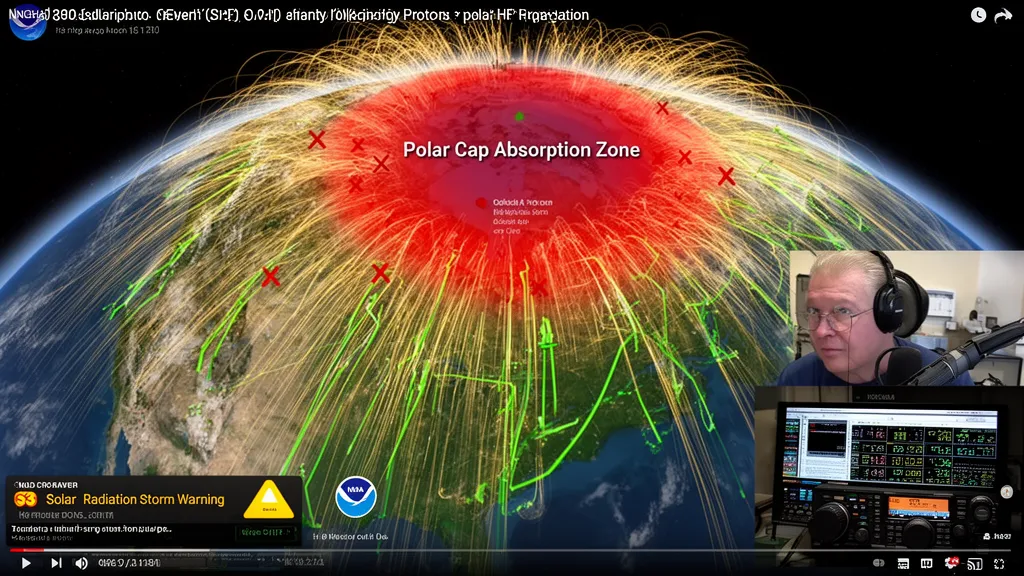
Operator’s Verdict: Solar proton events ionize the polar D-layer within minutes of a major solar flare, absorbing all HF frequencies on paths crossing geomagnetic latitudes above ~60°. Transpolar routes — Japan to Europe, USA to Russia — go completely dead within 30–90 minutes of an S2+ event and stay dead for 1–5 days. Paths below 60° geomagnetic latitude are unaffected.
What Solar Proton Events Are and Why They Are Not Geomagnetic Storms
Solar proton events (SPEs) and geomagnetic storms are distinct phenomena triggered by the same solar events but operating through completely different physical mechanisms. An SPE is the acceleration of protons to relativistic velocities by the electromagnetic impulsive phase of a major solar flare or, more commonly, by the bow shock ahead of a fast CME as it propagates through interplanetary space. These protons — primarily in the energy range of 10 MeV to several hundred MeV — travel at a significant fraction of the speed of light, not at solar wind velocity.
This is the critical distinction:
- Solar wind and CME plasma travel at 400–2,000 km/s. Earth transit time: 1–3 days.
- SPE protons travel at 0.1–0.9c. Earth transit time: 15 minutes to 2 hours.
A major solar event can simultaneously produce three separate, sequential radio effects: an X-ray burst causing an HF blackout within 8 minutes (the R-scale event), energetic protons initiating polar cap absorption within 30–90 minutes (the S-scale event), and the associated CME driving a geomagnetic storm 1–3 days later (the G-scale event). Each mechanism is independent. Each requires separate monitoring and response.
The September 2017 event sequence illustrates this clearly. The X8.2 flare from active region 12673 on September 10, 2017 produced an immediate R3 HF blackout on the sunlit hemisphere. Within 90 minutes, GOES proton flux had crossed the S2 threshold (100 pfu) and was climbing toward S3 (1,000 pfu), killing transpolar HF paths. Three days later, the associated CME arrived and produced a G4 geomagnetic storm — by which point the SPE’s polar cap absorption was still ongoing. Operators managing that week dealt with all three effects in overlapping succession.
The NOAA S-Scale: Measuring Solar Radiation Storm Severity
NOAA classifies solar radiation storms on a five-level S-scale based on peak flux of protons with energies greater than 10 MeV, measured by GOES satellites at geosynchronous orbit. Flux is expressed in pfu (particle flux units): particles · cm⁻² · s⁻¹ · sr⁻¹.
| S-Scale | >10 MeV Peak Flux (pfu) | HF Radio Impact | Events per Solar Cycle |
|---|---|---|---|
| S1 (Minor) | 10 | First detectable polar path degradation; experienced operators notice 10m/15m signal drops | ~50 |
| S2 (Moderate) | 100 | Clear polar cap absorption; transpolar paths unreliable | ~25 |
| S3 (Strong) | 1,000 | Transpolar HF blackout for days; all polar-path frequencies blocked | ~10 |
| S4 (Severe) | 10,000 | Near-complete polar HF blackout; absorption extends somewhat equatorward | ~3 |
| S5 (Extreme) | 100,000 | Total polar and sub-polar HF blackout; satellite hardware damage risk | ~1 per cycle |
The scale is logarithmic — each level represents a 10× increase in proton flux. S3 at 1,000 pfu is 100× the flux of S1 at 10 pfu. These are categorically different events, not increments on a linear scale.
For HF operators, the operationally significant threshold is S2: at 100 pfu, polar cap absorption on transpolar paths is clear and predictable. By S3, there is no viable HF option for paths crossing the polar cap; the only solutions are path avoidance or waiting for recovery.
How Protons Ionize the Polar D-Layer
The polar ionosphere has a unique geometry that makes it uniquely vulnerable. Earth’s geomagnetic field converges toward the magnetic poles, and field lines in the polar regions are nearly vertical, connecting the surface directly to interplanetary space through the polar cusps. At mid-latitudes, the more nearly horizontal field lines deflect incoming charged particles. In the polar caps, there is no such deflection — energetic protons following these field lines can reach D-layer altitudes.
When solar protons exceed roughly 10 MeV, they have sufficient energy to spiral along polar field lines and penetrate to D-layer altitudes of 60–90 km. At these altitudes, atmospheric density is sufficient to stop the protons, which deposit their kinetic energy by ionizing nitrogen and oxygen molecules. The resulting enhanced electron concentration produces intense HF absorption.
The absorption coefficient in the D-layer is proportional to Ne/f², where Ne is electron density and f is radio frequency. During an S3 event, D-layer electron density in polar regions increases by 2–3 orders of magnitude above quiet-day values. The consequences:
- Total absorption (>30 dB one-way path loss) for frequencies below ~15 MHz on polar paths
- Severe absorption (10–30 dB) for frequencies up to ~30 MHz during major S4 events
- Night-time operation provides no relief — protons are not photons and are not blocked by the shadow side
Unlike solar flare X-ray absorption (which is limited to the sunlit hemisphere and lasts minutes to 2 hours), polar cap absorption occurs day and night in polar regions and persists for 1–5 days.
During an active SPE, check your path’s highest geomagnetic latitude rather than geographic latitude. The geomagnetic pole sits at approximately 80°N, 110°W — over northern Canada, not the geographic North Pole. A path from W1 (New England) to OH (Finland) reaches geomagnetic latitudes of ~70°, making it vulnerable at S2+, while a path from W6 (California) to Germany touches ~65° geomagnetic — marginal at S2, blocked at S3.
The September 2017 SPE: A Case Study
The September 2017 solar event sequence is the most studied space weather episode of Solar Cycle 24 and illustrates all three NOAA scale effects in rapid succession.
Timeline:
- September 10, 2017 16:06 UTC: X8.2 flare from active region 12673 (near the western solar limb, W88). R3 HF blackout on the sunlit hemisphere. Duration: ~1 hour.
- September 10, ~18:00 UTC: GOES >10 MeV proton flux crosses S1 threshold (10 pfu) and is climbing rapidly.
- September 10, ~20:00 UTC: Flux exceeds S2 (100 pfu). Transpolar HF paths begin clear absorption effects.
- September 11, ~01:00 UTC: Flux peaks near S3 level (~1,000 pfu). Full polar cap absorption on all transpolar routes.
- September 12–13: Sustained elevated proton flux. Transpolar paths remain blacked out.
- September 13, ~00:00 UTC: CME from September 10 flare arrives. G4 geomagnetic storm begins.
- September 14: Proton flux begins declining toward S2; polar paths start gradual recovery.
For operators running Japan-Europe or North America-Japan paths via the short polar route, September 10–14 represented five days of effectively zero HF capability on those paths. Operators who recognized the situation early and shifted to long paths — which avoid the polar region — found success. The great-circle long path from Japan to the US East Coast runs southward over Southeast Asia, the Indian Ocean, and South America, maintaining geomagnetic latitudes well below 60° throughout.
Which Paths Are Blocked: Geomagnetic Latitude Is What Matters
The 60° geomagnetic latitude boundary is not the same as 60° geographic latitude. The geomagnetic pole is displaced from the geographic pole, so the affected zone is asymmetric in geographic coordinates.
Paths that cross >60° geomagnetic latitude and are blocked during S2+ events:
- JA (Japan) → W/VE (USA/Canada) via Arctic: geomagnetic latitude peaks above 80°
- W1/W2 (US Northeast) → SM/OH/LA (Scandinavia/Finland/Latvia): ~70° geomagnetic
- VE3 (Ontario) → UA0 (Siberia) via polar cap: ~85° geomagnetic
- G/PA (UK/Netherlands) → ZL (New Zealand) short path over pole: crosses both polar caps
Paths that stay below 60° geomagnetic latitude and remain usable during S3 events:
- W6 (California) → DL (Germany): ~62° geomagnetic (marginal at S2, usually blocked at S3)
- W4 (Southeast USA) → PY (Brazil): <45° geomagnetic — unaffected
- VK (Australia) → JA (Japan): ~55° geomagnetic — generally unaffected
- W1 (New England) → JA (Japan) via long path (southward over Pacific): <40° geomagnetic throughout
Duration and Recovery from Polar Cap Absorption
Recovery from PCA follows the decay of GOES proton flux back below the S1 threshold of 10 pfu. The timeline depends on whether the particle source is still active:
| S-Scale Peak | Typical PCA Duration |
|---|---|
| S1 | Hours to ~1 day |
| S2 | 1–2 days |
| S3 | 2–4 days |
| S4 | 3–5 days |
| S5 | 5–7+ days |
These durations can extend if subsequent flares or CME shocks replenish the proton environment before the original event decays. At solar maximum during an active sequence, PCA episodes can overlap and sustain polar D-layer ionization for more than a week.
Recovery is gradual after the GOES flux drops. The ionized D-layer requires several hours to recombine to quiet-day electron densities after the particle flux falls. The first polar paths to recover are typically the ones grazing the 60° boundary at lower frequencies — 40m paths at sub-polar latitudes recover before 20m paths at higher latitudes.
No operational technique bypasses PCA on affected paths. Unlike geomagnetic storms, where shifting to lower HF frequencies or NVIS can preserve local/regional links, PCA blocks all HF frequencies on polar-traversing paths. The only effective responses are:
- Use a path that avoids geomagnetic latitudes above 60°
- Use long path if it provides a lower-latitude route
- Monitor GOES proton flux and wait for recovery
- Shift to satellite or VHF/UHF for critical communications
Difference from Geomagnetic Storm HF Effects
Understanding where SPE effects end and geomagnetic storm effects begin requires tracking them separately, because major space weather events produce both.
| Feature | Solar Proton Event (PCA) | Geomagnetic Storm |
|---|---|---|
| Cause | Energetic protons from flare/CME shock | CME southward Bz coupling into magnetosphere |
| Onset | 15 min – 2 hours after flare | 15–30 min after CME arrival (1–3 days after flare) |
| Geographic scope | Polar cap only (>60° geomagnetic latitude) | Global, worst at high latitudes but extends to mid-latitudes in G4–G5 |
| Duration | 1–5 days | Typically 12–72 hours for main phase |
| Day/night dependence | None — affects polar paths at any local time | Reduced overnight as ring current partly recovers |
| Warning time | Minutes | Hours (from L1 Bz measurement) to days (CME trajectory models) |
| Lower-band workaround | None effective on polar paths | 40m/80m NVIS viable for regional paths at mid-latitudes |
During September 2017, operators had both effects simultaneously: PCA blocking polar paths from the S3 SPE while the G4 storm disrupted mid-latitude F2 propagation. Monitoring both GOES proton flux (for SPE status) and real-time Kp/Bz (for storm status) was essential.
Monitoring SPEs: GOES Proton Flux and S-Scale Alerts
NOAA SWPC issues S-scale watches, warnings, and alerts as GOES proton flux crosses each threshold. Watches are issued when conditions favor elevated proton flux but the threshold has not yet been crossed; warnings and alerts fire in real time as flux exceeds each level.
Practical monitoring workflow during an active period:
- Watch for X-class flares from well-connected active regions. The Parker spiral connects Earth most efficiently to solar longitude ~W50–W60. Major SPEs most often originate from active regions in this longitude zone. Flares from disk center or the eastern limb are less likely to produce significant SPEs at Earth.
- Open the NOAA GOES proton flux real-time plot. Any climb in >10 MeV flux above background (typically 0.1–1 pfu in quiet conditions) during or after a major flare is a precursor to watch.
- Act at S2, not S3. If you are running a transpolar path during an S2 event (100 pfu), absorption is already significant. Switching before S3 develops is more effective than discovering the path is dead mid-QSO.
- Track flux trend as well as current value. A flux still climbing at 500 pfu will reach S3 within minutes. A flux at 500 pfu but declining steadily may never cross S3.
DXRadar does not currently display live GOES proton flux data, but NOAA SWPC’s product at swpc.noaa.gov/products/goes-proton-flux provides the real-time data and historical event archive.
Frequently Asked Questions
What is a solar proton event?
A solar proton event is a significant increase in energetic proton flux at GOES geosynchronous orbit, specifically >10 MeV protons. These protons are accelerated during major solar flares or by the bow shock of a fast CME. They reach Earth in 15 minutes to 2 hours — orders of magnitude faster than the solar wind — and deposit their energy in the polar D-layer ionosphere by following geomagnetic field lines into the polar caps.
What is polar cap absorption and how does it affect HF radio?
Polar cap absorption is the intense D-layer ionization that occurs poleward of ~60° geomagnetic latitude when energetic solar protons penetrate to D-layer altitudes of 60–90 km. The resulting electron density increase produces absorption losses exceeding 30 dB one-way on paths crossing the polar cap. Because protons are not affected by day-night illumination, PCA operates equally at any local time in the polar region.
How long does polar cap absorption last?
S1 events: hours to 1 day. S2 events: 1–2 days. S3 events: 2–4 days. S4 events: 3–5 days. Recovery follows the decay of GOES proton flux below 10 pfu. Full ionospheric recovery can lag the flux clearance by several hours due to D-layer recombination time.
Which radio paths are affected by polar cap absorption?
Only paths whose great-circle routes cross geomagnetic latitudes above ~60°. This includes all transpolar short-path routes: Japan to Europe, North America to Russia/Siberia, Europe to New Zealand short path. Paths that remain below 60° geomagnetic latitude are unaffected regardless of SPE intensity.
How does an SPE differ from a geomagnetic storm?
An SPE produces polar cap absorption through direct D-layer ionization by energetic protons, affecting only high-latitude paths, with onset in minutes. A geomagnetic storm results from CME Bz coupling into the magnetosphere, producing global ring current intensification and F-layer disruption at a wider range of latitudes, with onset in hours after CME arrival.
Was the September 2017 SPE significant for HF operators?
The September 10, 2017 X8.2 flare produced an S3-class solar radiation storm that blocked transpolar HF paths for approximately 3–4 days. Combined with the associated G4 geomagnetic storm three days later, it was one of the most disruptive space weather weeks of Solar Cycle 24 for HF operators. Operators who shifted to long paths and monitored GOES proton flux recovered some usable paths during the event.