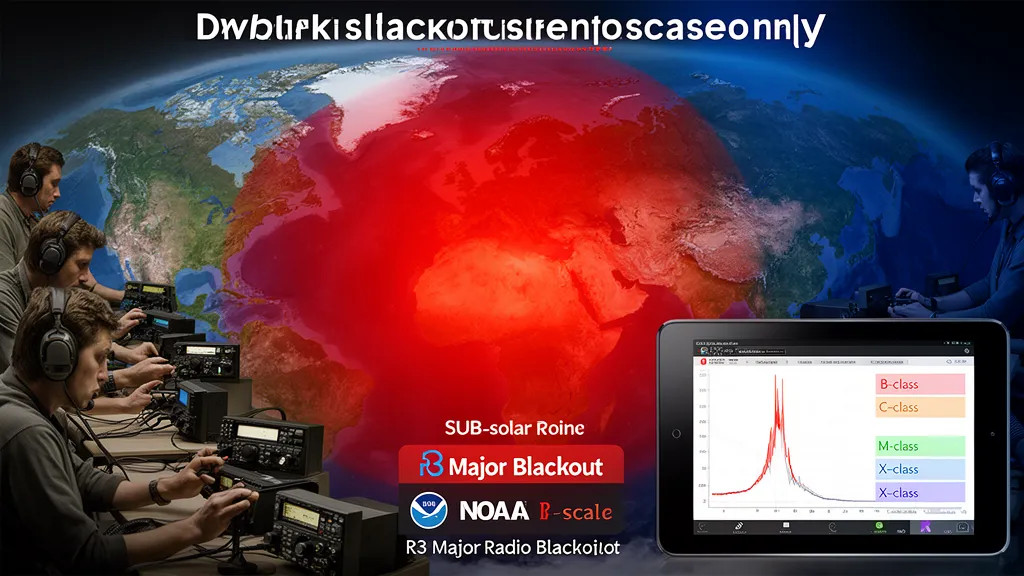
Operator's Verdict: If your bands go dead suddenly — signals dropping across 40m, 20m, and 15m simultaneously while your SFI is high — check the X-ray flux on DXRadar or NOAA SWPC. A sudden X-ray spike means a solar flare is in progress. Check which side of Earth is sunlit to know if you're in the affected zone. Recovery typically begins within 30–120 minutes depending on flare intensity.
What a Radio Blackout Is
An HF radio blackout is the sudden, near-total loss of usable HF communication on the sunlit side of Earth caused by an intense spike in solar X-ray radiation from a solar flare. The effect is rapid — absorption can increase dramatically within 2–5 minutes of a flare's X-ray peak — and affects all HF frequencies simultaneously (NOAA SWPC; ITU-R P.533-14).
The mechanism is D-layer absorption. Normally, the D-layer at 60–90 km altitude absorbs some HF energy but passes enough signal to allow F2 skip to function. During an X-ray event, the greatly elevated ionization turns the D-layer into an HF absorber that removes signal before it can reach the F2 layer. Signals are not reflected elsewhere — they are converted to heat in the lower ionosphere.
Unlike geomagnetic storms, which build over hours and affect high-latitude F2 paths selectively, radio blackouts hit instantly and hit all HF bands across the entire dayside simultaneously. The experience on air is abrupt and unmistakable.
The NOAA R-Scale: Quantifying Radio Blackouts
NOAA's R-scale (Radio Blackout scale) classifies HF radio blackout severity from R1 (minor) to R5 (extreme) based on peak X-ray flux, which is measured by GOES satellites in the 0.1–0.8 nm wavelength band. The R-scale maps directly to the standard GOES X-ray flare classification (NOAA Space Weather Scales).
| R-Scale | Flare Class | X-ray Flux (W/m²) | HF Impact | Recovery |
|---|---|---|---|---|
| R1 | M1–M4 | 10⁻⁵ to 5×10⁻⁵ | Weak; degradation on lower HF | 10–30 min |
| R2 | M5–M9 | 5×10⁻⁵ to 10⁻⁴ | Moderate; 40m and below affected | 30–60 min |
| R3 | X1–X9 | 10⁻⁴ to 10⁻³ | Strong; HF degraded on most bands | 1–2 hours |
| R4 | X10–X19 | 10⁻³ to 2×10⁻³ | Severe; HF unreliable for hours | 2–4 hours |
| R5 | X20+ | ≥ 2×10⁻³ | Extreme; HF out for most of day | 4+ hours |
The X-ray flux values are integrated flux in watts per square metre at 1 AU distance. GOES satellites measure this continuously; the values are publicly available in real-time from NOAA SWPC and on DXRadar's solar weather pages.
A single M-class flare (R1) happens several times per month near solar maximum. Don't panic when bands degrade briefly — check the X-ray graph, watch for the peak and subsequent decay, and expect bands to recover within 30–60 minutes. Major X-class events are rarer, but the recovery pattern is the same: worst at the X-ray peak, steadily improving as flux drops.
The Mechanism: X-Rays and the D-Layer
The D-layer is the lowest ionospheric layer, at 60–90 km altitude. Under normal daytime conditions, it has moderate ionization driven by solar Lyman-alpha radiation and galactic cosmic rays. This causes some HF absorption — you'll notice lower signal levels on 80m and 40m during daytime versus nighttime — but at levels that still permit usable propagation.
During a solar flare, the X-ray burst (primarily 0.1–0.8 nm hard X-rays) causes a sudden, intense increase in D-layer ionization. The X-rays ionize N₂ and O₂ at D-layer altitudes far more efficiently than the normal background radiation. Electron density in the D-layer can increase by a factor of 100 or more within minutes.
The absorption experienced by an HF signal is approximately proportional to the square of the electron density along the path. A 100× increase in electron density produces a ~40 dB increase in absorption — equivalent to losing 10,000 times more signal power. No practical antenna or transmitter upgrade compensates for 40 dB of additional absorption.
The X-ray burst travels at the speed of light, so it arrives simultaneously with the radio signal. There is no warning — you experience the blackout at the same moment the X-rays reach Earth. The only alerting mechanism is a solar flare optical or EUV observation, which NOAA SWPC uses to generate near-real-time alerts.
Which Bands Are Affected First
Lower frequencies experience more D-layer absorption than higher frequencies because absorption is roughly proportional to 1/f² — halving the frequency approximately quadruples absorption. This means the bands are affected in order, from lowest to highest:
R1 event (M2 flare):
- 160m and 80m: Essentially unusable. Absorption completely overwhelms signal.
- 40m: Severely degraded; may have marginal signal on high-angle paths.
- 20m–10m: Noticeably degraded but partially usable, especially at high angles.
R3 event (X2 flare):
- 160m through 40m: Complete blackout.
- 20m: Unreliable; intermittent signals possible.
- 15m: Marginal; may survive on paths where the reflection geometry minimizes D-layer path length.
- 10m: Somewhat less affected due to steeper reflection angles, but degraded.
R5 event (X20+ flare):
- All bands 160m through 10m: Complete blackout on dayside. No usable HF.
The 10m band is paradoxically slightly more resistant to blackouts than lower HF because 10m DX propagation uses low launch angles and longer single hops, meaning the signal spends less time traversing the absorbing D-layer than does a lower-frequency signal on the same path geometry.
How Blackouts Sound on the Air
An experienced operator can recognize a blackout onset before checking any monitoring data. The signature is distinctive:
- Sudden, simultaneous signal drop across all bands. Signals that were S7–S9 drop to S1–S2 or below across 40m, 20m, 15m, and 10m within a few minutes.
- Noise floor drops too. Because the D-layer absorbs background galactic noise at lower HF in addition to the desired signal, the receive noise floor on 40m and 80m also drops. If your noise floor suddenly falls quiet while signals disappear, it's almost certainly D-layer absorption, not a problem with your receiver or antenna.
- The change affects all directions. A geomagnetic disturbance might only affect high-latitude paths. A blackout hits all azimuths and all path lengths simultaneously on the dayside.
If you notice the anomaly and check an online X-ray monitor (NOAA SWPC, DXRadar), you will typically see a clear spike in the 0.1–0.8 nm flux trace, often several orders of magnitude above background. This confirms the cause within seconds of your observation.
Recovery: What Happens After the Flare
Recovery from a radio blackout follows a predictable pattern:
- X-ray flux peaks (this is when blackout is at its worst)
- Flux decays — usually exponentially, with a characteristic time of 20–60 minutes for most flares
- D-layer ionization drops as the excess electrons recombine. Recombination at D-layer altitudes is relatively fast (molecular ions recombine in seconds to minutes)
- Bands recover from the top down — 10m typically recovers before 20m, which recovers before 40m
The approximate recovery times listed in the R-scale table are for moderate conditions. A very intense X-class flare can have extended flux decay lasting several hours, especially if there is a series of flares from the same active region. The GOES X-ray graph is the clearest indicator of recovery progress.
After a major R3 or R4 event, don't give up immediately after the flare peak. Monitor the X-ray graph for the decay curve. Bands often return usable within 90–120 minutes, and the post-flare F2 layer is sometimes enhanced by residual ionization, providing temporarily better-than-normal conditions on the high bands once the D-layer clears. An X2 flare in the morning may be followed by improved 10m and 15m conditions in the afternoon.
Post-Blackout Enhancement: Residual Ionization Bonus
An often-overlooked effect follows major blackouts: post-flare F2 enhancement. A large X-ray burst that ionizes the D-layer also deposits significant EUV and soft X-ray energy at higher altitudes, temporarily increasing F2 ionization above the pre-flare baseline. Once the D-layer clears (1–2 hours post-peak for R3 events), the F2 layer may be stronger than before the flare.
Operators who close their radios during a blackout and don't return sometimes miss excellent conditions immediately following recovery. This enhancement is short-lived — typically 1–3 hours — and not guaranteed on every event, but it is a well-documented effect (ARRL; Hargreaves 1992).
Frequently Asked Questions
How do I know if a radio blackout is in progress?
Check the real-time GOES X-ray flux on NOAA SWPC or DXRadar's solar weather page. A blackout shows as a spike in the 0.1–0.8 nm (short wavelength) channel, typically rising sharply from the background baseline. NOAA issues near-real-time R-scale alerts via their SWPC notification system. On-air, the symptom is sudden, uniform signal loss across all HF bands on your dayside paths.
Can I still make contacts during a radio blackout?
Marginal operation may be possible depending on severity. During an R1 event, 20m and higher frequencies may remain partially usable. HF frequencies above 20m can sometimes sustain contacts on paths where the geometry minimizes D-layer traversal. Digital modes with FEC (FT8, JS8Call) tolerate more absorption than SSB because they operate closer to the noise floor. During R3+ events, satellite communications (which are unaffected by HF blackouts) and VHF/UHF local FM become the only alternatives.
Does a solar flare always cause a radio blackout?
Only flares with significant X-ray output cause HF blackouts. A-class and B-class flares produce negligible HF effects. C-class flares may cause barely detectable changes on 160m and 80m. M-class and X-class flares produce the R1–R5 blackouts in the NOAA scale. The correlation between optical flare brightness and X-ray flux is not perfect — some flares are X-ray-rich, others are optically bright but X-ray-poor. The GOES X-ray measurement is the definitive indicator.
What is the difference between a radio blackout and a geomagnetic storm?
Radio blackouts are caused by solar flare X-rays, affect the dayside only, onset within minutes, and recover within hours via D-layer absorption. Geomagnetic storms are caused by coronal mass ejections or solar wind enhancements, affect the entire globe (but predominantly high latitudes via auroral mechanisms), build over hours to days, and can last days. Both degrade HF, but through different mechanisms. A major flare can trigger both: the flare causes an immediate blackout, while the associated CME arrives 1–3 days later to cause a geomagnetic storm.