The Foundation: How Solar Cycles Are Defined and Numbered
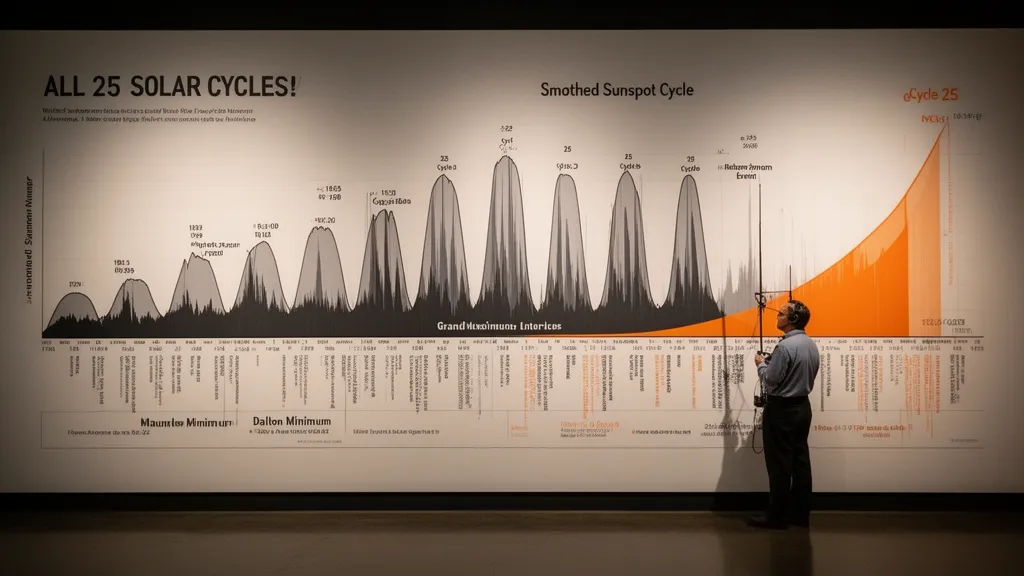
Solar cycles are periodic variations in the Sun's magnetic activity, observable through the 11-year waxing and waning of sunspot counts. The numbering system was established retroactively by Swiss astronomer Rudolf Wolf in the 1850s. Wolf identified a solar minimum around 1755 and designated the subsequent cycle as Cycle 1 — giving the numbering system an anchor point from which all subsequent cycles are counted forward.
The average cycle period is 11.0 years, but individual cycles range from approximately 9 to 14 years. This variability matters enormously for amateur radio planning: a short, intense cycle may compress excellent conditions into 3–4 years of high activity, while a long, weak cycle can mean a decade of poor HF propagation.
The primary metric used to track cycle progress is the Smoothed Sunspot Number (SSN), also called the International Sunspot Number, maintained by the Royal Observatory of Belgium's World Data Center SILSO. The smoothed value is a 13-month weighted average that removes short-term noise, providing a cleaner view of the cycle's overall trajectory. Daily and monthly SSN values swing dramatically; the smoothed number reveals the underlying trend.
A second important metric is the Solar Flux Index (SFI), a radio-frequency measure of solar activity at 10.7 cm wavelength (2.8 GHz), measured daily from Penticton, British Columbia, Canada. SFI correlates strongly with SSN and is the operationally most useful number for HF propagation prediction. Unlike SSN (a visual count), SFI is a physical measurement that directly quantifies the UV and soft X-ray flux responsible for ionizing the F2 layer.
Operator's Verdict: For HF operators, SFI above 150 reliably opens 10m, 12m, and 15m for F2 propagation. SFI below 80 means those bands are largely dead except for sporadic-E. The cycle history below tells you how often and how long you can expect SFI to remain above any given threshold.
The Waldmeier Effect: Predicting Peaks from Rising Slopes
In the 1930s and 1940s, Swiss astronomer Max Waldmeier identified a systematic relationship between a cycle's rising speed and its eventual peak intensity. Cycles that rise steeply from minimum to maximum tend to reach higher peak values. Cycles with gradual, shallow rises tend to be weaker.
This is operationally useful because the rising slope becomes apparent within 2–3 years of cycle minimum, providing predictive information about peak intensity before the peak is reached. If a cycle is rising faster than the average 4.8 years from minimum to maximum, expect a stronger peak.
The Waldmeier effect has notable exceptions and is not a reliable short-term forecasting tool, but it provides useful prior information for planning. Cycle 25's rapid rise from the 2019 minimum — observed clearly by 2021–2022 — was one of the early indicators that NOAA's conservative prediction of a smoothed peak near 115 was likely too low.
Cycles That Shaped Ham Radio History
Solar Cycle 19 (1954–1964): The Greatest Cycle Ever Recorded
Cycle 19 peaked in late 1957 to early 1958 with a smoothed SSN of approximately 285 (SILSO V2.0 International Sunspot Number) — the highest recorded in the era of modern solar observation. This coincided with the International Geophysical Year (IGY) of 1957–1958, an unprecedented global scientific collaboration that drove enormous growth in amateur radio activity and ionospheric research.
For operators active during that period, 10m behaved more like a VHF band than an HF one. Reliable F2 propagation to all continents, worldwide contacts on 10 watts, and openings lasting many hours per day were routine. The 10m contests of the late 1950s remain legendary among old-timers — log entries show contact rates impossible to achieve in any subsequent cycle.
The high SSN also meant elevated geomagnetic storm frequency. A solar maximum produces more CMEs, and high-energy CMEs produce the geomagnetic storms that create aurora and disrupt HF. The price of outstanding DX conditions is more frequent disruptions.
Solar Cycles 21 and 22 (1976–1996): The Dual-Peaked Modern Maximum
The period from approximately 1976 to 1996 encompassed two strong cycles that bookend what solar physicists call the "Modern Maximum" — a series of elevated cycles following the relatively quiet period of Cycles 14–17.
Cycle 21 peaked in late 1979 to early 1980 with SSN approximately 233. This was the cycle during which many of today's active Extra-class operators first became licensed. The late 1970s and early 1980s featured outstanding 10m and 12m conditions, and the band was reliably open to most of the world during daylight hours at peak.
Cycle 22 peaked in late 1989 with SSN approximately 212. It included two geomagnetically significant years: the March 1989 Quebec blackout storm (Dst approximately −589 nT, the strongest modern storm before 2024) and the Halloween storms of 1989 and subsequent events. Despite the storm activity, 10m and 15m DX conditions during 1989–1991 were outstanding.
| Cycle | Minimum Year | Peak Year | Peak SSN | Notable Feature |
|---|---|---|---|---|
| 19 | 1954 | 1958 | 285 | All-time record peak |
| 20 | 1964 | 1968 | 110 | Moderate; Korea-Vietnam war era |
| 21 | 1976 | 1980 | 233 | Strong; many current hams licensed |
| 22 | 1986 | 1989 | 212 | March 1989 Quebec storm |
| 23 | 1996 | 2000 | 181 | Y2K era; 10m reasonable but declining |
| 24 | 2008 | 2014 | 116 | Weakest cycle in 100 years |
| 25 | 2019 | 2024–25 | 200+ | Exceeded all predictions |
Solar Cycle 23 (1996–2008): The Last Strong Cycle Before the Drought
Cycle 23 peaked around SSN 181 in 2000. It was a moderately strong cycle — considerably weaker than Cycles 21 and 22, but sufficient to keep 10m open for DX work during daylight hours at peak. The Halloween storms of October 2003 occurred during the declining phase of Cycle 23, producing X17 and X28 flares and a brief G5 geomagnetic storm.
The 2003 storms are significant for modern amateur radio history because they occurred when the HF community was large, well-documented, and globally distributed. The reports from that event provide the best modern calibration data for how HF responds to extreme space weather — the 2003 storms caused complete HF blackout on polar paths and severe degradation globally for 24–48 hours during each major event.
Solar Cycle 24 (2008–2019): A Decade-Long Drought
Cycle 24 was the weakest solar cycle since Cycle 14, which peaked in 1906 with SSN 107. The smoothed peak of Cycle 24 reached only approximately 116 in April 2014, and the cycle was characterized by an unusually long and deep minimum at both ends.
For ham radio operators, Cycle 24 meant:
- 10m and 12m were largely dead for F2 propagation for extended periods
- The SFI frequently sat below 80 for weeks at a time — corresponding to essentially closed high bands
- 17m and 15m were unreliable for long-path DX during low-activity periods
- The period from approximately 2008 to 2011 saw some of the worst HF conditions in decades
This drove many operators permanently to FT8 and other digital modes, which have 10–15 dB advantage over SSB on weak paths. The Cycle 24 drought was arguably the largest driver of FT8 adoption — operators needed a mode that could work marginal paths when SSB would fail.
During Cycle 24's deep minimum (2008–2009), the SFI regularly sat at 65–70 SFU — the practical floor. At those levels, 10m is essentially inert, 12m barely produces F2 skips, and even 15m is unreliable for transcontinental paths. If you weren't active during that era, the contrast with current Cycle 25 conditions is remarkable.
The Maunder Minimum and Other Grand Minima
The 11-year cycle is not a rigid clockwork. Occasionally, the solar dynamo enters a state of dramatically reduced activity lasting decades — a "grand minimum." The most famous is the Maunder Minimum, spanning approximately 1645 to 1715.
During the Maunder Minimum, historical records — primarily sunspot observations by European astronomers — show that essentially no sunspots appeared for roughly 70 years. The few sunspots that did occur were predominantly in the northern solar hemisphere and followed different patterns than modern cycles. This was identified systematically by Edward Walter Maunder in the 1890s from analysis of historical records at the Royal Greenwich Observatory.
The Maunder Minimum coincides with the coldest phase of the Little Ice Age, when glaciers advanced, rivers froze that rarely froze before, and harvest failures contributed to social instability across Europe. The causal mechanism linking reduced solar activity to terrestrial cooling is still debated — the total solar irradiance change between minimum and maximum solar activity is approximately 0.1%, which alone is insufficient to explain the observed cooling. Indirect effects through UV-driven stratospheric chemistry and possible cloud nucleation feedbacks are under active investigation.
The Dalton Minimum (approximately 1790–1830) was a shallower grand minimum encompassing Cycles 5 and 6, both unusually weak. Cycle 5 peaked at roughly SSN 49; Cycle 6 at SSN 48. These two cycles produced over two decades of poor HF propagation — though HF radio would not be invented for another century.
The Modern Maximum (approximately 1950–2000) was a series of elevated cycles, Cycles 17 through 22, with consistently higher-than-average peak SSN values. Whether the Modern Maximum has ended or merely paused with Cycle 24 is one of the central questions in solar physics. Cycle 25's strong performance complicates the hypothesis that the Sun was entering a new grand minimum.
Solar Cycle 25: The Surprise Outperformer
The NOAA Solar Cycle 25 Prediction Panel, convening in 2019, issued a consensus forecast of a peak smoothed sunspot number of 115, with an expected range of roughly 105 to 125, similar in magnitude to Cycle 24 rather than the stronger late-20th-century cycles.
Cycle 25 has significantly outperformed this prediction. By mid-2024, smoothed SSN had exceeded 200, and the cycle produced multiple G5 geomagnetic storms — the first since the Halloween 2003 events. The May 2024 storm, reaching Kp 9 and Dst approximately −412 nT, was the most significant geomagnetic event in 21 years.
For HF operators, Cycle 25 has meant:
- Reliable 10m F2 propagation from approximately late 2021 onward
- 12m behaving as a consistent DX band for the first time since Cycle 22's peak
- 15m and 17m offering extended openings across multiple continents
- WSPR and FT8 spots confirming open paths that SSB operators are actively exploiting
- Multiple R3–R4 radio blackout events associated with X-class flares
The cycle's peak appears to have occurred in late 2024 to early 2025, based on the 13-month smoothed SSN trend. The declining phase has begun, though a single-peaked versus double-peaked maximum is still being assessed. Many cycles show a secondary peak 1–2 years after the primary maximum — if Cycle 25 follows this pattern, good conditions may persist into 2026.
What the Historical Record Tells Us About Cycle 26
Predicting Cycle 26 from the current vantage point is inherently uncertain. Reliable forecasting requires observing several years of rising activity after the minimum, which is not yet available. However, the historical record provides some guidance.
Leading indicators that will become visible in 2029–2031:
- The appearance of new-cycle sunspots at high solar latitudes (Spörer's law — new cycle spots first appear at ±35° latitude)
- Polarity reversal of active region magnetic fields — Cycle 26 spots will have reversed polarity from Cycle 25 (Hale's law)
- The rising slope of the new cycle, providing a Waldmeier-effect estimate of peak intensity
Current model estimates for Cycle 26, available from NOAA and various research groups, cluster around a moderate cycle — possibly in the SSN 130–180 range — but these estimates carry very wide uncertainty bounds. Some models using predictions of the Sun's internal dynamo state suggest a possible weakening trend, returning toward Cycle 24-level activity. Others suggest continuing moderate-to-strong activity through the 2030s.
The practical implication for operators: the current Cycle 25 declining phase (2026–2030) will see progressively declining SFI and reduced high-band reliability. Plan your antenna investments and operating strategies accordingly. A 10m Yagi optimized for the current peak will be underutilized within 3–4 years; a broad-coverage antenna system covering 17m–40m will serve the entire solar minimum period.
The cycle minimum between 25 and 26 is projected for approximately 2030–2031. Solar minima are excellent times for low-band (160m, 80m, 60m) DXing, where noise floors are lower and geomagnetic activity is reduced. They are poor times for top-band HF contest operations on 10m–15m. Operators who prepare for the minimum — including investing in low-band antennas and low-band operating skills — consistently outperform those who wait for the next peak.
Reading Solar Cycle Data on DXRadar
DXRadar's solar weather dashboard displays the current SFI updated every 10 minutes from the Penticton Observatory feed via NOAA SWPC. The cycle comparison tool shows current SSN alongside historical cycle profiles, letting you gauge where Cycle 25 sits relative to Cycles 19, 21, 22, and 24.
Key metrics and their cycle-phase interpretation:
| SFI Range | Cycle Phase Implication | 10m Status |
|---|---|---|
| 200+ | Near solar maximum | Wide open, worldwide |
| 150–200 | High activity | Good DX most daylight hours |
| 120–150 | Moderate activity | Occasional openings, Es supplements |
| 90–120 | Declining/rising | 10m unreliable for F2, Es only |
| 70–90 | Near minimum | 10m essentially dead for F2 |
| Below 70 | Deep minimum | 10m and 12m closed |
The SFI you see today on DXRadar is your single most useful proxy for the current state of the solar cycle and its implication for HF propagation above 14 MHz.
Frequently Asked Questions
How many solar cycles have there been?
Starting from Cycle 1 (beginning approximately 1755), we are currently in Cycle 25. This gives us 25 numbered cycles spanning roughly 270 years of continuous solar monitoring. The records prior to about 1850 are less reliable due to inconsistent observing methodology, but they are sufficient for identifying grand minima and the approximate cycle period.
Which solar cycle was the strongest for ham radio?
Solar Cycle 19, peaking in 1957–1958 with smoothed SSN approximately 285 (SILSO V2.0), was the most intense cycle in the modern record. Operators from that era describe 10m conditions that no subsequent generation has experienced — reliable worldwide propagation, high contact rates at low power, and openings lasting much of the daylight period. No subsequent cycle has matched it.
What is the Waldmeier effect?
The Waldmeier effect is the observed correlation between a solar cycle's rising speed and its peak intensity — faster-rising cycles tend to reach higher peaks. Identified by Max Waldmeier in the 1930s and 1940s, it provides useful (though imperfect) predictive power once a cycle's rising slope becomes clear, typically 2–3 years after minimum.
What happened during the Maunder Minimum?
The Maunder Minimum (approximately 1645–1715) was a period of near-complete absence of sunspots for roughly 70 years. If a similar event occurred today, HF operators would face decades of Cycle 24-level or worse conditions — essentially no 10m or 12m F2 propagation, unreliable 15m, and reliance on 17m and below for DX work. The probability of entering another grand minimum in the near term appears low given Cycle 25's performance, but it cannot be excluded.
Why was Solar Cycle 24 bad for ham radio?
Cycle 24 peaked at SSN 116 — one of the weakest cycles in a century. SFI rarely exceeded 150 and spent extended periods below 90, keeping 10m closed for F2 for months at a time. The cycle accelerated adoption of FT8 and other digital modes that can work marginal paths where SSB fails.
What is Solar Cycle 25 doing?
Cycle 25 has significantly exceeded NOAA's original 2019 panel prediction of a smoothed peak around 115, with an expected range of roughly 105–125. It reached smoothed SSN above 200 during its 2024–2025 peak, produced multiple major geomagnetic storms, and delivered the best HF DX conditions since the early 1990s. The declining phase began in 2025–2026 and the next solar minimum is expected around 2030–2031.
When will Solar Cycle 26 begin?
The transition between Cycle 25 and Cycle 26 will occur at the next solar minimum, projected for approximately 2030–2031. The new cycle's characteristics will not be reliably forecastable until approximately 2032–2033, when the rising slope becomes apparent. Current models suggest a moderate cycle, but historical accuracy of far-in-advance predictions is poor — as Cycle 25's performance demonstrated.