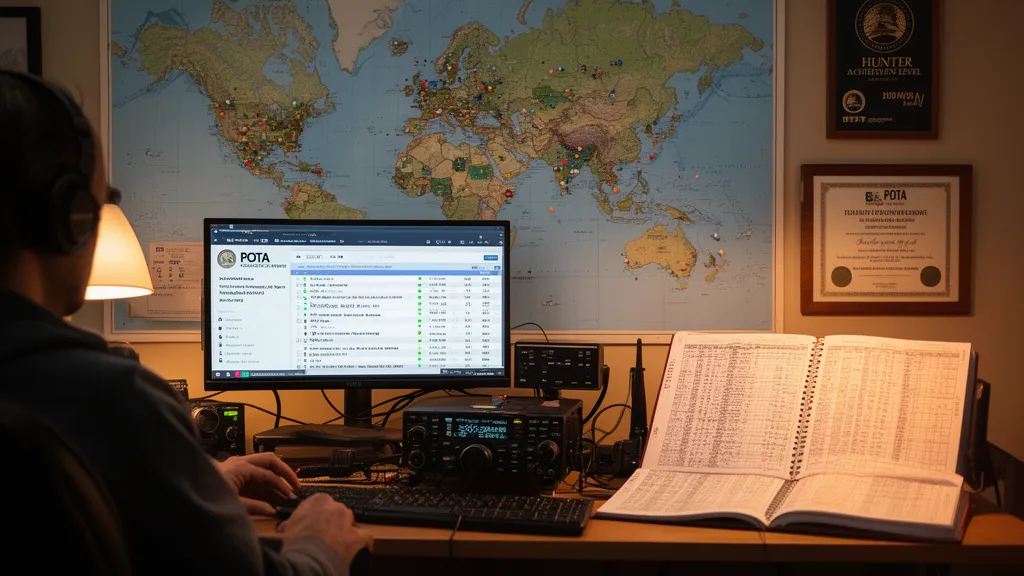
Operator's Verdict: Chasing made simple: Open pota.app/spots, find an activator on a band you can work, check DXRadar for current band conditions, call their callsign once, and confirm the 59. Most contacts complete in under 60 seconds. The hardest part is resisting the urge to give a lengthy signal report during a pileup.
The Chaser Mindset
Activators get the adventure; chasers get the DX. Every active activator is a motivated contact — they need QSOs to validate their activation, so they are genuinely happy to work you. This makes POTA chasing more welcoming than typical DX pileups where the rare station may have 200 callers and limited patience.
The chaser's tools are:
- A monitoring system for spots (pota.app, DXRadar)
- Knowledge of which bands work at which times of day
- Good pileup etiquette (short, precise callsign transmission)
Pro Tip: Open DXRadar's best bands now alongside pota.app/spots to see which bands have the strongest propagation right now. If the solar weather dashboard shows Kp rising above 4, skip activators on polar paths and focus on regional 40m NVIS targets within 800 km.
Finding Active Activators
pota.app/spots is the primary spot source. It shows:
- Activator callsign
- Park reference and name
- Frequency and mode
- Comment (often includes "TX 14250 SSB" or similar)
- Time of spot (age matters — spots older than 30 minutes may no longer be active)
DXRadar's POTA map shows the same data visually, with activators plotted on the map. Click any marker to see propagation context — is 20m currently supporting paths to that park's location?
Choosing Which Activator to Call
When multiple activators are spotted simultaneously:
-
Band conditions: Check DXRadar's live band status. If 20m shows EXCELLENT, prefer activators on 20m. If 20m shows FAIR (perhaps due to Kp 3), a 40m NVIS path to a regional activator may be more productive.
-
Spot age: Prefer spots less than 15 minutes old. Activators move bands and some leave the park without clearing spots.
-
Park rarity: New parks (never activated before) and parks with few total activations are valuable for awards. The pota.app spot page shows total activation count per park.
-
Distance and direction: Consider your antenna's best direction. A Yagi aimed east won't easily work an activator 200 km to your west.
Calling Procedure
During a small pileup (0–5 callers):
- Listen through a complete activator transmission to identify the frequency and pattern
- When the activator says "QRZ?" or finishes a contact, transmit your callsign once: "W1ABC"
- Wait 3–5 seconds for a response
- If no response, try once more after the next QRZ
During a large pileup (10+ callers):
- Find a small gap in the pile (between transmissions)
- Transmit just your callsign once — precisely, at normal speed, no phonetics unless the band is noisy
- Do not repeat multiple times per gap — it fills airspace and reduces everyone's chance
- When the activator picks you: confirm with "59, 73" and clear quickly to help them maintain rate
Never do:
- Transmit on the activator's transmit frequency
- Call on top of another station responding
- Ask for repeats unless genuinely unable to copy the exchange
- Give unsolicited signal reports without being called
Using DXRadar for Chasing Strategy
- Open DXRadar's main map with the POTA layer enabled
- Browse active spots — each shows activator callsign and park location
- Check current Kp and SFI at the top of the page
- If Kp > 4, filter to activators on 40m NVIS range (within 800 km) rather than DX 20m paths
- If a solar flare just occurred (M or X class visible on the X-ray chart), expect 20m to be noisy — check for 40m or 30m activators instead
POTA Awards for Chasers
| Milestone Badge | Unique Park Contacts |
|---|---|
| 10 parks | 10 parks |
| 25 parks | 25 parks |
| 50 parks | 50 parks |
| 100 parks | 100 parks |
| 250 parks | 250 parks |
| 500 parks | 500 parks |
| 1,000 parks | 1,000 parks |
Band endorsements and mode endorsements track contacts per band and per mode separately, rewarding operators who work parks on multiple frequencies.
Upload your contacts at pota.app after each session — when the activator uploads their log, your contacts are automatically confirmed and credited to your chaser account.
Frequently Asked Questions
What is POTA chasing?
POTA chasing means working activators who are operating from parks. Unlike activators who travel to a park, chasers typically operate from their home station or another fixed location. Every first contact with a park you have not previously worked counts toward your unique park total. POTA tracks milestone badges for unique park counts at 10, 25, 50, 100, 250, 500, and 1,000 parks.
How do I find POTA activators on the air?
The primary method is monitoring spots at pota.app/spots — a real-time list of currently active activators showing callsign, park reference, frequency, mode, and time. DXRadar also displays live POTA spots on its main map, with activators plotted at their park locations. Filter by band to find activators on a frequency you can work. Most activators spot themselves within minutes of beginning operation.
What is the calling procedure to work a POTA activator?
For a small pileup or no pileup: listen for the activator's CQ, then transmit just your callsign once (e.g., 'W1ABC'). Wait for the activator to respond. If they respond to your callsign, confirm with a signal report (typically '59'). For a large pileup: listen and wait for a gap, transmit your callsign once clearly, repeat if no response. Never transmit on the activator's transmit frequency. Only call on their listening frequency (split operation) if they announce 'listening 5 up' or similar.
How does DXRadar show POTA spots?
DXRadar's main map includes a POTA layer that plots active activator spots at their park locations. Each marker shows the park name, activator callsign, frequency, and mode. When you click a marker, it shows current band conditions between your location and the park. This integration helps you choose which activator to call based on both spot recency and current propagation conditions.
Can I work the same park multiple times?
Yes, but only the first contact at each park counts for your unique park count. Additional contacts with the same park on the same band-mode combination also count for band/mode awards. Working the same park on 20m SSB and 40m FT8 counts as two credits for band award purposes. Working the same park twice on 20m SSB only counts once. POTA's system encourages working diverse parks for the main count but rewards multi-band/mode operation for endorsements.