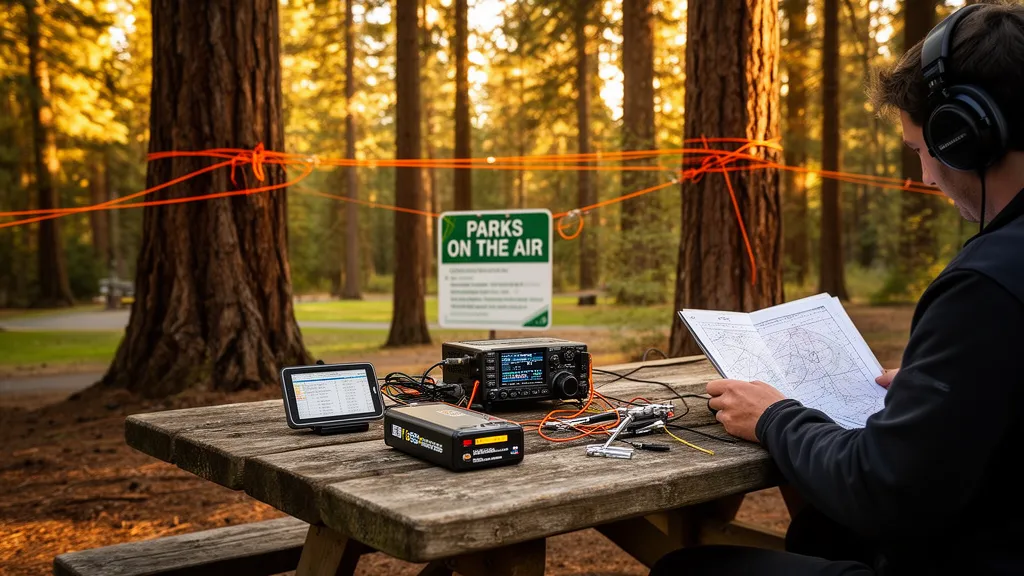
Operator’s Verdict: For most POTA activations, start on 20m and keep 40m on standby. Check the Solar Flux Index before leaving home — SFI above 100 means 20m and possibly 15m are productive; below 100, commit to 40m and 30m. Running 5W QRP adds roughly 13 dB of path margin penalty versus a 100W station, so propagation timing matters more than almost anything else in your kit.
What Band Is Best for POTA Activation?
20m (14 MHz) is the default POTA band for mid-latitude operators under most solar conditions. When SFI exceeds 100, 20m supports paths of 2,000–15,000 km during daylight hours, reaching hunters across multiple continents from a single park. 40m (7 MHz) is the reliable backup for regional hunters within 200–800 km via NVIS, and transitions to worldwide DX after local sunset. Band selection beyond this default depends on time of day, solar flux level, and how far you want your signal to travel.
Parks on the Air (POTA) activators typically operate portable — often with 10–100W and wire antennas — with many choosing 5–10W QRP rigs for weight savings. That QRP power level changes the propagation calculus significantly. A path that works comfortably at 100W may not close at 5W during marginal conditions. The difference between 100W and 5W is 13 dB of signal power — roughly two and a half S-units at the receiving station’s meter. Under good conditions, most HF paths have enough margin to close at QRP power. Under poor conditions, that 13 dB gap becomes the difference between a solid signal and a signal that is simply not detectable above noise.
The QRP Reality: Margin and When It Matters
QRP propagation works best when the path already has signal margin to spare. At SFI 150 on a mid-afternoon 20m transatlantic path, the F2 layer is densely ionized and signal levels are robust — a 5W station with a dipole at 9m height regularly makes S5–S7 contacts across 8,000 km. At SFI 85 on the same path, the F2 layer is thinner, path loss is higher, and a 5W station may be buried in the noise floor while a 100W station works the path adequately.
The approximation holds in practice: when conditions are “good,” QRP works anywhere a high-power station works. When conditions are “marginal,” QRP stations lose the path while high-power stations maintain it. Your mission as a QRP POTA activator is to choose bands and times where the path has excess margin — where even your 5W makes it to the hunter with a solid signal.
Three levers control that margin:
- Frequency — choose the band where propagation mode gives the best signal-to-noise ratio for your target hunters
- Time of day — operate when D-layer absorption is lowest and F-layer ionization is highest for your target path length
- Solar conditions — check SFI and Kp before driving to the park; a stormy activation on a poor-SFI day is not a failure, but it demands a different strategy
Band-by-Band Guide for POTA Operators
40m (7 MHz): The Anytime, Anywhere Band
40m is the most versatile POTA band. Daytime NVIS provides a 200–800 km skip-free local coverage area with no dead zone close to the antenna — ideal for activating a park and reaching regional hunters who may be too close for skip propagation on higher bands. NVIS on 40m requires a relatively horizontal antenna at low height — an inverted-V dipole with the apex at 6–9m works excellently.
After approximately 18:00–19:00 local solar time (vary by season and latitude), the D-layer thins enough to allow 40m to support longer F2 paths. By 21:00 UTC in the Northern Hemisphere winter, 40m supports worldwide paths from most mid-latitude QTHs. Activating a park in the late afternoon and staying until sunset gives you both NVIS regional hunters and the opening of transcontinental paths on the same band without changing antennas.
Atmospheric noise on 40m peaks in summer, particularly in tropical regions. Northern hemisphere operators activating summer parks in the Midwest or Southeast US will encounter higher QRN on 40m than in winter; a 5W QRP signal fighting S5 static crashes requires hunters with noise-canceling antennas or patience.
20m (14 MHz): The POTA Workhorse
20m is the band that makes POTA international. Under solar conditions of SFI 100 or higher, 20m supports F2 propagation to hunters 2,000–15,000 km away during daylight hours (approximately 08:00–20:00 local solar time at mid-latitudes, or roughly 06:00–18:00 UTC depending on your longitude).
The novel operating heuristic that QRP POTA operators should internalize: for 20m QRP, the sweet spot is 2–4 hours after your local sunrise. At this window, D-layer absorption is still low — the D-layer needs 1–2 hours of UV exposure to build to its daytime maximum — but F2 ionization has been building since before sunrise at higher altitudes and is already supporting transcontinental paths. This is the moment when your 5W closes paths that the same signal cannot close at 07:00 UTC (too much D-layer absorption for the path length) or at 16:00 UTC (D-layer is at maximum, absorbing more).
For a park activation starting at 08:00 local time in the US eastern time zone (13:00 UTC), the 20m sweet spot runs from approximately 13:00–15:00 UTC — when European hunters are in their afternoon hours and the path has maximum margin for QRP. This timing is not widely discussed in POTA guides but is consistently reflected in PSKReporter data for low-power stations.
15m (21 MHz): Daytime High-Solar Performer
15m is a productive POTA band when solar conditions cooperate. It requires SFI above 100 for reliable daytime F2 propagation, and performs best at SFI 120+. The band typically opens to Europe from mid-latitude US stations 2–4 hours after local sunrise, peaks in the mid-morning hours, and closes again as the Sun approaches the western horizon.
At 5W QRP on 15m with SFI 130, a compact vertical or wire dipole produces genuine pile-ups from European hunters — the F2 layer is dense enough that path loss on the 7,000–9,000 km transatlantic path leaves substantial signal margin even at QRP levels. The same antenna and power level on a day with SFI 85 produces nothing above the noise on 15m.
15m is not a band to plan around unless you know conditions before leaving home. Check is-15m-open (or the equivalent band status) before committing to a 15m antenna setup. If SFI is below 100 when you load the car, leave the 15m antenna at home and bring better 40m wire length instead.
10m (28 MHz): Magic When Open, Empty When Not
10m is the highest-reward, highest-risk POTA band. When SFI exceeds 120 and solar cycle conditions align, 10m supports F2 propagation with unusually low path loss — even a 5W QRP station with a quarter-wave vertical produces continent-wide and intercontinental contacts. Hunters specifically seek 10m activations because the band is less crowded and QRP signals that might be S3 on 20m are S7 on 10m during an opening.
Below SFI 100, 10m closes for F2 propagation except for unpredictable sporadic-E (Es) openings. Es on 10m is common from May through August in the Northern Hemisphere, with peak activity around 10:00–14:00 UTC and again 18:00–22:00 UTC, but it is not schedulable. You cannot plan an activation around Es; you can only recognize it and exploit it when it appears.
At Solar Cycle 25’s current stage, 10m is open with increasing regularity during equinox periods and mid-year months. Check is-10m-open in real time before and during your activation. When 10m is confirmed open, it is worth adding a simple 28 MHz quarter-wave vertical — 2.5m of wire — to your kit.
WARC Bands: 30m and 17m for Difficult Conditions
30m (10.1 MHz) is a POTA activator’s secret weapon because it is a WARC band — no contest activity means the band is never crowded, even on major contest weekends when 40m and 20m are completely occupied. 30m works under nearly all solar conditions; its propagation characteristics sit between 40m and 20m, providing regional skip on the order of 1,000–3,000 km during the day and longer paths at night.
17m (18 MHz) requires SFI 100+ for reliable daytime F2 propagation but is otherwise very similar to 20m in its skip characteristics. On contest weekends when every frequency on 20m is occupied, 17m offers quieter conditions and good hunter activity. It is not a primary activation band — keep it as an option when 20m is unusable due to QRM.
Pro Tip: Check the DXRadar best-bands-now page before leaving for the park. It shows current band conditions derived from live PSKReporter spot density — you can see at a glance whether 20m is populated with spots or empty, and whether there is unusual activity on 15m or 10m. Five minutes of pre-activation band research can determine your entire operating plan.
Solar Weather Assessment Before Your Activation
Knowing the solar flux before you drive to the park is as important as checking the weather forecast. An SFI reading takes 30 seconds to check and determines your entire band strategy.
| SFI Range | Bands to Prioritize | Expected 20m range | QRP Viability |
|---|---|---|---|
| SFI 130+ | 10m, 15m, 20m | 4,000–15,000 km worldwide | Excellent — pile-ups likely on all three |
| SFI 110–130 | 20m, 15m | 3,000–12,000 km | Good — solid contacts on 20m and 15m |
| SFI 100–110 | 20m | 2,000–8,000 km | Moderate — 20m reliable, 15m marginal |
| SFI 85–100 | 20m, 40m | 1,000–5,000 km | Fair — 20m shorter paths, 40m for regional |
| SFI 70–85 | 40m, 30m | Regional NVIS only | Limited — commit to 40m and 30m |
| SFI below 70 | 40m, 80m | NVIS local paths | Challenging — regional activation only |
Kp matters too — especially if your activation path takes signals over polar regions to reach European or Asian hunters. Keep Kp below 3 for best results. At Kp 4–5, your 20m path to Europe may still work but with reduced signal levels. At Kp 6+, transpolar paths fail and your hunter pool shrinks to lower-latitude stations. Check current space weather before heading out.
Gray Line: The QRP Activator’s Edge
The gray line — the terminator boundary between sunlit and dark Earth — produces a 30-minute window of enhanced propagation on 40m and 20m as it passes a given longitude. At the gray line, the ionosphere is in a transitional state that reduces D-layer absorption without the full daytime buildup — enabling long-distance paths at lower power than normally required.
For POTA activators near the sunrise terminator, this is a legitimate competitive advantage. An operator activating a park in the US Midwest at sunrise (approximately 12:00–13:00 UTC in December, 10:30–11:30 UTC in June) catches the gray line enhancement on 40m while the D-layer is still thin. European hunters in their late afternoon hours are also near the terminator on the opposite side. The combination extends 40m paths by 1,000–2,000 km beyond their normal reach, and the absence of D-layer absorption means 5W QRP goes further in this window than it does at any other time of day.
An inverted-V dipole for 40m, set up at the park the night before or at first light, with a 30-minute gray-line operating session starting at local sunrise, can produce pile-ups from Europe for US operators with 5W — contacts that would fail badly under midday conditions with the same power.
Antenna Strategy for POTA
Antenna choice for POTA is a balance between portability, effectiveness, and the target hunter population.
Inverted-V dipole — the most common and most effective POTA antenna. Low-angle performance is modest, but NVIS efficiency is excellent. A full-size 40m inverted-V (40m total wire, apex at 6–9m with a portable mast) is lightweight and covers regional hunters via NVIS and provides some directional gain for longer paths depending on orientation. Adding a 20m dipole on the same feedline (fan dipole) doubles band coverage with minimal added weight.
Vertical (ground-mounted, no radials) — effective for DX-oriented activations. A vertical antenna radiates at low elevation angles, which is exactly what long-distance F2 propagation requires. A telescoping vertical with a few ground-plane radials laid on the grass provides measurable improvement in DX signal levels over an inverted-V at the same height. Use a vertical when your activation goal is European or Asian hunters from North America on 20m or 15m.
End-fed half-wave (EFHW) — increasingly popular for POTA because it requires only one support point. An EFHW cut for 40m also resonates on 20m, 15m, and 10m via harmonic operation (with an appropriate transformer). Very portable. Performance is between a dipole and a vertical, varying by deployment angle.
The antenna decision should be driven by your target hunter population. If you want regional hunters on 40m NVIS, the inverted-V wins. If you want European hunters on 20m, orient your inverted-V toward Europe or use a vertical. If you want to maximize portable simplicity, the EFHW covers the most bands from one wire.
Seasonal Considerations
Summer (June–August, Northern Hemisphere): Higher atmospheric noise on 40m. Sporadic-E events open 10m and 6m unpredictably — carry a 10m antenna and be ready to exploit Es openings. 20m is reliable but D-layer absorption is at its annual peak (stronger UV from higher solar elevation angle), so path lengths are somewhat reduced compared to winter. 40m NVIS is most effective before 10:00 local time before D-layer absorption peaks.
Autumn and Spring (equinox months): Best overall conditions for most bands. F2 propagation is at its seasonal peak around the equinoxes; 15m and 10m are most productive. If SFI is above 100 during March or September, these are the best months to attempt 10m activations. Trans-equatorial propagation (TEP) is also at its seasonal peak, enabling 10m and 15m contacts between mid-latitudes in opposite hemispheres.
Winter (December–February, Northern Hemisphere): 40m is at its quietest — lower atmospheric noise, better signal-to-noise ratio, and longer nights mean 40m works worldwide for more hours per day. 20m closes earlier in the afternoon at high latitudes but produces excellent morning paths to Asia and Europe. 10m and 15m require higher SFI to compensate for the reduced solar elevation angle.
Frequently Asked Questions
What band is best for POTA activation?
20m is the best default band for most POTA activations — it reaches hunters 2,000–15,000 km away during daylight hours when SFI exceeds 100, covering multiple continents from a single park. 40m is the essential backup for regional hunters within 800 km via NVIS and becomes a worldwide DX band after local sunset. Start on 20m, drop to 40m when 20m quiets, and add 15m or 10m if SFI and solar conditions permit. For a complete view of current conditions, check the DXRadar 20m band page.
What SFI is good for POTA?
SFI above 100 is the threshold where 20m reliably supports long-distance paths and 15m becomes productive. At SFI 120+, 15m is in prime condition and 10m begins opening. Below SFI 85, focus on 40m and 30m, which work under almost any solar conditions. The DXRadar solar weather dashboard shows the current SFI updated every 10 minutes — check it before loading the car.
Can I do POTA QRP on 10 meters?
Yes, but 10m at 5W QRP requires the band to be genuinely open — which means SFI above 120 during the appropriate time of day (late morning to mid-afternoon for F2, and unpredictably for sporadic-E). When 10m is open and you have a simple quarter-wave vertical or dipole, 5W is surprisingly effective because 10m’s low noise floor and good antenna efficiency at the shorter wavelength provide more usable signal than expected. Before committing to a 10m setup, check is-10m-open for live confirmation of band conditions.
What time of day is best for POTA?
For 20m QRP, operate 2–4 hours after your local sunrise — this is the window where D-layer absorption is still low but F2 ionization has built enough for 2,000+ km paths. For most mid-latitude Northern Hemisphere operators in UTC+0 to UTC-7 zones, this translates to roughly 10:00–14:00 UTC depending on season. For 40m NVIS (regional hunters), operate from mid-morning until early afternoon. For 40m DX (long-haul paths), operate within 1–2 hours of your local sunset or sunrise, when the gray line enhancement is active.