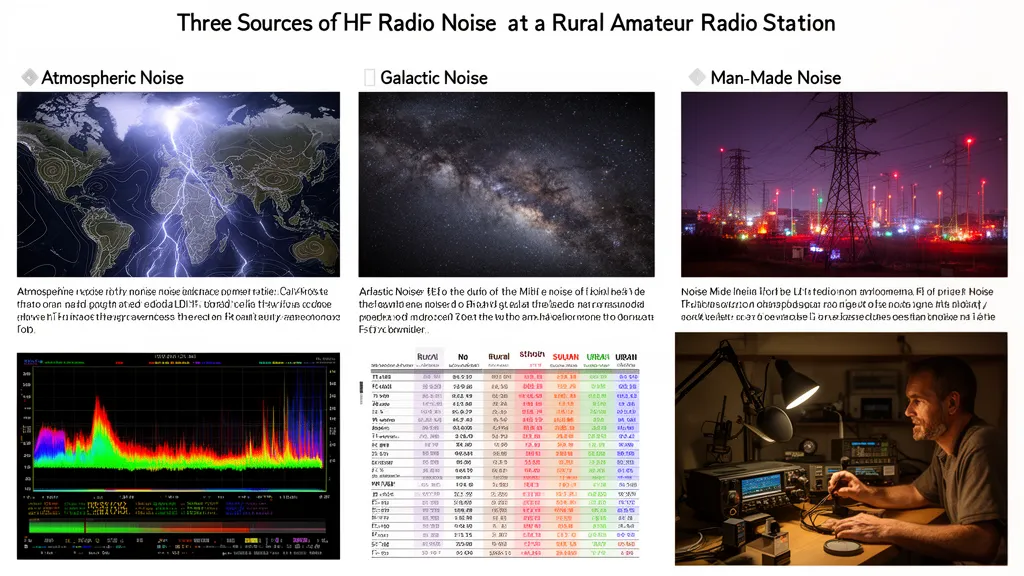
The Three Categories of HF Noise
The HF noise floor is not a single phenomenon — it is the sum of three distinct, overlapping sources, each with its own frequency behavior, time-of-day pattern, and mitigation approach. Distinguishing which source dominates on a given band is the first step toward improving your receiving situation.
The three categories are:
- Atmospheric and galactic noise (natural external noise): Lightning static (QRN) propagating via sky wave, plus the cosmic microwave background and galactic radio emissions.
- Man-made noise (QRM): Power line interference, switching power supplies, LED drivers, solar inverters, and other human-generated broadband and narrowband noise.
- Solar-induced ionospheric noise: Geomagnetic storm-driven ionospheric turbulence that raises the broadband noise floor on upper HF during disturbed conditions.
Each category has a characteristic frequency response, temporal pattern, and on-air signature. Understanding which one is limiting your receiving tells you what to do about it.
Pro Tip: Check DXRadar’s solar weather page before diagnosing noise issues — if a geomagnetic storm is in progress (Kp 5+), the elevated noise floor on 10m and 15m may be ionospheric in origin, not local. The best-bands-now page shows which bands have the lowest noise relative to signal activity right now.
Atmospheric and Galactic Noise: The Natural Baseline
Atmospheric noise (QRN) is dominated by lightning. At any given moment, roughly 40–50 lightning strokes per second occur worldwide (ITU-R P.372-16), primarily in the tropical and subtropical thunderstorm belts. Each stroke radiates a broadband impulse (sferics) that propagates via HF sky wave and arrives at distant receivers as crackling, popping static.
Atmospheric noise characteristics:
- Frequency response: Strongest on lower HF. ITU-R P.372 shows that man-made and atmospheric noise levels drop roughly 3–5 dB per octave as frequency increases. At 7 MHz, atmospheric noise is typically 30–40 dB above thermal noise floor; at 28 MHz, it is 10–20 dB above thermal noise floor under quiet conditions.
- Seasonal pattern: Loudest in summer afternoons and evenings local time, coinciding with peak thunderstorm activity. Quietest in winter nights.
- Geographic pattern: Worst in tropical and subtropical regions (within or near the lightning maximum belts). Quietest in arctic and antarctic regions.
- Diurnal pattern: QRN arrives via sky wave, so its level tracks the ionospheric propagation conditions — nighttime sky wave conditions can bring in distant storm static from the tropics even if your local area is thunderstorm-free.
Galactic noise sets the irreducible minimum floor on HF. It represents the cosmic microwave background and radio emissions from the galactic center and other celestial sources. At HF frequencies, galactic noise is typically masked by atmospheric noise except in extremely quiet, rural locations at night in winter. ITU-R P.372 includes galactic noise in its external noise models.
The absolute minimum achievable noise temperature on HF (limited by galactic background) is approximately 2,000–5,000 K at 14 MHz, equivalent to about −140 dBm in a 500 Hz bandwidth. This is the fundamental floor no receiver design or shielding can overcome.
Man-Made Noise: The Urban Penalty
Man-made noise is the dominant noise source for the majority of amateur operators in urban, suburban, and even many rural locations with nearby infrastructure. It does not vary with the solar cycle, weather, or time of day in predictable ways — instead, it depends entirely on what devices your neighbors are operating.
Common man-made HF noise sources include:
Switching Power Supplies
Every modern electronic device — computer power supplies, phone chargers, router supplies, television sets — contains a switching power supply operating at 20–200 kHz with harmonics extending through HF. A poorly designed supply radiates a comb of narrow interference lines every 20–100 kHz across the HF spectrum. On a spectrum display, they appear as regularly spaced carriers overlaid on the band. On CW, they may sound like a periodic buzzing or clicking at the switching frequency.
LED Lighting and Drivers
LED bulbs and strip lighting use constant-current drivers that switch at 40–200 kHz. Poorly filtered versions radiate broadband hash across the HF spectrum. The interference is sometimes correlated with light-switch state — toggling a room’s LED fixtures may produce a measurable noise change on 40m or 80m. LED street lights have been identified as significant interference sources in multiple ARRL interference reports.
Solar Panel Inverters
Grid-tied solar inverters are among the most problematic HF noise sources. They operate at high power (kilowatts), switch at tens of kilohertz, and are often located in close proximity to the amateur station. An inverter generating −90 dBm of conducted emissions can easily produce S7–S9 noise on 40m if the antenna is within 20–30 metres. Inverter noise typically disappears at night when solar production stops — a clear on-air diagnostic.
Power Line Interference
Arcing at pole-top hardware, corona discharge on high-voltage lines, and failing insulators produce broadband crackling noise that propagates several kilometers from the source. Power line noise has a characteristic sound: irregular crackling or buzzing, often correlated with weather conditions (wet insulators arc more). Frequency response: relatively flat across HF, with more energy at lower frequencies.
To identify whether your noise is from a specific man-made source: switch off your home’s main circuit breaker and observe whether the noise floor changes. If it drops, the source is in your home. If it doesn’t change, the source is external. For external power line noise, the noise level often increases during humid weather — a useful diagnostic signature.
Typical Noise Floor Values by Environment
The following values are approximate typical noise floors in a 500 Hz bandwidth, consistent with ITU-R P.372 noise models for external noise sources. Receiver thermal noise at room temperature in 500 Hz is approximately −147 dBm — well below the external noise floors listed, meaning external noise dominates HF reception in virtually all environments.
| Environment | 40m noise floor (7 MHz) | 20m noise floor (14 MHz) | 10m noise floor (28 MHz) |
|---|---|---|---|
| Rural, quiet (nighttime winter) | −135 dBm | −140 dBm | −143 dBm |
| Rural, quiet (daytime summer) | −128 dBm | −135 dBm | −140 dBm |
| Suburban, typical | −118 dBm | −125 dBm | −132 dBm |
| Urban, dense | −100 dBm | −110 dBm | −120 dBm |
Converting to S-meter readings (IARU: S9 = −73 dBm at 50Ω; each S-unit = 6 dB):
- Rural nighttime 40m: approximately S2–S3 ambient noise
- Suburban 40m: approximately S4–S5 ambient noise
- Urban 40m: approximately S7–S8 ambient noise — S9 signals from across the world are only marginally above the noise
The S-meter calibration note is important: the IARU defines S9 as 50 μV across 50 Ω at the antenna terminal (approximately −73 dBm). Signals are reported in S-units below S9 or as “S9 plus X dB” above it. Each S-unit is exactly 6 dB. However, many transceivers are not accurately calibrated at signal levels below S5 — use S-meter readings as relative indicators rather than absolute power measurements.
Solar-Induced Ionospheric Noise
The ionosphere itself becomes a noise source under disturbed conditions. Two mechanisms are relevant:
Geomagnetic Storm Noise
During geomagnetic storms (Kp 5 and above), increased ionospheric turbulence on upper HF bands raises the broadband noise floor. Auroral ionization is particularly noisy — the turbulent aurora creates a moving, irregular refracting medium that generates scintillation and broadband noise contributions on paths that traverse the auroral zone.
On 10m and 15m during a G2 or G3 storm, operators at mid-to-high latitudes (above about 45° N) may notice the noise floor rising even on paths that don’t pass directly through the aurora. This effect is distinct from QRN and QRM — it appears as a generalized rise in broadband noise without the characteristic signatures of lightning static or man-made sources.
D-Layer and the Paradox of Daytime Noise Reduction
This is one of HF’s counterintuitive behaviors. During daylight hours, the D-layer absorbs sky-wave signals passing through it — including the sky-wave noise arriving from distant atmospheric sources. This means the noise floor on 40m and 80m is often lower during daytime than at night, despite the D-layer also attenuating desired signals.
At night, when the D-layer disappears, sky-wave propagation becomes efficient on 40m and 80m — and all the noise from distant thunderstorm regions arrives unimpeded. The same mechanism that allows DX contacts on 40m at night also delivers continental-scale QRN.
Practical implication: if you’re chasing weak signals on 80m, there is often a window in the early morning (02:00–06:00 local time) where distant skip has shortened (reducing distant QRN arrival geometry) but ionospheric noise hasn’t built up yet. This varies by location and season, but is a real operating phenomenon.
Diagnosing Your Noise Floor: A Systematic Approach
If your S-meter shows S5 on 40m with nothing connected to the antenna terminal, you have a noise problem that exceeds the rural baseline. Here is a diagnostic sequence:
-
Disconnect the feedline from the radio. If noise drops dramatically, the source is external and arriving via the antenna. If noise barely changes, the source is inside your shack or receiver.
-
If external: Identify the frequency pattern. Regular comb-like spikes at fixed intervals = switching power supply. Broadband hash = inverter or LED driver. Irregular crackling = power line arc. Periodic pulses = local utility equipment.
-
If local to your home: Switch off the main breaker. If the noise disappears with the house power off, identify which circuit restores the noise when switched back on.
-
Time-of-day analysis: Does noise disappear at night? Solar inverter. Does it appear only during certain activities (microwave oven, laser printer operating)? Identify the device.
-
Check by frequency. Man-made noise is often stronger on lower HF and decreases with frequency; atmospheric noise follows a similar pattern but with day-night cycling. Flat noise across all HF frequencies often indicates a close-in source.
Operator’s Verdict: If your noise floor on 40m is S5 or above with your antenna connected and no specific signals visible, your operating environment is likely man-made noise dominated. A noise canceller (MFJ-1026 or equivalent), band-specific bandpass filters, a separate receive antenna (Wellbrook loop, Beverage), or moving the transmit antenna away from noise sources will provide more benefit than any receiver upgrade.
Frequently Asked Questions
What does 1 S-unit represent in practical terms?
One S-unit equals 6 dB, representing a 4:1 power ratio or approximately 2:1 voltage ratio at the receiver input. A signal that changes from S5 to S7 has increased by 12 dB — a 16-fold increase in received power. The IARU defines S9 as 50 μV at 50 Ω (−73 dBm). Signals below S1 may still be detectable on narrow digital modes like FT8 — the S-meter scale was designed for SSB voice modes and is not the meaningful threshold for digital operation.
Why does 160m have the worst noise floor of any amateur band?
At 1.8 MHz, atmospheric noise from distant lightning is at its maximum — ITU-R P.372 shows external noise at 1.8 MHz can be 20–30 dB higher than at 14 MHz. Additionally, man-made noise from switching power supplies reaches 1.8 MHz via conducted and radiated paths more effectively than at higher frequencies. The combination means 160m (Topband) operating is primarily limited by external noise rather than receiver performance for virtually all amateur stations outside arctic locations.
Does a better low-noise receiver improve HF performance?
For frequencies above about 10 MHz in a suburban environment, the answer is usually no. External noise sources dominate the noise floor by 20–40 dB above receiver thermal noise — improving the receiver noise figure from 10 dB to 3 dB gains you 7 dB, but if you’re sitting in a 20 dB man-made noise environment above thermal, the improvement is irrelevant. On VHF and UHF, or in extremely quiet rural HF locations, receiver noise figure matters. On HF in any typical environment, antenna system and noise source management yield far larger gains.
How does FT8’s noise floor differ from SSB?
FT8 requires approximately −20 dB SNR in a 2.5 kHz reference bandwidth, compared to approximately +10 dB SNR for comfortable SSB copy — a difference of about 30 dB. In practical terms, FT8 can decode signals that are 30 dB below what SSB requires, which explains why an FT8 QSO is possible when SSB would produce nothing but noise. This does not change the absolute noise floor, but it changes how much signal is needed above that floor for a valid contact.