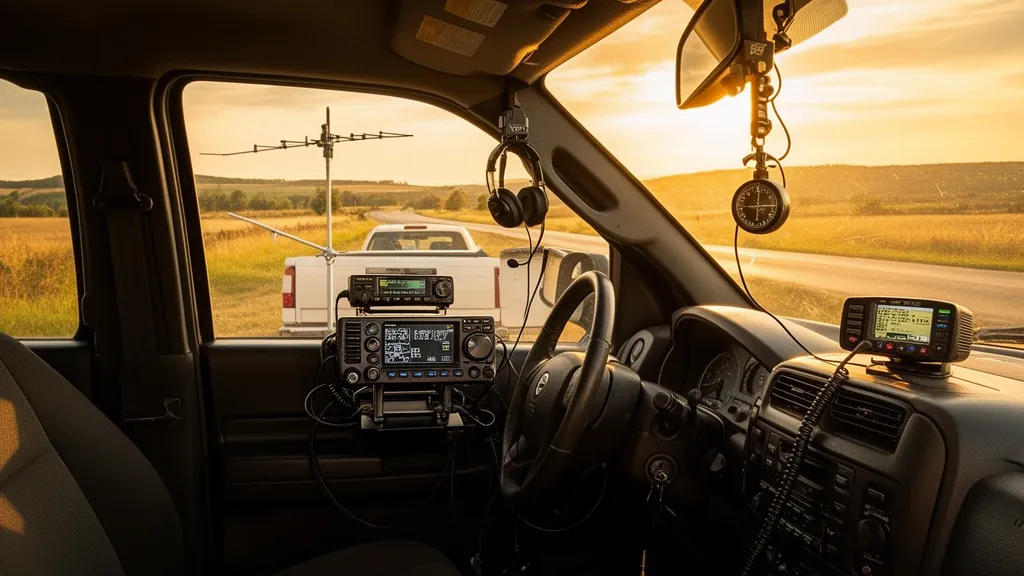
Operator’s Verdict: Mobile HF key factors: Antenna efficiency matters most — a well-tuned screwdriver antenna outperforms any compromise mount. 40m NVIS and 20m are your workhorses. Check DXRadar before leaving to know if 10m or 15m are worth monitoring during good solar conditions. Noise reduction: ferrite chokes first, ground bonding second.
The Mobile Antenna Challenge
A car is an extremely challenging antenna platform. The fundamental problem: any useful HF antenna must be comparable in size to the transmitted wavelength. A quarter-wave antenna on 20m is 5 metres (16 feet) tall — practical, if tall. On 40m, it would be 10 metres (33 feet) — impractical for a vehicle.
Mobile antennas solve this with electrical loading: a coil wound on the antenna element allows physical shortening while maintaining resonance. The trade-off is efficiency loss — a physically short, electrically loaded antenna radiates less efficiently than a full-size resonant element.
| Band | Full λ/4 Length | Practical Mobile | Efficiency vs Full Size |
|---|---|---|---|
| 10m | 2.5m (8.2ft) | Near-full size possible | ~90% |
| 15m | 3.6m (11.8ft) | Near-full size | ~80% |
| 20m | 5.0m (16.4ft) | Near-full size | ~70% |
| 40m | 10.0m (32.8ft) | Heavy loading required | ~30–50% |
| 80m | 20.0m (65.6ft) | Very heavy loading | ~10–20% |
This is why 10m and 15m are so effective for mobile DX during solar maximum — the antenna approaches full efficiency. And why 80m mobile is largely a waste of time.
Setting Up a Mobile HF Station
Power wiring: Run a dedicated heavy-gauge wire (10 AWG minimum for 100W, 6 AWG preferred) directly from the battery to the radio, with an inline fuse as close to the battery as possible. Never use the vehicle’s existing wiring harness — it’s designed for 12V accessories at low current, not RF-frequency switching loads.
Antenna mounting: The antenna needs a large conductive ground plane (the vehicle body) to work efficiently. Mount options:
- Trunk lip mount: Simple, no drilling. Uses trunk lid as ground connection (often poor).
- Ball mount on hitch: Excellent ground through frame; requires trailer hitch.
- Drill-through mount: Permanent, best electrical ground; requires drilling through body panel.
- Mag mount: Convenient but may slip at highway speeds; ground contact varies.
For best performance, the antenna mount should make solid electrical contact with the vehicle body (not just the surface — use a chassis ground braid for reliability).
Coax routing: Route coax away from the engine control unit wiring harness. PCM/ECU harnesses carry high-frequency switching signals that can mix with RF. Route coax along the opposite side of the vehicle interior from the main wiring loom.
Operating Bands for Mobile
20m for DX: Mobile 20m with a well-tuned screwdriver antenna produces surprisingly good DX contacts. An efficient 20m mobile antenna in a flat rural area can work Europe from eastern North America with 100 watts during good propagation.
40m NVIS: The most productive band for mobile operation at mid-latitudes during the day. 40m NVIS covers 300–600 km radius, which is ideal for communicating with home area stations, POTA chasers in your region, and EmComm nets. The antenna efficiency loss on 40m is partially compensated by NVIS’s tolerance for compromise antennas — NVIS radiation angle is high, not low, so antenna efficiency matters less than for long-haul DX.
10m and 15m during solar maximum: When SFI > 130, a near-full-size 10m or 15m screwdriver antenna extended to resonance is essentially a full-efficiency mobile antenna. The propagation plus efficiency combination produces remarkable DX contacts even while parked at a trailhead.
Check current solar conditions at DXRadar before tuning up for a mobile operation session.
Frequently Asked Questions
What is the best antenna for mobile HF operation?
The best mobile HF antenna is a compromise between performance and practicality. Common choices: (1) Screwdriver antenna (electrically tunable whip, 8–12 feet tall) — most versatile, covers 160m–6m with remote tuning; (2) ATAS-120A (Icom motorised antenna) — integrates with compatible Icom radios for automatic band switching; (3) Hamstick dipoles — inexpensive, resonant on specific bands, one per band needed; (4) Chameleon MPAS Lite — portable vertical that mounts on trailer hitch. For most mobile operators, a screwdriver antenna or ATAS-120A provides the best combination of performance and convenience.
What bands work best for mobile HF operation?
40m and 20m are the most practical for mobile HF. 40m NVIS provides excellent regional coverage (300–600 km) during the day without requiring precise antenna tuning. 20m offers international DX contacts when conditions are good. 10m and 15m require less antenna inductance (shorter loading coils), giving better efficiency, but depend heavily on solar conditions. 80m and 160m are theoretically operable from a vehicle but with extremely low efficiency due to very short antenna length relative to wavelength.
How do I reduce engine and alternator noise on mobile HF?
Mobile HF noise comes primarily from the vehicle’s electrical system: alternator whine (60–120 Hz hum varying with RPM), ignition noise (hash across all HF), and switching power supplies in modern vehicles. Solutions: (1) Ferrite chokes on the power lead and coax — snap-on ferrites at every equipment connection point; (2) Separate battery for radio with an isolator; (3) Star-ground all equipment to the vehicle chassis; (4) Bond the antenna mount to the vehicle body with braid; (5) Route power and coax away from ECU wiring harnesses. A quiet installation requires patient methodical diagnosis.
Can I legally operate a radio while driving?
FCC Part 97 permits mobile amateur radio operation while driving. However, state and local laws vary — many states have hands-free laws that may restrict certain radio operations. Operating a radio while driving requires genuine attention to both the road and the radio, which is difficult. Most mobile HF operators use voice mode (SSB) where interactions are brief; CW and digital modes (requiring keyboard/paddle operation) are generally inadvisable while moving. Voice-only operation with a headset and good ergonomics is the safest approach.
What power output is practical for mobile HF?
Most mobile HF installations run 100 watts maximum, as the vehicle’s 12V electrical system supports this level with a proper wiring installation. The vehicle alternator produces 12–14.4V at typical road speeds, sufficient for a 100W transceiver. Running 100 watts continuously may cause the alternator to work hard on older vehicles — monitor alternator temperature on extended operations. QRP (5–10W) installations are simpler, run longer on battery alone, and often produce satisfactory results when the antenna is properly matched.
Pro Tip: Before a mobile HF trip, check DXRadar’s best bands now page to see which bands have active propagation. If 20m shows EXCELLENT, your screwdriver antenna will deliver surprising DX. If conditions are poor, stick to 40m NVIS for reliable regional contacts — DXRadar’s solar weather dashboard will tell you if a geomagnetic storm is the culprit.