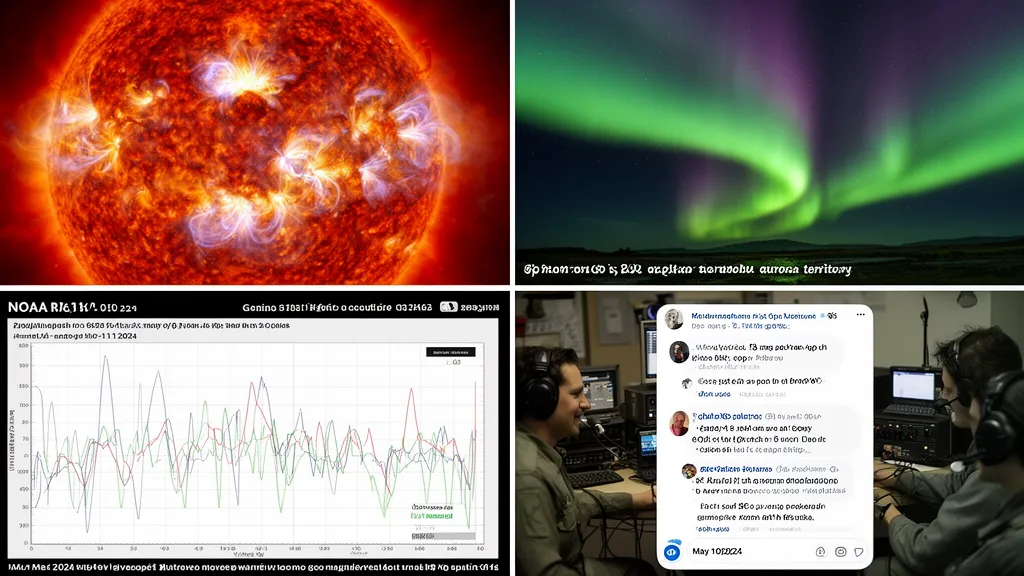
Operator’s Verdict: What happened: On May 10–13, 2024, Earth experienced the first G5 geomagnetic storm since 2003. HF was virtually unusable on polar and high-latitude paths for over 24 hours. Aurora was visible from Florida, Arizona, and Hawaii. The post-storm recovery produced exceptional F2 propagation. This article documents what happened, why, and what every HF operator should take from it.
Active Region 3664: The Source of the Storm
Active Region 3664 was one of the largest and most complex sunspot groups of Solar Cycle 25. At its peak, AR 3664 covered approximately 3,000 millionths of a solar hemisphere (MSH) — roughly 17 times the surface area of Earth. The region appeared on the eastern solar limb in early May 2024 and rotated into a geoeffective position near disk centre by May 8–10.
AR 3664’s magnetic configuration was classified as beta-gamma-delta, indicating a highly complex magnetic field with opposing polarities intermingled — the configuration most prone to X-class flare production. The region produced a series of major flares within 72 hours:
| Date (UTC) | Flare Class | Notes |
|---|---|---|
| May 8, 2024 | X1.0 | Initial major event; CME launched |
| May 9, 2024 | X2.2 | Second CME, faster than first |
| May 10, 2024 ~00:00 UTC | X3.9 | Third CME; compound event building |
| May 10, 2024 ~07:00 UTC | Storm sudden commencement | CME shock arrival at Earth |
| May 11, 2024 | G5 peak | Kp 9.33; maximum storm phase |
| May 14, 2024 | X8.7 | Largest flare of Cycle 25 to date; AR 3664 had rotated near west limb |
The compound CME is critical to understanding why this storm reached G5. Individual CMEs from the May 8–10 flares were each significant, but when the faster second and third CMEs overtook the first — a phenomenon called CME cannibalism — the merged structure arrived at Earth with amplified shock velocity and southward Bz component. The sustained, deeply negative Bz (reaching approximately −50 nT at peak) was the primary driver of the extreme Kp values.
The Storm Timeline: Hour by Hour
May 10, 2024: Storm Sudden Commencement
At approximately 06:00 UTC on May 10, the CME shock front arrived at the DSCOVR satellite at the L1 Lagrange point (approximately 1.5 million km sunward of Earth). Within minutes, ground-based magnetometers worldwide recorded a sudden increase in the horizontal component of the magnetic field — the storm sudden commencement (SSC).
Within the first two hours after SSC:
- Kp jumped from quiet (Kp 2) to Kp 7 as the initial shock compressed the magnetosphere
- G3 (Strong) storm conditions were in effect before the main southward Bz arrived
- 40m and 30m on polar paths showed degradation within the first hour
- European operators reported 20m failing on North America paths by 08:00 UTC
May 10–11: Main Phase — G5 Conditions
The main storm phase peaked during the May 10–11 UTC period. As the magnetic cloud arrived behind the initial shock, the interplanetary magnetic field (IMF) rotated to a strongly southward Bz. Sustained negative Bz below −30 nT drove the ring current to extreme intensity, producing the G5 storm designation.
Kp reached 9.33 — equivalent to Kp 9 in the traditional scale — the highest value measured since March 1989. The G-scale equivalent is G5 (Extreme), the maximum on the NOAA scale.
HF radio during the main phase:
- 20m was effectively useless on all paths crossing above 45°N great-circle latitude
- 15m and 10m were non-functional via F2 worldwide during the most disturbed period
- 40m NVIS remained marginally functional for stations south of 45°N on regional paths (under 500 km)
- 80m NVIS was the most reliable HF band south of 45°N during the peak — regional contacts to a few hundred kilometres were possible
- All transpolar circuits (NA–Europe via Arctic, NA–Japan via polar path) failed
Polar Cap Absorption
During the main phase, a solar proton event (SPE) associated with the earlier X-class flares added polar cap absorption on top of the storm-induced degradation. High-latitude stations above approximately 60°N and 60°S experienced complete HF blackout — not just degraded signals, but zero received signal above the noise floor. This is characteristic of polar cap absorption, where energetic protons directly ionise the D layer at polar latitudes.
Amateur radio operators in Alaska, Iceland, northern Scandinavia, and northern Canada reported HF completely dead from approximately 06:00 UTC May 10 through 18:00 UTC May 11 — over 36 hours.
Aurora Visibility: How Far South Did It Reach?
Aurora borealis was observed and photographed across an extraordinary geographic range during the May 10–11 peak:
| Location | Geographic Latitude | Notes |
|---|---|---|
| Alaska, northern Canada | 60–70°N | Overhead aurora, green/red/purple |
| Scotland, Norway | 55–65°N | Routine for high Kp; exceptional intensity |
| Southern England, Netherlands | 51–53°N | Naked-eye curtains; widespread social media reporting |
| New York, Pennsylvania | 41–43°N | Red and green aurora overhead |
| Florida, Texas | 25–30°N | Red aurora visible; photographically confirmed |
| Caribbean islands | ~18–22°N | Faint red aurora photographically confirmed |
| Hawaii | ~20°N | Photographically confirmed aurora — first in decades |
Why was aurora visible so far south? Two factors amplified the equatorward extent:
-
Storm intensity (G5): At Kp 9, the auroral oval expands to roughly 40° geomagnetic latitude. The equatorward boundary of the oval reached geographic latitudes of 25–30°N in North America.
-
Geomagnetic longitude offset of North America: The North American sector sits under the auroral oval at lower geographic latitudes than Europe because the magnetic pole tilts toward northern Canada. A station at 30°N in the eastern USA may be at a geomagnetic latitude equivalent to 40–45°N in central Europe.
Ham Radio Impact: What Operators Experienced
HF Failure at High Latitudes
The pattern was consistent across operator reports: at storm onset, 20m failed first on polar-routed paths, then 15m and 10m became unusable worldwide, then 20m became unusable even on mid-latitude paths. 40m was the last HF band to degrade, and NVIS paths on 40m and 80m under 500 km remained the most functional.
One experienced operator in Minnesota (44°N) logged the following on May 10:
- 08:00 UTC: 20m Europe paths going, long-path Japan gone
- 10:00 UTC: 20m short-path Europe failing, 15m gone
- 12:00 UTC: 20m dead. 40m NVIS to regional stations still 59+
- 18:00 UTC: 40m NVIS still working to 400 km radius; longer 40m paths failing
This sequence is exactly what propagation physics predicts: higher frequencies fail first as the MUF drops, and shorter NVIS paths (less affected by polar absorption) are most resilient.
40m NVIS as the Emergency Fallback
The clearest operational lesson from May 2024 was that 40m NVIS remains functional at mid-latitudes during major storms when all other HF fails. Regional EmComm networks that maintained 40m NVIS capability south of 45°N were able to continue operating through most of the storm’s main phase.
NVIS is effective on 40m when foF2 exceeds approximately 7.5 MHz — which continues even during moderate ionospheric disturbances at mid-latitudes. The storm’s D-layer enhancement increased absorption, but the shorter path lengths of NVIS geometry (maximum ~500 km) meant the absorption budget per kilometre was still tolerable.
Pro Tip: Pre-configure your radio with a 40m NVIS memory before the next G4–G5 storm. An inverted-V or flat-top dipole at 10–15 metres height is ideal. During storm main phase, keep a local net frequency on 40m NVIS — when 20m and 15m go silent, your regional 40m NVIS network will be the only functional HF communication remaining.
Post-Storm Enhancement: May 12–13
The storm’s recovery phase on May 12–13 produced one of the most remarkable F2 propagation events of Solar Cycle 25. As the ring current decayed and the ionosphere re-organised, foF2 values at many mid-latitude stations temporarily exceeded pre-storm levels — the classic positive phase of geomagnetic storm recovery.
Operators who returned to the radio 24–36 hours after the storm peak found exceptional 20m conditions with strong signals from across the world. Several reported working over 50 new DXCC entities in a single 4-hour operating session on May 12 UTC afternoon. 15m also opened unusually well for the season and SFI level.
The post-storm enhancement is not guaranteed and not always as pronounced as May 2024, but it is a predictable physical consequence of major storm recovery. Operators who abandon the radio during and after a storm miss this window.
Comparison with Previous Major Storms
| Storm | Date | Peak Kp | G-Scale | HF Impact |
|---|---|---|---|---|
| March 1989 Quebec | Mar 13–14, 1989 | 9 (9.0) | G5 | Power grid failure, complete HF disruption |
| Halloween Storms | Oct 29–Nov 1, 2003 | 9.3 | G5 | X17, X10 flares; satellite anomalies; HF blackout |
| May 2024 | May 10–11, 2024 | 9.33 | G5 | First G5 in 21 years; aurora to 20°N |
| September 2005 | Sep 10–11, 2005 | 8 | G4 | X17 flare; R4 blackout; no G5 |
The May 2024 storm ranked alongside the Halloween Storms and significantly below the Carrington Event (September 1859), which is estimated to have been equivalent to Kp 9+ sustained over multiple days. The May 2024 storm’s main phase lasted approximately 20 hours at G4–G5 levels before beginning recovery — intense but shorter than the Carrington Event’s multi-day disruption.
The X8.7 Flare on May 14
The largest X-ray flare of Solar Cycle 25 to date — an X8.7 — occurred on May 14, 2024, after AR 3664 had rotated to near the western solar limb. While this flare was the most energetic in terms of X-ray flux, its CME was not Earth-directed because of the limb position. The short-wave radio blackout from the X-ray flash itself was significant — an R3 (Strong) event — but no major geomagnetic storm followed.
This illustrates an important principle: flare class alone does not predict geomagnetic storm severity. An X8.7 from the limb produces a radio blackout but no storm. An X2 from disk centre with a fast, Earth-directed CME can produce G5 conditions. What matters for geomagnetic storms is the CME’s velocity, Bz component on arrival, and whether the event is Earth-directed.
Lessons for HF Operators
Lesson 1: Follow NOAA SWPC Alerts Actively
The May 2024 storm was not a surprise. NOAA SWPC issued a G4 Watch more than 24 hours before the storm sudden commencement, upgraded to G5 Watch as additional CMEs were confirmed. Operators who subscribed to SWPC email and SMS alerts (free, at swpc.noaa.gov/products/notifications-timeline) had advance notice to prepare. Operators who learned about the storm when their 20m suddenly died missed the planning window.
Lesson 2: Have a Storm Communication Plan
Know your fallback sequence before a storm hits:
- Maintain normal operations on 20m/15m while they last
- Switch to 40m long-haul as higher bands fail
- Fall back to 40m or 80m NVIS for regional circuits when long-haul fails
- Co-ordinate locally via VHF/UHF while HF is fully disrupted
Lesson 3: Don’t Abandon the Radio
The post-storm enhancement on May 12–13 rewarded operators who stayed active. Many of the exceptional contacts made during the recovery phase would not have been possible under normal conditions — the enhanced ionosphere temporarily produced path geometries and MUF values that exceeded typical solar-cycle-maximum values.
After a G3+ storm ends, put up a spot on 20m and 15m approximately 24 hours post-peak. You may find conditions far better than you expect.
Pro Tip: Bookmark the NOAA SWPC 27-day outlook (swpc.noaa.gov/products/27-day-outlook-107-cm-radio-flux-and-geomagnetic-indices). This product forecasts solar flux and geomagnetic A-index 27 days ahead — one full solar rotation. Large active regions often return on the second or third rotation, so if AR 3664 caused a G5 in May 2024, watching for its return in June 2024 was warranted. (AR 3664 did return as AR 3697 and produced additional X-class flares, though less severe.)
What AR 3664 Tells Us About Solar Cycle 25
Active Region 3664 was a reminder that Solar Cycle 25 has exceeded its pre-cycle predictions. Early NOAA and NASA panel predictions for Cycle 25 forecast a moderate cycle with a smooth maximum around 2025. Instead, Cycle 25 produced the largest sunspot groups and most energetic flares seen since Cycle 23 (which included the Halloween Storms).
The May 2024 G5 storm occurred on the ascending and then declining side of the cycle peak, not at the absolute maximum. Extreme events are not confined to the maximum — active regions capable of producing G5-level storms can appear anywhere in the cycle after activity has developed.
The current declining phase of Solar Cycle 25 in 2026 still carries meaningful G3–G4 risk. An AR 3664-class region returning to disk centre on the current cycle could produce another major event. NOAA’s real-time SDO imagery on the DXRadar solar weather page shows active regions currently on the solar disk.
Frequently Asked Questions
How strong was the May 2024 geomagnetic storm?
It reached G5 (Extreme) on the NOAA scale, with Kp 9.33 — the highest value since March 1989. It was the first G5 event since the October 2003 Halloween Storms, a 21-year gap.
What caused the May 2024 G5 storm?
Active Region 3664 produced multiple X-class flares between May 8–10, launching several CMEs in rapid succession. The faster CMEs overtook the slower ones (CME cannibalism), creating a compound merged CME that arrived at Earth with extreme shock velocity and a sustained southward IMF Bz exceeding −50 nT.
Where was aurora visible during the May 2024 storm?
As far south as Florida, Arizona, the Caribbean, and Hawaii — reaching approximately 20°N geographic latitude. North America’s geomagnetic longitude offset placed the auroral oval equatorward of what European observers at the same geographic latitude would experience.
Was HF radio usable during the May 2024 storm?
On high-latitude and polar paths, HF was essentially unusable during the main phase. 40m NVIS remained functional for stations south of 45°N on regional paths under 500 km. The post-storm recovery (May 12–13) produced exceptional F2 conditions on 20m and 15m.
What is a post-storm propagation enhancement?
After a major geomagnetic storm, the ionosphere often enters a positive phase recovery where foF2 temporarily exceeds pre-storm values, producing unusually good HF propagation. This window typically opens 24–48 hours after the storm peak and can last 12–36 hours.
What is CME cannibalism?
When a faster CME overtakes a slower CME launched earlier from the same active region, the two merge into a single compound structure with greater magnetic field energy than either CME alone. This merged event produces a stronger storm on arrival at Earth. AR 3664’s rapid sequence of X-class flares generated at least two such merging events.
How can ham radio operators prepare for G5 storms?
Subscribe to NOAA SWPC alerts for G3+ watches. Pre-identify your 40m NVIS fallback frequency for regional EmComm. Maintain awareness of the post-storm enhancement window (24–48 hours after peak) as an operating opportunity. Avoid concluding the storm is over until Kp has returned below 3 for at least 6 hours.
For companion reading, see Space Weather for Beginners and the Carrington Event and Ham Radio. Monitor current solar and geomagnetic conditions on the DXRadar Solar Weather page.