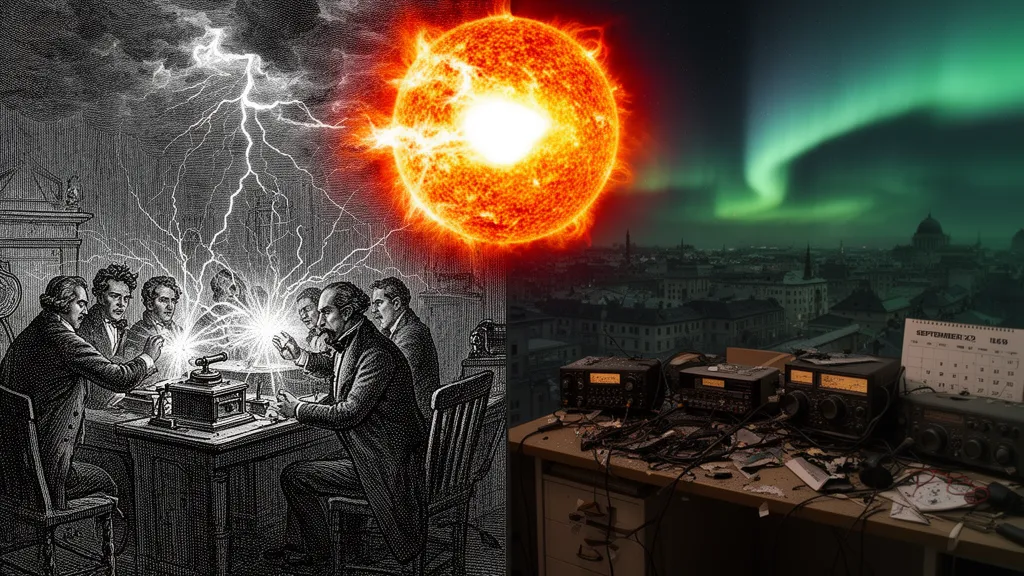
What Richard Carrington Saw on September 1, 1859
At approximately 11:18 UTC on September 1, 1859, British astronomer Richard Carrington was sketching sunspots through a projected solar image in his private observatory at Redhill, Surrey. He noticed two brilliant white patches of light appear within the sunspot group, rapidly intensifying over approximately five minutes before fading. He was the first person to visually observe a solar flare — an event so bright it was visible in projected white light rather than requiring spectroscopic equipment.
Independently and simultaneously, amateur astronomer Richard Hodgson observed the same event from his observatory at Highgate. The simultaneous observation by two independent observers established the credibility of what would become one of the most consequential solar events ever documented.
The flare lasted roughly 5 minutes for its white-light phase, though X-ray and UV emission continued longer. Carrington noted the event in his observing log and immediately dispatched news to the Royal Astronomical Society. He was cautious about drawing a causal connection between the solar observation and the geomagnetic effects that followed — famously writing “one swallow does not make a summer.” He was right to be cautious, but also right that a connection existed.
The associated CME arrived at Earth approximately 17.6 hours later — the fastest confirmed CME transit ever recorded. Typical CMEs take 1–4 days to cover the 150 million km from Sun to Earth. This one averaged roughly 2,400 km/s, compared to a typical CME speed of 400–600 km/s. The speed indicates an exceptionally energetic and compact ejecta cloud.
The Storm’s Intensity: What the Instruments Recorded
The Carrington Event produced a geomagnetic storm of extreme intensity — though quantifying it precisely requires careful interpretation of 19th-century magnetometer records.
Ground-based magnetometers at the Colaba Observatory in Bombay, India recorded a horizontal component deflection of approximately −1,600 nT. Modern estimates, extrapolating from multiple observatory records, suggest the storm’s Dst index equivalent reached between −850 and −1,760 nT. For context, the strongest storm in the modern satellite era — the March 1989 Quebec blackout storm — reached approximately −589 nT Dst. The May 2024 G5 storm peaked at roughly −412 nT.
The Kp index did not exist in 1859 (it was developed by Julius Bartels in 1939), but reconstructions based on magnetometer deflection consistently place the Carrington storm at the maximum of the Kp 9 scale — and beyond what the scale was designed to measure. The NOAA G-scale maximum is G5, corresponding to Kp 9, but the Carrington event almost certainly exceeded what a “Kp 9” implies for modern infrastructure.
Aurora was visible at latitudes that almost never see the northern lights. Reports from the Caribbean — Cuba, Jamaica — describe aurora so bright that gold miners in the Rocky Mountains woke up and started preparing breakfast, mistaking the auroral glow for dawn. Observations from Hawaii and southern India confirm aurora at geomagnetic latitudes below 20°. For aurora to reach those latitudes requires the auroral oval to have expanded dramatically equatorward, which occurs only during extreme storms.
Operator’s Verdict: The scale of the 1859 storm dwarfs any modern benchmark. No living radio amateur has experienced anything close to Carrington-class conditions. The May 2024 G5 storm — which itself caused significant HF disruption — was approximately 2–4× less intense on peak Dst measures.
What the Storm Did to 19th-Century Communications
The primary long-range communication technology in 1859 was the telegraph. The effects of the Carrington Event on telegraph infrastructure were dramatic and well-documented, providing the closest analogue to what a similar storm would do to modern networked electrical systems.
Across North America and Europe, telegraph operators reported:
- Sparks flying from telegraph equipment, starting fires in some offices
- Operators receiving electrical shocks from keys and equipment
- Lines operating autonomously — transmitting and receiving messages without battery power, driven entirely by geomagnetically induced currents (GICs)
- Some lines rendered completely inoperable for hours
One particularly striking documented exchange, published in the Boston Traveler on September 2, 1859, describes telegraph operators on the Boston–Portland line disconnecting their batteries and successfully continuing to communicate using only storm-induced currents for roughly two hours.
GICs are induced when rapidly changing magnetic fields thread through long conductors at ground level. The physics is identical to transformer action: the Earth’s magnetic field, varying rapidly during the storm, drives currents through any extended conductive path. In 1859, those paths were telegraph lines. Today, they are power grid transmission lines, natural gas pipelines, and transoceanic cables.
The Modern Infrastructure Exposure Problem
A Carrington-class event today would encounter a civilization orders of magnitude more electrically dependent than Victorian England — and far more vulnerable in specific ways.
The power grid is the primary concern. Modern high-voltage transmission systems rely on large power transformers operating at voltages up to 765 kV. A GIC of even a few tens of amperes flowing through the neutral ground connection of these transformers can cause half-cycle saturation — the transformer core saturates during one half of the AC cycle, producing extreme reactive power demand, harmonic distortion, and thermal stress.
The 2008 National Academy of Sciences report on severe space weather estimated that a Carrington-class event could permanently damage 300 to 500 large power transformers in the United States alone. These are not standard industrial components. They are custom-manufactured, weigh up to 400 tonnes, and carry lead times of 12–18 months for replacement. Many are manufactured in only a handful of facilities worldwide. Simultaneous failure of hundreds of transformers could leave large regions without grid power for months to years, not hours to days.
GPS is the second major vulnerability. The Global Positioning System relies on precise timing signals transmitted from satellites at 20,200 km altitude. During extreme geomagnetic storms, ionospheric disturbance degrades the accuracy of GPS positioning and timing signals. GPS-disciplined oscillators — used in cellular networks, financial trading systems, and power grid synchronization — can lose lock or produce erroneous timing during extreme events. Modern grid management systems depend on GPS time-stamped phasor measurement units (PMUs) for stability monitoring.
Low-Earth orbit satellites face direct radiation damage from energetic particles. The S-scale solar radiation storm that typically accompanies a major CME event can damage satellite electronics, degrade solar panels, and increase drag through atmospheric expansion. Many of the ~7,000 active LEO satellites might experience degraded capability or loss.
HF Radio During a Carrington-Class Event: What to Expect
For amateur radio operators, the storm evolution breaks into distinct phases — each with different radio implications.
Phase 1: The Flare (Hours 0–2)
The associated solar flare produces an immediate X-ray burst reaching Earth in 8 minutes. A flare capable of driving a Carrington-class CME would likely be X10 or stronger, producing an R4–R5 radio blackout. The dayside hemisphere would experience:
- Complete HF blackout from 1.8 MHz through 30 MHz
- Degraded VHF satellite communications
- Navigation signal loss on L-band frequencies
The nightside hemisphere remains largely unaffected during this phase.
Phase 2: Energetic Particle Arrival (Hours 1–24)
Solar energetic protons (SEPs) arrive within 30 minutes to several hours of the flare. An extreme event would produce an S4–S5 solar radiation storm. The primary radio effect is polar cap absorption (PCA): the energetic protons ionize the polar D-layer, making any HF path transiting through the polar regions completely opaque. This eliminates transpolar routes — North America to Europe via the polar path, for example — for potentially days.
PCA can persist even after the main geomagnetic storm has subsided, because energetic protons remain trapped in the radiation belts and continue precipitating.
Phase 3: CME Arrival and Main Phase (Hours 17–72)
When the CME arrives, the main geomagnetic storm begins. At Carrington-scale intensity:
- Global HF would be severely degraded or blacked out as extreme D-layer enhancement extends across the sunlit hemisphere
- Auroral absorption would additionally affect mid-latitude paths
- The ionospheric F-layer would be severely disturbed, making MUF calculations unreliable
- The entire 10m, 12m, and 15m bands would likely be unusable globally
- 20m and 17m would be intermittent and unreliable
- 40m and 80m NVIS would offer the best residual capability for regional communication
During the May 2024 G5 storm — far weaker than Carrington-class — operators who stayed on 40m NVIS with simple dipoles reported usable regional propagation to distances of 300–800 km when higher bands had completely collapsed. In an extreme event, 80m NVIS on locally resilient power would likely be the primary HF workhorse.
Phase 4: Recovery (Days 2–7)
As the storm subsides, bands recover from the top down. 10m and 12m recover last. 40m and 80m typically regain reliable NVIS performance within 24–48 hours of the storm’s main phase. Full F-layer recovery may take several days as the ionosphere returns to equilibrium.
Why Ham Radio Operators Matter in a Mega-Storm
The scenario created by a Carrington-class event is precisely the scenario amateur radio was invented to handle: widespread infrastructure failure requiring resilient, distributed, operator-driven communication.
Consider the asset inventory a licensed amateur brings:
- Self-contained HF stations capable of operating on battery, solar, or generator power
- Skilled knowledge of propagation conditions and frequency management
- Established emergency networks (ARES, RACES, AUXCOMM) with pre-planned frequencies and procedures
- Technically trained operators capable of adapting to degraded conditions
- Antenna systems that require no external infrastructure
During a multi-day or multi-week grid outage, satellite phones run out of battery. Cellular networks fail without grid power to base stations (typical backup runtime: 4–8 hours on battery, 24–48 hours with generator fuel). Internet infrastructure depends on data centers that typically have 24–72 hours of generator fuel. HF amateur radio with a simple dipole, a QRP transceiver, and a 12V battery can communicate across a continent.
The ARRL Amateur Radio Emergency Service (ARES) and its government counterpart RACES exist specifically to provide communication backup in disaster scenarios. Carrington-class events are discussed in emergency management plans as a “black sky” scenario — a catastrophe that takes out normal communication infrastructure simultaneously across a wide area.
The Probability Question
How likely is another Carrington-class event? The statistical answer is uncomfortable.
Physicist Pete Riley analyzed the historical record of major geomagnetic storms and published a 2012 paper in Space Weather estimating the probability of a Carrington-class event. His central estimate: approximately 12% per decade — roughly 1.2% per year. Over a 50-year active operating career, a licensed amateur radio operator faces a probability of roughly 45% that a Carrington-class event will occur during their lifetime.
A 2012 Lloyd’s of London risk assessment, “Solar Storm Risk to the North American Electric Grid,” estimated 20–40 million people could be without power for 1–2 years following an extreme event. That assessment was commissioned before the rise of GPS-dependent grid management, IoT infrastructure, and the current density of LEO satellites.
The May 2024 G5 storm (peak Kp 9, Dst −412 nT) was notable because:
- It was the first G5 event since the Halloween storms of October–November 2003
- It demonstrated that Cycle 25 is capable of extreme events despite originally being predicted as a weak cycle
- It gave infrastructure planners and ham radio operators alike a real-world rehearsal of G5 conditions
The 2024 storm was survivable because it was, by Carrington standards, moderate. It was a reminder of the exposure, not the event itself.
What DXRadar Monitors to Track Storm Risk
DXRadar tracks the real-time indicators that precede and define major geomagnetic storms:
- Kp index from GFZ Potsdam, updated every 3 hours
- X-ray flux from NOAA GOES satellites — the first warning of solar flares
- Solar wind speed and Bz from the DSCOVR satellite at the L1 Lagrange point, approximately 1.5 million km upstream of Earth — typically 15–60 minutes of advance warning before CME arrival
- NOAA SWPC alerts for G, S, and R-scale events
Set DXRadar’s space weather alerts to notify you when Kp exceeds 5 and when the GOES X-ray flux climbs above M-class. These two thresholds — Kp 5 and X-ray M1.0 — bracket the conditions where actionable decisions about antennas, operating frequency, and emergency activation are appropriate.
Frequently Asked Questions
What was the Carrington Event?
The Carrington Event was a solar flare observed by Richard Carrington on September 1, 1859, followed by the most intense geomagnetic storm in recorded history. The associated CME arrived at Earth in approximately 17.6 hours — far faster than the typical 1–4 day transit. Estimated Dst reached −850 to −1,760 nT; aurora was visible at geomagnetic latitudes below 20°, including the Caribbean and Hawaii.
Could the Carrington Event happen again?
Yes. Pete Riley’s 2012 analysis in the journal Space Weather estimated approximately 12% probability per decade. This is not a speculative concern — it is a quantified risk that insurance companies, grid operators, and emergency managers treat as a planning scenario. The question is not whether it will recur, but whether infrastructure will be hardened against it when it does.
What would a Carrington-class storm do to ham radio today?
During the main phase, HF would suffer complete or near-complete blackout on the dayside, with polar cap absorption eliminating transpolar paths for days. However, as the storm subsides, 40m and 80m NVIS — operated from battery-backed stations — would likely be among the few remaining long-range communication modes. This is the amateur radio community’s core emergency role.
How long would an HF blackout last during a Carrington-class event?
Based on scaling from G5 events and historical records, complete HF blackout on mid-latitude dayside paths could persist for 24–72 hours. Polar cap absorption from the energetic particle event might continue for several days beyond the main phase. 80m and 160m NVIS typically recover first; 10m and higher frequencies recover last.
Did the 1859 storm affect radio communications?
Radio was not yet invented. The 1859 storm affected telegraph infrastructure, inducing currents strong enough to operate telegraph equipment without batteries and cause fires in telegraph offices. This is the direct 19th-century analogue to what GICs would do to modern power grid transformers.
How does the May 2024 G5 storm compare to Carrington?
The May 2024 storm was the strongest since 2003 and an important benchmark, but its peak Dst of approximately −412 nT is roughly 2–4× less intense than Carrington estimates. DXRadar operators who experienced the 2024 storm saw near-complete collapse of 10m–20m and degraded 40m — the Carrington scenario would be significantly more severe and prolonged.
How can amateur radio operators prepare for a major geomagnetic storm?
Keep HF equipment on backup power independent of the grid. Maintain simple, resonant wire antennas that operate without active matching networks. Know your regional NVIS frequencies for 40m and 80m. Participate in ARES or RACES nets so procedures are familiar before an emergency. Monitor NOAA SWPC’s 3-day forecast and DXRadar’s real-time Kp and X-ray alerts. A QRP transceiver, a dipole, and a 12V battery is a highly resilient emergency communication kit.