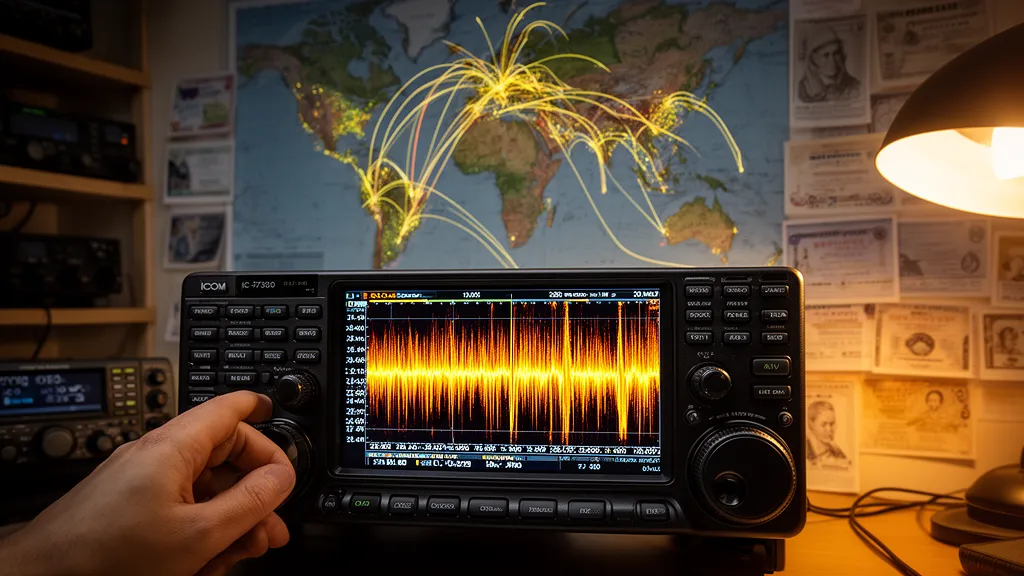
Operator's Verdict: 10m is the most solar-sensitive HF band. Check the current SFI on DXRadar's live 10m analysis page before every session. Above SFI 120, plan for global F2 DX during daylight. Below SFI 100, shift to sporadic-E monitoring (May–August) or work other bands. The current SFI is 104 — 10m is OPEN.
What SFI Level Opens 10 Meters?
An SFI (Solar Flux Index) above 120 SFU typically enables 10-meter F2 propagation on paths up to 5,000 km during daylight hours. At SFI 130–150, 10m reliably opens to most continents during the central daylight hours. At SFI 180 SFU or higher, 10m can remain open from shortly after your sunrise to near sunset, with S9 signals from multiple continents simultaneously. Below SFI 100, F2 propagation on 10m is unlikely except on near-equatorial paths at solar noon.
The relationship between SFI and 10m openings is driven by the Maximum Usable Frequency (MUF). Higher SFI means greater solar UV output, which ionizes the F2 layer more intensely, raising the critical frequency (foF2) and the MUF. For 10m to open, the F2 MUF on the path must reach or exceed 28 MHz. At low SFI, the MUF on most mid-latitude paths peaks around 20–25 MHz — just short of the 10m band. As SFI rises, the MUF climbs through the 10m band and eventually through 12m, 15m, 20m in sequence.
One important nuance: the F2 layer responds to cumulative solar UV, not just today's SFI. When SFI rises sharply, the ionosphere typically responds within 24–48 hours — not immediately. Similarly, a brief SFI dip does not instantly collapse 10m conditions. Multi-day SFI trends are more predictive than single-day values. DXRadar's live 10m conditions page shows the SFI trend alongside observed PSKReporter spots, combining the model prediction with actual observed propagation.
During Solar Cycle 25's peak years (2024–2026), SFI frequently exceeded 200 SFU, producing conditions not seen since the Solar Cycle 23 peak around 2001–2002. On those peak days, operators with simple dipoles were routinely working 100+ DXCC entities on 10m in a single weekend contest. The band was open simultaneously to Europe, South America, the Pacific, and Africa for six or more hours from mid-latitude North American QTHs.
The Quick Reference: Is 10m Open for My Station?
Use this table as a planning guide. Actual conditions depend on your QTH latitude, path geometry, time of day, and geomagnetic activity (Kp). The current live values are SFI 104 and Kp 0.
| SFI Level | Kp | Time (UTC) | Expected 10m Condition | Recommended Mode |
|---|---|---|---|---|
| Below 90 | Any | Any | Closed via F2; watch for Es (May–Aug) | FT8 on 28.074 MHz |
| 90–110 | 0–2 | Near noon UTC | Marginal — equatorial paths only | FT8 / CW |
| 110–130 | 0–2 | 4 hrs after sunrise | Moderate — 1–3 continent openings | FT8, CW, SSB |
| 130–150 | 0–2 | Daylight hours | Good — multi-continent DX | SSB / CW / FT8 |
| 150–180 | 0–2 | Daylight hours | Excellent — sustained multi-continent | SSB / CW |
| 180+ | 0–2 | Sunrise to sunset | Outstanding — global DX all day | SSB / CW |
| Any | 5+ | Any | Degraded on polar paths; mid-lat ok | Avoid polar paths |
High Kp (geomagnetic storms) degrades high-latitude paths. A Kp of 5 or higher (G1 storm, per NOAA Space Weather Scales) can close 10m on polar and auroral-zone paths, even when SFI is excellent. Mid-latitude paths are usually less affected unless Kp reaches 7 or higher.
Time of Day: When the 10m Band Is Most Productive
10m via F2 is strictly a daylight band. The D-layer absorbs 10m signals before they reach the F2 layer on nightside paths, and nightside F2 ionization is insufficient to support 10m reflection. The practical operating window is 2 hours after your local sunrise to 2 hours before your local sunset (all times UTC — calculate from your QTH coordinates).
Peak F2 conditions on any given path occur around local solar noon on the path midpoint — the point halfway along the great circle between your QTH and the DX entity. For a W5 (Texas) to DL (Germany) path of approximately 8,000 km, the midpoint is over the mid-Atlantic at roughly 30° W longitude. Solar noon at 30° W is approximately 14:00 UTC. The peak 10m window for that specific path is therefore approximately 12:00–16:00 UTC.
Different target regions therefore have different optimal windows from the same QTH:
| From W5 (Texas) | Target Region | Approximate 10m Peak UTC |
|---|---|---|
| W5 → Europe (EU) | Mid-Atlantic midpoint | 12:00–16:00 UTC |
| W5 → Japan (JA) | Pacific midpoint | 20:00–22:00 UTC |
| W5 → South America (PY/LU) | Northern SA midpoint | 16:00–19:00 UTC |
| W5 → Africa (ZS/VK) | Long path East | 02:00–06:00 UTC (marginal) |
These are approximate windows for Cycle 25 peak conditions (SFI 150+). At lower SFI, the windows narrow and some paths close entirely. Use the DXRadar band/10m page for your specific QTH calculations with current SFI input.
Pro Tip: Keep WSJT-X running in the background on 28.074 MHz FT8 from your first usable daylight hour onward during Cycle 25. DXRadar's live 10m analysis pulls PSKReporter spot clusters every 10 minutes — when you see the spot density spike on the map, 10m has opened and it's time to call CQ.
Sporadic-E on 10m: The Solar-Independent Opening
10m opens via sporadic-E (Es) when the Es MUF — the maximum frequency a given sporadic-E cloud will reflect — rises above 28 MHz. This happens without regard to SFI. An Es-opened 10m at SFI 70 during solar minimum behaves exactly like an Es opening at SFI 200 at solar maximum — the ionizing mechanism is entirely different and independent of the solar cycle.
Es openings on 10m are concentrated in the Northern Hemisphere summer (approximately May 1 through August 15), with peak activity in June and July. They can occur at any time of day, including evenings. Individual openings last from minutes to a few hours. They typically cover single-hop distances of 800–2,000 km from the Es reflection patch.
Key differences between Es and F2 on 10m:
| Property | Es Opening | F2 Opening |
|---|---|---|
| SFI requirement | None | Above ~120 for reliable openings |
| Season | May–August peak | Year-round (solar-dependent) |
| Typical path | 800–2,000 km | 2,000–10,000 km |
| Duration | Minutes to hours | Hours |
| Predictability | Very low | Moderate (SFI-driven) |
| MUF indicator | Not applicable | Check DXRadar SFI trend |
During solar minimum, Es is the primary mechanism for 10m openings. European stations worked EA, I, and G regularly on 10m in 2019–2020 (SFI below 80) via Es — at times when 15m and 20m were producing barely any F2 DX. Monitoring 28.074 MHz FT8 from May through August is worthwhile regardless of the solar cycle phase.
Related reading: see the full sporadic-E propagation guide for detailed Es physics, lane geometry, and detection techniques.
Trans-Equatorial Propagation and Other 10m Modes
Trans-equatorial propagation (TEP) is a distinct mode that opens 10m — and occasionally 6m — on paths straddling the geomagnetic equator. TEP operates by a different mechanism than either F2 or Es: plasma instabilities in the equatorial ionosphere create irregularities that scatter and guide signals across the geomagnetic equator.
TEP openings typically appear in the early to mid-afternoon local time at both ends of the path and peak near the equinoxes (March and September). A classic TEP path: W4 (Florida, approximately 27° N) working LU (Argentina, approximately 35° S) on 10m at 21:00–23:00 UTC in late September. Both stations are roughly symmetric about the geomagnetic equator, and afternoon ionospheric instabilities at the equator enable the path.
TEP on 10m behaves differently from F2:
- Signals can be strong but have a characteristic fluttery, rapid fading caused by multipath from the scattering mechanism
- Openings may occur at lower SFI than required for F2 on comparable distances
- TEP paths are generally North-South; East-West paths of similar length would rely on F2 instead
- TEP extends into the evening when F2 is declining — this is the clearest indicator: if 10m is showing strong signals after local sunset on paths across the equator, TEP is the likely mechanism
Aurora scatter on 10m is possible during geomagnetic storms (Kp 5+), but the signals are weak, severely distorted, and typically limited to azimuths pointing toward the aurora oval. Most operators will not successfully use 10m aurora scatter without digital modes specifically designed for scattered signals.
10m Band Plan and Frequencies
The 10-meter band spans 28.0–29.7 MHz internationally (ITU Radio Regulations). Permitted modes, power limits, and specific allocations within the band vary by country and license class — always verify your national regulations before transmitting.
Common 10m operating frequencies (verify your local allocations before transmitting):
| Frequency | Mode | Usage |
|---|---|---|
| 28.000–28.070 MHz | CW | CW DX, contest exchanges |
| 28.074 MHz | FT8 | Primary FT8 calling frequency |
| 28.180 MHz | FT4 | FT4 calling frequency |
| 28.200 MHz | Beacons | International beacon network (ITU Region 2) |
| 28.300–28.500 MHz | SSB | DX calling, contest SSB |
| 28.400 MHz | SSB | Common DX calling frequency |
| 29.000–29.200 MHz | FM simplex | FM operations (where permitted) |
| 29.600 MHz | FM | FM calling frequency (ITU Region 2) |
During a strong F2 opening, 28.300–28.500 MHz becomes the primary SSB DX action. FT8 on 28.074 MHz captures openings that are too brief or too weak for SSB — many short Es openings and marginal F2 paths that SSB cannot work at all are completeable on FT8.
Latitude Effects on 10m Propagation
Polar stations (above approximately 60° N or S) experience limited 10m propagation even at high SFI. The F2 layer at polar latitudes is thinner and lower in electron density than at mid-latitudes due to reduced average solar angle. The MUF at high-latitude paths may not reach 28 MHz even when equatorial paths are wide open.
The richest 10m operating regions are in the mid-latitudes (25° N–55° N and equivalent south) and equatorial zones. Equatorial stations often have the longest 10m season because their F2 MUF reaches 28 MHz at lower SFI thresholds than mid-latitude paths.
Geomagnetic storms hit high-latitude paths disproportionately hard. During a Kp 6–7 storm, a W7 (Pacific Northwest, ~47° N) to OH (Finland, ~61° N) path on 10m may be completely closed while W5 (Texas, ~30° N) to EA (Spain, ~40° N) on the same frequency remains open. The solar weather dashboard shows current Kp and geomagnetic storm status for path planning.
Frequently Asked Questions
What SFI is needed for 10 meters to open?
An SFI above 120 SFU typically enables 10-meter F2 propagation on paths up to 5,000 km during daylight hours. At SFI 150 or higher, 10m supports simultaneous multi-continent openings lasting 6+ hours. Below SFI 100, F2 propagation on 10m is unlikely except near the equator. Sporadic-E can open 10m at any SFI during May through August in the Northern Hemisphere.
Is 10m a daytime-only band?
For F2 propagation, yes — 10m requires solar ionization of the F2 layer and is effectively closed at night via that mechanism. However, sporadic-E, trans-equatorial propagation (TEP), and aurora scatter can open 10m outside daylight hours. During peak Es season, brief nighttime 10m openings on short paths do occur, particularly in June and July.
How do I know if 10m is open right now?
Check DXRadar's live /is-10m-open page for a real-time analysis using current SFI, Kp, and PSKReporter spot data. You can also monitor 28.074 MHz FT8 in WSJT-X — decodes from stations 1,000+ km away confirm an open band. PSKReporter's spot map filtered to the 10m band shows propagation lanes in real time.
Does 10m open during solar minimum?
F2 propagation on 10m is rare during solar minimum (SFI 65–80 SFU). The 10m MUF on most paths barely reaches 28 MHz even at solar noon. Sporadic-E still opens 10m during the summer months regardless of SFI. TEP can produce afternoon openings between mid-latitude stations on opposite sides of the geomagnetic equator even at low solar activity.
What is the best time to operate 10 meters?
For F2 propagation, the best window is 2–4 hours after your local sunrise to 2 hours before sunset, with peak conditions around local solar noon on the path midpoint — which varies by target DX region. For sporadic-E, monitor PSKReporter passively during May through August at any time of day. TEP openings typically occur in the afternoon and early evening local time around the equinoxes.