This article contains affiliate links. If you buy through them we may earn a commission at no extra cost to you. Comparisons are drawn from manufacturer specifications and attributed community reviews — we have not bench-tested these radios.
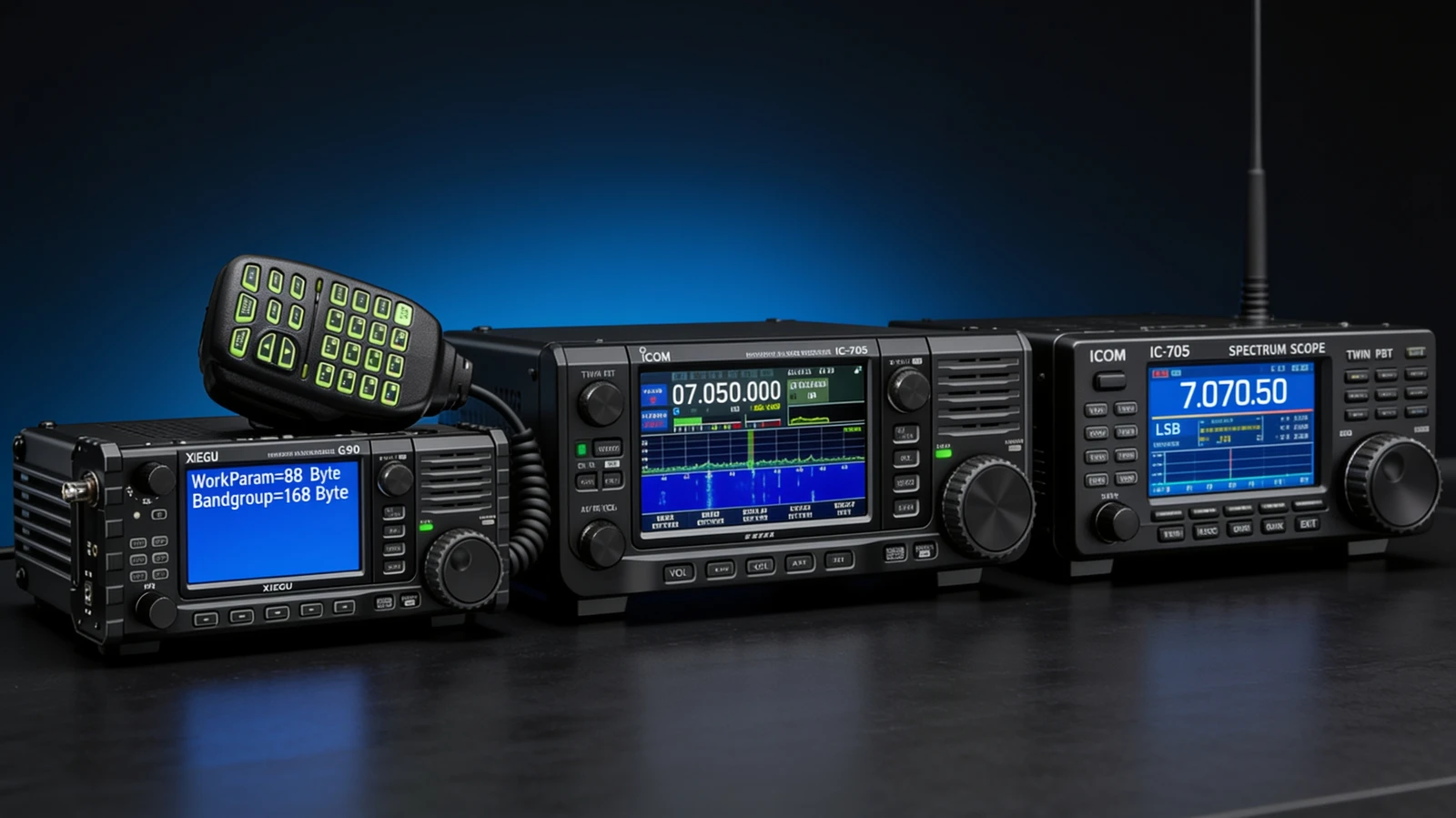
Operator’s Verdict: Three different answers to “portable HF,” not three tiers of the same radio. The G90 is watts-per-dollar: 20W and a genuinely good built-in tuner at the lowest price. The X6100 is the modern all-in-one: SDR interface, internal battery, mid price — with a receiver that community reviews call its weak spot. The IC-705 is the benchmark: best receiver, VHF/UHF + D-STAR, tiny battery appetite, at roughly triple the G90’s street price. Decide on tuner, receiver, and watts — not on brand.
The Spec Table
From manufacturer specifications (the same numbers our power budget calculator uses):
| Xiegu G90 | Xiegu X6100 | Icom IC-705 | |
|---|---|---|---|
| Output power | 20 W | 10 W (external supply) | 10 W (13.8 V) / 5 W (battery) |
| Bands | HF (0.5–30 MHz) | HF + 6m | HF + 6m + 2m + 70cm, all-mode incl. D-STAR |
| Built-in tuner | ✅ automatic | ❌ | ❌ |
| Internal battery | ❌ | ✅ (reduced power) | ✅ (5 W) |
| TX max draw | 8 A | 3 A | 3 A |
| RX draw | 0.5–0.65 A | 0.33 A | 0.26–0.32 A |
| Architecture | SDR, spectrum display | SDR, 4” touchscreen | SDR, large touchscreen + GPS |
Battery Reality (Computed, Not Guessed)
At a 50% operating cadence on a 12Ah LiFePO4, from the published draws:
| Radio | SSB runtime | FT8 runtime |
|---|---|---|
| IC-705 / X6100 | ~20 h | ~7 h |
| G90 | ~9 h | ~2.8 h |
The G90’s 20 watts are not free — its transmit draw is nearly triple the others’, and its receive draw roughly double. That still runs a full activation on a modest pack (and every pack in our battery comparison handles its 8A peak), but hikers counting grams should note where the amp-hours go. Run your own numbers in the power budget calculator.
Radio by Radio
Xiegu G90 — the value workhorse
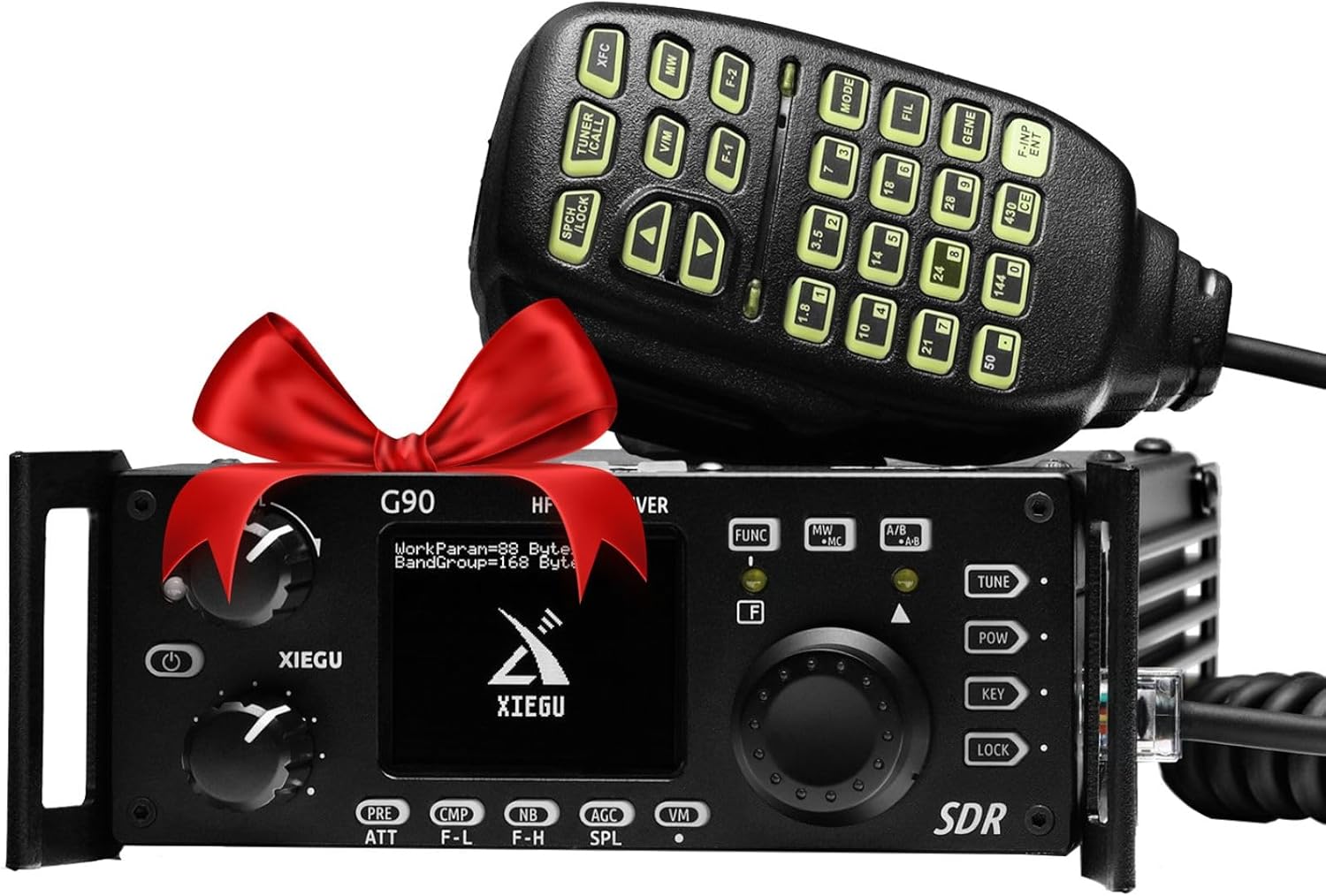
Twenty watts is a real advantage at the margins — roughly 3 dB over the QRP pair, which is the difference between a shaky contact and a solid one on a marginal band. The built-in automatic tuner is the other half of the value case: it forgives the compromise antennas portable operating actually involves. The costs: HF-only (no 6m), the heaviest battery appetite here, and an interface a generation older than the other two. For a first POTA radio on a budget, this is the default recommendation.
Xiegu X6100 — the modern all-in-one
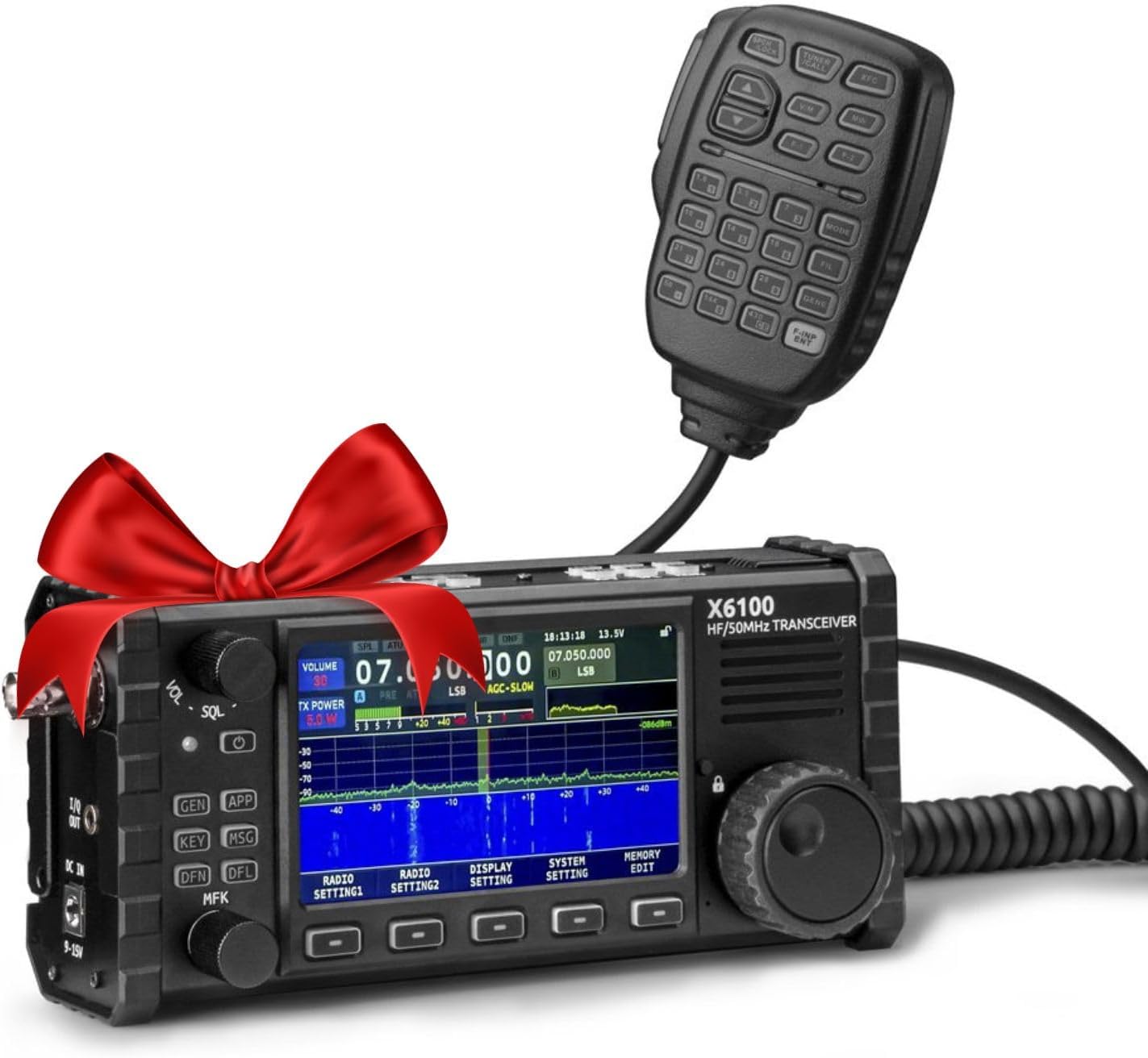
The X6100 looks and feels the most modern: big touchscreen waterfall, internal battery, Bluetooth, one self-contained package. Two honest caveats, both consistent across community reviews: the receiver can overload in strong-signal environments where the IC-705 stays composed (QRPer’s comparison concluded operators wanting benchmark performance should go straight to the IC-705), and the internal battery runs reduced power — full 10W wants an external pack anyway. Note also that Xiegu now sells the newer X6200; if you’re shopping this tier, check its current pricing before committing.
Icom IC-705 — the benchmark
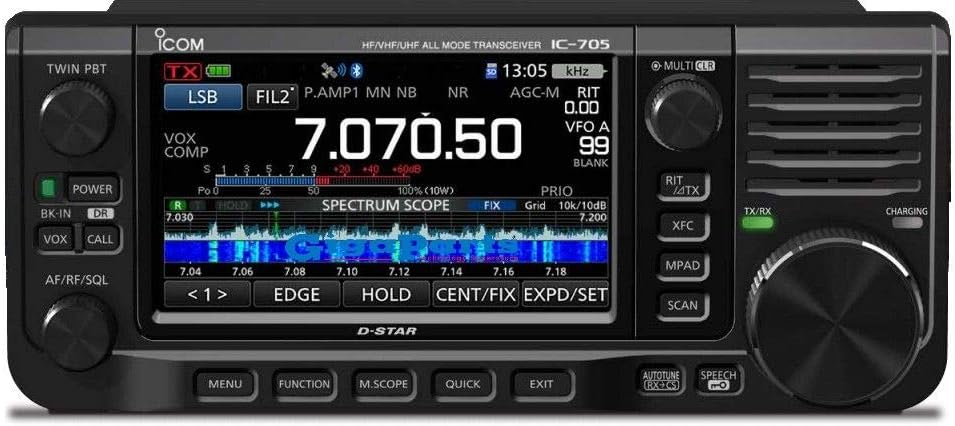
The IC-705’s case is refinement: the receiver, the display, GPS, and the fact that it’s also a full VHF/UHF all-mode radio with D-STAR — one box covering HF POTA by day and the local repeater or satellite pass by night. Its 3A maximum draw is the lowest here, which is why it runs essentially all day on a lunchbox-size battery (details in our radio-specific battery guide). The price is the argument against: at typical street prices it costs roughly as much as a G90 and an X6100 combined, and it still needs an external tuner for non-resonant antennas.
Pro Tip: Whichever you pick, check current band conditions before deciding you need more watts — when 10m or 15m is open, 10W works the same stations 100W works on a dead band. The wattage debate matters most exactly when propagation is worst.
Where to Buy
Best value + tuner
Xiegu G90
20W, built-in ATU, spectrum display — the budget POTA workhorse.
- 20 W
- Auto tuner
- HF only
Modern all-in-one
Xiegu X6100
Touchscreen SDR with internal battery — self-contained mid-tier portable.
- 10 W
- HF + 6m
- Internal battery
Successor X6200 exists — compare current pricing.
The benchmark
Icom IC-705
Best-in-class receiver, HF through 70cm all-mode with D-STAR and GPS.
- 10 W
- HF–70cm
- 3 A max draw
Frequently Asked Questions
Is the Xiegu G90 or the IC-705 better for POTA?
The G90 gives you 20 watts and a genuinely good built-in tuner for roughly a third of the IC-705’s street price — the practical POTA workhorse. The IC-705 gives benchmark receive performance, VHF/UHF with D-STAR, and a 3A max draw that runs all day on a small pack. Buy the G90 for value and forgiveness with compromise antennas; buy the IC-705 if the budget allows and you value refinement over watts.
What is the biggest weakness of the Xiegu X6100?
Community reviews consistently note its receiver can struggle in strong-signal environments compared with the IC-705’s, and its internal battery supports only reduced power — full 10W output needs an external supply. Its strengths are the modern SDR interface and all-in-one form factor at a mid price.
How long do these radios run on a 12Ah battery?
Computed from manufacturer draw specs at a 50% operating cadence: the IC-705 and X6100 both run roughly 20 hours of SSB or 7 hours of FT8 on a 12Ah LiFePO4. The G90’s 20 watts costs more: roughly 9 hours SSB and under 3 hours of FT8. All three fit comfortably within a small pack’s BMS limits.
Do any of these radios need an external antenna tuner?
The G90 has an excellent built-in automatic tuner — a major part of its value. The IC-705 and X6100 have no internal tuner, so with non-resonant antennas you’ll add one (the IC-705 commonly pairs with Icom’s AH-705 or the mAT-705). With resonant antennas like an EFHW cut for band, none of them needs a tuner.