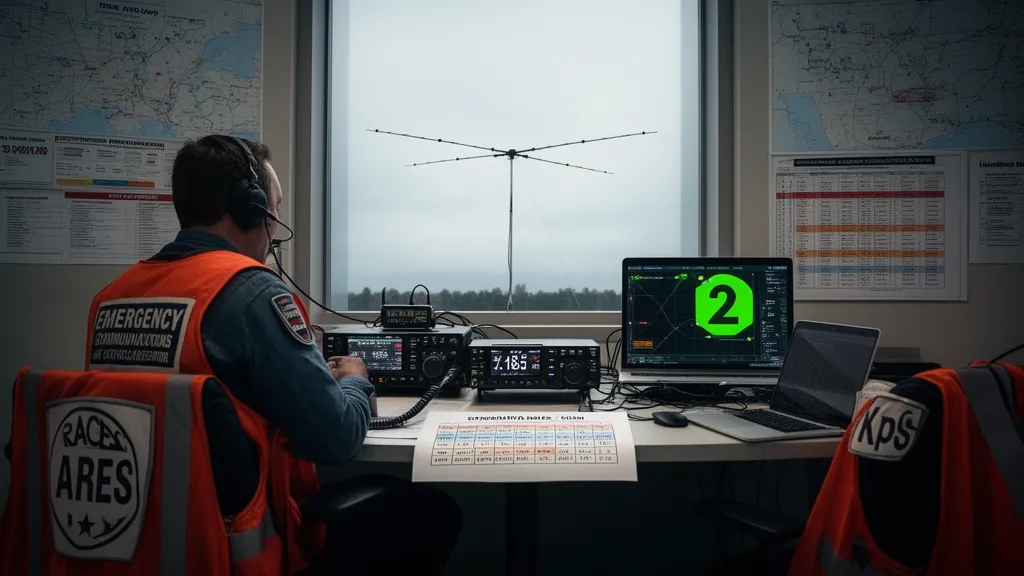
Operator's Verdict: 40m NVIS covers your region (300–800 km) regardless of solar cycle. 60m provides backup when 40m is marginal. 20m handles inter-state and national coordination. Monitor DXRadar during activations — a Kp spike above 5 or M-class flare requires immediate band change assessment.
Why HF for EmComm
Hurricane Katrina (2005), Superstorm Sandy (2012), and the May 2024 solar superstorm demonstrated the same lesson: when infrastructure fails, amateur radio HF provides the only reliable long-distance communication that works independently of the grid.
HF via NVIS provides:
- Coverage: 300–800 km radius from a single station with 100W
- Infrastructure independence: Requires only a transceiver, antenna, and battery
- Penetration: HF passes through urban RF environments that defeat VHF/UHF
- Coordination range: Wide enough to reach a state or regional EOC directly
Pro Tip: Check DXRadar's best bands now and your band-specific pages before heading out — live propagation data beats any static forecast.
NVIS: The Core EmComm Propagation Mode
NVIS (Near Vertical Incidence Skywave) sends signals nearly straight up, which return to Earth within 300–800 km — no skip zone, complete coverage of the circle around the transmitter.
Optimal NVIS frequencies by solar condition:
| Band | Frequency Range | Best Use |
|---|---|---|
| 80m | 3.5–4.0 MHz | Night NVIS only (D-layer absorbs by day) |
| 60m | 5.3–5.4 MHz | 24-hour NVIS; EmComm standard band |
| 40m | 7.0–7.3 MHz | Day and night NVIS; primary EmComm band |
Antenna for NVIS: A horizontal dipole at 10–15 metres height (roughly 0.1–0.15 wavelengths) provides excellent NVIS radiation (near-vertical lobe). Even a dipole at 5 metres works adequately for NVIS — the absolute height matters less than orientation (horizontal for NVIS; vertical for DX).
The 60m Band for EmComm
In the USA, amateur radio has secondary status on 5 specific channels in the 60m region. These are USB voice channels with a defined 2.8 kHz bandwidth:
| Channel | Dial Frequency (USB) | Notes |
|---|---|---|
| 1 | 5.3305 MHz | Used for inter-area coordination |
| 2 | 5.3465 MHz | Primary EmComm channel in many areas |
| 3 | 5.3570 MHz | SHARES inter-agency channel |
| 4 | 5.3715 MHz | Backup/secondary |
| 5 | 5.4035 MHz | Less commonly used |
Why 60m excels for EmComm:
- 5 MHz lies below the D-layer absorption threshold during most daytime conditions
- NVIS works reliably at 5 MHz regardless of solar flux (even solar minimum SFI 70)
- 60m suffers less from the late-afternoon D-layer absorption that affects 40m
- 5 MHz is used by federal agencies (SHARES, FEMA HF nets) — amateur 60m enables coordination
Note: Maximum power on 60m is 100 watts ERP (effective radiated power), and only the 5 specific channels are permitted.
Planning EmComm Propagation with DXRadar
During a real-world emergency activation:
-
Before deployment: Check DXRadar's solar weather for current Kp and SFI. A Kp above 4 means polar paths are degraded — note this for operators attempting inter-regional coordination via longer paths.
-
During activation: If contacts fail on 40m, check DXRadar's live band status. A sudden degradation may indicate a solar flare (X-ray flux rising) or Kp spike. Move to 60m channels and re-assess.
-
Night operations: 80m NVIS becomes available after sunset. 80m provides tighter coverage (200–400 km) than 40m, useful for very localized coordination. Monitor 3.985 MHz (North American ARES standard).
-
Multi-hop fallback: If NVIS fails entirely (major storm, G4+ event), consider 20m for longer-range inter-regional coordination. At Kp 7, the polar cap is disrupted but mid-latitude 20m paths may still function.
ARES and EmComm Net Structure
The Amateur Radio Emergency Service (ARES) organises emergency communication at local, section, and regional levels. Most ARES sections publish their primary and backup net frequencies. Key net types:
- Local (county) ARES nets: Primarily VHF simplex/repeater, secondary 40m/80m NVIS
- Section EmComm nets: 40m/60m NVIS, secondary 20m for longer ranges
- Regional/national nets: 20m for inter-state, 60m Ch 3 for SHARES coordination
Register with your local ARES section and obtain their frequency list before an emergency occurs — not during.
Frequently Asked Questions
Why is HF radio important for emergency communications?
HF radio provides communication independent of terrestrial infrastructure — no repeaters, towers, internet, or power grid required. A 100W HF station with a battery can communicate 300–2,000 km using NVIS propagation without any intermediate infrastructure. During disasters, when cell towers are damaged and internet is unavailable, HF remains functional as long as the ionosphere is intact. This makes it the foundation of the Amateur Radio Emergency Service (ARES), RACES, and the SHARES high-frequency network.
What is the 60m band and why is it important for EmComm?
The 60m band (5 MHz region) consists of 5 specific USB channels assigned to amateur radio in the USA: 5.3305, 5.3465, 5.3570, 5.3715, and 5.4035 MHz dial frequency (USB). 60m occupies an ideal NVIS range: below the daytime D-layer absorption threshold for long-haul paths but above the lower frequencies that suffer severe daytime attenuation. It provides reliable 300–700 km NVIS coverage regardless of solar conditions and often remains usable when late-afternoon 40m NVIS weakens.
What bands should I plan for EmComm at different distances?
Coverage zones by band for NVIS (daytime, mid-latitude): 80m = 0–400 km; 60m = 200–700 km; 40m = 300–800 km; 30m (digital) = 500–1,500 km. For emergency communications within a county or state (under 500 km), 40m NVIS is the primary band. For inter-state coordination (500–1,500 km), 20m and 30m provide coverage. For national or international emergency nets (1,500+ km), 20m is the standard.
How do geomagnetic storms affect EmComm HF?
Geomagnetic storms (G1+, Kp 5+) primarily affect polar paths and high-latitude propagation. Mid-latitude NVIS paths below approximately 40° N geographic latitude typically survive G1–G2 storms (Kp 5–6) on 40m and 60m. During severe storms (G3–G5, Kp 7+), even mid-latitude paths may degrade. For EmComm planning: if a G3+ storm is in progress, fall back to 60m NVIS (which is more resilient than 40m) for local coverage, and have VHF/UHF backup plans ready for truly local (under 50 km) coordination.
What net frequencies should EmComm operators know?
Key US EmComm frequencies: 7.185/7.290 MHz (40m ARES), 14.265/14.300 MHz (20m traffic/emergency), 3.985 MHz (80m ARES, eastern US), 5.357 MHz (60m Ch 3, inter-agency), 146.52 MHz (2m national calling/simplex backup), 146.40 MHz (ARES simplex fallback in many regions). Individual ARES sections have published frequencies — consult your local section website. Also note: SHARES (SHAred RESources) network uses 60m as its primary HF coordination band.