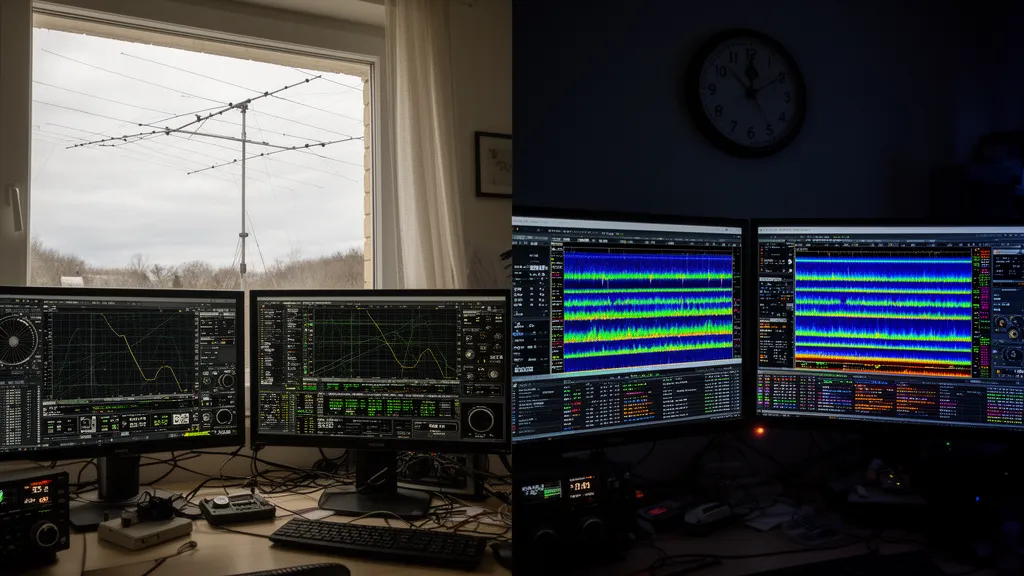
Operator's Verdict: 40 meters is amateur radio's most versatile HF band — NVIS regional coverage by day, intercontinental DX by night, functional even during moderate geomagnetic storms. It works at any point in the solar cycle. Current SFI is 137 and Kp is 0.33 — check the live 40m status for what the band is doing right now.
40 Meters in the Solar Cycle
Unlike 10m, 15m, and 17m, the 40 meter band (7.000–7.300 MHz) does not depend on the solar cycle for basic functionality. The Maximum Usable Frequency (MUF) on typical mid-latitude paths rarely drops below 7 MHz even at solar minimum. The F2 layer supports 40m propagation under virtually all conditions.
What the solar cycle does affect is the quality and geographic reach of 40m DX:
| SFI Range | 40m Daytime | 40m Nighttime |
|---|---|---|
| < 80 (minimum) | NVIS 300–600 km | DX to ~8,000 km, paths limited |
| 80–120 (moderate) | NVIS 300–800 km | Global DX routinely possible |
| 120–180 (high) | NVIS 500–1,000 km | Global DX with multiple paths |
| > 180 (maximum) | NVIS to 1,500 km | Extended DX, more paths open simultaneously |
Even at SFI 70 — a very quiet sun — 40m supports reliable regional paths. It is the band least affected by solar minimum.
Pro Tip: 40m is the band that works when everything else fails. Check the live 40m band status for current spot activity, and use best bands now to see if higher bands are worth trying first. During geomagnetic storms, 40m NVIS is your most reliable HF fallback for regional communications.
The NVIS Mode: 40m by Day
During daylight hours, the D-layer (60–90 km altitude) absorbs 7 MHz signals on low-angle paths, effectively limiting distant skip. What remains is a highly useful NVIS (Near Vertical Incidence Skywave) coverage zone.
NVIS sends signals nearly straight up, where they reflect off the F-layer at 200–300 km altitude and return to Earth within 300–800 km radius. There is no skip zone for NVIS — stations within this radius can work each other reliably.
Practical implications for 40m NVIS:
- Antennas should be low — 10–15 metres height (roughly 0.1–0.15 wavelengths) produces a high-angle radiation lobe ideal for NVIS
- A simple dipole at 10m is more effective for NVIS than a well-engineered dipole at 20m
- This makes 40m NVIS the ideal EmComm band: within-state coverage, works with modest equipment and battery power, robust against geomagnetic disturbances
For POTA activations during daytime, 40m NVIS is often the most productive band for reaching chasers within your region, while 20m handles the DX.
The DX Mode: 40m at Night
When darkness falls across the path, D-layer absorption disappears and 40m opens to long-haul F2 propagation. Typical nighttime 40m characteristics:
- Transatlantic paths (North America to Europe): open from approximately 0100–0700 UTC depending on season
- Transpacific paths (North America to Japan/Asia): open roughly 0700–1400 UTC
- Path lengths: single-hop up to ~3,500 km; multi-hop paths can span global distances
The best DX on 40m is usually achieved when the entire path is in darkness — typically midnight local time at the mid-point of the path. This is when both skip distance and absorption are optimised.
Antenna Considerations
40m presents a trade-off: a half-wave dipole is approximately 20 metres long, which is manageable at most home stations but requires attention to height for different objectives.
| Antenna Height | Best Use |
|---|---|
| 5–10 m (λ/16–λ/8) | NVIS — regional daytime coverage |
| 15–20 m (λ/8–λ/4) | Compromise — some NVIS, some DX |
| 30–40 m (λ/2+) | DX — low-angle radiation, maximum skip distance |
Most operators at fixed stations compromise around 15–20 m, which provides reasonable performance in both modes.
For portable operation (POTA, EmComm), a 20 m end-fed half-wave wire at 10 m height with a 49:1 transformer (EFHW presents ~2,000–5,000 Ω — a 9:1 unun is for random-wire antennas, not EFHW) is highly effective for daytime NVIS coverage and reasonably good for overnight DX.
The Interference Problem
40m is one of the noisier HF bands due to:
- Regional AM broadcasting — shortwave broadcasters operating in the same allocations in ITU Regions 1 and 3
- High atmospheric noise — 7 MHz falls in a range of elevated galactic and atmospheric noise
- Dense amateur activity — 40m is extremely popular, especially at night
The broadcasting interference is most severe on the lower portion of the band (7.000–7.200 MHz) and varies with propagation — a powerful European broadcaster may blot out a 7.100 MHz frequency for a North American station on certain evenings.
Practical mitigations:
- Use the full 7.000–7.300 MHz allocation where your region permits
- USB (upper sideband) is standard for phone above 7.125 MHz in the Americas
- FT8 at 7.074 MHz typically avoids the worst broadcasting interference
Operating Segments
| Mode | Frequency Range (IARU Region 2) |
|---|---|
| CW (general) | 7.000–7.125 MHz |
| CW (DX window) | 7.000–7.025 MHz |
| Phone (SSB) | 7.125–7.300 MHz |
| SSB calling | 7.200 MHz (traditional) |
| FT8 | 7.074 MHz |
| FT4 | 7.047 MHz |
| JS8Call | 7.078 MHz |
| RTTY | 7.040–7.060 MHz |
| SSTV | 7.171 MHz |
Storm Performance
40m is the recommended fallback band during geomagnetic storms. While 20m, 15m, and 10m degrade rapidly as Kp rises, 40m NVIS paths below ~40° N geographic latitude typically remain functional through G2 (Kp 6) storms.
During major storms (G3+, Kp 7+):
- Polar and high-latitude paths on 40m degrade
- Mid-latitude NVIS paths (under 800 km) remain most reliable
- Consider 60m or 80m for local-regional EmComm if 40m also degrades
Check current Kp at DXRadar's solar weather dashboard before committing to a path-dependent 40m schedule.
40m Summary
40 meters is arguably the most practically useful HF band for most amateur radio operators:
- Works at solar minimum and solar maximum
- Provides regional NVIS by day, intercontinental DX by night
- Survives moderate geomagnetic storms
- Requires manageable antenna lengths
- Supports all major operating modes (CW, SSB, FT8, digital)
If you are new to HF and need one band that will always work for something useful, start with 40m.
Frequently Asked Questions
When is the 40 meter band open for DX?
40 meters supports long-distance DX (transatlantic, transpacific) primarily at night, roughly from 1–2 hours after local sunset until 1–2 hours after local sunrise. During daylight hours, the D-layer absorbs 7 MHz signals and limits range to regional NVIS paths (300–800 km). The best DX window on 40m is typically midnight local time, when the entire path is in darkness.
What is 40m good for during the day?
During daylight hours, 40m excels at NVIS (Near Vertical Incidence Skywave) propagation, providing reliable coverage within approximately 300–800 km radius. This makes it the preferred band for emergency communications, ARES/RACES nets, regional traffic nets, and POTA activations targeting chasers in the surrounding region. Antenna height of 10–15m (roughly 0.1–0.15λ) optimises the near-vertical radiation angle for NVIS.
What are the 40m operating segments?
In IARU Region 2 (Americas): CW 7.000–7.125 MHz, phone (SSB) 7.125–7.300 MHz, FT8 7.074 MHz, FT4 7.047 MHz, JS8 7.078 MHz. Note that Regions 1 and 3 have different phone sub-band allocations (7.100–7.200 MHz), which can cause interference in the overlap zone particularly on transatlantic paths.
Does the 40m band work during geomagnetic storms?
40m is one of the most resilient HF bands during geomagnetic disturbances. At Kp 4–5, polar paths on 20m/15m degrade while 40m NVIS paths below 40° N latitude typically remain functional. During G3+ storms (Kp 7+), even 40m may be disrupted on paths transiting the auroral zone, but regional NVIS paths at mid-latitudes often survive. If the bands sound dead, try 40m NVIS before giving up.
Why is there interference on 40 meters from broadcasting?
The 7 MHz band overlaps with shortwave broadcasting allocations in ITU Regions 1 and 3 (Africa, Europe, Asia-Pacific). Amateur radio has secondary status on 7.000–7.200 MHz in those regions, meaning shortwave broadcasters take priority. In Region 2 (Americas), amateurs have primary status across the full 7.000–7.300 MHz allocation. Interference from international broadcasters is most common on the lower portion of the band (7.000–7.200 MHz) when propagation supports transatlantic paths.