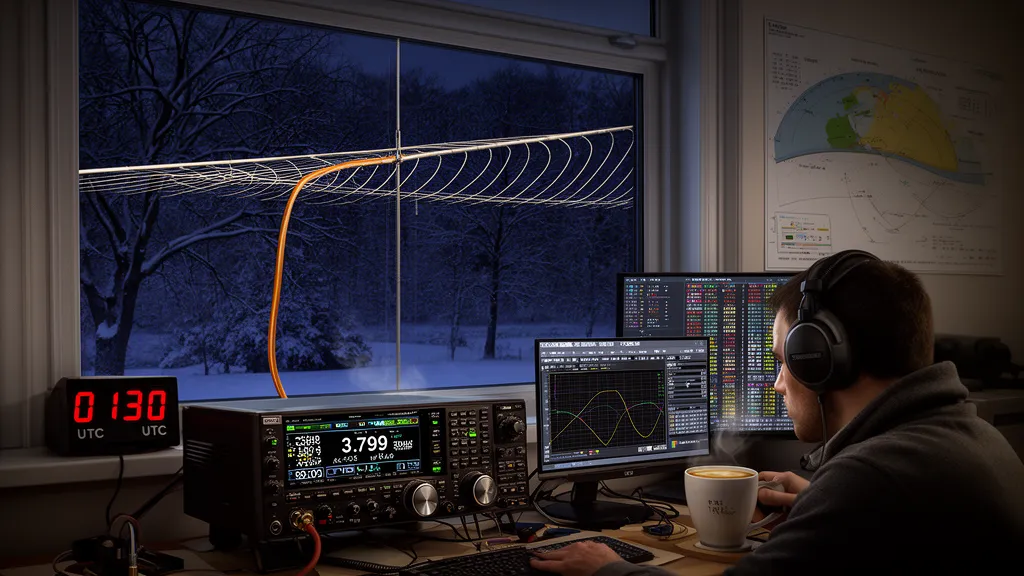
Operator's Verdict: 80m is the band to reach for when geomagnetic storms silence 20m and 15m. Night-time SFI and Kp matter less here than on higher bands — 80m carries regional and inter-continental traffic reliably after dark. Check the live 80m status for current spot activity. Current SFI is 137 and Kp is 0.33.
What the 80 Meter Band Is and How It Behaves
The 80 meter band — 3.500 to 4.000 MHz in ITU Region 2 (Americas), 3.500 to 3.800 MHz in Region 1 (Europe/Africa) — occupies a unique position in the HF spectrum. It is too low for reliable daytime DX, too noisy for casual operating in summer afternoons, yet it is one of the most versatile and storm-resistant bands for nighttime regional and inter-continental communication.
The band's behaviour divides cleanly into two distinct operating modes dictated by solar elevation: daytime NVIS or ground wave within a few hundred kilometres, and nighttime F2 propagation covering up to 8,000 km or more. Operators who understand this boundary work 80m productively around the clock.
Daytime Propagation: D-Layer and NVIS
During daylight hours, the D-layer absorbs virtually all 80m energy on long-haul paths. The D-layer, at 60–90 km altitude, is ionised by solar UV and X-ray flux and is strongest near local noon. At 3.5 MHz, D-layer absorption at zenith can exceed 30 dB for paths that require the signal to traverse the sunlit D-layer multiple times (ITU-R P.533-14).
The practical result: daytime 80m is limited to:
- Ground wave: out to approximately 400–600 km depending on terrain and soil conductivity. Salt water extends this further.
- NVIS (Near Vertical Incidence Skywave): near-vertical radiation angles (60–85° from horizontal) allow signals to pass through the D-layer at near-normal incidence, where absorption is lowest. If foF2 exceeds 3.5 MHz — which requires SFI above roughly 80 at mid-latitudes — NVIS paths of 50–800 km are possible.
For emergency communications and regional nets, 80m NVIS is the preferred daytime channel. A dipole at 5–10m height produces a high-angle radiation pattern ideal for NVIS. At that height, a half-wave 80m dipole radiates predominantly toward the zenith, filling the near-distance coverage zone that a high-gain DX antenna misses entirely.
Pro Tip: If your emergency communication plan relies on 80m NVIS during the day, verify that the local foF2 exceeds your operating frequency. Below SFI 80, foF2 at mid-latitudes during winter days can drop below 3.5 MHz, eliminating daytime NVIS on 80m. Monitor DXRadar Solar Weather for SFI trends.
Nighttime Propagation: D-Layer Collapse and F2 DX
After local sunset, D-layer recombination proceeds rapidly — the layer essentially disappears within 30–60 minutes of sunset at the path terminator. With the absorbing layer gone, 80m signals reach the F2 layer and reflect back to Earth. This transition is audible on any 80m receiver: the band goes from noise to signals almost like a switch being thrown.
Single-hop F2 skip on 80m spans approximately 1,500 to 3,000 km. A station in central Europe can easily work stations across Africa, the Middle East, or the eastern seaboard of North America on a single F2 hop. Longer inter-continental paths — Japan from Europe, Australia from North America — require two or more hops, each hop still supported by F2 at lower altitudes than required on 10m.
The key nighttime 80m DX windows by path:
| Path | Typical Window (UTC) | Notes |
|---|---|---|
| USA East Coast → Europe | 22:00–06:00 UTC | Both regions in darkness |
| USA West Coast → Japan | 12:00–16:00 UTC | Both in darkness in respective local night |
| Europe → Japan | 19:00–03:00 UTC | Longer path; needs clean geomagnetic |
| North America → Australia | 08:00–14:00 UTC | Varies by season; winter best |
The single most important operating heuristic for 80m DX: both ends of the path must be in darkness. Partial darkness — one station in daylight — kills 80m much faster than it kills 40m, because the D-layer absorption at the sun-lit end terminates the usable F2 geometry.
80m Band Plan
The 80m band plan varies by ITU region. In Region 1, national regulators have segmented phone more tightly than in Region 2. The ARRL plan for Region 2 and IARU Region 1 guidelines give these primary segments:
| Segment | Region 2 (Americas) | Region 1 (Europe) | Mode |
|---|---|---|---|
| 3.500–3.525 MHz | CW QRS / QRP | CW (3.500–3.510 DX) | CW |
| 3.510–3.560 MHz | CW DX / contest | CW | CW |
| 3.560–3.600 MHz | CW / RTTY | CW + RTTY | CW/Digital |
| 3.573 MHz | FT8 | FT8 | FT8 |
| 3.590 MHz | RTTY/PSK31 | RTTY | Digital |
| 3.600–3.800 MHz | Phone | Phone | SSB |
| 3.800–4.000 MHz | Phone (Region 2 only) | Not allocated | SSB |
| 3.845 MHz | — | — | SSTV |
3.573 MHz is the primary FT8 operating frequency worldwide for 80m and is typically the first indicator of band openings. During good nighttime openings, the FT8 waterfall fills with inter-continental paths visible as clustered signals.
Note that Region 1 operators do not have access to 3.800–4.000 MHz. When working split with Region 2 stations, Region 1 operators cannot transmit in the upper portion of the band. Verify your allocation before transmitting above 3.800 MHz.
The Noise Challenge on 80m
80m is the noisiest HF band in common amateur use. Noise comes from two primary sources:
Atmospheric (natural) noise — lightning discharges worldwide generate wideband RF energy that propagates globally at these frequencies. In tropical regions with active thunderstorms, the noise floor at 3.5 MHz can reach S7–S9 or higher on summer afternoons local time. ITU-R P.372-16 models this noise and shows that the 3.5 MHz band has 10–20 dB more atmospheric noise than the 14 MHz band under equivalent conditions.
Man-made noise — switching power supplies, LED drivers, solar inverters, and unshielded data cables all radiate noise in the MF/lower HF range. In urban or suburban environments, the man-made noise floor on 80m can exceed S5 even at midnight.
Seasonal pattern for atmospheric noise at mid-latitudes:
- Summer (June–August): worst noise, particularly afternoons and early evenings. Thunderstorm activity in the Americas and Africa peaks. S7–S9 noise floors common at 18:00–22:00 local.
- Winter (November–February): substantially lower noise. Nighttime 80m DX is most productive in winter.
- Spring/Autumn: intermediate. Noise builds after sunset as storms develop.
Receiving Antenna Solutions
The high noise environment on 80m has driven significant innovation in receiving-only antenna design. Operators serious about 80m DX typically use separate transmit and receive antennas:
- Beverage antenna: a terminated longwire at low height (1–3m), oriented toward the desired DX direction. Lengths of 200–500m produce narrow, low-noise patterns. Front-to-back ratios of 20–30 dB are achievable. Beverage antennas dramatically reduce both atmospheric noise and man-made QRM from unwanted directions.
- K9AY loop: a small (approximately 2m diameter) flag loop with a terminating resistor. Fits in a typical suburban yard. Provides 15–20 dB front-to-back and substantially lower noise than a full-size dipole. Rotatable by remote-controlled relay switching.
- Wellbrook loop / shielded magnetic loop: smaller loop designs with high common-mode rejection. Useful in high man-made noise environments.
The fundamental principle behind all these designs is noise directivity — the antenna's pattern rejects noise from all but the target direction. A dipole is omnidirectional; these antennas are not.
Pro Tip: Running a separate receive antenna on 80m is transformative. A K9AY loop that costs under $200 to build can improve your practical SNR by 15–20 dB over a dipole, which on a noisy summer night is the difference between copying a DX signal and not knowing it was there.
Storm Resistance: Why 80m Survives When 20m Dies
80m's propagation mechanism makes it inherently more storm-resistant than higher HF bands. During geomagnetic storms, the F2 layer at high latitudes is disrupted by particle precipitation and magnetospheric compression. High-frequency bands (10m, 15m, 20m) that require high MUF on high-latitude F2 paths fail first.
80m, by contrast, requires very low MUF — typically 3–5 MHz — for its nighttime propagation. The F2 layer, even substantially degraded by a G2 or G3 storm, still supports these low frequencies. The negative phase of a geomagnetic storm (where electron density is reduced) has to be severe to drop the nighttime foF2 below 3.5 MHz at mid-latitudes.
Operational evidence supports this: during the May 2024 G5 storm (Kp 9.33 — the strongest since the October 2003 Halloween Storms, per NOAA SWPC storm report), 20m and 15m were effectively dead on high-latitude paths for 18+ hours. 80m NVIS continued to support regional traffic across Europe and North America throughout, and nighttime F2 on 80m resumed within hours of Kp dropping below 6.
Practical rule: when geomagnetic activity knocks out 20m, move to 80m for nighttime regional coverage. The band will carry regional traffic (500–2,500 km) through G2–G3 storms that make higher bands unusable.
| Geomagnetic Level | 20m Impact | 80m Nighttime Impact |
|---|---|---|
| G0 (Kp 0–2) | Excellent | Excellent |
| G1 (Kp 5) | Degraded high-lat paths | Minor, mostly unaffected |
| G2 (Kp 6) | High-lat paths poor | Regional paths intact |
| G3 (Kp 7) | Most long paths fail | Inter-regional reduced |
| G4 (Kp 8+) | Nearly complete failure | Short-hop paths remain |
Transmit Antenna Options for 80m
Antenna efficiency is critical on 80m because the competition is a high noise floor. A poor antenna not only transmits with reduced ERP but receives more noise relative to signal.
Full-size half-wave dipole: at 3.6 MHz, a half-wave dipole is 39.4m long. Oriented east–west, it provides broadside gain to north and south. For most operators, stringing a dipole across a suburban lot requires creativity but is achievable.
Inverted-V dipole: the apex is raised as high as possible, with legs sloping to near ground level. At apex height of 15m, the inverted-V has slightly higher radiation angles than a flat dipole at the same height — better for NVIS, marginally worse for DX. Widely used for its ease of installation.
Full-wave horizontal loop: 84m perimeter (for 3.573 MHz), fed with ladder line through a balanced tuner. Provides low-noise receiving characteristics and multiple radiation angles depending on frequency. The horizontal loop on 80m has lower vertical angle than a dipole at the same height, which improves DX performance.
Quarter-wave vertical: 21m tall, requires an extensive ground radial system (32+ radials of at least 0.25 wavelength for maximum efficiency). Provides low-angle radiation and is omnidirectional — the preferred transmit antenna for inter-continental 80m DX when height is not available.
For stations with a modest yard and a single support:
- Inverted-L: vertical section as tall as possible, horizontal section making up the remainder of the quarter-wave. A 15m vertical section plus 6m horizontal gives approximately quarter-wave resonance with a lower radiation angle than a pure horizontal antenna.
Operating 80m: Practical Strategies
When to start monitoring: begin monitoring 80m about 30 minutes before local sunset. The band will be noisy and D-layer-absorbed until the terminator passes your QTH, then open with remarkable speed.
DX calling frequencies: the ARRL DX calling frequency on 80m phone is around 3.750 MHz for Region 2. CW DX concentrates in the bottom 25 kHz (3.500–3.525 MHz). For FT8 inter-continental contacts, monitor 3.573 MHz from local sunset through to sunrise.
Long-path 80m: 80m long-path contacts are worked by operators with highly directional antennas. Long paths require darkness on a much longer segment of the great circle route. Beaming long-path on 80m is generally only practical with large antenna arrays (phased verticals, 4-square arrays), but when the conditions are right, paths that are impossible short-path become workable.
Grey line enhancement: the boundary between day and night (the terminator) produces enhanced ionospheric conditions as the D-layer rapidly recombines. On 80m, working the grey line — specifically in the 30–60 minutes around local sunset and sunrise — sometimes produces exceptional signal strengths on paths that align with the terminator. This enhancement is real but brief and not as dramatic on 80m as it is on 40m.
Contest operation: 80m supports heavy contest activity on CW and SSB. During CQ WW, CQ WPX, and ARRL DX contests, the low end of 80m fills wall-to-wall with CW and the phone segments are packed. High-power stations (1 kW+) dominate, but QRP and intermediate stations can still make many contacts by working the lower-power DX stations that are easier to work on a clear frequency.
Frequently Asked Questions
What is the range of 80 meters during the day?
Daytime 80m is limited to ground wave (up to ~500 km) and NVIS skywave at 50–800 km when foF2 exceeds 3.5 MHz. Heavy D-layer absorption at these frequencies eliminates longer paths during the hours centered on local noon. For daytime regional coverage, 80m NVIS (using a low dipole at 5–10m height) is highly effective.
How far does 80m reach at night?
After D-layer collapse at sunset, 80m opens via F2 propagation for 1,500–3,000 km single-hop paths. With two hops, inter-continental contacts to 6,000–8,000 km are regularly made. The practical limit is mutual darkness: both ends of the path must be in local nighttime.
Why is 80m so noisy?
At 3.5 MHz, atmospheric noise from worldwide lightning activity dominates. ITU-R P.372-16 establishes that the noise floor at this frequency in temperate regions can reach 20–30 dB above thermal noise, with peak values in summer thunderstorm seasons. Man-made interference from switching electronics adds further noise in residential areas.
Does geomagnetic activity hurt 80m?
Much less than higher bands. 80m nighttime propagation requires only a 3–5 MHz MUF, which the F2 layer maintains even under G2–G3 geomagnetic storm conditions. During storms that completely eliminate 20m propagation, 80m typically continues to support regional paths (500–2,500 km). At G4 and above, 80m is also affected, but it is consistently the last HF band standing.
What antenna should I use for 80m DX?
For DX (low radiation angle), a quarter-wave vertical with a good ground radial system is the standard choice. A horizontal dipole works but needs to be at least 0.5 wavelength high (~40m) for competitive low-angle radiation. For the best of both worlds, a separate receive antenna (Beverage or K9AY loop) dramatically reduces the noise floor that degrades weak DX signals.
What is the best time of year for 80m DX?
Northern winter (October–February) from mid-latitudes. Longer nights mean more simultaneous darkness across long paths. Atmospheric noise is lower in winter than in summer. The polar and auroral regions are more active geomagnetically in equinox periods, but 80m's relatively low frequency keeps it usable even during moderate polar absorption events.
Can I use 80m for emergency communications during the day?
Yes, via NVIS — provided foF2 at your location exceeds 3.5 MHz. This requires SFI above roughly 80 during the day. Below SFI 80, the daytime foF2 can drop below 3.5 MHz at mid-latitudes, eliminating 80m NVIS coverage. Monitor the DXRadar Solar Weather page for current SFI, and understand your backup plan if daytime NVIS is not available.
For companion reading, see the 40m Band Guide, NVIS Propagation, and Why Are the Bands Dead Today?. Check live 80m conditions on the DXRadar band status page, then compare the low bands against today's full Current Ham Band Conditions.