Operator's Verdict: A geomagnetic storm is in progress or a CME arrival is imminent if Kp is climbing above 4 and Bz is trending southward. Monitor Kp and Bz on the DXRadar aurora page. High-latitude paths (transpolar 15m, 10m) are likely degraded; mid-latitude NVIS on 40m and 80m may still be viable depending on storm intensity.
What a Coronal Mass Ejection Actually Is
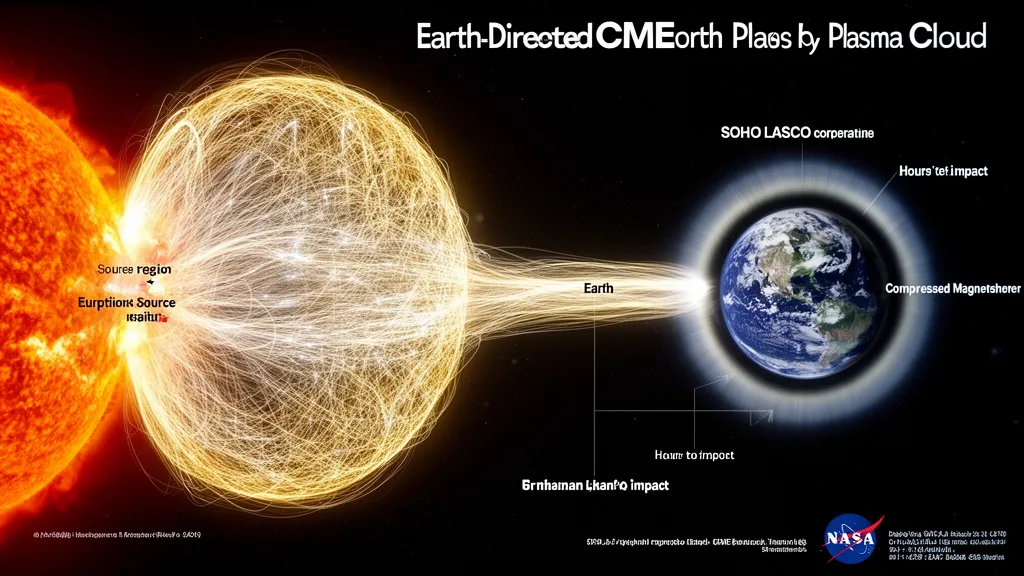
A coronal mass ejection is a discrete eruption of billions of tonnes of magnetized plasma expelled from the Sun's corona at speeds ranging from 250 to 3,000 km/s (NASA DONKI database). Unlike the continuous solar wind, a CME is a single coherent structure — a magnetic flux rope carrying embedded field lines from the Sun — that expands outward through interplanetary space and can engulf Earth's magnetosphere completely.
The energy source is magnetic: solar active regions (sunspot groups) build up stressed magnetic field configurations over days to weeks through photospheric motions. When opposing field lines are forced together, magnetic reconnection occurs — stored energy releases explosively as accelerated particles, X-ray radiation (often producing a simultaneous flare), and the ejected plasma cloud. Not every CME originates from a sunspot group. Erupting filaments — vast arcs of dense cool plasma suspended in the corona along polarity inversion lines — can also launch CMEs with no associated flare.
The CME expands as it travels. A narrow CME with a 20° half-angle may miss Earth entirely even if nominally aimed in our direction. A halo CME — where the expanding cloud appears as a full ring surrounding the blocked solar disk in SOHO LASCO coronagraph imagery — means the CME cone encompasses the Sun-Earth line. Halo CMEs in the DONKI database carry high probability of Earth impact and prompt immediate NOAA watches.
CME speed is the single most important parameter for storm prediction. Fast CMEs drive stronger shocks, compress the magnetosphere more violently, and produce stronger geomagnetic storms — provided the embedded magnetic field has a significant southward (negative Bz) component upon arrival.
How NOAA Tracks CMEs: DONKI and ENLIL
NOAA's Space Weather Prediction Center operates the DONKI database (Database Of Notifications, Knowledge, Information) jointly with NASA's Community Coordinated Modeling Center. Every detected CME is catalogued with:
- Activity ID (timestamp-based identifier)
- Start time (UTC of first detection in coronagraph)
- Source location (heliographic latitude/longitude of the eruption)
- Speed at 21.5 solar radii from Sun-center (km/s)
- Half-angle (angular width of the CME cone in degrees)
- Type (S = slow, C = common, O = occasional, R = rare, ER = extremely rare — based on speed distribution)
- ENLIL model run results including estimated arrival time at Earth
The WSA-ENLIL + Cone model is NOAA's numerical space weather prediction tool. It ingests coronagraph-derived CME parameters and propagates the ejection through a 3-D model of the inner heliosphere to predict arrival time at L1 (and thus Earth). Current accuracy is ±6–12 hours for arrival time and somewhat less precise for peak storm intensity, which depends heavily on Bz — a property the model cannot reliably predict far in advance.
When ENLIL predicts a significant Earth-directed CME, NOAA issues a geomagnetic storm watch typically 1–3 days in advance. When the CME shock arrives at the L1 monitoring spacecraft (DSCOVR or ACE), a watch upgrades to a warning with a 15–60 minute lead time.
CME Arrival: What Operators Experience in Real Time
The first detectable sign of CME arrival at Earth is the Storm Sudden Commencement (SSC), also historically called a sudden commencement (Sc). This is a brief, sharp rise in the horizontal component of Earth's surface magnetic field, detectable on magnetometers worldwide and visible on Kp data as a rapid uptick. The SSC marks passage of the CME-driven interplanetary shock through the magnetopause.
For HF operators, the SSC itself is largely benign — it precedes the actual storm. What follows over the next 1–6 hours is the storm main phase, driven by the southward Bz within the magnetic cloud behind the shock. If Bz remains strongly negative (below −10 nT), the storm intensifies rapidly. Kp climbs: Kp 5 = G1 storm, Kp 6 = G2, Kp 7 = G3, Kp 8 = G4, Kp 9 = G5.
The storm recovery phase follows as Bz rotates northward, ring current decays, and Kp falls back toward 2–3 over 12–72 hours. A well-developed G3 storm often takes 24–36 hours from main phase to full recovery.
On the radio: as Kp climbs above 4, high-latitude F2 paths begin to degrade. By Kp 6, transpolar routes (e.g., JA→W1 over the Arctic, or VK→SM via the polar cap) are typically unreliable on 10m and 15m. By Kp 8–9, 20m is disrupted on paths above 45°N, 40m may drop MUF below usable levels at high latitudes, and even mid-latitude operators notice 10m closing prematurely despite a potentially adequate SFI.
The G-Scale: Storm Severity and HF Impact
NOAA's geomagnetic storm scale (G1–G5) maps onto Kp and describes expected radio effects (NOAA SWPC Scales):
| G-Scale | Kp | HF Radio Impact | Typical Occurrence |
|---|---|---|---|
| G1 (Minor) | Kp 5 | Weak power grid fluctuations; minor HF degradation at high latitudes | ~1,700 per solar cycle |
| G2 (Moderate) | Kp 6 | HF radio propagation degraded at high latitudes; 20m intermittent | ~600 per solar cycle |
| G3 (Strong) | Kp 7 | HF intermittent on polar paths; low-frequency navigation affected | ~200 per solar cycle |
| G4 (Severe) | Kp 8 | Wide HF blackout; possible satellite navigation anomalies | ~100 per solar cycle |
| G5 (Extreme) | Kp 9 | Complete HF blackout in polar and high-latitude regions; power grid at risk | ~4 per solar cycle |
The storm severity depends on two factors: CME speed (which governs shock strength and initial Bz magnitude) and the orientation of the embedded magnetic field. A slow CME with strongly southward Bz can outperform a fast CME with northward Bz in producing geomagnetic activity. This is why storm prediction from CME parameters alone carries significant uncertainty — the internal magnetic structure of the CME is only measured definitively when it passes L1, ~30–60 minutes before Earth impact.
The May 2024 G5 Event: A Case Study
The storm of May 10–11, 2024 reached G5 intensity — the first G5 storm since the Halloween storms of October–November 2003. NOAA SWPC recorded Kp reaching 9 on the planetary scale, and regional geomagnetic indices peaked higher at some high-latitude stations.
The source was a cluster of X-class flares from Active Region 3664 between May 8–10, 2024. Multiple CMEs launched in rapid succession and merged in transit — a phenomenon called a CME cannibalization or complex ejecta event. The combined structure arrived at Earth with both high speed and strongly southward Bz sustained for over 6 hours, driving the main phase deep into G5 territory.
HF impact was severe at high and mid-latitudes. Transpolar paths (JA→W/VE via Arctic, SM→ZL via polar cap) were completely disrupted. European operators working North America on 20m reported complete propagation loss for 8–12 hours. Remarkably, some low-latitude paths (Caribbean to South America, low-latitude Africa to Southeast Asia) remained partially usable on 40m and 80m where D-layer conditions were less perturbed and MUF stayed viable.
In the 24–48 hours following the storm's recovery phase, multiple operators reported unusually good 15m and 10m conditions at mid-latitudes — a textbook post-storm positive phase, consistent with enhanced F2 ionization during the recovery.
CME Double Strike: When Two CMEs Arrive in Sequence
Multiple CME events — common during solar maximum when active regions produce flare series over several days — can produce compounding effects. A second CME arriving during the recovery phase of an ongoing storm may:
- Prevent recovery — the ring current stays energized, keeping Kp elevated for days
- Deepen the storm — if the second CME has southward Bz, it drives a new main phase before the first has recovered
- Interact in transit — faster CMEs can sweep up and merge with preceding slower ones, creating combined ejecta that are more geoeffective than either alone
The practical implication for operators: during active periods with multiple M/X-class flares from the same region over several days, assume geomagnetic unsettled conditions will persist for 3–5 days and plan contest or DXpedition operations accordingly.
Identifying Earth-Directed CMEs Before They Arrive
You do not need to wait for storm onset. Several tools give advance notice:
LASCO coronagraph imagery (SOHO): A halo CME — expanding ring filling the C3 field of view to 32 solar radii — is the primary visual indicator of an Earth-directed event. The DONKI database typically catalogues these within 1–3 hours of detection.
SDO AIA 304 Å: An erupting filament (dark arc lifting from the chromosphere in red-colored imagery) often precedes a CME. Filament eruptions visible near disk center carry the highest Earth-impact probability.
SDO AIA 193 Å: Active region magnetic complexity — bright interlocked loop structures — indicates a stressed field capable of producing a major CME. New flux emergence adjacent to existing sunspot groups is a CME precursor.
NOAA SWPC watches: When ENLIL model runs indicate ≥50% probability of a significant storm, NOAA issues a geomagnetic storm watch typically 24–48 hours before expected arrival. DXRadar's solar weather page displays active SWPC alerts.
L1 monitors (DSCOVR/ACE): When the CME shock front hits DSCOVR at L1, Bz data transitions from relatively quiet to chaotic. A sudden southward deflection with simultaneous solar wind speed jump (e.g., from 400 to 600 km/s) indicates CME arrival. You have 15–60 minutes before the storm main phase begins at Earth.
Set up NOAA SWPC email or text alerts for geomagnetic storm watches. The alert lands in your inbox 1–3 days before CME arrival — enough time to reschedule a contest, adjust a DXpedition operating plan, or prepare for good aurora VHF conditions on 6m and 2m if you're at high latitude.
Post-Storm F2 Enhancement: Working the Recovery
The storm recovery phase occasionally produces propagation that exceeds pre-storm baselines. This positive ionospheric storm effect occurs because thermospheric disturbances alter the composition and wind patterns in the F2 region, sometimes increasing foF2 and MUF above their undisturbed values.
The effect is:
- More pronounced at mid-latitudes (30°–50°N/S) than at high or equatorial latitudes
- Most reliable in the first 12–36 hours after Kp falls below 4
- More common during the descending phase of a major storm (G3 or higher) than after minor storms
- Documented in historical ionosonde records and referenced in ITU-R P.1239 storm-time ionospheric models
Operationally, this means monitoring 10m and 12m during the 24–48 hours after a major storm clears. Some of the most unexpected mid-cycle DX openings occur in this post-storm window. Check DXRadar's live Kp trend — when Kp has been at or below 3 for 6+ consecutive hours after a storm peak, conditions are improving and post-storm enhancement may be underway.
What to Do When a CME Is Inbound
A practical operating checklist for the 24–72 hours following a major CME detection:
- Check the DONKI entry — note speed, half-angle, and ENLIL predicted arrival time. A CME with speed above 1,000 km/s and half-angle above 30° warrants serious attention.
- Watch Bz at L1 — the hour before predicted arrival, monitor DSCOVR/ACE Bz on DXRadar. If Bz begins trending southward as the solar wind speed jumps, the storm main phase is imminent.
- Adjust your operating plan — transpolar paths will be first to fail. Shift to lower-latitude routes or lower bands. 40m and 80m NVIS remain viable at mid-latitudes through all but the most extreme events.
- Log conditions — your own observations are data. Note what bands closed, when, and your QTH grid square. Ionosonde networks are sparse; operator reports fill the gaps.
- Look for VHF aurora — Kp 7+ can drive aurora propagation on 6m and 2m for operators above approximately 40°N. CW is most effective for auroral scatter contacts.
- Wait for recovery — patience pays. Conditions typically return to baseline within 24–72 hours. If the storm was G3 or higher, monitor 10m and 12m for post-storm enhancement.
Frequently Asked Questions
How long does it take a CME to reach Earth?
A typical CME travels at 400–800 km/s and reaches Earth in 1–3 days from the moment of ejection. Fast CMEs exceeding 1,500 km/s have arrived in under 18 hours. NOAA's ENLIL model provides arrival time predictions accurate to within ±6–12 hours.
What is a halo CME and why does it matter for ham radio?
A halo CME appears as a full 360° expanding ring in LASCO coronagraph imagery because it is propagating directly toward or away from the observer — i.e., Earth-directed or anti-Earthward. A full halo seen on SOHO indicates high probability of a direct hit and impending geomagnetic storm within 1–3 days.
Does a solar flare always accompany a CME?
No. CMEs and solar flares are related but independent events. Roughly 70% of major CMEs are associated with flares, but CMEs can erupt from filament channels and quiescent regions without any detectable flare. Conversely, large flares can occur without a significant CME.
What Kp level does a CME typically produce?
A moderate CME with sustained southward Bz upon arrival typically drives Kp 5–6 (G1–G2). A fast CME with strong southward Bz can produce Kp 7–9 (G3–G5). The May 2024 event — a cluster of X-class flares and multiple CMEs — produced a G5 storm, the strongest since 2003.
Can band conditions actually improve after a geomagnetic storm?
Yes. Post-storm F2 enhancement — sometimes called a positive phase — can raise MUF above baseline values for 12–48 hours after the storm's recovery phase. This occurs because the disturbed thermosphere alters ionospheric chemistry temporarily in ways that can boost electron density at mid-latitudes.