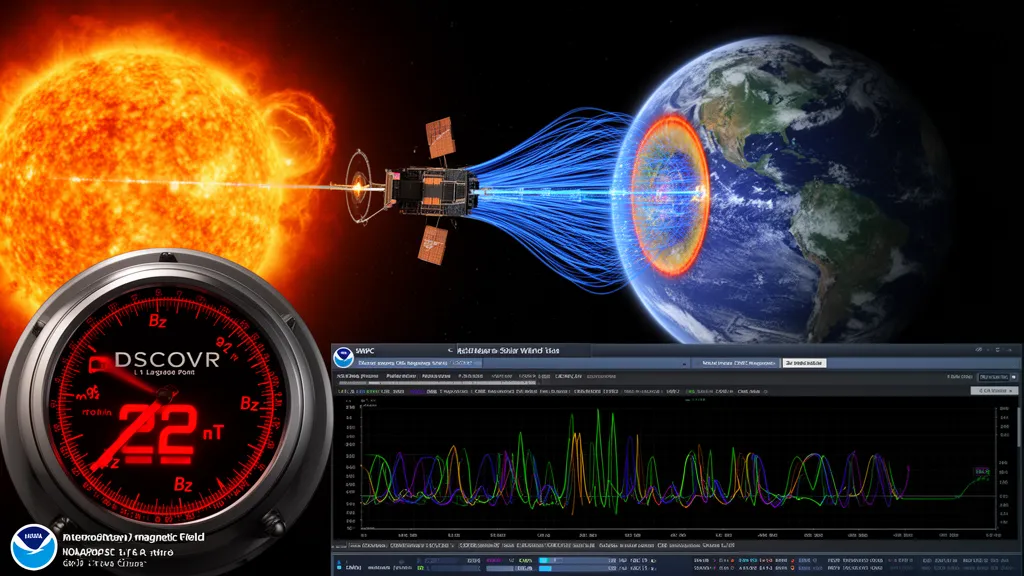
Operator's Verdict: If Bz on DXRadar's aurora page has been below −10 nT for 30+ minutes, a geomagnetic storm is actively building. Close down 10m and 15m on high-latitude paths, shift to lower bands, and watch Kp for progression. A recovery above −5 nT that holds for 1+ hours signals the storm is easing.
What the Interplanetary Magnetic Field Is and Where It Comes From
The interplanetary magnetic field (IMF) is the Sun's own magnetic field, drawn outward through the solar system by the continuous flow of solar wind plasma. The Sun's magnetic field lines are anchored in the solar photosphere, but as the solar wind carries plasma radially outward at 400–800 km/s while the Sun rotates once every ~27 days, the field lines form a curved structure called the Parker spiral — named after Eugene Parker, who predicted its existence in 1958 from plasma physics first principles.
At Earth's orbital distance of 1 AU, the Parker spiral makes an angle of roughly 45° to the Sun-Earth line. The IMF at Earth has a typical magnitude of 5–10 nT under quiet conditions, rising to 15–30 nT during CME passage. Its direction fluctuates continuously, and that direction — specifically its north-south component, Bz — is the controlling variable for magnetospheric coupling.
Bz is measured in geocentric solar magnetospheric (GSM) coordinates, a coordinate system aligned with Earth's magnetic dipole axis rather than the ecliptic plane. In GSM coordinates, positive Bz points roughly northward (away from the ecliptic south) and negative Bz points southward. The distinction from ecliptic coordinates matters because the tilt of Earth's magnetic dipole varies with season — the same IMF vector can project a different Bz in GSM coordinates at different times of year. This is the root cause of the Russell-McPherron equinox effect.
The Physics of Bz Coupling: Why Southward Means Storm
Earth's magnetic field at the magnetopause — the outer boundary of the magnetosphere — points predominantly northward on the dayside. When the IMF also points northward, the two fields are parallel at the magnetopause interface; topology dictates they cannot easily reconnect. Solar wind deflects around the magnetosphere and minimal energy transfers inside.
When Bz turns negative (southward), the IMF and Earth's dayside magnetospheric field become antiparallel at the magnetopause. Magnetic reconnection can occur: field lines from the solar wind merge with Earth's field lines, opening a channel for energy and momentum transfer. Solar wind particles stream through this channel and are accelerated into the magnetosphere.
The effects cascade:
- Magnetopause compression: The dayside magnetopause moves earthward — under extreme events it can drop inside geosynchronous orbit (~6.6 Earth radii).
- Ring current intensification: Energetic particles (tens to hundreds of keV) drift around Earth in a toroidal current at 3–6 Earth radii altitude, producing a global depression in the surface magnetic field measurable as the Dst index (Disturbance Storm Time index).
- Substorm activity: Energy stored in the stretched magnetotail releases episodically as substorms — brief intense events producing aurora, particle precipitation, and geomagnetically induced currents.
- Ionospheric heating: Joule heating at high latitudes from particle precipitation disrupts neutral atmosphere chemistry and alters F2 electron density — the direct cause of HF degradation.
The entire chain from southward Bz to HF disruption operates on timescales of 30 minutes to 2 hours. The ring current does not build instantly; it requires sustained energy input. A 5-minute Bz excursion to −20 nT is far less damaging than 2 hours at −10 nT. Both the magnitude and duration of southward Bz determine the resulting Kp.
Bz Thresholds and HF Impact
The relationship between Bz and geomagnetic storm level is not rigid — storm intensity also depends on solar wind speed and density — but the following thresholds are well-established in NOAA SWPC operational experience and ITU-R P.1239 ionospheric storm documentation:
| Bz (nT, sustained) | Duration | Likely Kp | G-Scale | HF Operational Impact |
|---|---|---|---|---|
| 0 to −3 | Any | 1–3 | None | No significant impact |
| −3 to −5 | 2+ hours | 3–4 | Unsettled | Minor degradation above 65°N/S |
| −5 to −10 | 1–2 hours | 5–6 | G1–G2 | High-latitude paths (>60°) degrade; transpolar paths unreliable |
| −10 to −15 | 1+ hours | 6–7 | G2–G3 | 15m/10m unreliable above 55°N; aurora possible >55°N |
| −15 to −25 | 30+ min | 7–8 | G3–G4 | 20m disrupted at high latitudes; aurora to 50°N; 6m aurora possible |
| Below −25 | 30+ min | 8–9 | G4–G5 | Wide HF disruption; 20m unreliable to mid-latitudes; aurora to 40°N |
Bz also fluctuates on timescales of minutes within a sustained event. A storm with average Bz of −12 nT will include brief excursions to −20 nT or even −30 nT, interspersed with recoveries toward −5 nT. These fluctuations cause the "stepwise" Kp increases often seen during major storms — each brief intensification adds to the ring current before recovery partially unloads it.
When Bz drops below −10 nT and holds for 30+ minutes, close down 10m and 15m high-latitude paths immediately. The Kp reading will catch up to the Bz-indicated storm intensity within 1–2 hours. By the time Kp shows G3 on your display, the ionospheric damage driving that Kp reading is already happening — Bz is the leading indicator, Kp is the lagging confirmation.
Bz Within a CME: The Magnetic Cloud
Not all southward Bz arrives as part of steady-state solar wind. The most intense and sustained southward Bz events accompany CME magnetic clouds — the magnetically organized core of a coronal mass ejection.
A CME magnetic cloud is a flux rope: a twisted bundle of magnetic field lines with a coherent helical structure. As it passes Earth over 12–24 hours, the field orientation rotates smoothly through north-to-south or south-to-north depending on the rope's chirality (handedness) and tilt. If the south-pointing portion of the rotation faces Earth, Bz will drop into strongly negative territory and sustain there for hours — the recipe for a major storm.
The challenge: before the CME arrives at L1, its internal Bz orientation cannot be reliably predicted from coronagraph imagery alone. The CME's magnetic topology is set at the source region but current imaging cannot resolve the necessary sub-structure to forecast Bz reliably from Sun-disk observations. NOAA and NASA research teams are actively working on CME magnetic field prediction, but as of 2026 this remains the principal gap in space weather forecasting accuracy (NASA CCMC research documentation).
This uncertainty is why NOAA storm watches issued 1–3 days in advance cannot specify storm intensity with high confidence. The watch tells you a CME is coming; only L1 data in the final hour tells you whether it will produce a G1 or a G5.
Bz Fluctuation vs. Sustained Southward Bz
A single look at instantaneous Bz can be misleading. The solar wind Bz at L1 (measured by DSCOVR's magnetometer at 1-minute cadence) oscillates continuously. During a CME passage, these fluctuations overlay the large-scale rotation of the magnetic cloud. During quiet solar wind, short-period Alfvén waves drive Bz swings of ±5–10 nT on timescales of minutes with no geomagnetic consequence.
What matters for storm development:
- Trend: Is Bz drifting more negative over the past hour, or is it oscillating around a mean?
- Floor: What is the minimum Bz in the past 30 minutes? Repeated dips below −10 nT that recover but return lower each time indicate building storm conditions.
- Duration at threshold: How many consecutive minutes has Bz been below −5 nT? Below −10 nT?
DXRadar's aurora page displays a 1–2 hour Bz trend chart — this is the key display for making this assessment. An isolated −15 nT spike that lasted 3 minutes and then recovered to +2 nT typically produces minimal Kp elevation. The same −15 nT held for 45 minutes has driven G3 storms in historical NOAA records.
The Russell-McPherron Effect: Why Equinoxes Are Stormy
Geomagnetic activity peaks near the March and September equinoxes — a pattern first explained quantitatively by Russell and McPherron in their landmark 1973 paper. The mechanism involves the changing orientation of Earth's magnetic dipole axis relative to the Sun-Earth line through the year.
In GSM coordinates, Bz is measured relative to Earth's dipole direction. As Earth orbits the Sun, the angle between the ecliptic and Earth's magnetic equatorial plane changes with the seasons. At equinoxes, the Parker spiral IMF — which has a preferred orientation in ecliptic coordinates — projects a larger southward component in GSM coordinates than it does at solstices. Specifically, the Y-component of the GSM field (the dawn-dusk component) at equinoxes contributes a systematic southward Bz driver that adds to whatever Bz the solar wind already carries.
The practical consequence for operators:
- March and September are peak months for geomagnetic storms at any given solar wind input
- The same coronal hole stream that produces Kp 3–4 in December may produce Kp 5–6 in March
- Contest planning that accounts for seasonal storm probability will have fewer unpleasant surprises
This effect is well-documented in long-term NOAA Kp statistics. It is not a small effect: the equinox-solstice difference in storm frequency is roughly a factor of 1.5–2 at comparable solar wind conditions (ITU-R P.1239 provides the statistical ionospheric storm frequency distributions by season).
IMF Sector Boundaries: Brief Disruption, Not a Storm
In addition to large-scale Bz variations, the IMF has a large-scale sector structure. The heliospheric current sheet (HCS) — a vast undulating surface separating regions of opposite IMF polarity — sweeps past Earth approximately twice per 27-day solar rotation. When Earth crosses the HCS, the IMF polarity reverses: a sector boundary crossing occurs.
Sector boundary crossings can produce brief geomagnetic disturbances (Kp 3–4 enhancements lasting a few hours) but rarely drive major storms unless accompanied by a high-speed stream or CME. The primary radio impact is mild ionospheric variability for 12–24 hours. However, sector boundary crossings are predictable ~1 rotation in advance and appear in NOAA 27-day geomagnetic activity forecasts. For operators planning a precise DX operation, even minor predicted disturbances are worth tracking.
Monitoring Bz in Practice: DXRadar Aurora Page
DXRadar's aurora dashboard provides real-time Bz sourced from NOAA DSCOVR data feeds, updated at the same cadence as NOAA's published data stream.
What to look at:
- Current Bz value — the instantaneous reading. Below −5 nT: elevated attention. Below −10 nT: potential storm in progress.
- Bz trend line (1–2 hours) — more important than the instantaneous value. A trend line that has been negative and deepening over the past hour signals ongoing storm development.
- Current Kp — confirms whether the Bz signal has translated into actual storm-level geomagnetic activity. If Bz is −12 nT but Kp is still 3, the storm has not fully developed yet. Give it 1–2 hours.
- Solar wind speed — context for interpreting Bz impact. Bz −10 nT in 700 km/s wind drives a stronger storm than the same Bz in 400 km/s wind because the energy flux (speed × Bz) is higher.
The combination of these four numbers — Bz, Bz trend, Kp, solar wind speed — gives you everything needed to assess current storm conditions and short-term HF outlook. No other space weather metric is more directly coupled to the ionospheric behavior that determines whether your 20m path to Japan is open or closed.
Frequently Asked Questions
What is Bz in space weather?
Bz is the north-south component of the interplanetary magnetic field (IMF) carried by the solar wind. Measured in nanotesla (nT), it is the single most important parameter for predicting geomagnetic storm intensity. When Bz is negative (southward), solar wind energy couples into Earth's magnetosphere through magnetic reconnection, driving Kp elevation and HF disruption.
How negative does Bz need to be to affect HF radio?
Bz must sustain values below approximately −5 nT for 1+ hours to drive a G1 geomagnetic storm. Bz sustained below −15 nT for 1 hour typically produces G2–G3 conditions. Below −25 nT for 30+ minutes is G4 territory. A brief southward dip that recovers within minutes rarely produces lasting storm effects because the ring current requires sustained energy injection to build.
What is the IMF and where does it come from?
The interplanetary magnetic field (IMF) is the Sun's magnetic field carried outward through the solar system by the solar wind. Anchored to the rotating Sun, it forms the Parker spiral — a curved structure that spans the entire heliosphere. At Earth's orbit, the IMF has a typical magnitude of 5–10 nT and can fluctuate rapidly in direction, particularly during CME passage.
Why are geomagnetic storms more common at equinoxes?
The Russell-McPherron effect explains equinox storm prevalence. At March and September equinoxes, the geometry of the Sun-Earth-IMF alignment means that even a nominally weak IMF has a larger effective southward component in geocentric solar magnetospheric coordinates. The magnetosphere becomes more vulnerable to reconnection with any given Bz value, producing more frequent storms even at moderate solar wind conditions.
Can Bz predict a geomagnetic storm before it starts?
Yes, but only with 15–60 minutes of warning. The DSCOVR spacecraft at L1 (1.5 million km from Earth) measures Bz in the arriving solar wind. When Bz turns sharply southward at L1, you have approximately 15–60 minutes before that solar wind reaches Earth and storm conditions begin. There is currently no reliable method to predict Bz orientation days in advance.