This article contains affiliate links. If you buy through them we may earn a commission at no extra cost to you. Prices and ratings come from Amazon and change constantly.
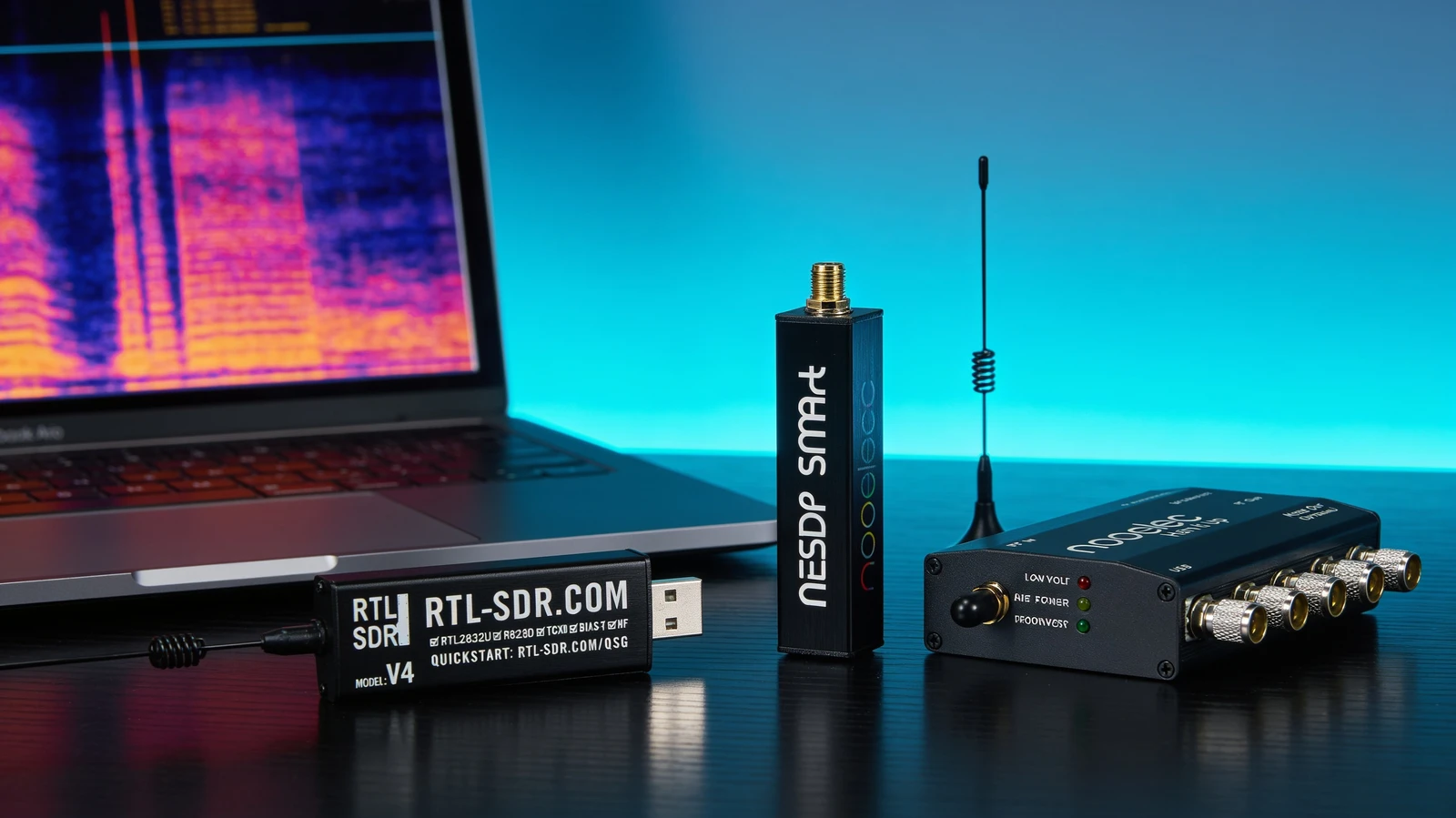
A software-defined radio is the cheapest, most educational piece of gear in ham radio. For the price of a nice dinner, a USB dongle turns your laptop into a wideband receiver with a live spectrum waterfall — and for anyone who cares about propagation, that’s a superpower. You can watch a band open in real time, run WSPR to map exactly which paths are alive, and check what you’re hearing against live band conditions. Here are three SDRs for three needs.
Quick Picks
| Need | SDR | ~Price | Why |
|---|---|---|---|
| 🥇 Best all-rounder | RTL-SDR Blog V4 | ~$82 | TCXO, filtering, HF direct-sampling |
| 💸 Cheapest entry | Nooelec NESDR SMArt v5 | ~$42 | Great VHF/UHF value |
| 📻 Best for HF | Nooelec NESDR HF Bundle | ~$125 | Includes upconverter for HF |
🥇 Best All-Rounder
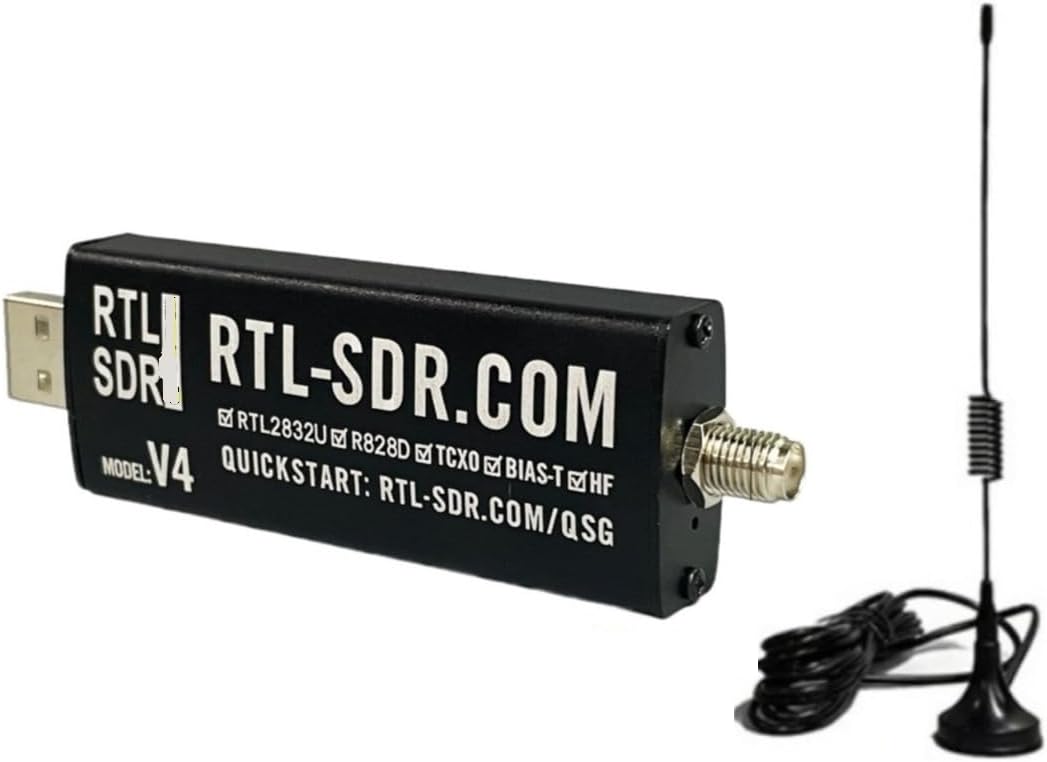
RTL-SDR Blog V4
The community standard. A TCXO keeps it frequency-stable, built-in filtering cuts interference, and direct sampling lets it tune down into the HF bands — one dongle for HF through UHF.
- ~500kHz–1.7GHz
- TCXO
- HF direct-sampling
Pair with SDR# or SDR++ and a proper antenna.
💸 Cheapest Entry
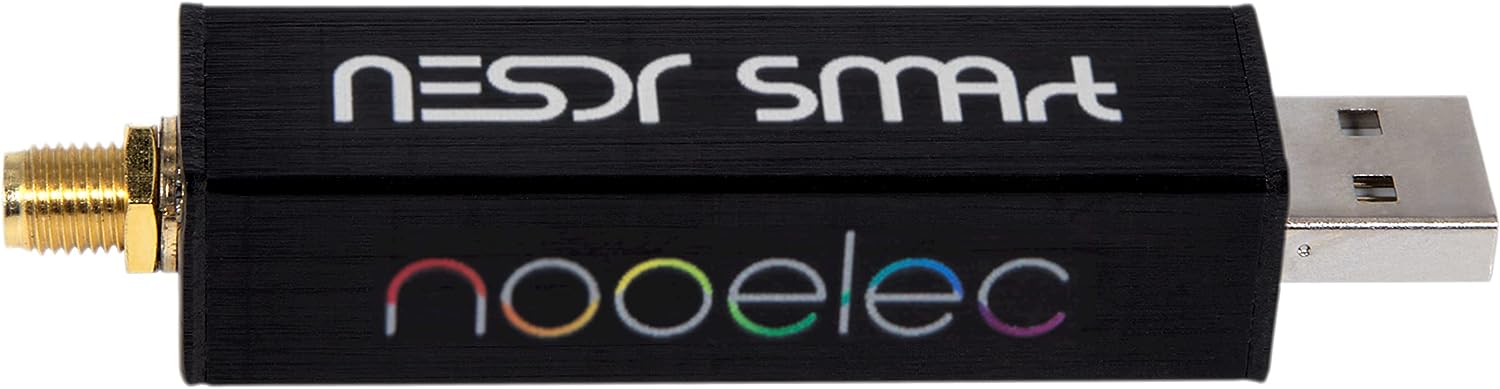
Nooelec NESDR SMArt v5
A superb-value VHF/UHF dongle with an aluminum case and good heat handling. The easiest, cheapest way to start watching 2m/70cm, aircraft, and satellites on a waterfall.
- 100kHz–1.75GHz
- Aluminum case
- Best value
Amazon: 4.5/5 from 2,815 reviews. Needs an upconverter for clean HF.
📻 Best for HF
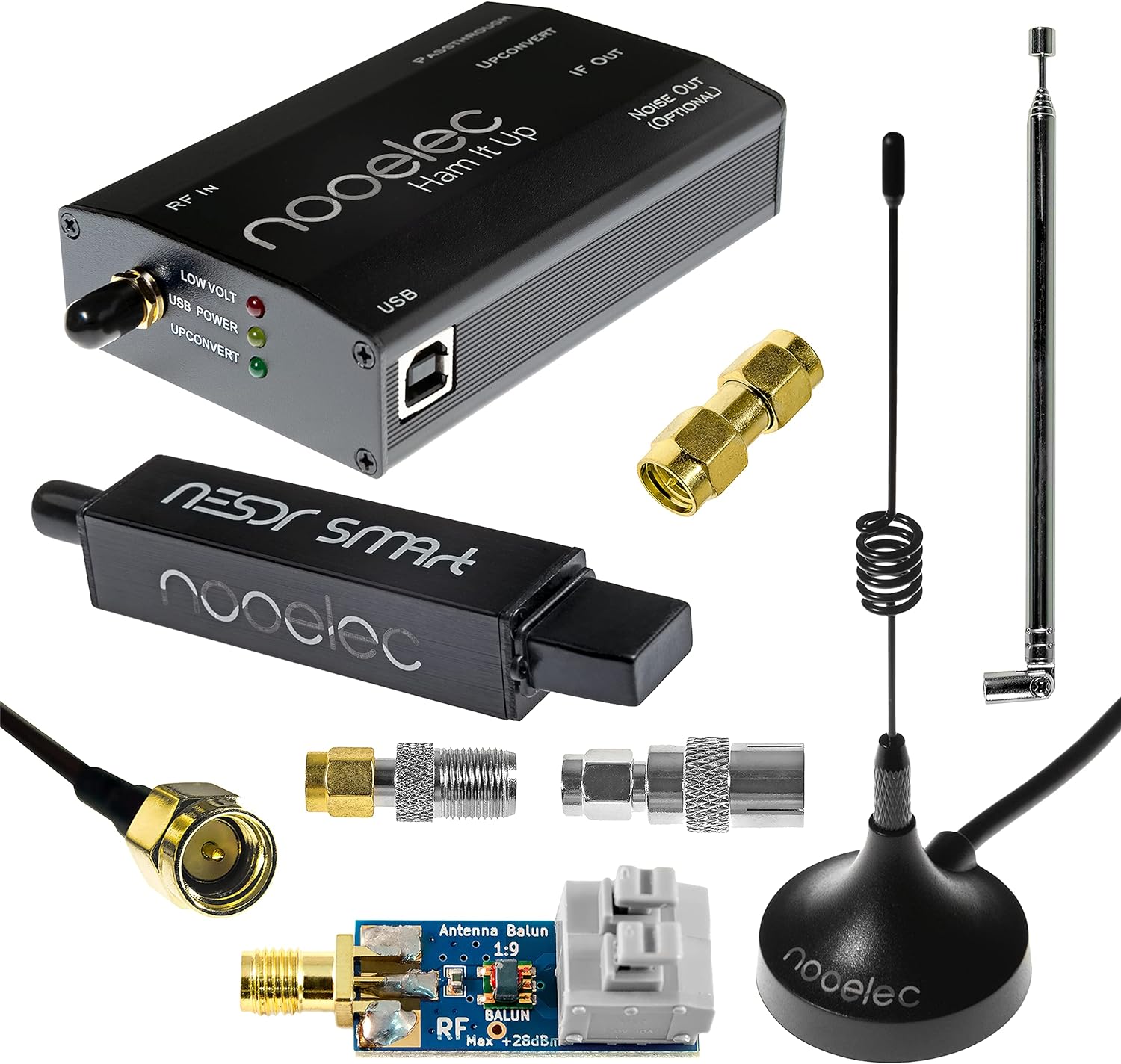
Nooelec NESDR HF Bundle
An SDR plus a Ham-It-Up upconverter and antenna, so you can properly receive the HF ham and shortwave bands out of the box. The turnkey pick for HF and WSPR monitoring.
- HF via upconverter
- Antenna included
- Turnkey HF
Amazon: 4.3/5 from 961 reviews. Best for serious HF propagation watching.
Why an SDR is the best propagation tool you can buy
Reading about the MUF and solar flux is one thing; watching a band physically open on a waterfall is another. With a cheap SDR you can:
- Run WSPR and see, path by path, which bands are open to where — then log it to WSPRnet and compare with DXRadar’s live conditions.
- Decode FT8 to gauge activity and propagation without transmitting.
- Watch the gray line sweep across a band at sunrise and sunset — the theory in our gray line guide becomes visible.
- Verify the tools. When our propagation apps say 20m is open, your own SDR is the ground truth.
What you’ll also need
An SDR is only as good as its antenna. A basic telescopic whip gets you started on VHF/UHF; for HF you’ll want a wire outside and, for the non-V4 dongles, an upconverter. A USB extension cable and ferrite chokes reduce computer noise. Software is free — SDR++, SDR#, or CubicSDR to start, then WSJT-X for WSPR and FT8.
Who should skip these
If you want to transmit, an SDR receiver isn’t the answer — you need an HF radio and a license. And if you demand lab-grade HF performance, dedicated receivers like the SDRplay or Airspy line outperform a $40 dongle. But for learning propagation and monitoring the bands, a cheap RTL-SDR delivers 90% of the value for a tiny fraction of the cost.
Frequently Asked Questions
What is the best SDR for ham radio in 2026?
For most operators the RTL-SDR Blog V4 is the best all-round starter SDR: it has a temperature-controlled oscillator for frequency stability, built-in filtering, and the largest software ecosystem, all for under $100. The Nooelec NESDR SMArt v5 is the cheapest solid option at around $42 for VHF/UHF monitoring, and the Nooelec HF Bundle adds an upconverter so you can receive the HF ham bands.
Can a cheap RTL-SDR receive HF ham bands?
Not directly — most RTL-SDR dongles start around 24 MHz, above the HF bands. To receive HF you need either an upconverter (included in the Nooelec HF Bundle) or a dongle in “direct sampling” mode like the RTL-SDR Blog V4, which can tune down to about 500 kHz. For serious HF monitoring the upconverter bundle gives cleaner results.
What can I do with an SDR for propagation?
A cheap SDR turns a laptop into a propagation window. You can watch a band’s activity live on a waterfall, run WSPR to see exactly which paths are open and log them to WSPRnet, decode FT8 to gauge conditions, and compare what you receive against tools like DXRadar’s band conditions. It’s the cheapest way to learn what the ionosphere is doing in real time.
Do I need a license to use an SDR receiver?
No. Receiving is unlicensed — an SDR is a receive-only device, so anyone can use one to monitor the ham bands, shortwave broadcast, aircraft, and more. You only need an amateur license to transmit. That makes an SDR a great way to explore radio and study propagation before or without getting licensed.
RTL-SDR Blog V4 vs Nooelec NESDR — which should I buy?
Both are excellent budget dongles. The RTL-SDR Blog V4 adds a TCXO for stability, better built-in filtering, and HF direct-sampling, making it the better all-rounder. The Nooelec NESDR SMArt v5 is a few dollars cheaper and superb for VHF/UHF. Buy the V4 if you want one dongle that also does HF; the NESDR if you only need VHF/UHF and want to spend the least.