This article contains affiliate links. If you buy through them we may earn a commission at no extra cost to you. Loss figures are published reference values (W4RP tables / manufacturer data) — cable batches vary, and water damage changes everything.
Operator’s Verdict: Buy coax by band × length, not by folklore. On HF under 50 ft, RG-8X is fine and light — about 1 dB of loss you’ll never hear. At VHF, or on 100 ft runs, the table below is brutal: RG-8X gives up 4.7 dB at 144 MHz per 100 ft (two-thirds of your power) where LMR-400 loses 1.5 dB. One rule beats all cable upgrades: keep water out.
The Numbers (Published Reference Values, dB per 100 ft)
| Cable | ~30 MHz (HF) | 144 MHz (2m) | Character |
|---|---|---|---|
| RG-58 | ~2.5 | 6.2 | Thin, cheap — jumpers only |
| RG-8X | ~2.0 | 4.7 | Light, flexible — the portable default |
| RG-213 | ~1.2 | 2.8 | Rugged classic — permanent HF |
| LMR-400 | ~0.7 | 1.5 | Low-loss standard — VHF/UHF and long runs |
Reading dB honestly: 3 dB = half your power gone in the cable. 1 dB ≈ 20% — real, but smaller than the difference between a good and bad antenna hour.
Scale by Your Actual Run
Loss is proportional to length. That 100-ft column shrinks fast for typical stations:
| Run | RG-8X @ 30 MHz | RG-8X @ 144 MHz | LMR-400 @ 144 MHz |
|---|---|---|---|
| 25 ft (POTA) | 0.5 dB | 1.2 dB | 0.4 dB |
| 50 ft (typical home) | 1.0 dB | 2.4 dB | 0.8 dB |
| 100 ft (big lot) | 2.0 dB | 4.7 dB | 1.5 dB |
The practical conclusions fall straight out:
- POTA/portable HF: RG-8X, no debate — the half-dB you’d save with heavy cable isn’t worth carrying.
- Permanent HF at 50–100 ft: RG-213 or LMR-400; you buy it once, the fractions of dB are free forever after.
- VHF/UHF base, any real length: low-loss cable is not optional. The antenna guide’s gain claims die in cheap feedline.
- A high SWR multiplies all of this — mismatch raises effective line loss beyond the table. Tune at the antenna (see the analyzer guide).
The One Rule Above All: Water
Every number above assumes dry cable. Water intrusion into foam dielectric can multiply loss many times over while the jacket looks perfect — it’s the most common reason a station “got deaf over the winter.” Weatherproof every outdoor connector (self-amalgamating tape over the joint), drip-loop every entry, and when an old run behaves oddly, test it against a known-good jumper before blaming the radio or the ionosphere. (If the bands themselves are the suspect, check conditions first — the cheapest diagnostic there is.)
The Picks
The portable/HF default
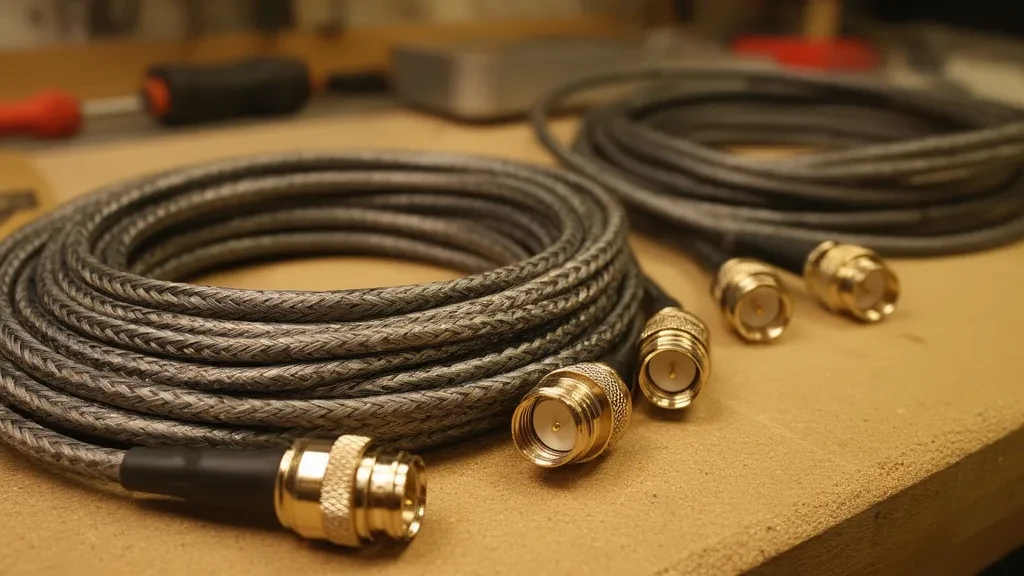
STEREN RG-8X 50 ft (PL-259)
Pre-terminated 50-foot RG-8X — light enough for the pack, low-loss enough for any HF run this length.
- 50 ft
- PL-259 ends
- ~1 dB @ HF
Shack plumbing
RG-8X 3 ft Jumpers (2-pack)
Short jumpers for radio→tuner→meter runs, where loss is irrelevant and flexibility is everything.
- 3 ft ×2
- PL-259
For permanent and VHF runs: LMR-400 and its equivalents come in many terminated lengths — current options. Buy name-brand or reputable-assembler cable; “LMR-400 type” bargains vary wildly in actual loss and shielding.
Frequently Asked Questions
What coax should I use for HF?
For HF runs under ~50 ft, almost anything decent works — even RG-8X loses only about 1 dB over 50 ft at 30 MHz, which is inaudible. Use RG-8X for portability, RG-213 or LMR-400 for permanent installs where you want the loss budget spent nowhere. Below 30 MHz, connector quality and weatherproofing matter more than cable class.
Is LMR-400 worth it over RG-8X?
At VHF/UHF and on long runs, decisively: at 144 MHz per published tables, 100 ft of RG-8X loses 4.7 dB (over two-thirds of your power) versus LMR-400’s 1.5 dB. On short HF runs the difference is fractions of a dB — spend the money on the antenna instead. Buy by band and length, not by reputation.
Does coax loss affect receive too?
Yes, identically — a 3 dB feedline eats half your transmit power and 3 dB of received signal. On HF, where band noise usually exceeds receiver noise, modest loss barely changes what you hear; at VHF/UHF with quiet antennas, feedline loss directly costs you workable weak signals.
When should I replace old coax?
When water has gotten in — waterlogged foam dielectric can multiply loss far beyond the table values while looking fine outside. Suspect any cable with cracked jacket, corroded connectors, or unexplained SWR shifts; a known-good jumper and an analyzer settle it quickly.