This article contains affiliate links. If you buy through them we may earn a commission at no extra cost to you. We never fake test results — antenna behavior here is standard physics, and prices come from Amazon.
Your first HF antenna matters more than your first radio. A modest radio into a good antenna hears and reaches far more than an expensive rig into a compromise. The best beginner antenna depends entirely on your space: two trees and a yard point you one way, a small HOA lot another. This guide picks the right first antenna for each situation — and the honest truth is that the cheapest option is often the best.
Quick Picks
| Situation | Antenna | ~Price | Why |
|---|---|---|---|
| 🥇 Have space + supports | Wire dipole / EFHW | ~$30–70 | Cheapest, most efficient — build it |
| 🏡 Small yard / HOA | Comet CHA-250B | ~$494 | No radials, small footprint, all-band |
| 🎒 Home + field | JPC-12 vertical | ~$139 | Portable, 40m–6m, easy setup |
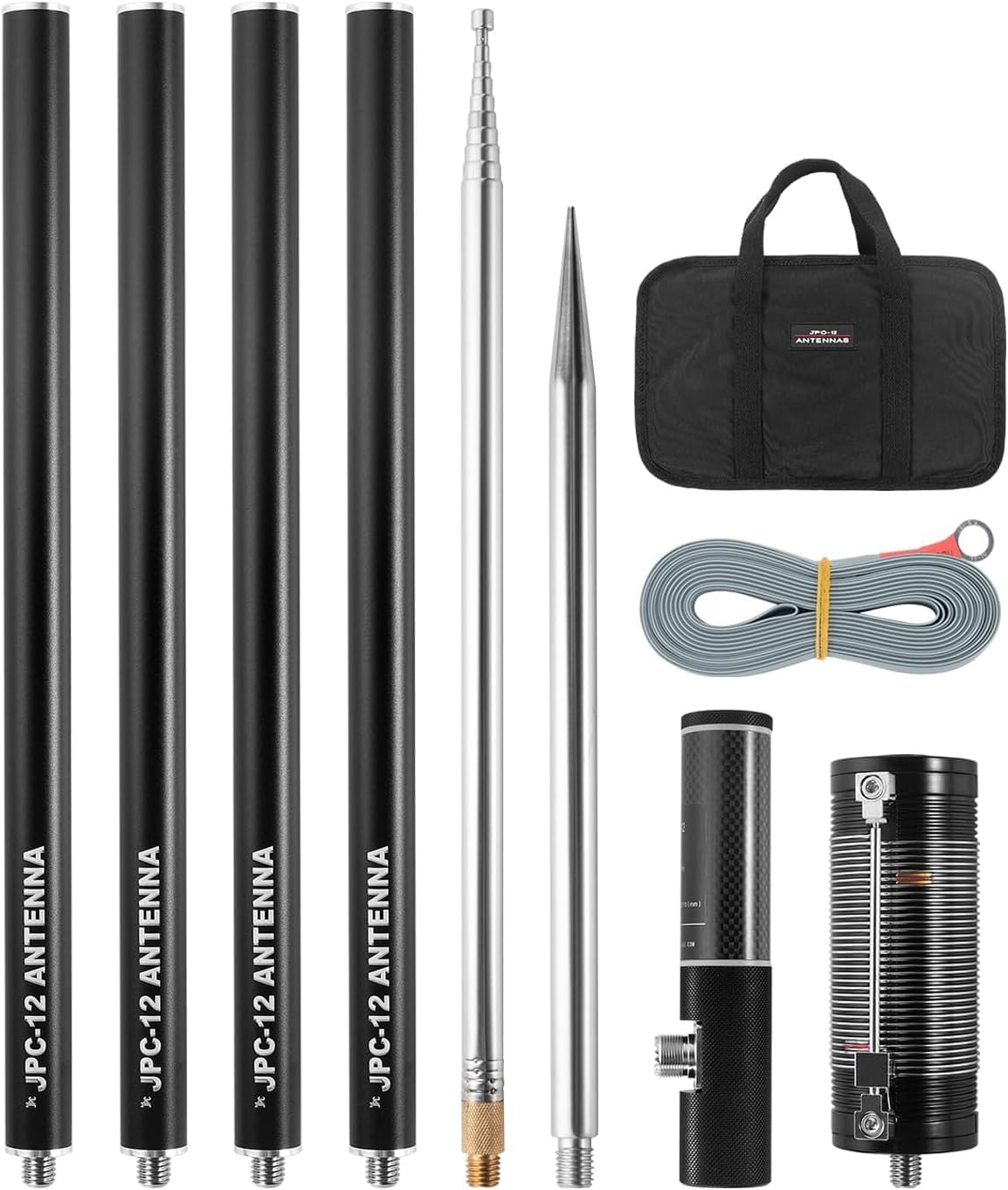
🎒 Best Home-and-Field Value
JPC-12 HF Vertical
An affordable 40m–6m portable vertical that doubles as a temporary home antenna. Sets up in minutes with a ground spike and counterpoise, and covers most of the HF bands a beginner will use. The value pick if a wire won't work for you.
- 7–50 MHz
- Vertical
- Portable + home
Amazon: 4.7/5 from 275 reviews. Use the counterpoise for best SWR.
🏡 Best for Small Yard / HOA
Comet CHA-250B
A broadband no-radial vertical that covers 3.5–57 MHz from a single small footprint — no radial field to lay out and nothing to hang in a tree. The go-to for HOA lots and tight spaces where a wire antenna isn't possible.
- 3.5–57 MHz
- No radials
- Small footprint
Amazon: 4.2/5 from 68 reviews. Convenience over ultimate efficiency — but it gets you on the air.
The best beginner antenna is often a wire
Before you spend hundreds on a vertical, know this: a resonant dipole or end-fed half-wave wire, built for under $70, will match or beat most commercial antennas — if you have two supports (dipole) or one (EFHW) and a little space. It’s the highest performance per dollar in all of ham radio.
- Two trees and a yard? Build a dipole for your favorite band. It’s cheap, efficient, and quiet.
- One tree? An end-fed half-wave gives you easy multiband operation from a single support.
- The best EFHW and dipole kits often come from ham-specialist vendors rather than big retailers, and homebrew is cheaper still — see our end-fed vs dipole vs vertical guide to choose.
Buy a commercial vertical when a wire genuinely won’t fit your situation — not by default.
How to choose
- You have space and supports. Build a wire dipole or EFHW. Nothing beats it for the money.
- You’re in an HOA or tiny lot. The Comet CHA-250B no-radial vertical gets you on all bands discreetly.
- You want one antenna for home and POTA. The JPC-12 vertical travels and sets up anywhere; see our POTA antenna guide for more portable options.
Pair whatever you choose with a decent radio — our best HF radio for beginners guide has the picks — and get the antenna as high as you safely can. Then check what’s open and start calling CQ.
Who should skip these
If you only want local VHF/UHF, you don’t need an HF antenna at all — see our VHF/UHF antenna guide. And if you have the space and two trees, don’t buy an expensive vertical out of habit; a homemade dipole will likely outperform it for a fraction of the cost.
Frequently Asked Questions
What is the best HF antenna for a beginner?
A simple resonant dipole or an end-fed half-wave wire is the best and cheapest first HF antenna if you have somewhere to hang it — both are efficient and forgiving. If you can’t put up a wire or live under HOA rules, a no-radial vertical like the Comet CHA-250B gets you on all bands from a small footprint. And if you want one antenna for home and the field, a portable vertical like the JPC-12 does both.
Do I need an expensive antenna to start on HF?
No. The best-performing first antenna is often the cheapest: a wire dipole you build yourself for under $30 will outperform many commercial antennas. Spend on a good feedline and get the antenna as high as you safely can rather than on an expensive antenna mounted low. Commercial verticals earn their price mainly when you lack the space or supports for a wire.
What HF antenna works in a small yard or with an HOA?
A no-radial vertical like the Comet CHA-250B is popular for tight and HOA-restricted lots because it needs no radial field and has a small footprint. A stealthy wire antenna — a thin end-fed run along a fence or up a tree — is another option. Verticals radiate at a low angle that’s good for DX, which partly offsets their compromises in a small space.
Is a vertical or a dipole better for a first antenna?
If you have two supports and the space, a dipole is usually the better and cheaper performer, especially for regional contacts. A vertical is better when you lack space, need all-band coverage from one antenna, or want low-angle DX. Many beginners start with a dipole for one or two bands and add a vertical later for convenience and DX.
How high should my HF antenna be?
Higher is almost always better for a horizontal antenna — aim for at least a quarter wavelength above ground, which is about 33 feet on 40m. Most beginners can’t get that high, and that’s fine: a lower dipole still works well for regional contacts via high-angle NVIS propagation. A vertical’s performance depends more on its radial system than its height.